
Beyond the front page: A playbook for agency PR in a fragmented media world

For agency professionals in public relations, communications, and public affairs, the old PR playbook is officially out, with the traditional, top-down method of disseminating information – pitching your press release to a national, getting a front-page splash, and watching your story spread – a thing of the past. Today, comms operates on a fragmented map with no clearly marked course forward.
This multi-platform media environment, defined by complex and unpredictable story journeys, is a fresh field of opportunity for comms professionals who understand its new rules. For agencies, it’s a time to update strategies, redefine what success means for clients, and integrate public affairs and media relations efforts more closely than ever before.
To help, here are key pointers for agencies:
1. Redefine ‘Success’: Niche is the new national
Despite the huge variety of platforms out there, plenty of clients continue to put pressure on agencies for a front-page splash. But a story doesn’t have to hit the front page of a national newspaper to reach a significant audience.
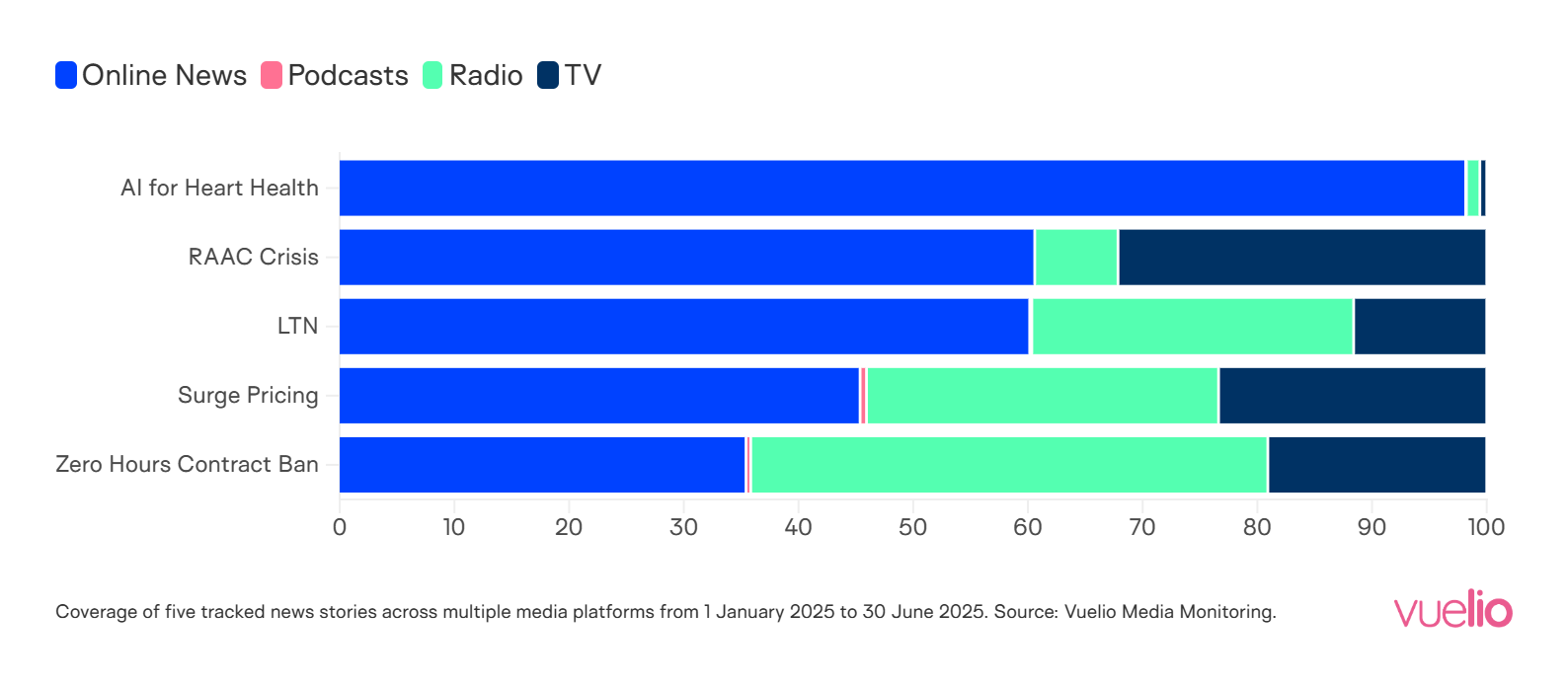
Analysing a specific story’s journey highlights the different routes available to agencies and their brands. Tracking coverage and conversation around the topic of ‘AI for Heart Health’, for example, shows that tabloid coverage shouldn’t be the ultimate aim for every campaign.
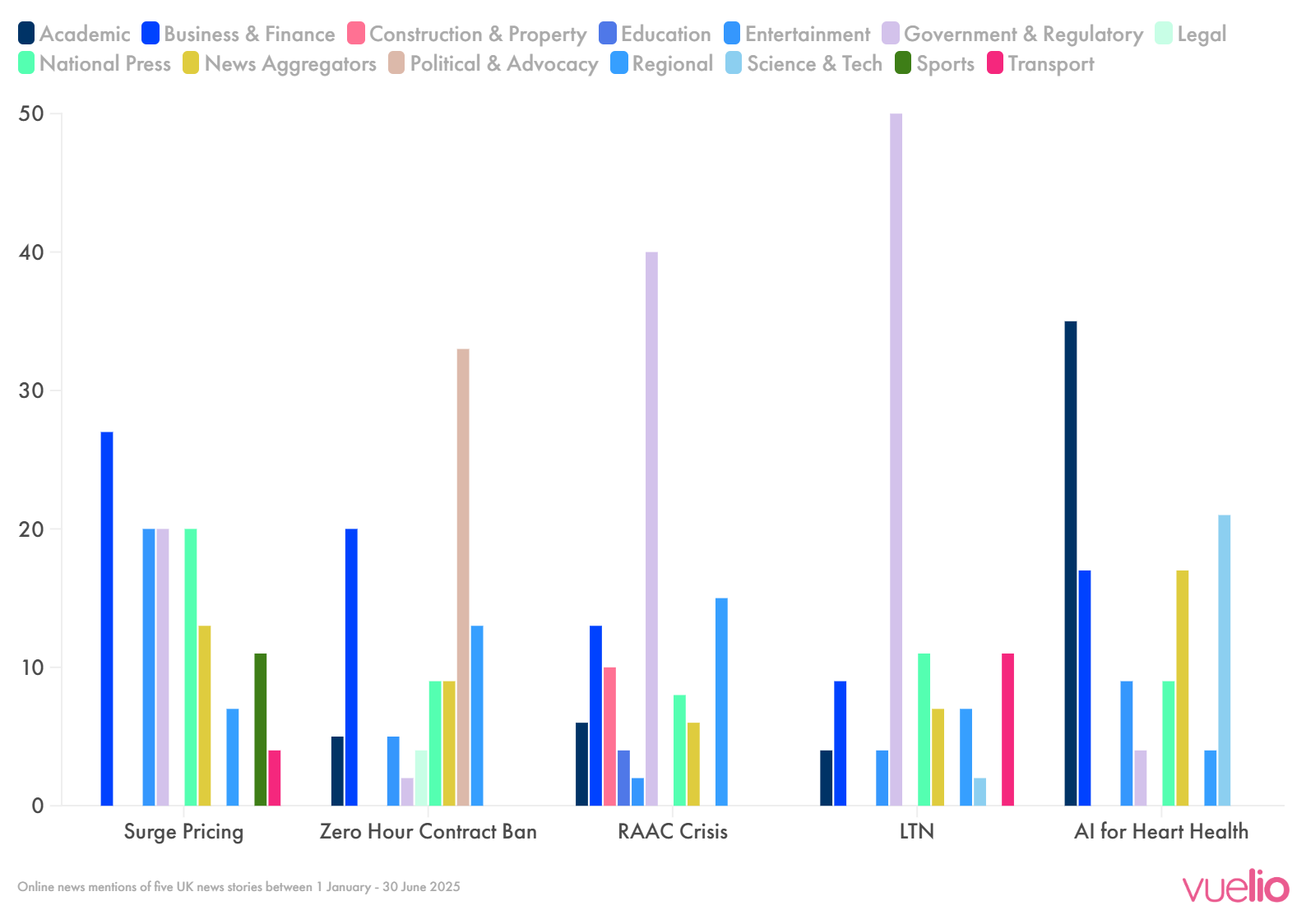
This story’s spread was rooted in organic, community-driven conversation, starting on forums, and moving to academic papers, journals, and websites, successfully reaching very specific, and highly valuable, stakeholder audiences.
A crucial distinction for agency client management – volume alone doesn’t tell the whole story. Reaching a small but highly-engaged audience of experts, academics, or policymakers can be far more valuable than a fleeting mention on a national broadcast.
This also applies to formats. While radio coverage volume might dwarf that of podcasts, for example, the latter has a dedicated audience of downloaders, much more likely to be engaged with the content. For our clients, landing that perfect niche podcast could be a more strategic win than a dozen scattered radio clips.
2. Manage the ‘pinball machine’ of politics
Public affairs and politics are now almost inseparable from PR, and should be considered as part of any campaign.
Vuelio’s Kelly Scott describes public interest stories as potential ‘pinballs’, that can ‘hit a political buffer, bouncing around further, racking up more coverage… potentially distorting the story if it becomes politicised for party gain.
‘If your media team and public affairs team are following stories separately, and using a siloed engagement plan… you are missing a huge opportunity,’ she warns.
Political and regulatory attention – like CMA investigations – can prolong a narrative’s lifecycle significantly, and land them in unexpected sectors. Reporting around the RAAC crisis, for example, received more coverage in Regional outlets than in the expected Construction & Property sector. The story of surge pricing received surprisingly little coverage in law-focused outlets, despite questions from online audiences about its legality.
For agencies, mapping stakeholders is a solid starting point, but so too is being prepared for a story to be picked up by actors with their own agendas.
When a story becomes politicised, agencies must be ready to:
– Correct misinformation at pace and offer good data.
– Engage directly with the media and political influencers involved.
– Motivate third-party stakeholder voices to add credibility and balance.
3. Find the connectors to break through the echo chamber
Despite all the interconnected platforms that make up the modern media landscape, it can still become severely siloed.
Coverage of surge pricing provides a clear example of this – broadsheets focused on issues around labour and fairness, alongside regulatory and market implications, while tabloids centred instead on drawbacks for the general public, with the price of concert tickets a recurring element.
Audiences for each largely stayed in their own echo chambers and weren’t exposed to diverse and different takes on the issue.
The value agencies can bring is bridging such silos by identifying the connectors. For the story of surge pricing, these are national broadcasters (which provide a shared space), specific interest publications (like LADBible or Sky Sports, that reach audiences across class lines), and influencers/experts (projecting a story across very different groups – Martin Lewis is just one example).
These connectors are a vital part of a modern media relations strategy, providing opportunities to break a story out of a single, self-reinforcing narrative.
4. Master the Two-Track Story
One of the curious parts of media fragmentation is how a single topic can spread in distinct ways that never intersect. AI for Heart Health coverage from the first half of 2025 did exactly this:
Track 1: The technical, medical story. This lived in academic or medical publications, and among niche communities and forums online. It reached a limited, but highly engaged, group of professionals, academics, and autodidacts.
Track 2: The mainstream story. When a specific angle of ‘smart pyjamas’ crossed over, it appeared in outlets including Daily Mail and The Mirror, but skipped spaces that ordinarily play host to more technical discussions.
Monitoring niche publications and social spaces to understand which stories have the capacity to break through into the mainstream is vital for agencies working with a variety of clients.
5. Ditch ‘Social First’
Still pitching ‘social first’ strategies? You could already be falling behind.
As Sean Allen-Moy, Head of Media Relations Strategy at Burson, puts it:
‘The concept of a ‘social first’ strategy is outdated. The reality is “social everywhere, always”.’
Tracking coverage of the zero hour contract ban in the UK bears this out. While the story was driven by personal experiences and work advocacy shared on social platforms, this fueled broadcast segments and column inches, which are always in need of case studies. Forget traditional media at your peril.
Monitoring and understanding the interplay between traditional coverage, social sharing, and forum-based discussion is a must – agencies must identify where audiences consume content and meet them there.
‘It’s endlessly fascinating how stories evolve, but it presents a real challenge for brands to fuel the fire – or put it out in some cases – across so many, constantly changing platforms and algorithms,’ says Brands2Life Exec Chair, Business & Technology André Labadie.
‘Using (increasingly AI-enhanced) listening and analytics tools to identify emerging trends through social is key so you can influence the narrative in its infancy. This is really changing how brands can take control of issues early and predict how they’re likely to evolve.
‘What definitely hasn’t changed is the need to add something new to the story, stay close to the media to develop new angles at the right time, and then use all the relevant platforms to amplify it.’
6. Follow the new PR playbook
This fragmented landscape demands a fluid strategy. As Amy Chappell, Head of Insights at Vuelio, puts it, a story is ‘no longer a fixed communication, but a fluid journey shaped by who picks it up and how it is retold’.
The agency playbook must be built on adaptability:
Think Ecosystem, Not Endpoint: Stop treating media coverage as the finish line. Instead, build responsive strategies that anticipate how stories will evolve across platforms.
Reframe Monitoring as Navigation: Tracking coverage isn’t about counting clips. It’s about understanding how narratives are reframed to know exactly when to step in, clarify, or amplify.
Embed Adaptability: Build flexibility into campaigns. This means having spokespeople and expert commentators ready to engage quickly to retain a degree of control in unpredictable times.
For agencies willing to embrace this complexity, the opportunities are immense. Moving from linear pitching to dynamic navigation can prove the indispensable value of agency support to clients and prospects.
Want more on navigating this new landscape? Check out the full story in Vuelio’s latest report ‘How news travels in today’s fragmented media environment’.


Leave a Comment