
Why are public sector comms teams not tracking their AI visibility?

In May 2026, AI assistant GOV.UK Chat launched inside the GOV.UK app. Built on more than 80,000 pages of official guidance, it was designed to answer citizens’ questions on tax, driving, childcare, apprenticeships, and benefits. The soft launch saw great take-up, signalling to government departments, regulators, NHS trusts, and local authorities that a majority of the general public are now ‘AIing it’ versus ‘Googling it’.
But not every member of the UK public will be asking GOV.UK Chat for answers, instead going to ChatGPT, Gemini, Copilot, Perplexity, and Claude, which weren’t built on official government guidance. Answers from these LLMs will serve up whatever the web has indexed, regardless of whether that material is accurate, balanced, or years out of date.
The stakes are high for comms teams reckoning with this new AI-mediated information ecosystem, but even higher for public sector organisations with responsibilities to people across the country who depend on them.
When the ‘official’ answer is not fully reliable
Research from the Open Data Institute tested over 22,000 citizen-related queries against leading models including ChatGPT-4o, Gemini, and Claude, and the results found that multiple models were giving incorrect guidance on regulations including Guardian’s Allowance and Sure Start Maternity Grant eligibility. As Professor Elena Simperl of the ODI warned: ‘If language models are to be used safely in citizen-facing services, we need to understand where the technology can be trusted and where it cannot’.
What can Government agencies do to keep AI answers correct if the AI systems that supply them are drawing on sources of such diverse nature and reliability as local press, forums, campaign group websites, and out-of-date PDFs that happen to rank well?
Strategy for AI visibility needs to be different for public sector comms teams
For a consumer brand, AI visibility is primarily a matter of reputation and sales, but for public sector bodies, the stakes are whether people can access a service, meet a deadline, or continue to trust an institution.
Different types of public sector organisation carry different exposure:
- Service-delivery bodies (DWP, HMRC, local councils running bins, council tax and planning, NHS trusts) depend on AI-generated answers being current. Eligibility criteria, rates and deadlines change; a chatbot repeating last year’s rules goes past inconvenience to real potential costs to a resident who acts on it.
- Regulators (Ofgem, Ofcom, the FCA, the CQC, the ICO) need to be treated by AI systems as the primary, authoritative source on their own remit. If a chatbot leans more heavily on a consumer campaign site or a trade publication’s interpretation than on the regulator itself, this needs to be identified and mitigated.
- Policy departments and ministries (DWP, DfE, Defra, the Cabinet Office) need policy explained with the caveats intact. Technical accuracy is not the same as genuine clarity, and AI systems can smooth away all-important nuance.
- Councils, combined authorities, and devolved administrations need visibility into how residents are informed about local decisions, especially contentious ones like council tax rises or planning applications. Here, local papers, residents’ Facebook groups, and campaign pages often shape the AI-generated answer more than the council’s own statements.
Five questions for UK public sector comms teams to ask now
1) If a resident is not visiting the organisation’s website, where are they getting their answer instead, and is it correct?
2) How is the organisation’s most recent decision, incident, or policy change actually being described when someone asks an AI about it?
3) When new information is published, does it appear in AI-generated answers reasonably quickly, or is a chatbot still confidently repeating last year’s position?
4) Where is the gap between what has been published and what people are actually being told by these tools?
5) How much of the narrative is being shaped by campaign groups, opposition voices or local press, rather than by the organisation’s own primary sources?
Most comms teams currently have no reliable way of answering these questions. Traditional media can be monitored and social sentiment tracked, but few organisations have visibility into what ChatGPT or Gemini is telling people about them at any given moment, or which sources those answers are drawn from.
How Lumina’s AI View provides that visibility
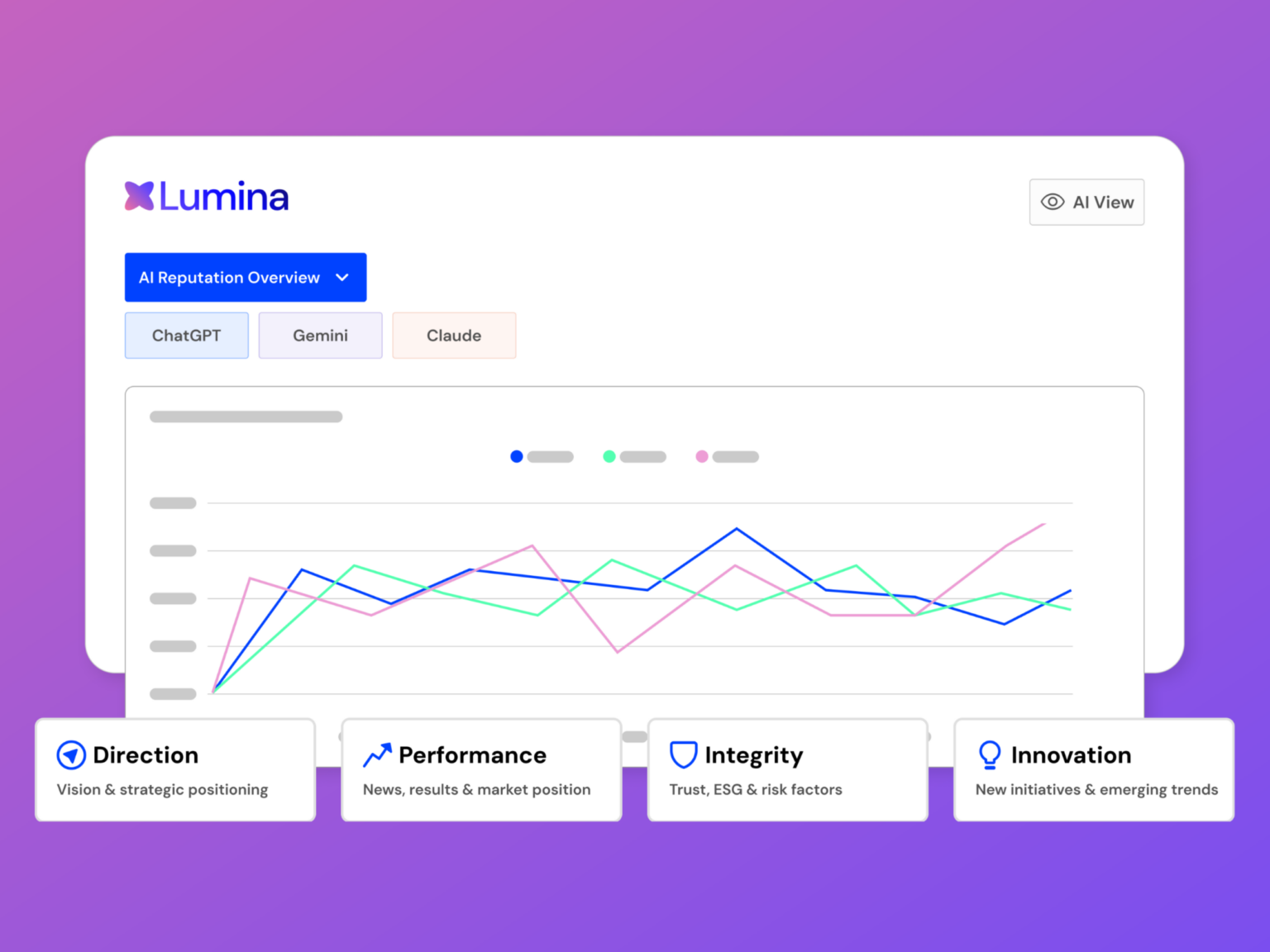
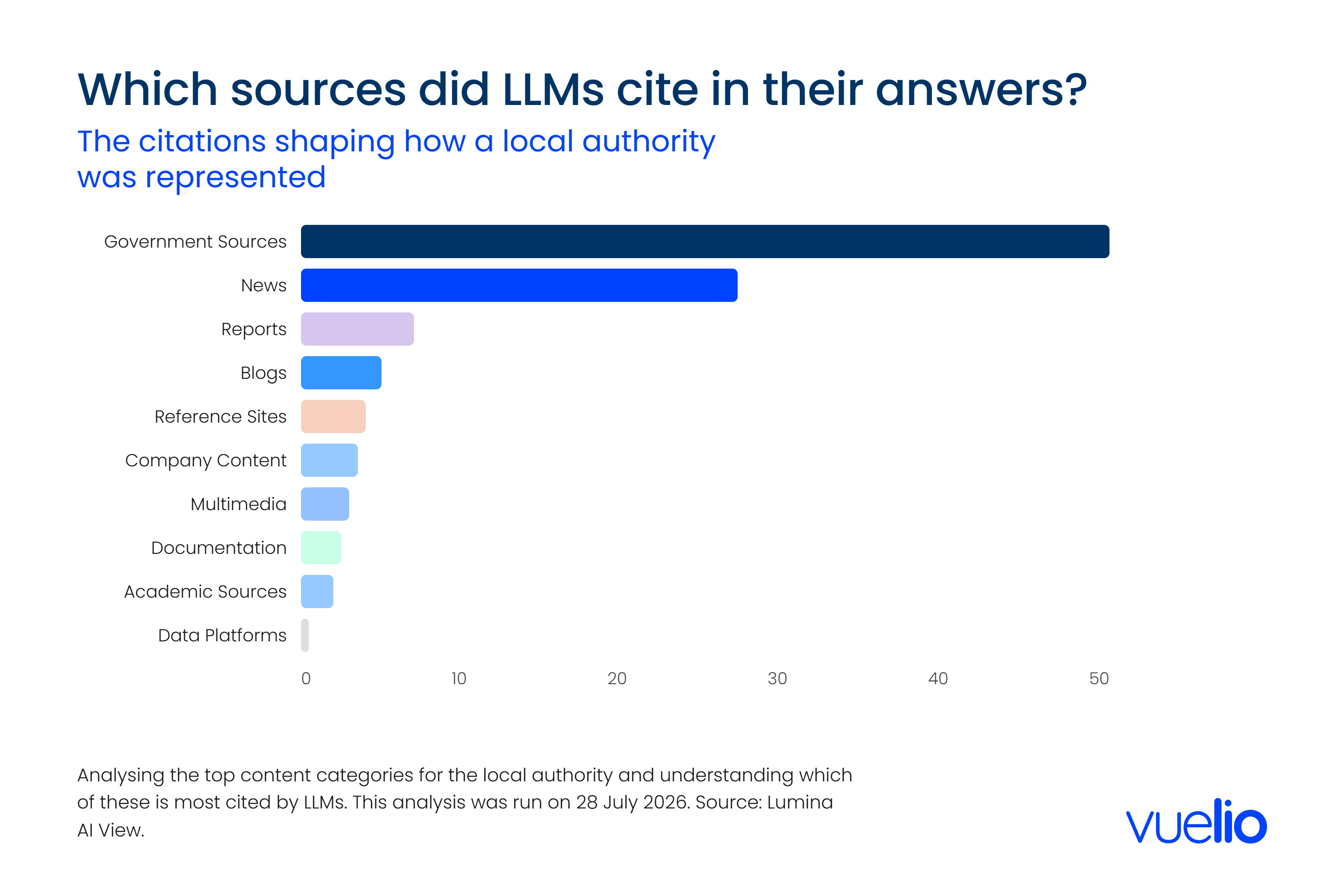
This is the gap that AI View, part of Vuelio’s Lumina suite, has been developed to address. It tracks what large language models such as ChatGPT, Gemini, and Claude are citing when they answer questions about an organisation — not only what they say, but which sources those answers are drawn from. For a public sector communications team, this means the ability to see, in one place:
- Source footprint — whether AI answers are drawing on an organisation’s own official guidance, national press, trade and specialist titles, campaign sites, or forums, and how that mix shifts over time.
- Competitive and peer benchmarking — how an organisation’s visibility compares with a neighbouring authority, special interest groups, a comparable regulator, or another department handling a similar issue.
- Alerts when citation patterns shift suddenly — valuable when a policy announcement, an incident or a contentious local decision begins to change how AI systems discuss an organisation, allowing a comms team to respond before the narrative sets.
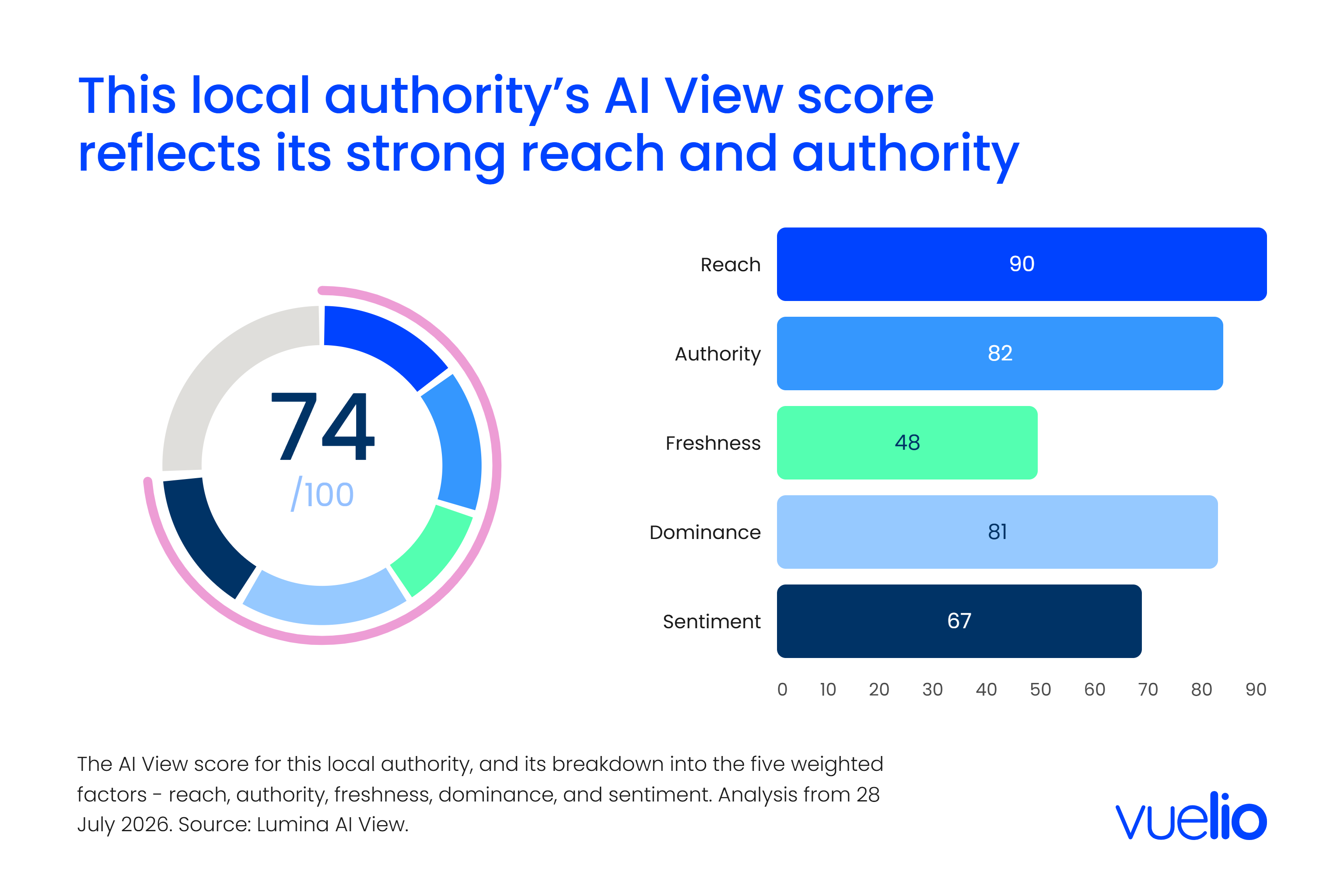
Consider a county council approaching budget-setting season. AI View could reveal whether questions about a proposed council tax rise are being answered using the council’s own published rationale, or drawing almost entirely on an eighteen-month-old local newspaper article and a residents’ social media discussion. This is precisely the kind of gap an organisation would want to identify while there is still time to address it, rather than after a scrutiny committee meeting has already raised it.
The GCS’s own Assist tool demonstrates that government communications teams are already comfortable deploying AI internally, for drafting plans and reviewing content. AI View addresses the other half of that picture: understanding how AI represents an organisation externally, to the people it serves.
The public are going to LLMs for answers, but do organisations know what they are being told in response, and whether they are the ones providing that answer?
Find out more about Vuelio’s AI View to see what it can reveal about an organisation’s AI visibility.


Leave a Comment