
Communicating in the chaos: How to map out today’s multi-channel media space

PR professionals are operating in a media environment that looks nothing like it did even a decade ago. With no clear map ahead for sharing your message and gaining the attention of your desired audience, how should comms teams proceed with their campaign planning and media outreach?
Vuelio’s latest webinar ‘Mapping the media: How do stories travel today’s fragmented landscape?’ delved into the issue with the help of industry experts Sean Allen-Moy, Head of Media Relations Strategy at Burson UK and Jacob Granger, Community Editor for JournalismUK.
Missed it? Watch the full webinar here.
Read on for trends explored during the session to help with your strategic comms…
The decline of ‘traditional’ media: Is it all bad for PRs?
The emergence of digital platforms has fundamentally changed how audiences consume content. The numbers from the 2025 Reuters Institute Digital News Report give a stark reminder of this reality: UK consumption of print is down to 12% and television news to 48%.
‘I don’t think this will come as a surprise to anyone,’ says Sean, who leads Burson’s engagement and innovation within the earned media space, from corporate to consumer, and served over a decade as a broadcast journalist for outlets including Sky and the BBC.
‘If you were on the tube this morning, I doubt you saw many people reading broadsheet newspapers. Everyone would have been staring at their screens and scrolling.’
Online-first, mobile-led formats like TikTok are stepping in to take up the slack, offering digestible news and entertainment in vertical video formats, catering to shorter attention spans and more niche interests. The traditional, top-down approach of old, pushing out a press release and awaiting coverage, simply doesn’t work across all modern channels.
Adding to this challenge is the trend of news avoidance and media distrust. Interest in news has dropped significantly in the UK, from 70% in 2015 to just 38% last year, something more pronounced among women, young people, and those without a university degree. But it’s not all doom and gloom. There are many ways to reach audiences now, already being grasped by publishers, and ready to be capitalised on by the comms industry with stories to share.
‘What makes this less depressing is if you think about general content,’ advised Sean.
‘Yes, people aren’t consuming as much news, but they are still consuming information and content, and that’s what the media provides.
‘The average length that people can pay attention to screens is 43 seconds, and that’s what we’ve got to work with now. We might not be seeking coverage on a linear television channel, but 60% of people watch their TV news coverage on Instagram and TikTok, so they are still going to new organisations to find that content; they’re just finding it in other places.
‘It’s thinking about newspapers no longer being the number 1 target – actually think about where your audience is. Rather than aiming for the front page of The Times (which would be fantastic), try The Times’ podcast, Times Radio, the subscriber newsletters – that’s where we need to go.
‘It’s up to us as comms people to go where our audiences are, rather than where we think they are, or where they were traditionally.’
Nichification: The power of the highly-engaged stakeholder
While securing a national front-page splash remains a highly valuable get for any comms team (as long as the story is positive, and wanted by your organisation, of course…), it shouldn’t be the ultimate aim for every campaign. Fragmented media creates pockets of highly valuable, deeply engaged audiences well worth tapping into.
Vuelio’s latest report ‘How news travels in today’s fragmented media environment’ tracked five public interest stories to highlight the different ways narratives can spread across today’s media ecosystem. Analysis of the journey of reporting around ‘AI for Heart Health’ highlights the power of reaching a highly-engaged audience first versus blasting out a message to the general public and hoping for the best.
This story’s spread was rooted in science-led articles and organic, community-driven conversation on forums like Reddit before moving to mainstream online news outlets.
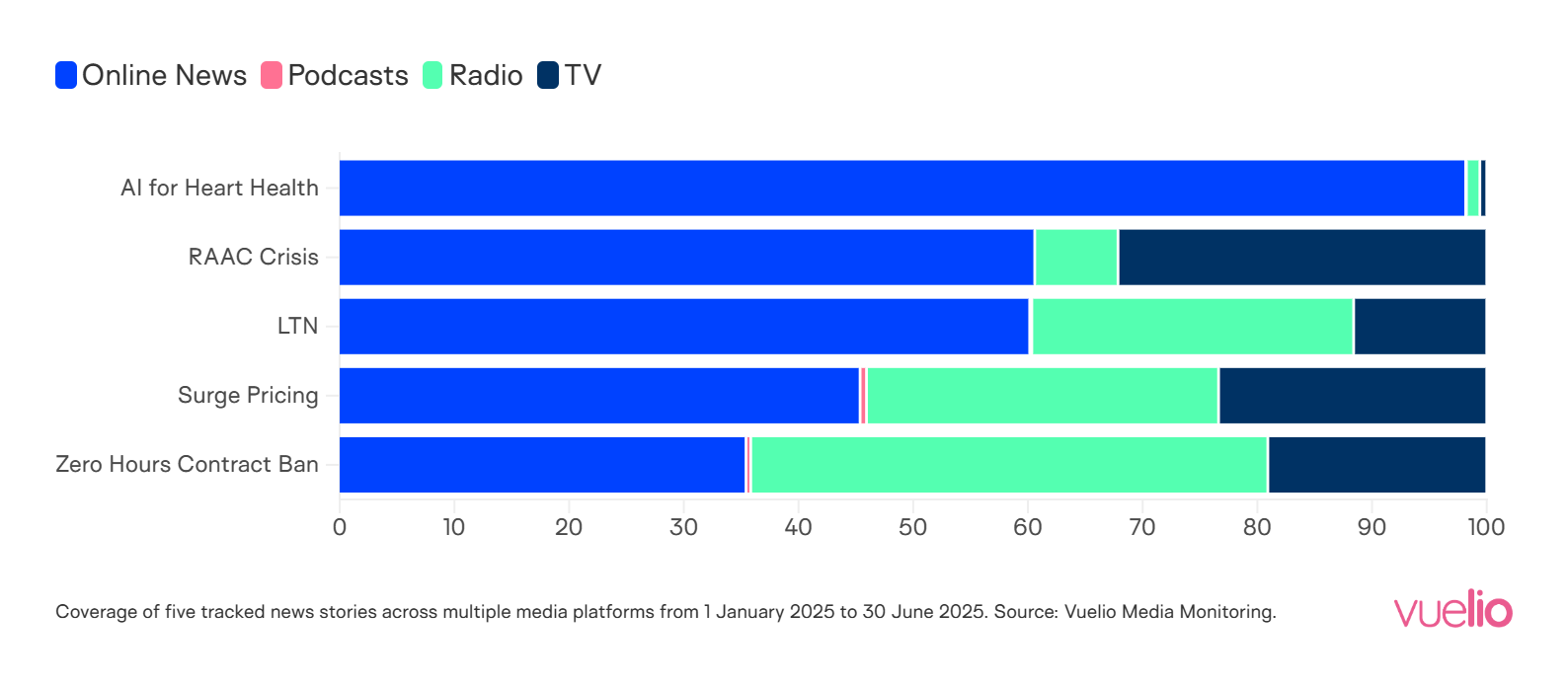
In this landscape, volume alone does not tell the whole story. Reaching a small, highly-engaged audience of experts, academics, or policymakers can be far more valuable than a fleeting mention in a national publication. This same logic applies to format: while radio coverage might offer higher volume, a mention on a relevant podcast can be a more strategic win, reaching an audience that has actively chosen to download and engage with the content.
Jacob, who reports on the digital news industry for JournalismUK, explained the parallel pivot to an increased focus on audience within the media:
‘It’s just harder and harder to get people’s attention nowadays, and the only solution to that problem, as far as I’m concerned, is a greater emphasis on relevance, and really understanding exactly what it is that people care about. Making sure that is your focal point, and that you’re addressing that every day in your coverage.
‘I’d say for the last ten years or so the news industry has been grappling with this problem, and creating more audience-centric strategies to be more relevant to our users.
‘There’s more to this publishing model of today than just what’s breaking and what’s just happened – the “who, what, where, when, why” that Sean and I were trained on as journalists.
‘The only answer is a greater emphasis on relevance and understanding who your audiences are, what they care about, what their pain points are, and making sure those are addressed.’
The rise of community and audience interaction
The drive to reach ‘top of funnel’ traffic for the media as well as PR teams has been made incredibly difficult, and even redundant in many cases, with the rise of LLMs like Gemini and ChatGPT ‘middlemanning’ between the public and publishers.
‘Direct traffic isn’t what it once was,’ said Jacob.
‘Search and social is increasingly competitive, and news is losing the fight there.’
Where the media can bring audiences back into the fold to engage with their content directly is in the ‘mid-funnel’ space – online forums, app brand extensions, LinkedIn groups, and community features like comment sections and Q&As.
Established brands, like The Times, are actively investing in their apps and community features to retain audiences. By encouraging interaction in the comments section and making readers feel heard, they are centring community building and audience retention.
The part of PR here is to recognise that outreach is a two-way street. Once a story is shared, platforms and forums can prolong it, kill it, or even warp it beyond recognition. This makes monitoring and engagement critical. Find where your stakeholders and audiences are, and engage with them there, advises Sean:
‘We all exist on social now, and from our perspective, it’s “social everywhere, and social always”. Yes, we are consuming video from the BBC, but we tend to be consuming it on social media.’
Escaping a media silo by identifying key connectors
Despite the interconnectedness of modern platforms, a single topic can still spread in distinct ways that never intersect, resulting in severely siloed stories. Which is great if you have a crisis you don’t want to hit the aforementioned front pages of national newspapers… but not so wonderful if your story isn’t something you want to keep quiet.
Comms teams can overcome a story staying siloed by identifying and leveraging connectors.
For the story of ‘Surge Pricing’ – which took two very different directions in the UK broadsheets and the tabloids – connectors included specific interest publications (sport-centred outlets like LADBible and SkySports) and influencers and experts (finance expert Martin Lewis, who can project a story across otherwise distinct groups).
Identifying these connectors is a vital part of a modern media relations strategy, offering opportunities to break a story out of a single, self-reinforcing narrative or echo chamber. If you want to do that, of course…
‘That relates to how we plan our campaigns now, how we plan our outreach,’ said Sean.
‘We no longer just ask, how do we target print journalists? What channels do we need to look at? How do we look at social? What we now try to do is look at the ecosystem. Who are the voices that are influencing our target consumer and our target audience? Is it brands? Is it particular journalists? Is it influencers? Is it Gemini and ChatGPT? Is the audience consuming them via broadcast? Are they consuming them on their mobile phone, in real life?
‘Look at the platforms they’re on, and then create the content that reaches them on those platforms. Are they consuming content on Instagram, on TikTok? Are they watching the content on YouTube? Are they mostly steering towards audio on Spotify?
‘At the heart of this is getting rid of the way we have traditionally done things.’
No story’s journey is predictable, so make flexibility part of your plan
This fragmented media landscape is not something to fear. Filled with opportunity for new voices to break through, and ways to reach previously uncatered-to audiences, the media and comms industries must be ready to adapt.
For the comms side, this means being flexible when working with the media, too:
‘Newsrooms know their readers best, and you need to trust them to do their jobs, trust them to know the right angles, to know the right treatments for the stories,’ said Jacob.
‘If they’re saying this is a story for social, that’s going to look different than if they were to run it on the front page of their newspaper. There might be a completely different set of values and treatments and approaches to telling that story. But it might also be that a journalist comes back and says, look, there’s an entirely different angle here that we should explore.
‘Be open to that, because it is in news organisations’ best interest to perfect this, because they live or die by how relevant they are to their audience.’
For Sean on the PR side, it’s about ‘moving from thinking to knowing’:
‘My colleague Allison Spray, our Chief Data Intelligence Officer for EMEA always talks about moving from thinking to knowing. And that has to be the goal, really, in anything we do, and what we do for our clients.
‘Earned media tends to be more influential, but it involves more risk. The answer is to find out where your audiences are. We can’t guess now.’
Mapping out the media space now? Forge a path of audience-centric strategies that are as fluid as the modern media ecosystem itself.
For more on what media fragmentation means for your comms strategy, read the Vuelio report ‘How news travels in today’s fragmented media environment’.


Leave a Comment