
Navigating the modern media maze for brands

In 2025, the idea of a story travelling directly from the PR team, to the newsroom, straight to the right audience is long gone. Today, stories scatter, ricochet, and sometimes completely transform as they pass through an ecosystem of platforms.
For in-house comms teams at big UK brands tasked with securing significant attention for their campaigns, this fragmented environment can feel chaotic and difficult to circumnavigate. But it’s also full of opportunity – here is what brand comms teams need to know for connecting with audiences now…
From broadcast to broadband: the shape of today’s media
According to the latest Reuters Institute Digital News Report, UK audiences have shifted away from print and TV (down to just 12% and 48% respectively) towards an online-first, mobile-led media landscape.
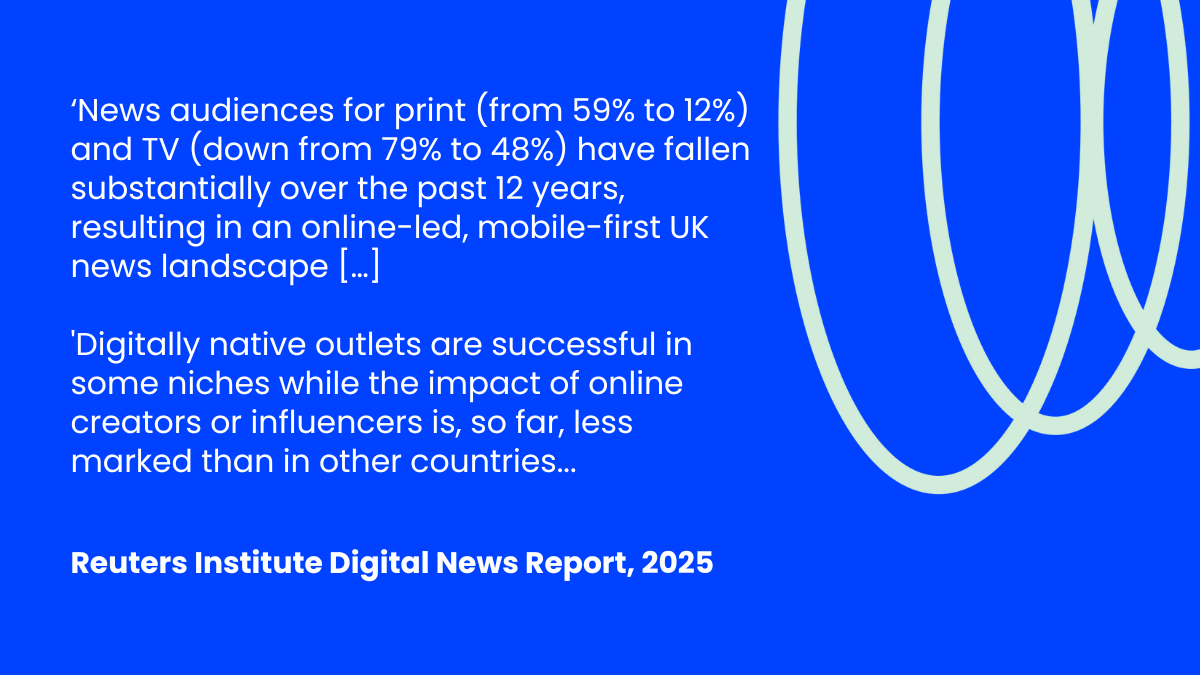
For PRs, this means the traditional ‘top-down’ model of securing coverage and waiting for amplification no longer applies. Every story now takes a unique, often unpredictable route through the media ecosystem.
This doesn’t mean that ‘traditional’ media isn’t important – long-trusted media brands have simply branched out into a number of new formats, and audiences can be found spread among them.
Stories take unexpected turns
Vuelio’s latest report ‘How news travels in today’s fragmented media environment’ tracked specific stories across the first half of 2025 – from the AI for Heart Health innovation to the Zero Hour Contract Ban. The findings reveal just how differently narratives can evolve:
AI for Heart Health stayed niche and technical, thriving in academic journals and specialist sites before making a surprise leap to tabloids when an AI pyjamas invention caught the press imagination.
Low Traffic Neighbourhoods moved from hyper-local activism on Reddit and X into national election talking points.
Surge Pricing split the nation’s media in two: broadsheets debated regulation and market fairness, while tabloids raged about pint and gig prices.
Zero Hour Contracts began as social storytelling – people sharing experiences online – before policy debate brought it into mainstream broadcasting.
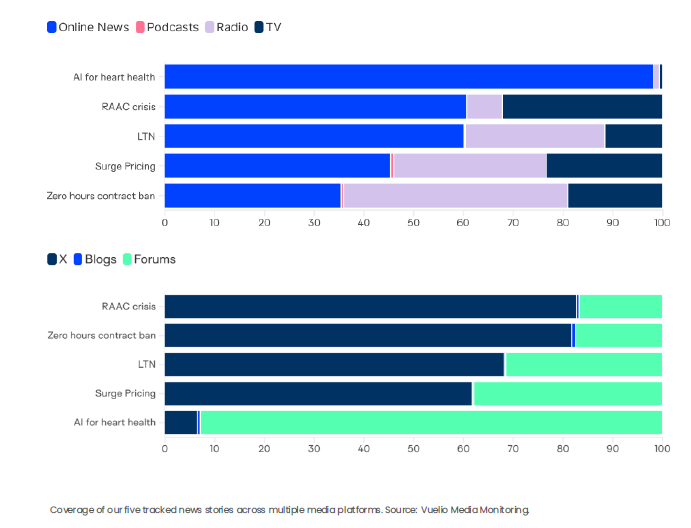
These examples highlight a key lesson: media coverage is no longer linear, but lateral. Stories can leap between siloes, or split into parallel versions depending on who picks them up.
The new rules of engagement
As Vuelio’s VP of Government & Stakeholder Kelly Scott notes, ‘The journey of public interest stories can be like a pinball machine — hitting political buffers that change their course’.
Brands are particularly subject to regulation and therefore political interest. Managing reputation in this landscape means engaging quickly, across both media and political spheres.
Correcting misinformation, activating credible third-party voices, and keeping stakeholder networks mobilised are now essentials, not extras.
Amy Chappell, Vuelio’s Head of Insights, adds:
‘Each platform, each audience, leaves its imprint. A story isn’t a fixed communication anymore – it’s a fluid journey shaped by who picks it up and how it’s retold.’
How brands can adapt
For in-house comms leaders, this fragmentation requires a mindset shift:
Think ecosystem, not endpoint. A press release isn’t the end of your campaign — it’s the start of a story’s evolution. Map where it might travel next.
Monitor for meaning, not mentions. Media monitoring should track how narratives are reframed across outlets and audiences, not just tally coverage.
Plan for pivots. Build adaptability into campaign design. Prep spokespeople and experts to engage at pace when narratives shift.
Bridge your siloes. Media, comms, and public affairs teams can’t operate separately anymore – their worlds now overlap daily.
Opportunity in the fragmentation
Fragmentation isn’t just a challenge – it’s fertile ground for smarter strategy. With the right insight, the right relationships, and the right timing, stories can thrive in unexpected places.
As Burson’s Head of Media Relations Strategy Sean Allen-Moy puts it:
‘To succeed, brands must know precisely where their audience consumes content and meet them there.’
For UK comms professionals, the task is to treat this new landscape not as a maze to get lost in, but as a map full of alternative routes. Because in 2025, the story doesn’t stop at publication – it starts there.
Want more on navigating this new media landscape? Check out the full story in Vuelio’s latest report ‘How news travels in today’s fragmented media environment’.


Leave a Comment