
Why integrating political and media strategy is the secret to successful campaigns

While the days of a stable, single-route news cycle are long gone, the modern media ecosystem can still be successfully navigated by comms teams… providing they pay attention to all possible diversions and directions a story can travel along, including the political.
Today, the line between media management and public affairs has blurred. How to navigate the confusion? In short, by incorporating political monitoring into your media monitoring strategy.
Using insights from the Vuelio report ‘How news travels in today’s fragmented media environment’, augmented by several leading comms experts, we share advice on how to plot your course through the interwoven media and political landscapes.
Steering through the unpredictable news cycle
The most significant takeaway for modern communicators is the loss of a predictable arc. Kelly Scott, VP of Government and Stakeholder at Vuelio, describes the modern journey of a public interest story as a series of unpredictable rebounds, where a narrative hits various political buffers that abruptly change its trajectory:
‘The path a story takes today is incredibly kinetic,’ says Scott. ‘A narrative can strike a political trigger and suddenly veer off in an entirely new direction. In this environment, it is absolutely vital to correct misinformation at pace, engage with both media and political influencers, and mobilise credible third-party voices’.
Vuelio’s analysis of major stories from the first half of 2025, including the RAAC crisis and the debate over Low Traffic Neighbourhoods (LTNs), demonstrates this phenomenon in action.
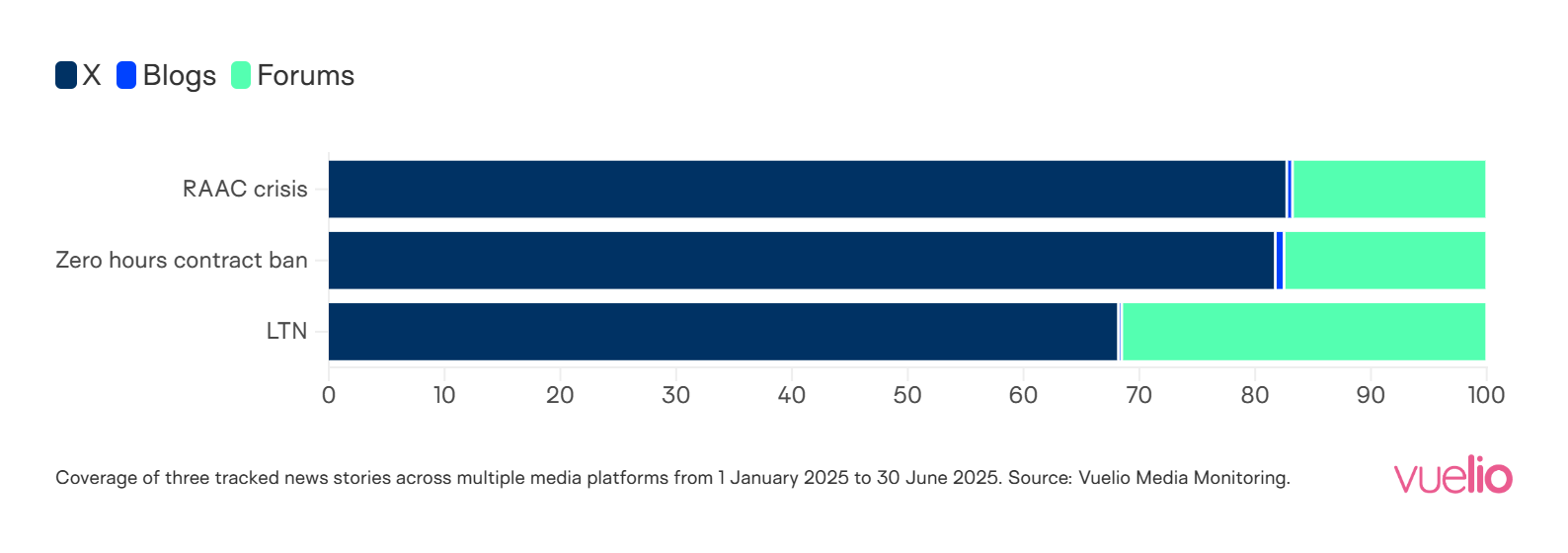
LTNs, for instance, began as a hyper-local debate about planning but were rapidly pulled into a national political conversation about environmental policy and government control. By the time the story reached the national stage, it had evolved from a story about traffic to a shorthand for wider political division.
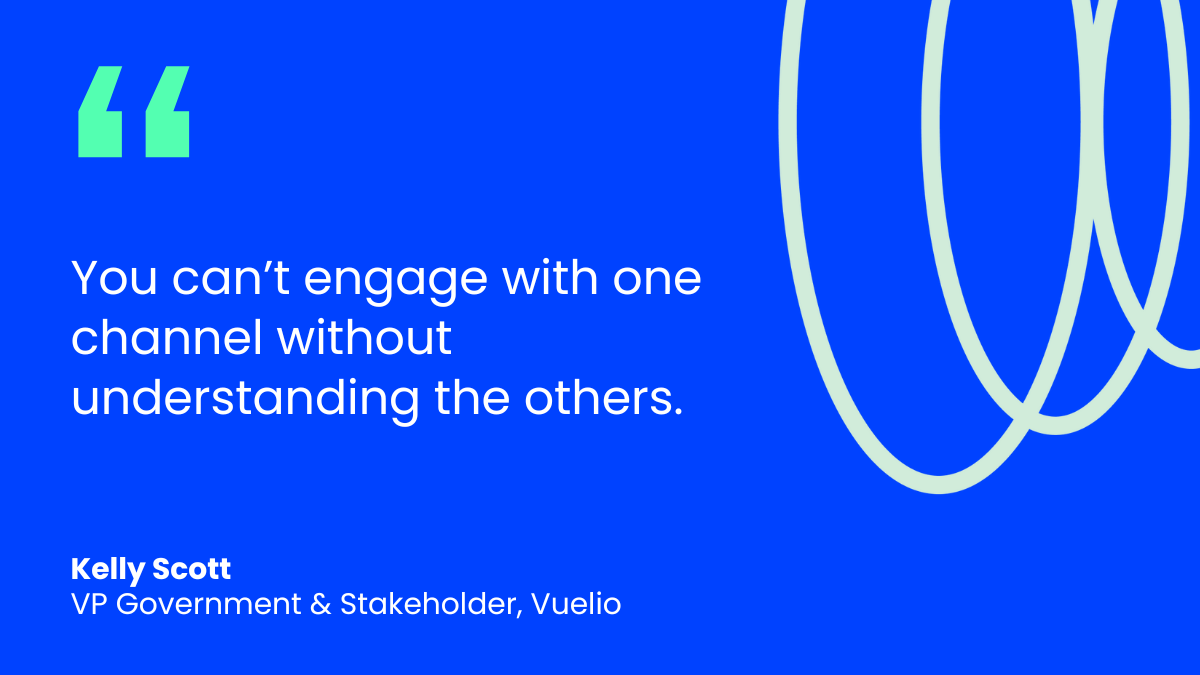
The lesson for PR professionals: you can no longer wait for a story to reach the mainstream before you act. As Kelly Scott puts it, the fragmented nature of modern media means that ‘you can’t engage with one channel without understanding the others’.
Going beyond the click with KPIs
As the media landscape fragments, the way to measure success must evolve. When audiences are consuming parallel, but often disconnected, versions of the same issue, the traditional ‘big hit’ in a national broadsheet may no longer be the ultimate KPI.
Vuelio’s research into the coverage of ‘Surge Pricing’ showed that different media audiences lived in almost entirely separate echo chambers. While business outlets framed the issue through market regulation, tabloids focused on the cost to the consumer – and even then, there was great discrepancy between mass media on precisely what cost to the consumer (beer, transport, etc) was being cited. If your comms strategy only measures one such strand, you could be missing half of the picture.
Measurement is now less about counting clips and more about understanding movement across the ecosystem. Charlie Campion, External Affairs and Policy Manager at Mental Health Matters, argues that this shift requires a complete rethink of how comms and public affairs have been previously aligned:
‘Politicians are paying closer attention than ever to public opinion,’ Campion explains. ‘This means that conversations in the press, online forums, and across social media have become essential to any successful public affairs strategy. Integration and collaboration between public affairs and communications teams are now more critical than ever.’
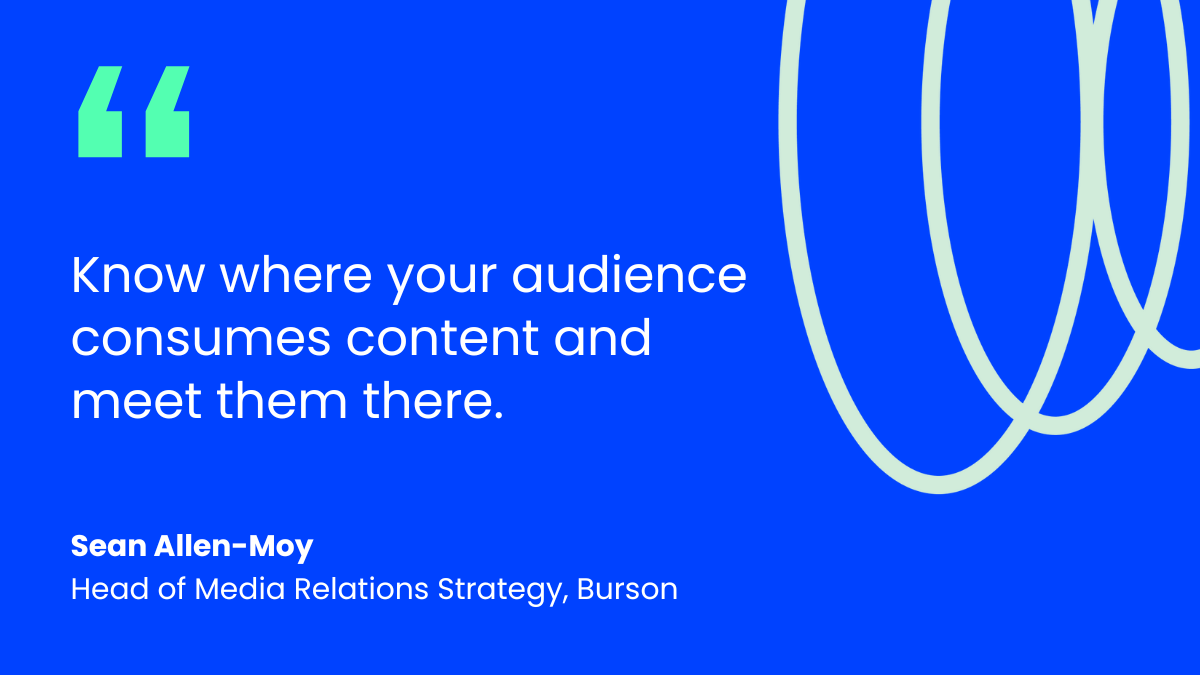
Without integrated KPIs that track both media sentiment and political intent, organisations risk traversing the landscape with a limited field of vision. Sean Allen-Moy, Head of Media Relations Strategy at Burson UK, simplifies the challenge: ‘You must know exactly where your audience consumes their content and meet them there’.
Why comms can’t refuse to play politics
If the fragmentation of the media is the how of modern comms, then politics is the why. There is a growing consensus that communications professionals can no longer afford to treat ‘politics’ as a separate silo or a niche interest. Legislation and regulation now permeate every aspect of brand reputation – and integrating political monitoring into your media strategy is even more important this year as we get closer to May’s local elections in the UK…
‘Politics drives the agenda, and the geopolitical world is moving faster than ever, often dictating the speed and direction of media and stakeholder conversations,’ believes Kerry Parkin, founder of The Remarkables.
‘If your product or brand is touched by political events, it must be factored into your mindset and planned for, even through the disruption.’
A lack of political literacy can be terminal for a PR campaign. Anton Greindl, Director of Public Affairs at Tilton Consultancy, warns that failing to track policy and regulation results in mistimed launches and messages that become ‘politically toxic’ before they even land:
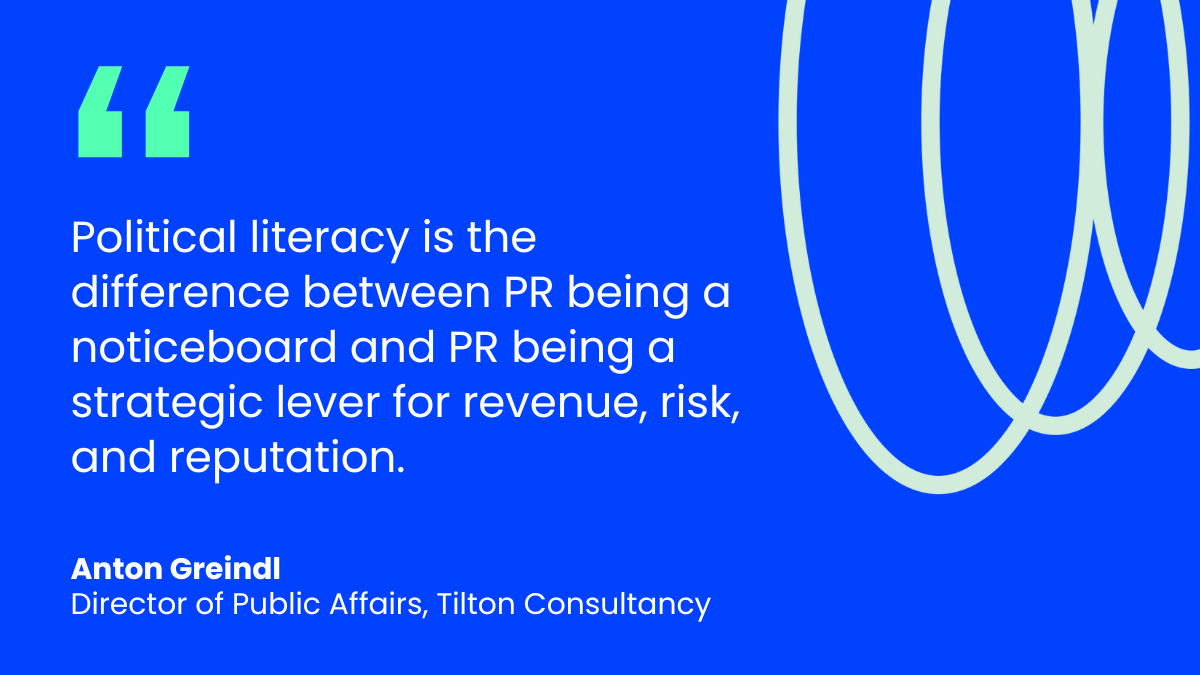
‘Policy literacy is the difference between PR being a mere noticeboard and PR being a strategic lever for revenue, risk, and reputation,’ Greindl argues. ‘When politics moves, you need to lead with substance, consistency, and implementation detail’.
Putting a unified strategy into place
Monitoring the media and monitoring Westminster are now part of the same job. The combination further allows teams to anticipate crises rather than simply reacting to them.
In an age of digital connection, and media siloes, cutting through is about masterminding the journey of a story through various spaces. Successful organisations are those that can read the entire ecosystem, engage multiple stakeholders, and adapt their strategy in real time.
As we look toward an increasingly complex future, the advice from the industry is to lean into this complexity rather than retreat from it. The most successful comms professionals will be those who break down the walls between their media and public affairs teams, ensuring that every KPI measured and every story told is informed by a deep understanding of the political current.
Where stories now cross-pollinate across a thousand different platforms at once, a narrow focus is a dangerous one. To survive and thrive, you must understand every platform out there.
For more on traversing today’s multi-platform media and political spaces, check out Vuelio webinar ‘Mapping the media: How stories travel today’s fragmented landscape?‘, with Burson UK’s Sean Allen-Moy and JournalismUK’s Jacob Granger.


Leave a Comment