
25 years of the Journalist Enquiry Service: Its impact on the biggest news stories, then and now

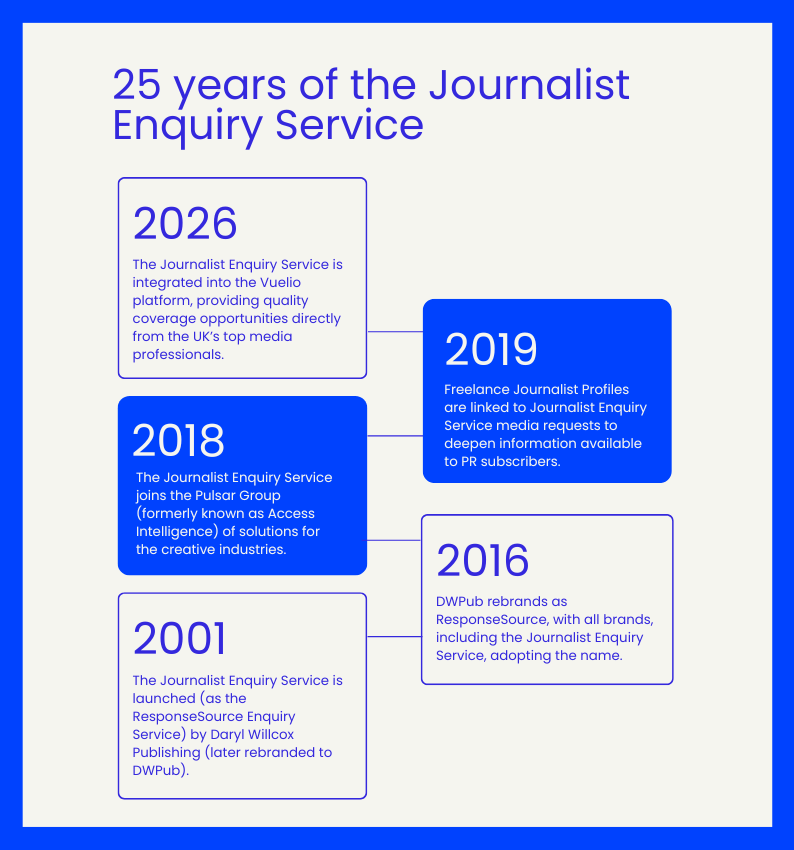
The ResponseSource Journalist Enquiry Service celebrates a special milestone this year as it’s 25 years since its launch. The service has been there to assist thousands of journalists over this period, and give PRs the opportunity to secure media coverage for their experts, case studies, press releases and more.
Here is a look back at some of the biggest events and stories the Journalist Enquiry Service was able to help amplify across the UK over the last 20 years, and what’s happening in our 25th year.
Global economic events
Talking about big economic events from the last 20 years, 2008 would stand out for many of us in the UK and Europe – certainly comms and journalists tasked with covering the business and personal finance beat at the time.
Personal Finance-related media requests from journalists and broadcasters surged in the midst of the crisis, reflecting the immediate need for consumer information about what this meant for the public’s finances. And UK PR and comms people were there to help, offering advice from key experts and case studies from those impacted.
But that wasn’t the end of wide-spread financial woes, with the Cost of Living Crisis continuing to rumble on. First catching significant media attention towards the end of 2021, the Journalist Enquiry Service’s Personal Finance category saw a significant and sustained spike, increasing by nearly 70% from 1,926 in 2020 to a peak of 3,254 in 2022. Journalists needed practical, consumer-focused advice on budgeting, inflation, and debt, and turned to the UK PR users of the Journalist Enquiry Service for support. In 2022, Business & Finance media requests peaked again, (6,339) this time with asks for corporate strategy and the broader economic outlook.
What does this mean for PRs now?
If you want to reach out to a journalist covering Business & Finance in 2026, the focus should be on thought leadership and forward-looking analysis. Go beyond simple reporting when responding to requests and offer expert commentary on long-term economic forecasts, sector-specific performance in challenging environments, and strategic advice for businesses navigating the current climate.
Trying to get coverage with Personal Finance journalists? The big increase in the number of requests during times of crisis over the last 20 years suggests that the media is looking for immediate, practical advice on topics like saving, managing utility bills, mortgages, debt management, and more. For these significant events that will affect consumers due to high inflation and economic volatility, have experts ready to provide clear, non-jargon solutions.
Infrastructure and construction
While the Construction & Property and Manufacturing, Engineering & Energy categories on the Journalist Enquiry Service are traditionally less busy than others – primarily serving niche trade publications – related requests grew significantly between 2005 and 2008 – peaks coinciding with the planning and initial heavy construction phases of projects like the Elizabeth Line and the Battersea Power Station redevelopment – both having driven high media interest in the sector’s activity and scale.
Manufacturing, Engineering & Energy requests from the media have surged again recently – indicating the media’s increased focus on the industrial and supply-chain aspects of large-scale infrastructure, and perhaps the growing focus on energy transition, too.
What does this mean for PRs now?
When it comes to Construction & Property-focused media, general construction activity is less newsworthy than project milestones. If you want to get media coverage in this sector, focus on major project announcements, planning approvals, and any impactful delays. There is also a chance to cover innovative engineering if you can explain how it is done, the final launch, and what impact this is going to have on the sector and the local community.
Manufacturing, Engineering & Energy has seen major growth as a category recently and will most likely continue due to major projects like HS2 still on-going and recent ones like Thames Tideway only recently completed. The focus for PRs needs to be on technical innovations, UK manufacturing successes, and the energy implications of infrastructure. Stories and experts to talk about the materials used, the engineering feats, and the green energy solutions will resonate strongly with journalists covering this sector.
Political instability and change
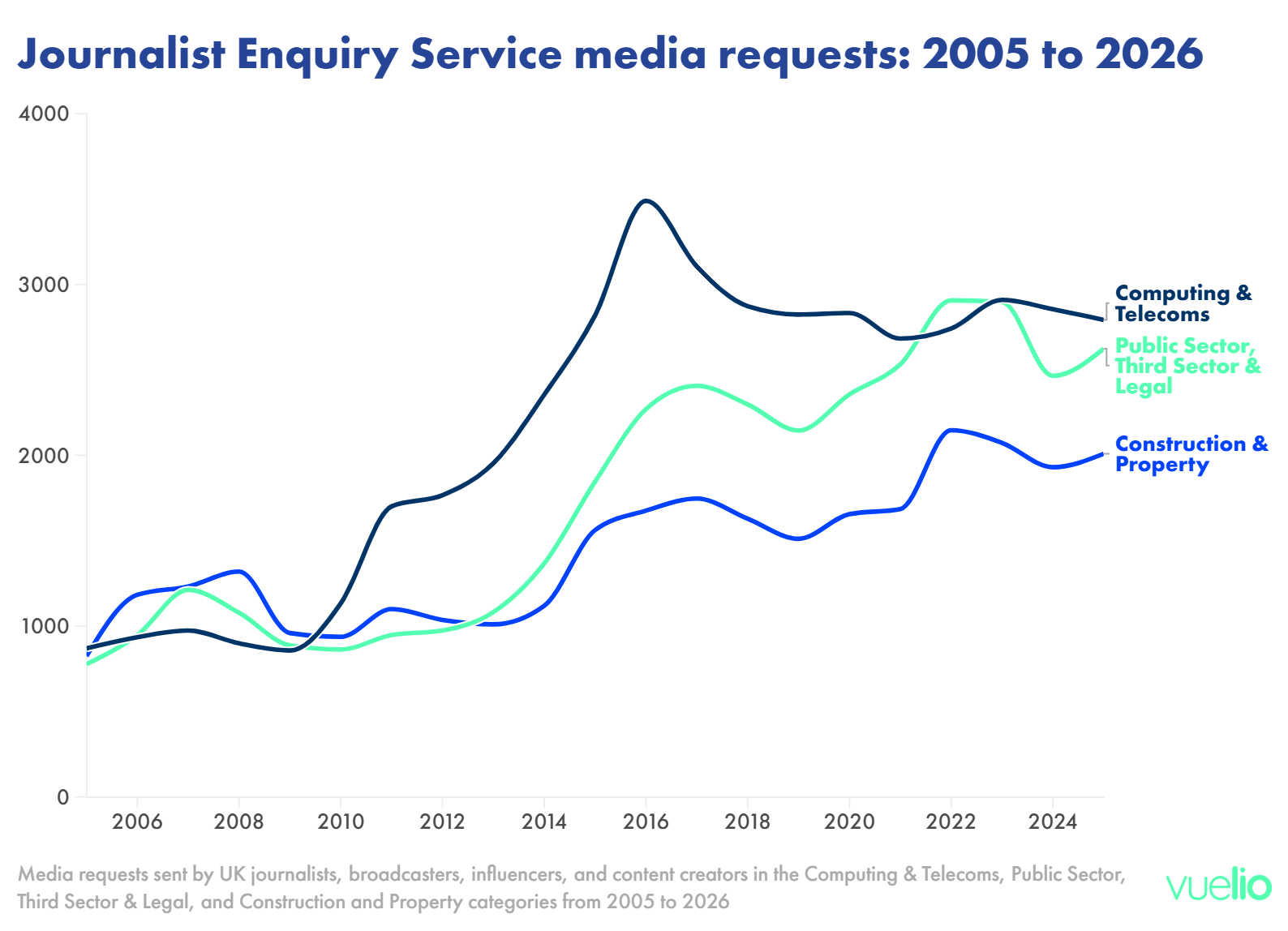
The Public Sector, Third Sector & Legal category is another traditionally smaller category for the Journalist Enquiry Service, but it’s seen a sustained increase in requests from the media since 2015 – unsurprising, considering the political uncertainty of Brexit in 2016, calls for Scottish Independence and several different changes of Prime Minister during the recent Conservative government.
The number of requests shot up from 1367 in 2014 to 2407 in 2017 – taking in the 2015 General Election and the 2016 Brexit Referendum, reflecting the massive focus from journalists on both the legal and public implications of leaving the EU.
Requests from journalists hit an all-time high of 2907 in 2022, coinciding with the Conservative government making multiple Prime Minister changes (Boris Johnson, Liz Truss, and Rishi Sunak) – journalists sought to cover the continued political instability, and the fallout around the cost-of-living crisis – something PR subscribers to the Journalist Enquiry Service were able to help with.
What does this mean for PRs now?
When political turmoil or constitutional shifts occur (like a new PM or a major policy pivot), PRs should focus on proactively pitching legal and public policy experts with clear, non-partisan analysis of how new legislation, devolved powers, or government restructuring will affect public services, the third sector, or regulatory environments. After an election or a major policy announcement (e.g. a post-Brexit trade deal, a new devolution package), the focus should shift to the mechanics and consequences of the policy. The number of journalist requests don’t just peak before a change, but also afterwards as the media covers the implementation and the ensuing legal and social challenges.
In terms of the opportunities for the Third Sector, the periods of crisis or public sector cuts ( often a consequence of political change), increase the media’s attention on charities and non-profit organisations. PRs working in this space should focus on data-driven stories demonstrating the impact of their work in filling gaps left by state services and advocating for policy change.
The social media boom and new technology
The development of technologies has been vast over the last twenty years and from 2005 until 2017, there was massive growth and journalists have made use of the Consumer Technology category with requests rocketing up from 903 to 4794. This coincided with the explosion of smartphones, social media platforms, and the app economy, and journalists were keen to cover all these changes. Since 2017, the number of requests has remained high, with the media tending to focus on general consumer gadgets and apps as they develop and evolve.
The Computing & Telecoms category has likewise seen a similar initial rise in requests from the media, hitting its peak in 2016 with 3490. This was largely driven by the development of modern communication infrastructures such as broadband, 4G, and cloud services. Another increase in journalist attention came in 2023 after the launch of the first major landmark in large language models (LLMs) – ChatGPT. AI has become one of the most consistent keywords on the Journalist Enquiry Service, but deep tech topics like quantum computing can also crop up in other categories such as Business & Finance and Manufacturing, Engineering & Energy.
What does this mean for PRs now?
Journalists that cover consumer technology, such as gadgets, are less likely to be looking for the technical specifications (which drove interest pre-2017) and are now more focused on the cultural, social, or personal impact of the technology. For instance, covering the ethics of a new social media feature, or how an app changes lifestyle, will resonate better than simply launching a new phone model.
PRs working in spaces such as AI and quantum computing may want to look beyond just the Computing & Telecoms category and also pitch to business journalists who will be looking at the commercial application, ROI, or national industrial strategy behind the technology. Most tech journalists working on trade outlets will know the technical complexity of new technologies and will instead be interested in covering the tangible, real-world benefits of what is being developed and launched.
The Journalist Enquiry Service in 2026: Even more ways to connect with the media
ResponseSource and Vuelio have always sought to support the comms and media industries with their unique challenges. This year, we’ve integrated media requests from the Journalist Enquiry Service into the Vuelio Media Database to enrich and expand opportunities for connection and collaboration.
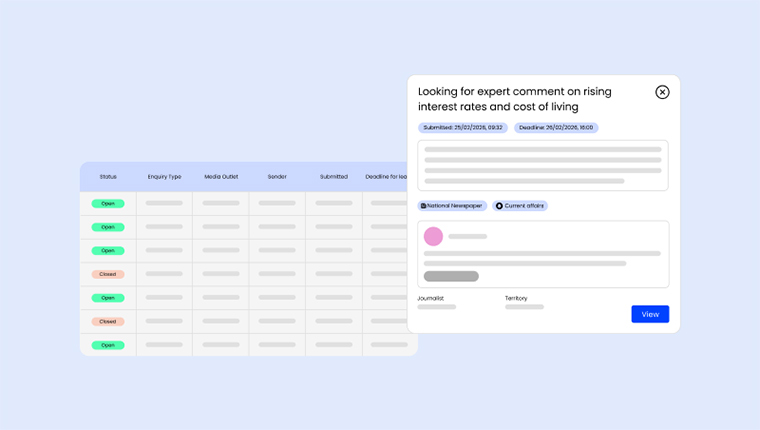
Embedding media requests into the Vuelio Media Database directly provides PRs a peek into newsrooms now, combining with insight into what is coming up months in the future from forward features lists.
As the media and comms industry evolves with the changing times, the Journalist Enquiry Service will continue to be here to connect them, and help with the big news stories of the future.
Find out more about the Journalist Enquiry Service here.


Leave a Comment