
The opportunities for PRs and comms professionals working with public service media
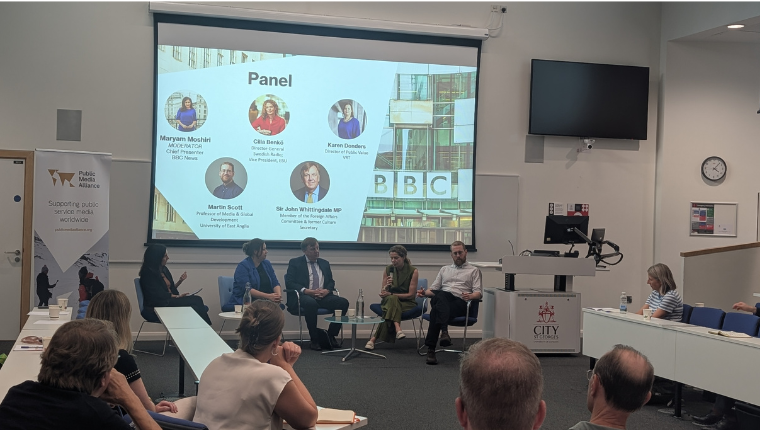
Public service media is under increasing pressure – both in terms of funding and in maintaining audiences. A recent event held in collaboration between the Public Media Alliance and Centre for Journalism and Democracy, covered how the industry can prove its continuing value to audiences and the public. Here is what this means for PRs and comms professionals when it comes to working with broadcast outlets.
The societal importance of public service media
Journalism and the media has always played an important role in society, and that’s still the case. Cilla Benkö, Director-General of Sveriges Radio, said that ‘77-80% of the population (of Sweden) claim we play a great role when it comes to value for society, and that has been even more intense since the full-scale invasion of Ukraine’. Karen Donders, Director of Public Value at VRT, added to this by saying that not only the public but politicians are seeing the value of it:
‘I also feel that the debate has shifted a bit away from what is the added value (of public service media) to what would we lose if we didn’t have it anymore. Information security is really important, where you have so much geopolitical pressure, and a dominance of big tech. Politicians, from left to right, feel that public service media is something that is very important for society’.
However, that doesn’t mean that changes aren’t necessary, with Karen going on to say that ‘in our coverage of public service media, we sometimes have to relate more to the agenda of average working class people in our society, because that is where a lot of frustration against public service media is coming from’.
What this means for PRs
During extraordinary events like pandemics and global conflicts, audiences turn to public service media for their news. One current challenge for the media is remaining relatable and connected to the communities they are covering. Journalists and broadcasters will be looking for personal case studies, especially around topical issues or current events.
Editorial independence and trust
Martin Scott, Professor of Media and Global Development at UEA, believes that maintaining editorial independence could become more difficult with the ‘likelihood of a far less democratic government appearing in our country’. He also explained what had happened to Voice of America in the US, stressing the need to ‘safeguard our public service broadcasters’.
Sir John Whittingdale, Conservative MP for Maldon and former Culture Secretary spoke specifically about the BBC, saying that currently ‘the BBC is seen to be independent, objective and factual, in a way that others aren’t, and that is a massive asset’. Sveriges Radio is also benefitting from audience trust. Cilla shared:
‘We are crucial as a counterweight to disinformation and propaganda within our own country, because we are the most trusted source of news in Sweden’.
What this means for PRs
Maintaining trust is crucial for broadcasters moving forward – to do this, they need information, statistics, and experts which are easily verifiable. A rise recently in fake experts making their way into the press means that journalists might look to do more checks than usual. Make sure you have your experts credentials ready to send over.
Challenges around funding
Major broadcasters in the UK are facing funding issues and having to make cuts – often to editorial staff. In the case of the BBC, Sir John said this is due to ‘another few 100,000 people deciding each year they don’t need to pay the license fee. This means the license fee has to go up, having been frozen for a time, but that probably will result in more people deciding they don’t want to pay for it any longer’. However, Martin said that it’s still in a good place compared to other countries:
‘Despite the current cuts, it is still head and shoulders above international broadcasters in France, Germany, and Spain in terms of its funding, reach, influence, prestige, and trust. It has this rare privileged position.’
The challenge, especially for the BBC, is proving value to the audience. It’s something Cilla and Sveriges Radio have already tried to address:
‘We started to get people to realise that they don’t even pay 10 pence a day for the entirety of Swedish radio. For that cost, they get four national frequencies and 25 local radio stations which broadcast 240 hours of local content every day. Plus high quality podcasts, and a symphony orchestra and a choir in a concert hall. After this, they were not so convinced that they were paying too much. It’s about how you argue your case to a broader public’.
What this means for PRs: With so many cuts and changes taking place, double check that any contacts you work closely with are still at the organisation you’re seeking coverage in. Budget costs also mean that broadcast opportunities are more likely to be a free opportunity for your client or expert. Considering the national and global coverage that these outlets have, they represent great opportunities for raising awareness.
Reach out to relevant contacts across the media industry with the Vuelio Media Database – find out more here.


Leave a Comment