
How the UK media are making use of technology to bring audiences back
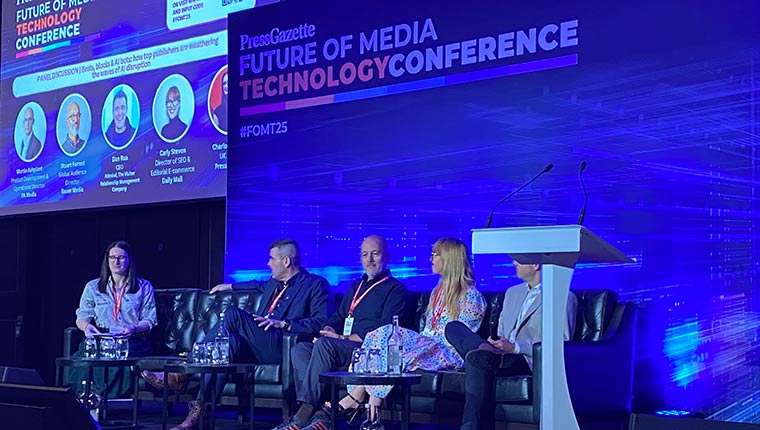
The evolution of AI has forced the comms industry to completely rethink its role in the media ecosystem, and journalism is facing the same conundrum.
For the challenges being faced in the media industry now, check out insight shared at this year’s Future of Media Technology Conference from Press Gazette, featuring speakers from PA Media, the Daily Mail, The Times, PinkNews, Bauer Media, and more…
A big problem for brands: AI’s impact on GEO and SEO
Many speakers throughout the conference referred to the devastating impact of LLMs on traffic previously picked up from Google Search. And Google was the focus of much consternation:
‘I’ve worked on the publisher side for about 20 years, before joining PA Media, and during that time, it was mostly seen that Google were the “good guys” among the frenemies that were out there, in the sense that our objectives were aligned,’ said Martin Ashplant, product development and operations director for PA Media.
‘Publishers wanted to get really good quality content out there. Google wanted really good quality content on the web, so that people came to the open web and didn’t go into closed systems. That’s clearly changed, and I think that’s been clearer and clearer over the last few years. And this isn’t just about AI. This is about how the Google interface has changed, and there is no longer that ability to rely on getting the click.’
Carly Steven, director of SEO and editorial e-commerce for the Daily Mail, explained the impact being seen at the brand:
‘There is obviously a huge period of disruption right now, massive changes related to AI overviews rolling out. Like a lot of publishers, we’re seeing the impact of that.
‘The reality is that when there are AI overviews for our keywords, the click-through rate goes down. I think we all know that nobody really clicks when there’s an AI overview present, and that impacts on traffic.
‘But, by the time an AI overview appears, that story has moved on and our readers aren’t searching for it anymore – its impacts are negligible. That doesn’t mean to say that it doesn’t matter. It absolutely does. But our brand is in a very fortunate position in that a significant portion of our traffic is direct, from branded searches. That makes us quite resilient in the face of these changes.’
Anna Sbuttoni, deputy head of digital for The Times and The Sunday Times, believes the early upheaval is finally settling down for publishers:
‘We have seen that Google Search referrals were fluctuating, but it is relatively steady right now.’
In fact, the benefits of SEO and GEO have been in flux for a while already, as Bauer Media’s Stuart Forrest, global audience director, explained:
‘Zero Click Search has been an issue for publishers for a long time. There was a website years ago called Celebrityheights.com, for example, that would tell you that Tom Cruise is five foot six. That site went out of business because you didn’t need to go there once Google would provide the answer. AI is just the next step of that.’
Caroline Fenner, chief revenue officer for PinkNews, agreed that this is just the latest step in a long-standing issue:
‘Everyone’s been reluctant to rely heavily on Google Search for a very long time now, because of the algorithm changes and how unreliable it’s been.
‘PinkNews is fortunate in that we get a lot of our traffic via socials. But, speaking to other publishers, it is a concern, and you need to look at other ways to generate traffic now. “Google zero” seems to be the new phrase being used. In case that happens, we’re constantly looking at new ways to drive traffic to our website. Likes, comments, shares, all sorts of stuff on social, the comments, dwell time, repeat users – we’re looking at ways to keep people within our ecosystem. That lends itself to WhatsApp groups, Facebook communities, and subreddits – it’s making sure there’s a safe space for the community to feel like they belong.’
Helping audiences find their community are platforms like Reddit:
‘Forums feed the algorithm in terms of SEO and AI results as well,’ said Tom Rolfe, director of publisher development at OpenWeb. ‘It’s going to be a great place for UGC [user generated content], but it’s not going to touch your content on site. It will be its own thing, almost like a subdomain for publishers. We’re really happy that forums like Reddit are being favored by Google and AI, because it’s providing an opportunity.’
For what else Google is ‘favouring’ these days, Daily Mail’s Carly asked for more transparency:
‘I think the biggest plea that we have to Google as publishers is to be able to see the data. We can’t track it properly, and we don’t get that information in our analytics tools. If we did, we could properly attribute the impact of AI on traffic. But right now that’s very, very difficult to see.’
Where in the ‘funnel’ can audiences be found now?
Where ‘top of funnel’ traffic – referrals from Google Search – has reduced drastically for many smaller publishers that won’t rack up ‘branded searches’ from audiences searching for the title or brand in question, Tom advocated a pivot to ‘mid-funnel’-focused strategies:
‘For a long time, publishers were very focused on “top of funnel” traffic – what we’d call ‘free traffic’. It’s a bit like a drug, you know, all this coming from nowhere. Now we’re having to shift that publisher mindset to ‘mid-funnel’ engagement. When the user hits the site, it’s figuring out what’s the value exchange for them? That’s something you can offer with community features – commenting, reaction tools, really focusing on keeping them there for as long as possible.’
The Times’ Anna spoke about their equivalent of the ‘mid-funnel’ – The Times app:
‘Commenting on our site is very much a subscriber privilege, and it’s being part of The Times’ community.’
Her fellow panelists admitted to reading the comments before the article when consuming news – a rising trend among wider audiences, too. In the same way PinkNews encourages community, The Times has grown this via their app – where commentary and feedback from readers is encouraged to continue engagement.
What can’t be replicated by AI?
Publishers are faced with the reality that much of their content can now be produced by AI, and potential readers are being directed to AI summaries instead of the content they’ve been trained on. Panelists spoke of the need to rethink priorities, and what journalists can do that AI can’t:
‘The Times has a 240-year history, and it’s something that we need to protect – the legacy and the authority that we have,’ said Anna.
‘It’s something that we talk about and enforce in the newsroom every day. When we’re talking about live coverage or story packages, we’re always thinking, what’s the exclusive? What have we got that’s original, that’s distinctively The Times that no one else has? How can we contribute to this conversation? How can people read, watch, or listen and understand what’s going on?
‘The next step for us is really putting our reporters at the core of what we do. How can we show our workings more, show that it is humans creating the content, and the hours, months, or years that can go into an investigation?
‘That’s something we’re exploring. Showing what we do as a way to bring people back, keep people in. For them to know that they can come to us’.
Martin at PA Media believes original content must in incentivised, for the good of publishers and LLMs: :
‘The worst case end point is we get to a place where there is no value in creating original content, because everything is being summarised. My call would be to invest in producing high quality journalism, original content, going out there and getting the stuff that isn’t yet there to be scraped. Because if you lose that, you lose the reason for people to go out and be creative.’
How the media is making use of data and metrics
Sheena Peirse, chief customer officer at Mediahuis Ireland, was firm on the importance of continual testing and improvement for publishers in the current landscape:
‘‘What you really see across the board – my team, the customer, subscriptions, the marketing team – is development, iterating. Test, learn, iterate. Use your data. Find out what works. Make it work. Move on.”
But which metrics can actually be trusted? David Goddard, SVP of business development, measurement and publisher solutions for DoubleVerify, highlighted the inherent issues with data-led strategies:
‘The problem with any metric is that they can be gamed. Thinking about attention, for example – is it engaged attention? Is it just a video playing at the corner of the screen? Is it somebody who’s actually watching the content? It’s really difficult to say for sure.’
Maintaining brand safety
Should alignment with ‘hard’ news be a big no-no for brands? No necessarily, believes Imogen Fox, global chief advertising officer for The Guardian:
‘We know that 96% of people read their news online in some form. So why on earth would you not want to put your brand near them? If you are – and I hate using this word – brave, you advertise next to the news. You do see good results.
‘People used to think that The Guardian is more famous for the advertising we don’t take than the advertising we do. It’s been our job as an ads team to say, actually, what we’re really good at is connecting brands with culture.’
But is the term ‘brand safety’ itself a blocker? David at DoubleVerify defined the issue in a different way:
‘I think the terms “brand safety” and “brand suitability” can be confused and intertwined. We can say in this room, news is 100% brand safe. There’s no brand safety issues with news. There are sensitivities to particular content, and publishers need to utilise tools to ensure that advertisers are avoiding the sensitive parts of news. There will be particular news subject matter that some brands will insist on avoiding. The rest of the news can be highly performant for advertisers.’
Should AI bots be blocked to ‘protect’ publishing?
Dan Rua, CEO of Admiral, The Visitor Relationship Management Company, believes AI bots should be blocked from training on content from publishers. He shared a clear message that the media industry should work together, using his experiences at Napster as an example:
‘AI is a scary disruption. But if navigated well, there’s opportunity. Copyright sets the guardrails of what is okay and what is not okay. Figuring out the value exchange that works for users is key. In the case of music copyright, there was an industry solidarity – music labels were on the same page of what needed to happen. They weren’t really bickering with each other about how to tackle it – ultimately, they got together and made a difference.
‘I think step one here is blocking the bots. Doesn’t mean in the future you might not find more creative ways to work in the whole ecosystem.’
Carly disagreed – referring to the Daily Mail’s collaboration with AI companies, and other publishers’ deals to allow AI training:
‘I don’t think it’s helpful to malign the bots, because if you do, that leads to a kind of arms race of evasion and detection, where publishers are constantly spending on protection, bots are constantly spending to improve evasion, and actually, the only people who win that scenario are the tech companies.’
Martin at PA Media was also open to the possibilities AI could provide to publishing and big brands:
‘Despite the kind of negativity that we’ve been talking about today, I’m actually really bullish about AI – I think it presents a real opportunity.
‘We will start to see a premium placed on human-generated content as it becomes harder and harder to wade through “AI slop”. Having humans involved will become the big point of difference.’
Director of FT Strategies Adriana Whiteley offered practical advice to all content creators seeking audiences now:
‘Focus on niche content that directly meets your user needs, and do that while you have an audience. After you’ve lost your audience, it’s going to be much harder to take it back. We have a window of opportunity to work on those areas and understand what people want. Create a specific product. Make the products richer – increase that stickiness in what you offer.’
For more on how the media industry is connecting with audiences now, check out insight shared during our Seeking Audiences: Journalism in the Platform Era event with speakers from BBC News, ITV, LSE, and more.


Leave a Comment