
The Legislative Look ahead from Total Politics and Vuelio
With the country readying itself for a new devolution framework, what changes are coming up in justice, healthcare, and education? And what do public affairs and comms professionals need to work into their strategy for the year ahead?
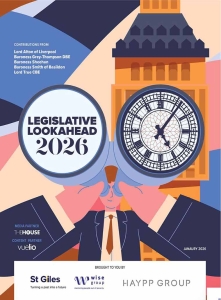
Total Politics has published its Legislative Lookahead for 2026, featuring insight from a number of Vuelio’s own in-house political researchers and analysts, alongside a mix of political peers and experts including Baroness Smith of Basildon, Lord True CBE, Baroness Grey-Thompson DBE, Baroness Sheehan, Haypp Group, and St Giles Wise.
For the full look, download the ebook here, or read on for lessons from the key milestones, committee inquiries, and bill stages coming up throughout the 2026 parliamentary session.
Pressures to deliver
The parliamentary calendar for 2026 is defined by a Government under pressure to show results. As the ‘year of delivery’ gathers pace, the volume of legislation is expected to intensify, creating a crowded marketplace for attention. Jennifer Prescott, Political Analyst at Vuelio, notes that this shift requires a more forensic approach to monitoring.
‘The government’s primary focus is now on the tangible implementation of its missions,’ Prescott explains.
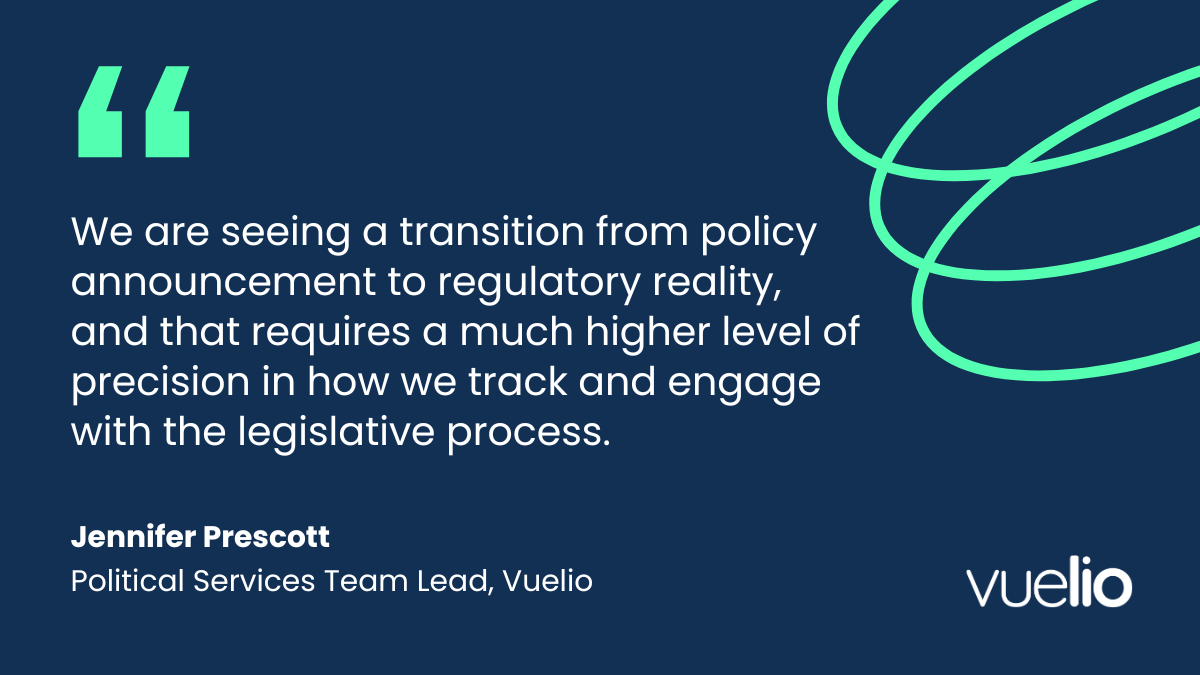
‘For those in communications, this means moving beyond broad political trends and focusing on the specific mechanics of upcoming Bills. We are seeing a transition from policy announcement to regulatory reality, and that requires a much higher level of precision in how we track and engage with the legislative process.’
This sentiment is echoed by Ingrid Marin, who highlighted the sheer volume of activity within the various government departments:
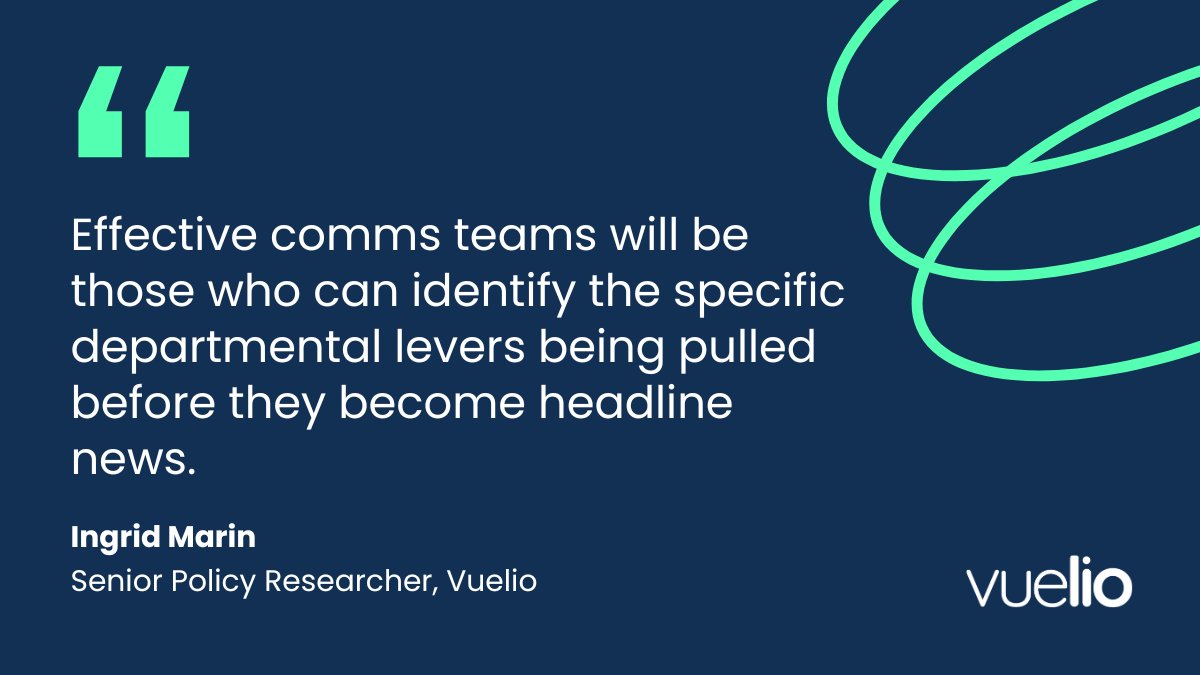
‘With so many departments pushing through primary legislation simultaneously, there is a real danger of legislative noise where key impacts are missed,’ Marin warns. ‘Effective comms teams will be those who can identify the specific departmental levers being pulled before they become headline news.’
The ethics of influence
One of the most significant hurdles for the Government’s 2026 agenda lies in the House of Lords. With a heavy legislative programme and a series of high-profile constitutional reforms on the horizon, the upper chamber is set to become a primary site of scrutiny. For PR professionals, this means the corridors of power extend far beyond the Commons.
‘The House of Lords will act as a critical checkpoint for the Government this year,” advises Aidan Stansbury.
‘We expect to see significant debate around the constitutional role of Peers, but more importantly, their work in the committee rooms will be where the technical details of regulation are hammered out. Communications strategies must account for this slower, more deliberate phase of the legislative cycle.’
Parallel to this is a heightened focus on transparency and the ‘duty of candour.’ Billy Barham suggests that the ethical landscape of influence is shifting:
‘There is an increasing expectation for transparency, not just in lobbying but in the broader relationship between the public and private sectors,’ says Barham.
‘Legislation like the proposed Hillsborough Law or changes to human rights frameworks will place a new premium on corporate accountability. Communicators need to be ahead of this curve, ensuring their organisations aren’t just compliant with the law, but aligned with the evolving expectations of public integrity.’
Politics beyond Westminster
The 2026 local elections are set to provide a significant test of the political mood throughout the country. For brands and organisations, the bubble of Westminster can often obscure the reality of how policy is being received in the regions.
The interplay between national policy and local delivery is where reputations are often won or lost:
‘The 2026 local elections will serve as a mid-term referendum on the government’s success,’ says Laura Fitzgerald.
‘For comms professionals, it’s vital to understand how national legislative themes (such as housing, transport, and net-zero) are playing out at a community level. The rise of smaller parties and shifting voter priorities means that a ‘one size fits all’ national message is increasingly insufficient.’
This local dimension is particularly acute when it comes to the delivery of public services.
‘We are looking at a year where local authorities are under immense financial pressure while being tasked with delivering on national mandates,’ adds Ellie Farrow.
‘The friction between central government ambition and local government capacity will be a major story in 2026. Communicators must be prepared to navigate these tensions, particularly when their sectors rely on local partnerships or planning.’
What this means for comms and Public Affairs
The legislative agenda is the blueprint for future press cycles, and for PR and PA, foresight is vital for effective crisis management and prevention.
By aligning communication strategies with the milestones ahead, teams can move from reacting to the news to shaping the narrative around the laws that will define the next decade. Understanding the implications of legislation for stakeholders, and communicating value, will be vital for the year ahead.
Read the full ebook from Total Politics here, and learn more about Vuelio’s full Political proposition.


Leave a Comment