
Why Do Different LLMs Say Different Things About Your Brand? (And How Comms Teams Can Take Control of the Narrative)

Ask ChatGPT what your company does best, then ask Perplexity, then Gemini, then Claude. If you have never tried this before, brace yourself: these LLMs won’t deliver four identical answers. Instead, each will provide a different narrative, drawn from a different combination of sources, shaped by each model’s idea of what matters about your organisation.
For years, brand reputation management meant controlling what showed up on page one of Google and landing coverage in the right titles. While that work still matters, those forming opinions about your organisation now are less and less likely to be scrolling search results, and increasingly likely to be asking an AI assistant directly, taking its answer at face value.
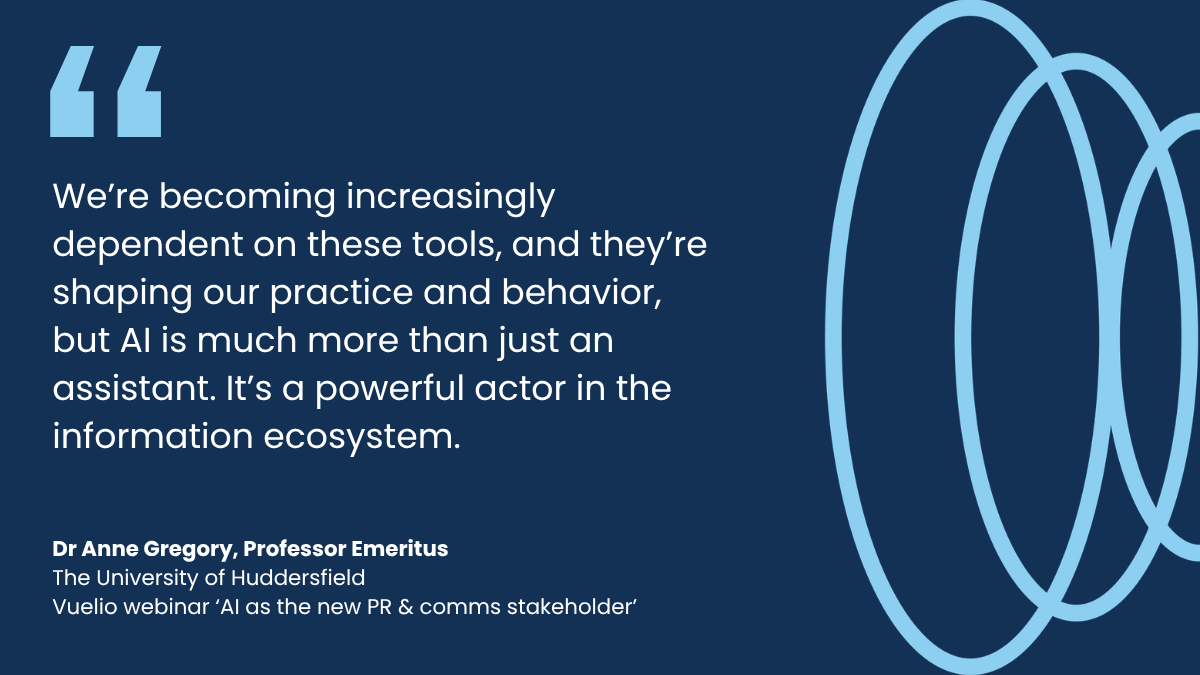
Generative Engine Optimisation (GEO) is becoming as important to comms teams as SEO ever was.
There’s one crucial distinction, however. As Purposeful Relations’ Stuart Bruce shared at our recent event ‘How AI is changing the way we communicate’, SEO was an instance of a power channel and mechanic – that might have been expected to sit beneath certain comms functions, at least in part – ultimately belonging entirely to a different part of the business. It is not yet clear which function in an organisation will ‘own’ GEO’; perhaps, given the pervasiveness of the tech, the answer is everyone.
Either way, understanding why models disagree about your organisation is the first step to making sure that what they are sharing about you is the story you want to be told.
The New Reality of Brand Perception in the AI Era
Stakeholders, journalists, and prospective clients are increasingly skipping the click-through altogether, and instead simply asking an AI assistant to summarise who you are, what you are known for, and who your competitors are, and then acting on whatever answer they’re given.
That would be manageable if every model gave a consistent answer… but they don’t. This can fragment your narrative exactly where you have the least control. If Claude surfaces a crisis from five years ago, while ChatGPT is citing your most recent earnings report, stakeholders forming a first impression of your organisation are working from two different stories, and both of them could be sourced from something your team didn’t write or sanction.
The 5 Reasons LLMs Diverge on Your Organisation
Models don’t disagree at random. Each divergence has a mechanical cause, and understanding it is what makes the problem solvable rather than just frustrating.
1. Different RAG and real-time search sources
Most modern LLMs don’t rely purely on pre-trained memory, but search live web indexes. Gemini leans on Google-indexed news and content; Perplexity draws heavily on Reddit, Wikipedia, and niche industry forums; and ChatGPT relies substantially on Bing’s index (given the financing and ownership role of Microsoft). If your PR strategy only targets traditional financial media, for example, you might dominate the narrative on one model, while disappearing, or being mischaracterised, on another that is pulling from consumer forums and social discussion instead.
2. Training cutoff dates and fine-tuning data mixes
Base models are trained on web snapshots taken at specific points in time. A model without live search (i.e. Claude or Deepseek) switched on may still be describing your organisation through the lens of a merger, rebrand, or crisis that has long since been resolved. Although it should be noted that even models with the mechanic enabled often won’t utilise it as part of their retrieval unless they land on a clear reason to. This kind of historical narrative lag can keep echoing an outdated version of a narrative.
3. Authority and citation weighting
LLMs assess source trust differently, weighing citations, structured data, and domain authority. Wikipedia, and Wikidata entries, as examples, are central to this. If a competitor has a clean Wikidata presence and citations from high-authority domains, models will associate them with the keywords that matter faster than a brand that’s relying on marketing copy alone.
4. Model architecture and safety alignment
System prompts, temperature settings, and the reinforcement learning each vendor applies post-training all shape tone and emphasis. Claude tends to be more cautious and caveat-heavy, often surfacing risk alongside reward. Gemini leans into consumer and Google-ecosystem data. ChatGPT tends to synthesise a broad sweep of top web summaries. The same facts are presented with very different tones depending on a searcher’s LLM of choice.
5. Prompt context and user intent
Even the way a question is framed changes the answer.
‘Is [organisation X] reliable?’ and ‘Compare [organisation X] to [Competitor]’ pull from different sub-vectors of a model’s embedding space. This means two stakeholders asking about the same company, in slightly different ways, can walk away with meaningfully different impressions.
How to Audit and Align Your AI Footprint
None of this means AI narratives are beyond influence. Inputs must be managed with the same rigour comms teams already apply to press coverage. Indeed, coverage itself is one of the strongest shaping forces.
Start by mapping your AI source footprint: work out which outlets, review sites, and publications are actually being cited when each major model discusses your organisation. From there, the shift from SEO to GEO means writing press releases and corporate updates with clear entity-attribute statements — plain, factual descriptions of who you are and what you do, rather than flourishes and adjectives that a model has no structured way to parse.
It also means making sure your strongest media placements land in outlets that LLMs actually index and cite, not just the ones with the biggest print circulation (don’t forget tier 2 and trade titles — LLMs are proven to value them). And where a model is clearly pulling outdated or negative information from an obscure forum or a stale article, the fix is to out-publish it: build fresh, authoritative citations in high-weight outlets until the newer, more accurate narrative is what gets surfaced.
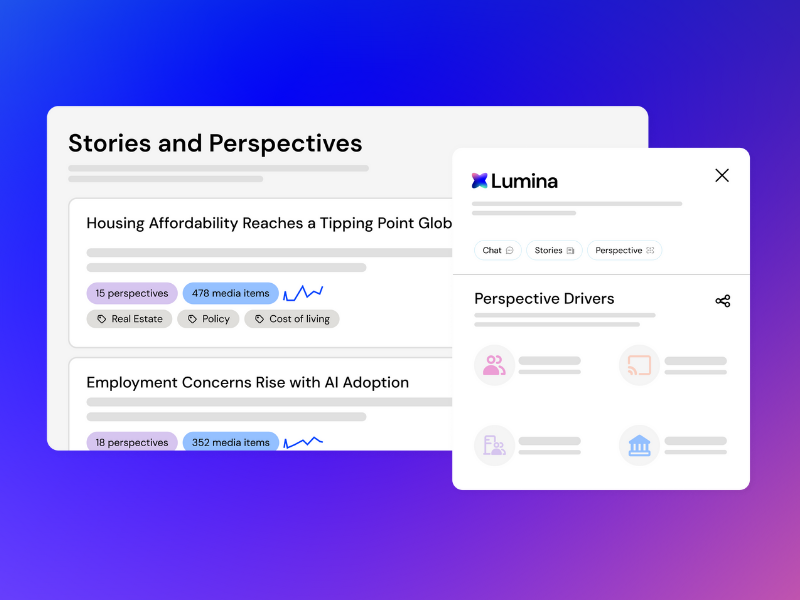
Monitor what LLMs are saying to control your story
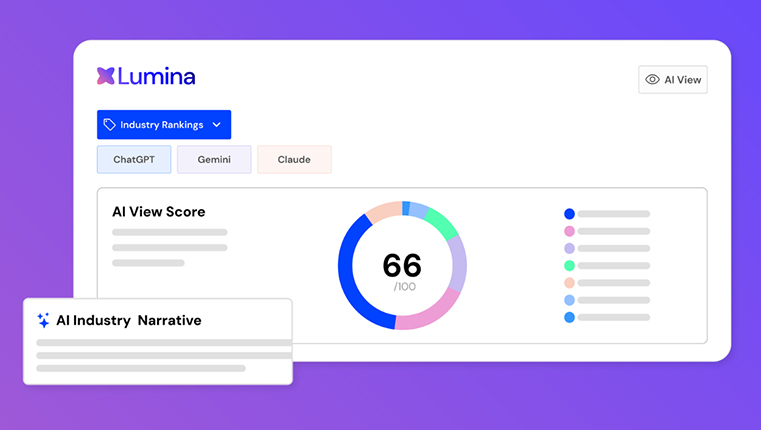
Lumina, our intelligent AI suite built for modern PR and comms teams, is designed to evolve traditional media monitoring into genuine narrative intelligence for the AI age. Lumina AI View is built specifically to track what tools like ChatGPT, Gemini, and Claude are saying about your organisation, which sources are shaping those answers, and how your AI citation footprint stacks up against that of your competitors.
Lumina AI View gives comms teams three things they currently have almost no visibility into: citation source tracking, so you can see exactly which outlets are driving your narrative across each model; competitive AI benchmarking, so you can compare your citation strength and share-of-voice against industry peers; and narrative shift detection, so you get an early warning when citation patterns move because of breaking news or a shift in sentiment, before it becomes a bigger problem.
LLMs usher in a major change in the comms space, but PR & comms teams are far from powerless. In fact, through the quality, authority, and distribution of the sources feeding it, they can have a massively meaningful impact on the organisation or business in question.
Get in touch to register your interest and see what Lumina AI View can do for your organisation’s AI visibility today.


Leave a Comment