
Is earned media the solution for comms in the age of AI Answers?

Artificial intelligence has evolved from an experimental tech-stack tool to become a vital part of the fabric of daily reality for public relations. Alongside pitching stories for human-made editorial calendars, comms practitioners are navigating a deeply fragmented media ecosystem where generative engines like Large Language Models (LLMs) fundamentally alter how information is created, distributed, and consumed.
For years, the PR industry measured success by the strength of a clipping or the positioning of a link on a Google Search results page. Today, the interface between brands and audiences has changed. The fast rise of agentic browsers and AI companions that summarise the web has boosted media intelligence from a supporting function to a mission-critical part of the comms infrastructure.
To survive in this new reality, communication teams must understand the new role of earned media; the primary fuel powering the AI answer engines that shape brand reputation.
How generative engines are rewriting the search playbook
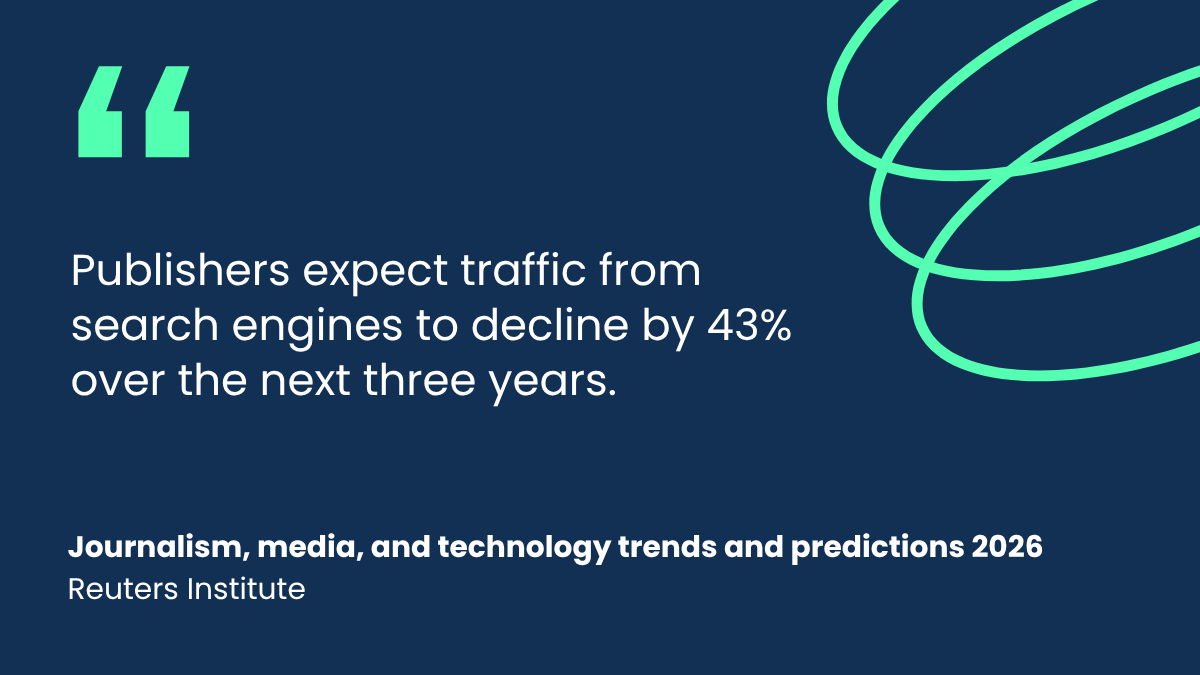
The traditional digital marketing funnel is facing an existential crunch. According to Nic Newman’s ‘Journalism, media, and technology trends and predictions 2026‘ report for the Reuters Institute, publishers expect traffic from search engines to decline by 43% over the next three years. This sharp downturn follows recent dramatic declines in referrals from social media platforms. The culprit at the centre of this disruption? Google’s AI Overviews.
Now appearing at the top of roughly 10% of search results in the United States and rolling out globally, these AI summaries have driven a massive surge in zero-click searches — scenarios where users get their answers directly on the search page without ever clicking through to a corporate website or news source.
This shift is heavily driven by changing consumer behaviours. Data from a January 2026 study ‘Navigating the Shift: A Comparative Analysis of Web Search and Generative AI Response Generation‘ highlights that Google’s AI Overviews now reach 2 billion monthly users across 200 countries, with referral traffic from AI platforms growing by 357% year-over-year. Crucially, the way people search has evolved: 57.9% of searches triggering AI Overviews are now phrased as full questions, and queries of eight words or longer have a 57% probability of generating an AI-synthesised response rather than a traditional list of blue links.
These platforms do not return ranked document lists but synthesise answers, reason over retrieved evidence, and selectively cite sources they judge to be authoritative. And what these engines consider authoritative is, increasingly, earned media.
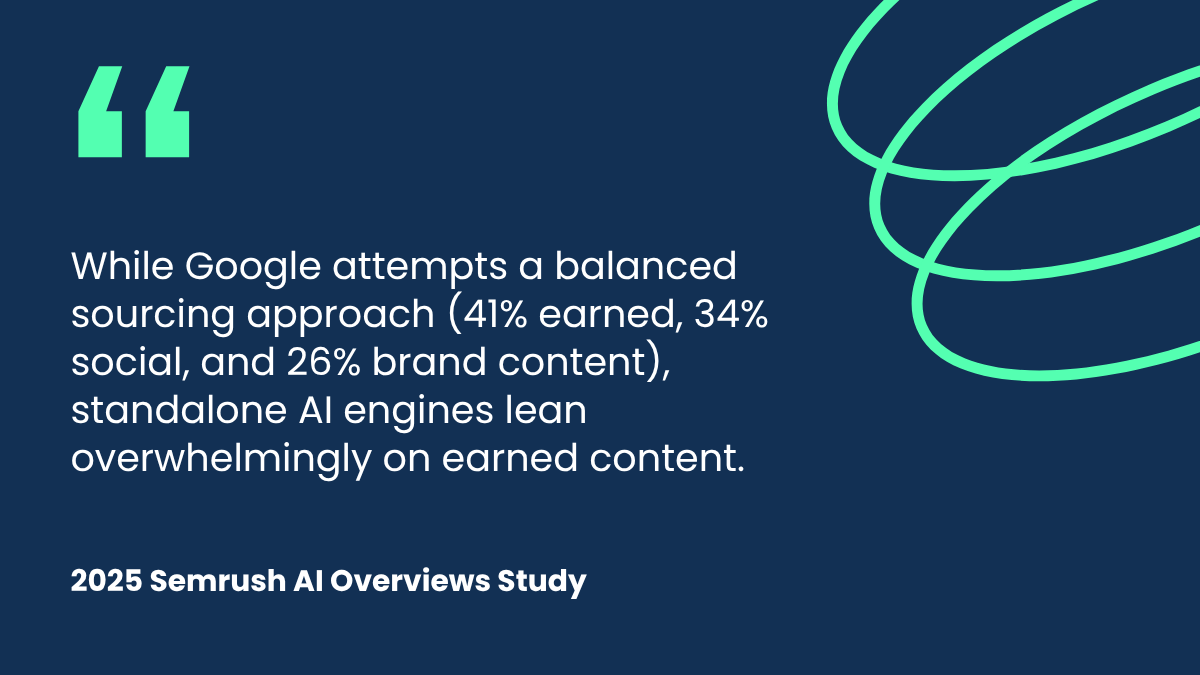
A 2025 Semrush AI Overviews Study revealed that while Google attempts a balanced sourcing approach (41% earned, 34% social, and 26% brand content), standalone AI engines lean overwhelmingly on earned content. Anthropic’s Claude concentrates most heavily on earned media at 65% (and a mere 1% on social), followed by OpenAI’s GPT-4o at 57% earned media.
To highlight this trend further, Gartner’s ‘Top Predictions to Inform 2026 Comms Strategies‘ and Purposeful Relations’ ‘The Impact of Generative Relations and Communications‘ reports both validate that AI search engines heavily favour citing earned, shared, and organic owned content over paid channels. More than 95% of links cited within these platforms are non-paid mentions, with earned media accounting for 89% of those citations. Journalistic content alone accounts for 27% of citations, skyrocketing to 49% for queries requiring real-time, recent information.
Ultimately, LLMs rely on the credibility that traditional PR has spent decades cultivating. However, simply securing a mention is no longer enough. As Nicole Yost, Director of Communications and Corporate Affairs at the British Heart Foundation (BHF) pointed out during Vuelio’s recent in-person event ‘How AI is changing the way we communicate‘, the challenge has evolved. Managing communications for a major healthcare charity means navigating an environment where AI is used not just to draft messaging, but to predict trends and actively counter misinformation. Nicole observes:
‘Various studies have shown that AI is using earned media for its content. But how do you differentiate and cut through the noise, is the question. Earned media is having a moment. I was talking to some colleagues earlier, and they’re saying it’s everywhere, all over LinkedIn, it’s “PRs’ time” and all that. But, only if you can cut through the noise, be really trusted and credible, are you going to have an impact on your brand.’

Making your earned media count for LLMs
While the data paints a glowing picture for the resurgence of PR, communications teams must avoid treating these statistics as a one-size-fits-all victory. Context, nuance, and strategy matter more than raw volume.
Stuart Bruce, PR Futurist and Co-founder of Purposeful Relations — a management consultancy specialising in advising in-house comms teams, international bodies like the OECD, and charities on AI adoption — urges a grounded perspective.
Reflecting on the sudden flood of vendor reports, Stuart notes:
‘All these reports that have been coming out say that LLMs favour earned media in terms of where they get information from, and where they put their citations. That’s partially true.
‘Our white paper analysed the multitude of reports that have been published throughout the year (anybody that’s selling an LLM tool published a report to justify them to marketing). One said that 95% of LLM citations are from earned media. Another one said 43%. And yes, the importance of earned media is absolutely on the rise, but it’s really important to realise it’s not the only one, and it is very different between different sectors.’
To make earned media truly count within AI summaries, communications strategies must move past old-school broad message distribution. The focus must pivot toward building earned proof, shaping the credible, factual raw material that both human audiences and intelligent machine agents use to determine who is genuinely trustworthy.
A strategic roadmap for modern PR: Treating AI as a stakeholder
If LLMs are actively mediating how the public understands your organisation or your clients, you can no longer treat them as neutral tech tools; they are actually a brand-new audience. Stuart suggests a distinct shift in how teams approach Generative Engine Optimisation (GEO), breaking it down into three flexible, strategic pillars tailored to organisational needs:
1. Build an AI Stakeholder Map
‘The first thing you need to do is to actually understand the space,’ Stuart advises. ‘We describe AI as a stakeholder, because we wouldn’t start trying to influence stakeholders until we fully understand them.
‘Do you have your stakeholder map? Trying to create that is actually really difficult when it comes to LLMs, because there are several of them, and then they’re all going to be saying different things.’
Comms teams must map which models their audiences use and audit how their brand currently surfaces across different engines.
2. Constant recency and the power of niche media
LLMs possess vast amounts of historical data within their static models, but when a user asks a time-sensitive question, the engine must look outward for real-time information. ‘So, if you want to influence what’s not in the model, they’re going to be looking for really up-to-date, recent information — you’re constantly feeding the beast and making sure that your information out there is recent,’ says Stuart.
This will markedly change media targeting strategy:
‘The second thing to consider is, what does that mean? Does that include your website? That might mean just refreshing a page, updating a page, but also things like labelling if a page has out-of-date information. AI needs to be taught that. It needs to understand relevance, and that’s basically where earned media comes in. It’s not necessarily going to be your tier-one titles. It could actually be small, niche titles. It could be trade press. It could be expert blogs. And that’s because LLMs know that’s a specialist source, this is going to be where to find reliable information.’
3. Establish multiple touchpoints for reputation
An isolated piece of coverage will no longer be effective on its own. AI models look for cross-referenced consistency across the web to validate a claim. Stuart provides a practical example:
‘You might have a spokesperson featured in the Daily Mail, but if that’s the only reference to them, AI is not necessarily going to consider them a credible spokesperson. If they were available on your website, if their LinkedIn profile constantly talks about the same thing, if they’ve spoken at conferences, if they’re in earned media, they instantly become a credible source. You’ve got to have those multiple touchpoints.’
Shifting trust: When audiences believe AI over brands
The urgency of this strategic pivot becomes clearer when considering how rapidly public trust is transitioning. During a recent Vuelio webinar ‘AI as the new PR & comms stakeholder‘, Dr Anne Gregory — Professor Emeritus of Corporate Communication at the University of Huddersfield and a leading international researcher who has directed the Global Capability Framework — highlighted how deeply this machine mediation influences public perception:
‘AI is much more than just an assistant; it is a powerful actor in the information ecosystem.
‘It mediates our engagement with organisations and individuals, and evidence is emerging that AI is often believed more than other traditional sources.’
This observation is backed by hard data. Purposeful Relations’ report, in partnership with 72Point, surveyed 5,000 UK adults to uncover modern attitudes toward media, news, and generative tech. The findings regarding trust were eye-opening: While scientists and technical experts predictably ranked highest at 80%, AI answers achieved a 44% trust rating.
‘So 44% of people trust that LLM answer: they’re not necessarily going to go to your website,’ Stuart noted.
This creates a reputational hazard if your infrastructure is lagging. Dr Anne issued a stark warning for teams slow to adapt to this shift:
‘Even though we know these summaries are often incomplete and biased, we tend to believe them. If we don’t regard AI as an influential stakeholder, we could be putting ourselves in jeopardy.’
The new toolkit for AI visibility
To transition from traditional communicators into central corporate strategists who manage reputation in this new climate, PR professionals need tools built specifically for their workflows. They cannot rely on legacy search engine tools designed purely for digital marketing or paid media.
‘Vuelio is launching something soon, which will be another tool that will help you to understand that,’ revealed Stuart during our latest event.
‘The tools that are coming from the PR space are a lot more useful to PR people than some of the ones that are coming from the digital marketing and the search space. They understand the pressures, the trends, the type of information that we need to know.’
This targeted innovation underpins Vuelio, providing an AI Visibility solution that’s specifically geared towards PR & Comms.
Lumina AI View helps you understand what AI knows about you, and where it learned it from. By tracking the sources that models such as Gemini, ChatGPT and Claude cite when representing you, it reveals where you stand — and how to impact this.
The battleground for brand relevance has officially shifted. By ensuring your earned media strategy is continuous, highly credible, and verified across multiple digital touchpoints, you can ensure your organisation, and the clients you work with, are not just indexed by the algorithms, but trusted by them.
Find out more about Vuelio’s Lumina solutions here.


Leave a Comment