
Factoring AI, fragmentation, and uncertainty into your comms strategy
With AI now integrated into the very fabric of the media and informational landscape, the rules of PR and corporate communications are being rewritten. But are traditional PR skills a thing of the past?
To unpack what is changing in comms and what will endure in this AI-enabled era, Vuelio hosted an expert panel discussion.
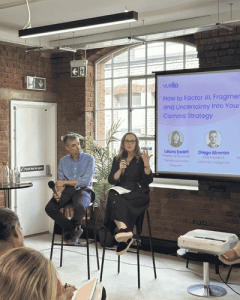
‘How to Factor AI, Fragmentation, and Uncertainty Into Your Comms Strategy’, hosted by Vuelio’s Head of Content Marketing Alex Bryson, brought together three industry leaders, each offering a distinct perspective on the evolving requirements of the profession. Pearson‘s Director of Financial Communications Laura Ewart, who brings 20 years of experience in financial, corporate, and executive communications, provided a practitioner’s lens on the pressures of modern, high-stakes environments. Diego Bironzo, a Vice President at Edelman Intelligence, offered deep experience in navigating reputation management and trust in the wake of crises, providing a strategic view on how brands can maintain authority in an AI-mediated world. Representing the measurement and intelligence side, Amy Chappell, Head of Insights Strategy at Vuelio, joined the conversation to share findings from our curated media analysis and observations from her breadth of experience in the PR and media landscape.
Is AI an accelerant, rather than a paradigm shift?
While AI is often discussed as a revolutionary force, the panel noted that its primary immediate impact has been to intensify existing trends.
‘My view is that AI, at least at the moment, is not so much a paradigm change when it comes to comms, but an accelerant,’ said Diego.
‘This technology has accelerated some of the shifts we’ve been seeing for a number of years as digital became more prominent… including speeding up story cycles and fragmenting audiences. As a result, increasingly, we’re also seeing the effects of “context collapse”: the messages that, for my grandparents’ generation, would have been mediated by mass media, now are appearing completely unmediated, distributed across platforms to various audiences, traveling in unexpected ways.’
Amy explored how AI is changing the way people access information and form opinions about organisations. While reputation has always been influenced by a mix of media coverage, expert commentary, and stakeholder discussion, AI platforms are increasingly becoming another route through which people discover and evaluate information.
Amy examined the role of AI and LLMs as a mediator for messaging and the news cycle:
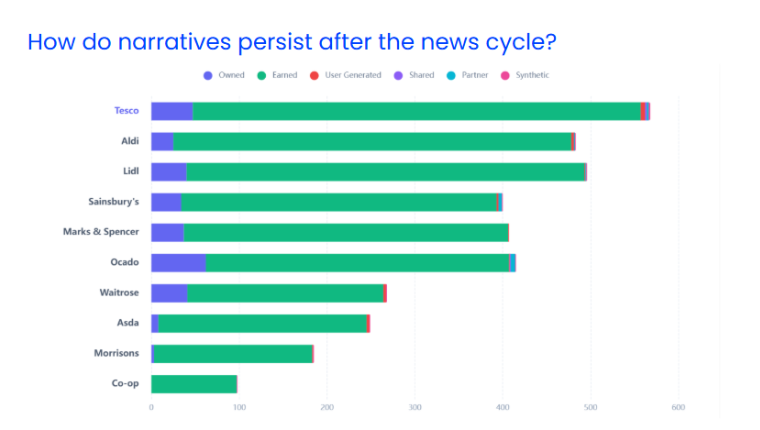
‘Using Vuelio’s AI View tool, it’s possible to look into citations of organisations mentioned across the major LLM platforms. In this example, one thing that stands out is the different sources that are feeding the LLMs – earned media overwhelmingly dominates AI citations.
‘AI and LLM platforms, seemingly, at least in this sector, aren’t just looking for the most recent coverage. In this example, we found that LLMs weren’t looking for the most recent; it was a combination. A crisis that happens one week doesn’t automatically affect how LLMs cite organisations the next.’
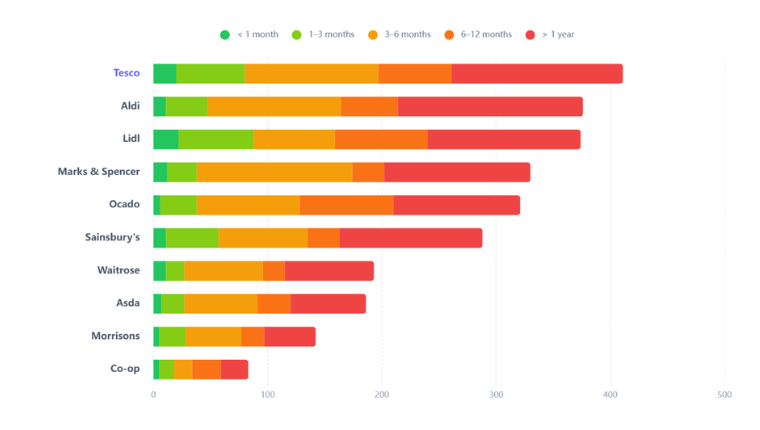
Amy found that the sources feeding into the supermarket citations were mainly trade titles – The Grocer, the Grocery Gazette, for example. For each new story, or campaign, traditional ‘Tier 1’ titles aren’t automatically going to be the first port of call for LLMs.
‘Clear messaging and spokespeople are still so important to have. So, if Tesco or Sainsbury’s continue to target those types of publications that are feeding the LLMs at the moment, that may have a positive impact on their reputation in the future.’
The emergence of AI as a stakeholder
One of the most significant shifts identified by a growing number of PR practitioners is AI’s active participation in the information ecosystem as a stakeholder.
‘Increasingly, what we’re seeing is AI ultimately being another audience,’ said Amy. ‘In terms of what LLMs are serving about organisations, it’s almost another consumer base.’
Diego expanded on the implications for brand management: ‘I like the idea of treating AI as an additional audience, a stakeholder, because LLMs play a role in mediating your message, adding a layer of interpretation before your content is served up to audiences. As a consequence, perceptions can be shaped from a number of different signals, and these are increasingly harder to keep control of.’
But this doesn’t just have an impact on brand reputation – Laura emphasised the financial implications:
‘AI is an audience as well as a tool, especially in financial comms, where investors are using AI to synthesise lots of data. You’ve also got AI bots, which are automatically trading without humans in the loop – so you need to think of it as an audience when you’re putting your press releases and your content together.’
The strategic necessity of human authenticity
As AI platforms become central to how information is served, the demand for high-quality, authentic human content has increased. When audiences and algorithms alike are flooded with synthetic noise, trust becomes a primary differentiator.
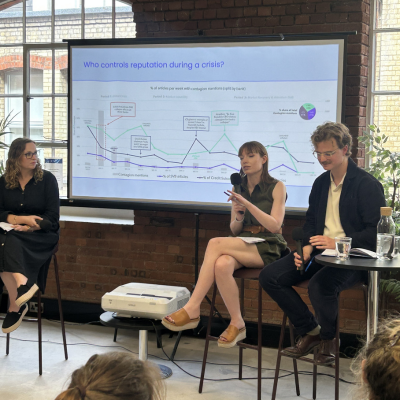
‘Over the past year, there has been a growing expectation upon PRs to use AI in their everyday comms, but it’s not just about knowing how to prompt an AI, it’s also about how to use your critical thinking and judgment to know how and why you’re going to be using AI,’ Laura said.
Where critical thinking is needed, and PRs luckily have this in their wheelhouse already, is in channel selection.
‘For actually getting cut through, we’re finding the best things to do are op-eds, comment pieces, and podcasts. People are looking for voices they can trust and which they feel are authentic, and I think that’s why we’ve seen the rise of the podcast.’
Diego echoed this focus on the human element, noting that earned media has become ‘more relevant than ever’ because of the way it feeds into AI search and interpretation:
‘Increasingly, an authentic and culturally relevant message is becoming more and more important, and that’s the kind of content that people are going to want to see. It needs to be both informed by data and insights as well as have that “human in the loop” touch for authenticity and empathy.’
Practical Integration
As organisations look to position themselves within this new infrastructure, the panel stressed the importance of factoring Generative Engine Optimisation (GEO) into strategies.
Regarding how to appear in AI search results, Laura advised a long-term approach:
‘Think about how you can tailor your content to adjust for AI search – there’s lots of different tips and tricks that we’re learning as we go along. For example, LLMs draw from FAQs a lot, so that’s something to think about for website content.’
Diego added that this requires consistent monitoring:
‘People are at the stage of establishing a baseline of where they appear in searches on GEO, being mindful of the fact that answer engines are highly dynamic and constantly changing. It’s important to start understanding what is the baseline, what behaviors and sources shape answers, and think about how it impacts strategy, how we can start to feed the right type of content to LLMs.’
The Future of the Profession
Ultimately, the consensus among the panelists was that AI will not replace the PR professional, but rather demand a more sophisticated, intelligence-led approach to strategy.
Amy summarised the outlook:
‘I’m a big advocate in thinking that AI has actually increased and enhanced the role of the PR. Human skills are going to be increasingly important. It’s still about trust, so getting out there, meeting with journalists, and building relationships with them will continue to be really key.’
As the industry moves through these stages of maturity, from narrative stewardship to influence intelligence, successful comms teams will be those that treat AI as a central stakeholder, prioritise evidence-led communication, and double down on the human connection that algorithms cannot replicate (for now…).
Find out how LLMs are representing your brand and clients in their answers with Vuelio’s AI View.
For more on how AI is changing the way we communicate, check out key insights from our previous Vuelio panel event with Purposeful Relations’ Stuart Bruce, the British Heart Foundation’s Nicole Yost, and JournalismAI’s Tshepo Tshabalala.


Leave a Comment