
Labour milestones review hospital waiting lists

Labour Milestones Review: Clearing hospital waiting lists

Labour has placed fixing the ‘broken’ NHS at the core of its pre- and post-election political messaging, connecting this milestone intrinsically in its mandate; failure to improve the state of the NHS and the wider health sector would epitomise its governmental failure.

To prevent this, political messaging has been supplemented by policy. In the Autumn Budget, Spring Statement and Spending Review, the NHS and the Department for Health and Social Care emerged the real ‘winners’ with other departments picking up the scraps of funding left. Equally, in a June and July which saw strategies and sector plans published frequently, the 10 Year Health Plan was a key point of attention, taking large expansive steps hoping to revitalise the NHS through ‘major surgery, not sticking plasters’.

The dire state of the NHS is unequivocally clear, and Lord Darzi’s report, published in September 2024, found waiting lists at an all time high, up 200% since 2010. In 2020, there were 720,000 people waiting over 18 weeks for elective treatment. Following the pandemic spike and a steady increase since, in July 2024, upon Labour’s election, 2.85m people were waiting between 18 and 52 weeks, with a further 290,000 waiting over a year. This amounts to 58% of patients meeting the 18 week target, 34 percentage points shy of the milestone. Therefore, Labour’s challenge was and is still to inversely reflect this backlog, reversing the steady increase and going further to reach the 92% target, last met over ten years ago.

So far, as of May 2025, 60.9% of patients are waiting less than 18 weeks, thus, early signs point to a failure to reach this milestone, where the moderate improvements over the last year would reflect an eventual 75% rate, falling short of the target. Rebuttals to this will cite that the policies have had little time to bed in and are in the process of delivering the changes needed to innovate service, harness doctors’ capabilities, recruit new staff and tear through the backlog.

The 10 Year Health Plan sets out these changes. Firstly, one of the triad of core shifts is moving care from hospital to community. This involves reforming the NHS to the Neighbourhood Health Service, functioning as a one-stop shop for community-based care. This move, backed and called for by the sector, hopes to shift the culture of the operating model by directing the correct need and care into the community, freeing up NHS staff to deal with pertinent issues and tackle the backlog. Despite this, moving health to the community is nothing new, and has circulated health ministers’ discourse since the Blair Government. Thus, this calls into question, as highlighted by the Chief Executive of the Health Foundation Dr Jennifer Dixon DBE, whether ‘lessons have been learned’ from past failures. Further, harnessing technological innovation, another core shift, hopes to relieve the administrative burden placed on staff. Mechanisms such as the Single Patient Record, to store all patient data in one transferable place, should work to relieve staff of administrative duties and allow them to focus on providing care and working through the backlog.

Ultimately, as many large multi-year targets do, any improvements will have to be seen. But, with a clear mandate, health and care at the nucleus of Labour’s mission and clear policy put in motion, convincing excuses will be needed to explain any stalling improvements.

For more on how the Labour Government is delivering on its promises, read the Vuelio Political team’s take on its housing and policing commitments.

Labour milestones - policing

Labour Milestones Review: Law and order

Back in May last year, Keir Starmer and members of the then Shadow Cabinet launched the Labour Party’s ‘Steps for Change’, outlining actions their government would take towards achieving Starmer’s five missions. One of these steps was to ‘crack down on antisocial behaviour’, by having more police presence on our streets and introducing tougher new penalties for offenders. Then Shadow Home Secretary, Yvette Cooper, noted that 90% of crime was essentially going unsolved under the Conservatives and pointed out that community confidence in policing was plummeting. In saying this, Cooper framed Labour not only as a party of law and order, but also as one capable of restoring trust. By promising visible action on antisocial behaviour, Labour sought to connect policing policy with broader public concerns about safety and social cohesion.

Less than a month after attaining office, riots broke out across the country following the Southport stabbings. The events served as an early stress test of the Government’s capacity to deliver on its law and order commitments. While the unrest highlighted the case for stronger police powers, it equally demonstrated that enforcement alone cannot address the root causes of disorder without parallel investment in community trust-building.

In October, Home Secretary Yvette Cooper made a statement following the acquittal of Sergeant Martyn Blake in the Chris Kaba case, setting out measures to improve accountability, standards, and public confidence in policing. She stressed the need to respect the jury’s verdict while recognising reduced public trust (particularly among Black communities) and long-standing problems in the police accountability system. These comments signalled an attempt to defuse tensions while maintaining political credibility with both police and minority communities.

Two major reports followed in late 2024 and early 2025 that painted a complex picture of public trust in policing. A YFF survey found that while Black teenagers were the most likely to say their local police do a good job, they and their mixed ethnicity peers were far less likely than White children to believe officers treat everyone fairly or use force only when necessary. In contrast, a Policy Exchange study suggested that ethnic minorities overall reported significantly higher levels of confidence and satisfaction in the police than White respondents. Taken together, these findings suggest that general perceptions of police effectiveness can coexist with deep concerns about fairness, particularly in day-to-day interactions.

In order to present the Labour Government as a guarantor of religious freedom and public order, the Government announced in March that they would be introducing new powers to protect places of worship from disruptive protests, as part of the Crime and Policing Bill. These measures aimed to help police manage protests near synagogues, mosques, churches, and other religious sites by setting clear conditions on protest routes and timings to prevent intimidation. Then in May, the Government also introduced new rules to ensure that police officers found guilty of gross misconduct are automatically dismissed (barring exceptional circumstances).

In terms of funding, Chancellor Rachel Reeves announced in last year’s Autumn Budget new measures changing employer national insurance contributions (NICs). In response, the Conservatives accused the Treasury of not conducting an impact assessment or consulting police forces on the changes prior to the announcement. Despite this, the Government announced in August that police officers across England and Wales would receive a 4.2% above-inflation pay rise, covering all ranks up to chief superintendent. It was also confirmed later that month that, for the financial year ending 31 March 2026, funding for policing in England and Wales would be up to £19.9bn.

This all comes as we still await the Government’s White Paper on police reform, which is due to be published at some point this year, focusing on governance, efficiency, and resource allocation. In the autumn, the Public Accounts Committee will also begin its inquiry on police productivity, questioning Home Office officials on financial constraints and how the department ensures police forces will deliver value for money going forward. The timing of the White Paper and the PAC inquiry could prove politically sensitive, as both will likely set the terms for future debates on whether the Government’s early interventions in policing have delivered measurable improvements, or whether its approach remains more rhetorical than results-driven.

For more on how the Labour Government is delivering on its promises, read the Vuelio Political team’s take on housing commitments. 

Labour Milestones Review: How is the Government doing on housing?

Labour’s return to power in last year’s election (their first win since 2005) came with a strong mandate to deliver meaningful change. Central to Labour’s manifesto was a commitment to build 1.5 million new homes, alongside immediate reforms to the National Planning Policy Framework (NPPF). The party also promised a generational investment in social housing and long-overdue reforms to fix the broken leasehold system and the private rented sector. Framing the new approach, Angela Rayner stated that ‘this Labour Government are on the side of the builders, not the blockers’—a clear signal of intent to move beyond the planning inertia and delivery shortfalls seen in recent years.

The Government’s flagship policy on housing was its pledge to build 1.5 million homes in this Parliament. While deemed a ‘stretch’ by Housing Minister Matthew Pennycook, shortly after the election, the Government established a New Homes Accelerator to take direct action on individual sites. This was later backed by the creation of a new National Housing Bank. Central to delivery has been reforming the planning system: restoring housing targets via an updated NPPF, reallocating poor-quality ‘grey belt’ land, and requiring councils to maintain a five-year land supply and an up-to-date local plan. Further measures in the Planning and Infrastructure Bill aim to modernise planning committees, delegate more decisions to officers, and streamline approvals for Nationally Significant Infrastructure Projects (NSIPs). To boost capacity, 300 additional planning officers are also being recruited. In addition to this, more support has been provided for SME builders through establishing a new ‘medium site’ category with reduced planning rules, and establishing a Small Sites Aggregator to unlock small sites which otherwise would not be developed.

However, planning reform alone won’t be enough. Industry leaders have consistently warned that without a significantly larger construction workforce, housing targets will remain out of reach. According to the Construction Industry Training Board (CITB), the sector needs to recruit around 47,860 additional workers each year between 2025 and 2029—amounting to nearly 240,000 new workers over five years. The Home Builders Federation (HBF), alongside major developers like Barratt Redrow, point to skills shortages, an ageing workforce, and the effects of Brexit as key challenges behind the shrinking labour pool.

In response, the Government has acknowledged a ‘dire shortage’ of construction workers and introduced a series of measures to address it. These include the creation of Skills England, a new national body focused on tackling skills gaps; a £600m investment in construction training; and the launch of a Construction Skills Mission Board with an ambition to recruit 100,000 new workers annually. While these initiatives signal a clear intent to turn the tide, many in the industry are waiting to see whether they will translate into meaningful change on the ground.

As mentioned, all of these commitments signal serious intent—but tracking their progress and ensuring their delivery will be key to turning policy into real change. It could also be argued that more needs to be done to make the political case that these changes will genuinely improve voters’ lives. Beyond boosting supply, the Government is also battling with deep-rooted challenges across the housing system. From tackling poor-quality existing stock—particularly in social housing and high-rise blocks—to rolling out the Warm Homes Plan, addressing homelessness, and reforming outdated rental and leasehold laws through the Renters’ Rights Bill, the scale of the task ahead remains vast.

10 Year Health Plan

Optimism and opportunity? The Government’s 10 Year Health Plan for England

On Thursday, Secretary of State for Health and Social Care Wes Streeting published the Government’s 10 Year Health Plan for England. Predicated by the Lord Darzi report published in September, the Plan sets out to offer both an optimistic vision of the future and opportunity for the NHS on the backdrop of a concrete diagnosis of the current state of play that the NHS must ‘reform or die’. The plan sets out to fix these issues, placing science and technological innovation at the core of its Plan, hoping to propel the NHS from behind the curve to leading from the front.

The Plan is structured on three big shifts. The first, from hospital to community, rewords the NHS to Neighbourhood Health Service, shifting service from hospital to community care. Neighbourhood Health Centres are the beginning of this, functioning as a ‘one-stop shop’ with centralised patient care harnessed by AI and technological advancements. According to the NHS Confederation, support is there for this move, with health leaders committed to a more preventative, community-based NHS. This offers a complete restructure and cultural shift in the operating model, where success could be a ‘real win’ as described by The King’s Fund in reaction to the plan. However, having been long argued for by the sector, the Chief Executive of the Health Foundation Dr Jennifer Dixon DBE says she is unsure whether ‘lessons have been learned’ from past failures. The shift to community care is welcomed by the sector overall, with the British Geriatrics Society highlighting the need for co-produced neighbourhood services that provide good outcomes for older people. Picker welcomes the Plan’s emphasis on placing patients at the centre, through improved feedback routes, ‘Patient Power Payments’, and personalised care plans, and ARCO who says the move will leave patients ‘better off’.

This shift also sets out how dentistry, community pharmacy, and mental health provision will be further localised in community hubs and health centres. In reaction, the British Psychological Society say bringing mental health services to the community will lead to better outcomes, helping people at the earliest access point. Going beyond, Mind has called for more to be done including a further comprehensive plan that places mental health at the centre of the new NHS in order to truly tackle its deterioration in society.

For the second shift, taking the NHS from ‘analogue to digital’ involves the innovation of NHS technology. This includes the introduction of a Single Patient Record to streamline patient health accounts in one place, accessible from all points of provision. The NHS App is set to be revolutionised with a host of ‘My’ tools to help ease booking of appointments, cut down on archaic waste, provide quick advice, and improve the management of patient care. A HealthStore will deliver new innovative apps to further aid the experience and AI will be utilised to ‘liberate’ staff from their bureaucracy. Technological advancements must also go hand-in-hand with productivity improvements and the Plan sets forward how tariffs, new contacts, pay incentives, and financial planning will help boost this metric.

Technological advancements are welcomed by the sector and seen by the Nuffield Trust as a ‘real game changer’. NICE, a key component of new technological changes, say the Plan gives them the power to get medicines to patients faster, distribute health technology and maximise value for money through innovation. However, there is concern, as pointed out by The King’s Fund, technological improvements have often been ‘big on promise but lacking in delivery’. Further, the Chief Executive at Public Digital Chris Fleming has said that technology, especially in the NHS app, will mask the actual failure of services and, as noted by the Royal College of Physicians, can only work if co-designed with patients and staff in mind. Thus, while welcomed for its innovative ambition, more certainty is required to demonstrate its benefits.

The final shift, from sickness to prevention, sets a precedent to stop ill health at source, raise the ‘healthiest generation of children ever’, protect preventable NHS costs, and support economic growth. This includes harnessing AI and genomics to advance predictive analysis and diagnosis. The Tobacco and Vapes Bill, the introduction of healthy food standards, new weight loss drugs, investment in active lifestyles, a point scheme that rewards healthy lifestyles, strict alcohol requirements also will all work to tackle preventable risk factors.

Turning the tide on risk factors is key to saving lives and costs, and is welcomed by many in the sector, including the RCP and Diabetes UK who respectively stress that tackling tobacco and preventing obesity are key to stopping life-altering long-term conditions. On the contrary to this sentiment, the Institute for Alcohol Studies says it’s ‘embarassing’ to launch a prevention plan that ignores the most effective way to reduce alcohol harm in Minimum Unit Pricing. Healthwatch, a member of the 10 Year Health Plan working groups, welcomes some preventive initiatives but highlights the absence of plans for those with disabilities and cost-of-living support which also stand as key risk factors.

More widely, it is easy to read a long-term plan or strategy and be consumed by the breadth of positive measures that, in accordance with their objectives, will deliver beneficial change. The real sticking point involves an assessment of what choices and trade-offs were made. A key point of this is social care, a concern raised by many in the health sector even when the 10 Year Plan was only hypothesised in 2024. The Plan today, set with the backdrop of pending Baroness Casey’s Review, does little to address these concerns. The British Geriatrics Society has said that without a ‘sustainable social care system the 10 Year Health Plan will find it hard to succeed’ and therefore, as described by The King’s Fund, the Plan hinges on ’whether the government is willing to act more urgently – or indeed at all – to implement social care reforms’. Similarly, the Health Foundation says the plan is too focused on just the NHS and not the Government’s ambition to rebuild the nation’s health, reflecting concern of adverse consequences outside the three shifts. Another common theme in reaction is a question of how, which still remains pertinent to many. The Nuffield Trust articulates this well, saying the Plan is trying to ‘heal thyself’ through efficiencies and feedback but does little to address actual needs. This question also holds whether there is the funding capacity, with a lower than historic average spend projected by the Spending Review, combined with the costs of moving care to community and technological innovation.

The public perception of the Plan is that it is ambitious and clear on its foundational pillars for reforming the NHS away from a looming ‘death’. It looks to bring the service to the neighbourhood, harnessing technology to drive efficiency, bolster patent care and clamp down on health risks. However, concerns remain on its feasibility, its affordability and the potential losers, such as social care.

Featured image for cyberattack report

Retail cyberattacks & the UK press reaction

What happens when brand reputation is threatened by malicious attacks from outside actors?

This is the situation currently being faced by UK retail brands following a number of global cyberattacks that have put customer information – and company loyalty – at risk. What can comms teams put in place to prepare for the possibility they’re next? 

Our latest report ‘Retail cyberattacks & the UK press reaction’ examines how impacted brands have communicated the data breaches to stakeholders, as well as the reception so far.  

Infographic for cyberattacks

Using data and insight from Vuelio Media Monitoring and the Journalist Enquiry Service, this report unpacks:

  • How the UK press have reported on cyberattacks and data breaches impacting household name retail brands.
  • What journalists and broadcasters covering the growing issue are requesting from PR and comms professionals for their reports and think pieces.
  • Why both proactive and reactive PR strategies are vital for organisations at risk of cyberthreats. 


AI & Risk report

How to manage your reputation in a world transformed by AI

Are PR teams prepared to deal with the ramifications of AI integration across UK industries? 

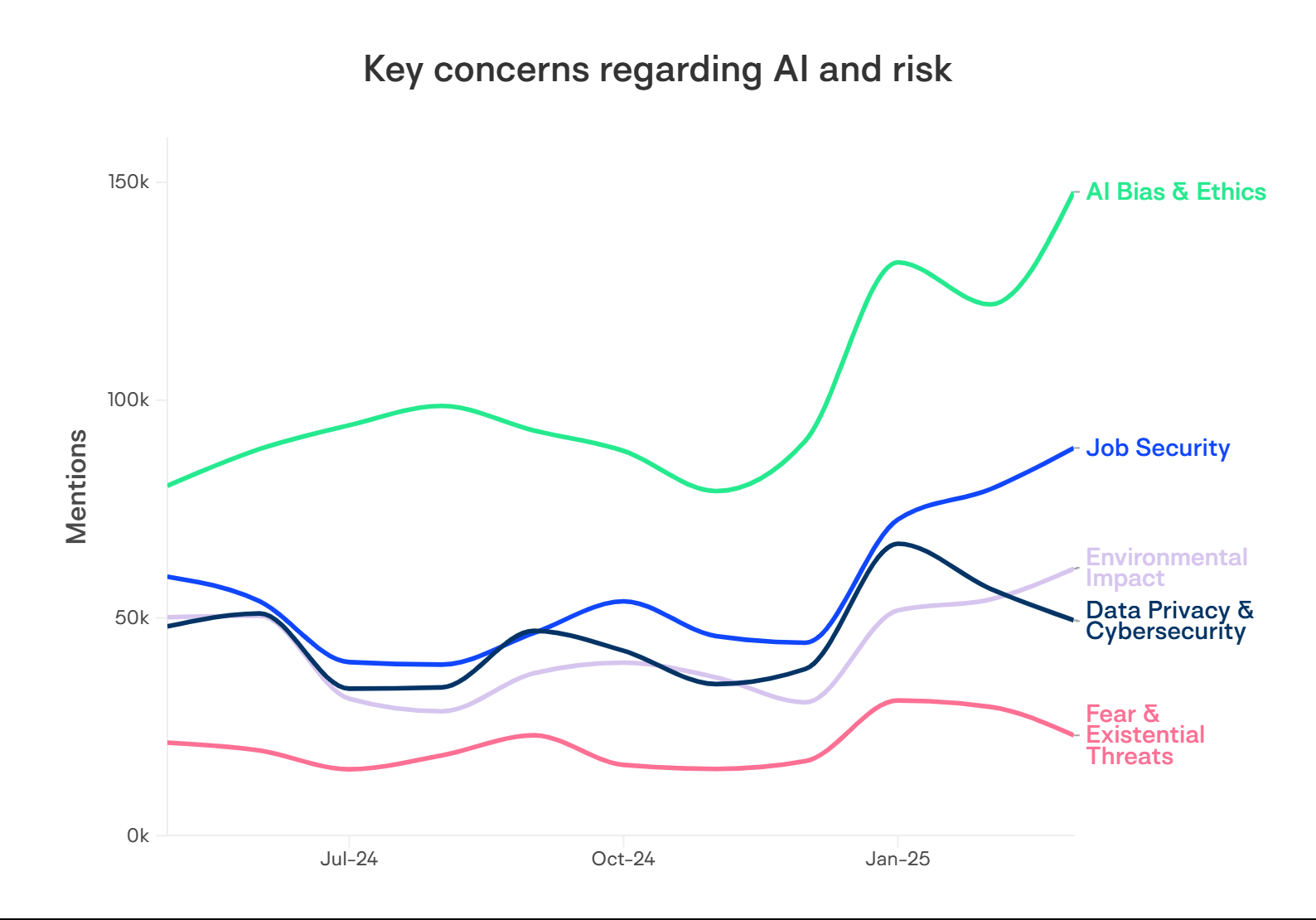
In our latest report ‘How to manage your reputation in a world transformed by AI: As industries adapt, what will be the role of PR?’ we examine press and public perceptions to outline the risks to businesses, public bodies, and their comms teams.

Graph showing key concerns on AI and risk

Using data and insight from Vuelio Media Monitoring and the Journalist Enquiry Service, this report unpacks:

  • Key areas of concern for the UK press and public and how this will impact comms strategies
  • How the UK media is reporting the risks of AI and what this means for media outreach
  • What AI-integrated organisations and industries are doing to secure engagement, and trust, from their stakeholders.
The fundamentals of stakeholder strategy

The fundamentals of stakeholder strategy: A guide

Just as stakeholders come in many forms, so too do the relationships you and your organisation need to form with them.

With so many different factors to account for, a reliable stakeholder management solution can be the difference between successful campaigning and relationship-building, and a myriad of missed opportunities.

To help with your mapping, planning, and management, this Vuelio guide ‘The fundamentals of stakeholder strategy’ features advice on:

  • The different types of stakeholders you’ll encounter, whatever your industry
  • Mapping and modelling those stakeholders
  • Empowering your team with the tools they need to maintain and grow stakeholder relationships
When politicians talk about AI is anyone listening?

When politicians talk about AI, is anyone listening? Innovation and regulation in the UK

In January of this year, Prime Minister Keir Starmer shared his plans to position the UK as an AI ‘superpower’.

As his fellow political and business leaders across the world grapple with the challenges that come with innovation, excitement for promised efficiencies mixes with questions regarding longer-term impacts.

How much has the Labour Government’s keen focus on this evolving technology influenced the conversation around artificial intelligence in the UK so far?

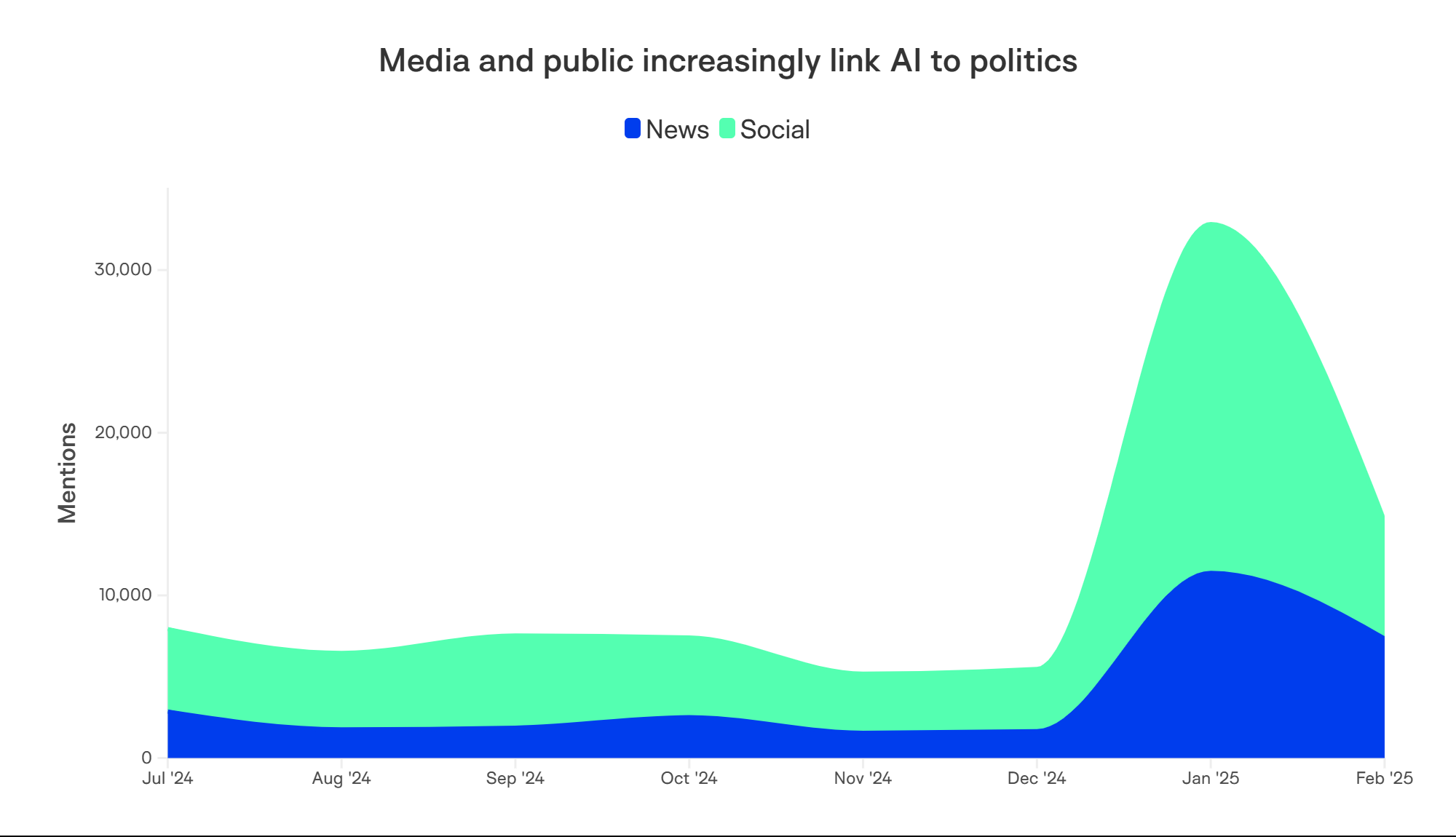
Our latest Vuelio report ‘When politicians talk about AI, is anyone listening: Innovation and regulation in the UK’ tracks the political, media, and public conversation to find out just how much influence our ruling party has on this topic.

Graph to show news and social volume around politics and AI

Using Vuelio Political and Media Monitoring; insight from the ResponseSource Journalist Enquiry Service; and social listening, we examine:

  • How the AI conversation has grown in the UK press and on social media since the General Election of 2024
  • What journalists and broadcasters covering AI are most interested in reporting
  • Which politicians & parties are best at making their voices heard around AI
Political monitoring

The top political monitoring platforms for PR, political, and public affairs professionals

Things move fast in politics. If you’re an organisation with political stakeholders, political monitoring you can rely on is a must.

For choosing the right platform for your needs, here are the best political monitoring platforms for those in PR and communications, public affairs, and marketing.

1) Vuelio

Political Monitoring is just one of the solutions the multiplatform Vuelio offers for those working in the PR, comms, marketing, media, political, and public affairs industries. Alongside an international media database, press release distribution, and campaign analysis solutions, and stakeholder management, Vuelio provides political monitoring and a fully integrated political database.

This comprehensive public affairs platform monitors everything happening across the UK’s Parliaments and Government departments, as well as important moves in the wider political ecosystem. Going beyond monitoring, Vuelio opens up the ability to directly engage with key political stakeholders and make meaningful contributions to policy. Find details for parliamentarians, special advisors, council leaders, and council chief executives, and get full visibility of conversations happening via traditional sources – parliament, committees, briefings, press, and blogs – as well as social media platforms.

Political content is analysed by the dedicated in-house team and delivered in a format tailored to you and your team, in Vuelio Political Reports, downloadable seasonal reports, and election specific newsletters.

2) Dods Political Intelligence

Dods aims to inform, educate and advise on parliament and policy, offering coverage on regulatory changes and more. Its political intelligence services include monitoring and research to aid in the reach of communications and campaigns.

Personalised alerts on policy and political issues come from a bank of historical information from a variety of sources across the UK and EU.

Originally founded in 1832, Dods focuses on a human-driven approach in favour of AI-amplified results.

3) DeHavilland

Combining in-house expertise with technology, DeHavilland political monitoring aims to provide users with political data from thousands of sources. Updates are tailored to provide teams with what they need to know and cut out irrelevant noise.

Information is gathered from government, parliament, European parliament, and committees and is shared in a digestible format by team analysts and policy researchers.

Alongside monitoring, the platform offers insight and stakeholder management for public affairs and government relations.

4) PolicyMogul

This platform aims to offer comprehensive and timely monitoring, cutting out government and political developments that may be irrelevant. Offering AI-written summaries designed to contextualise political updates, ‘near real time’ data is available for specific areas of interest.

Alerts – which focus on verified information over potentially overwhelming real time updates – can be shared via email or the platform’s integration with Slack.

PolicyMogul also offers a political stakeholder CRM and embeddables that can be added to websites or blogs.

5) Navigate Politics UK

Offering briefings and client catch-ups, Navigate Politics UK offers ‘human-led’ services to help public affairs leaders stay ahead of political updates.

The automated user interface is designed and delivered by in-house public affairs professionals, sharing updates in daily briefings, alerts, and summaries that are custom-built for public affairs teams. Users can choose from morning briefings, mid-morning round-ups, live coverage, tailored summaries, and weekly grids.

6) PoliMonitor

Used by public affairs and communications professionals from organisations big and small, PoliMonitor helps its users understand and engage with political discussions.

On offer alongside the monitoring is stakeholder mapping, relationship management, transcripts and summaries, client relationship management, research and reports, horizon scanning, and an integrated contact database.

7) Randall’s Monitoring

With over 45 years of experience in monitoring the political sphere, Randall’s offers coverage of Westminster, Whitehall, the Scottish and Welsh Parliaments and the Northern Ireland and Greater London Assemblies. With email and web-based distribution systems, this platform’s parliamentary monitoring has coverage of debates, questions, motions and select committee activities and its general political monitoring covers party political news and policy developments.

Randall’s also provides stakeholder monitoring, and political and parliamentary advice.

AI in beauty

AI in beauty equals risk – and opportunity – for the PR & comms industry

One industry forging ahead with AI integration – and battling the risks and opportunities that automatically come with the breaking of new ground – is beauty. 

A sector identified with youth and innovation is once again acting as a bellwether for a broader societal trend, and is already playing host to questions around safeguarding and what this means for society. 

These questions are especially relevant for the PR, Comms and Public Affairs pros responsible for charting the tides of media and public opinion – and for creating messaging that lands.

Our report ‘AI in beauty equals risk – and opportunity – for the PR & comms industry’ uses Vuelio Media Monitoring, social listening, and insight from the ResponseSource Journalist Enquiry Service to track how AI in beauty sparked both public conversation and press coverage. 

Media coverage of AI in beauty

As the UK’s Online Safety Act impacts organisational strategy on AI, and the Labour Government increases its focus on artificial intelligence in business, this report aims to offer a roadmap for sectors tasked with navigating the challenges. 

Download the full report for… 

  • How the UK press are reporting on AI use in the beauty industry so far
  • Public reactions on the authenticity of campaigns that utilise AI imagery and enhancements
  • The ways brands are tackling the issue of AI ethics within their comms
Political overview of 2024

Key developments from UK policy and politics in 2024

As we step into Christmas and the New Year, the Vuelio Political Team have been thinking and writing about the key developments that pervaded UK policy and politics in 2024. Here is our overview…

Treating the NHS

Helen Stott, Policy Researcher

Wes Streeting’s first act as Health Secretary was to make a speech declaring the NHS ‘broken’ and to commission Lord Darzi to conduct an investigation into its current state. Darzi’s review was published a few months later and, perhaps unsurprisingly, he laid the blame for the NHS’s decline squarely at the fault of previous Conservative governments. Darzi claims that although the health service is still suffering the effects of COVID-19, it was severely weakened going into the pandemic as a result of years of underfunding. He was also critical of the reforms introduced by former Health Secretary Andrew Lansley in 2012.

Having diagnosed the problem, the Government is now tasked with delivering the treatment. Prior to the election, Labour made it clear that their plans for the health service would rely on three key shifts; firstly a shift away from hospitals and to delivering more care in community settings such as general practice, local pharmacies, and community mental health services. Moving ‘downstream’ is crucial to Labour’s second goal, which is to shift towards a more ‘preventative’ model. The argument is that as the UK faces an aging population with more complex health needs, the only way to stop health costs from spiralling out of control is to get better at early intervention or even preventing ill health from occurring in the first place. This ties in with the Government’s public health ambitions, and their intentions to introduce stricter regulations on junk food. Finally, the first two goals will be underpinned by a shift towards digital, with an ambition to properly digitise the NHS and create electronic patient records, which will allow for proper coordination between different parts of the health and social care system.

The Government is currently in the process of consulting on their 10 Year Health Plan which is due to be published in spring 2025. There are still big questions about how much extra funding the NHS can expect to receive in order to deliver the plan, and about what the Government’s ambition to create a National Care Service will entail.

Planning reform goes top of the priority list

Ellie Farrow, Junior Policy Researcher

Last week, the Government published an 82-page National Planning Policy Framework report outlining its plan to ‘overhaul planning rules’ in order to fix the so-called housing crisis and enable the building of 1.5 million new homes by the end of the next Parliament. The revised framework reintroduces mandatory targets for councils, prioritises brownfield sites, introduces ‘golden rules’ for development on the green belt, and offers additional funding to local authorities’ to aid this transition.

Following this, the ONS released figures showing that the economy had shrunk in October; notably the figures revealed zero growth in the services sector, with manufacturing and construction declining at a pace of 0.6% and 0.4% respectively. This perhaps comes as no surprise to some who have repeatedly expressed concerns for the labour shortages in the sector, the Royal Institution of Chartered Surveyors (RICS) has consistently argued that there is a growing gap between the demand for infrastructure development and the available workforce.

In addition to these concerns, under the new plans, councils in England will no longer have the power to contest developments. Instead, planning is to be centralised – or ‘regionalised’ – leading to a disempowerment of local planning offices and committees. These changes, however, came just days before the Government’s much-anticipated English Devolution White Paper. As of this week, the Government has published their English Devolution White Paper which promises to deliver a ‘permanent shift of power away from Whitehall and into the hands of those who know their communities best’. Whether this tallies with centralising planning laws is yet to be seen.

The devolution ‘revolution’

Jennifer Prescott, Political Services Team Lead

In the first week after Labour’s election victory, Keir Starmer and Angela Rayner met with England’s 12 metro mayors to confirm their longstanding intention to expand devolution, promising to ‘deliver the most ambitious programme of devolution this country has ever seen’. The devolution agenda is the first of Labour’s five missions to kickstart economic growth and has been set out in their English Devolution White Paper, published on 16 December. The paper pledges a ‘devolution by default’ approach and outlines its ambition to establish ‘strategic authorities’ (of 500,000 or more residents) covering the whole of the country, meaning that borough and district councils will be abolished. Chair of the District Councils’ Network Sam Chapman-Allen called the move the ‘opposite of devolution, taking powers away from local communities’. Similarly, one council leader in Sussex – an area that has recently submitted an expression of interest in devolved power – called it a ‘death knell for local democracy’. However, the Government’s intention behind the plan to favour larger, combined authorities is to give cities and regions ‘a bigger voice’.

Mayoral strategic authorities will receive consolidated funding pots for housing and planning, transport, skills, and employment support, with the Greater Manchester, Liverpool City Region, North East, South Yorkshire, West Midlands, and West Yorkshire combined authorities being the first. While the Local Government Association welcomes the transfer of powers and money to local leaders, it said it ‘cannot distract from the severe funding pressures that are pushing local services to the brink’. Given the proximity, it’s unclear how pivotal yesterday’s Local Government Finance Settlement will be for the viability of local authorities.

The Government will shortly set out its Devolution Priority Programme aiming to deliver inaugural mayoral elections in May 2026. Discussions have been had with places including Cheshire and Warrington, and Norfolk and Suffolk, and places on the Priority Programme will be confirmed in January.

The post-16 education and skills landscape

Michael Kane, Policy Researcher

A 2023 report by the Education Committee demonstrated the complex nature of the post-16 education and skills landscape – significantly, this simply reiterated the same point that had been made before by the Independent Panel on Technical Education in 2016 and the Wolf Review in 2011. 2024 saw the continuation of this complexity. At the start of the year, then Prime Minister Rishi Sunak was pursuing his plans for an ‘Advanced British Standard’, a plan to, in essence, combine A Levels and T Levels, see every student study ‘some form of maths and English to age 18’, and defund alternative qualifications such as BTECs.

Labour’s election complicated matters: Sunak’s Advanced British Standard was scrapped and derided as unfunded by the Chancellor, and less than month into Government, Education Secretary Bridget Phillipson announced a ‘short review of post-16 qualification reforms at level 3 and below’. The culmination of this review in December saw the Government largely renege on the previous Government’s plans for widespread defunding as they announced that 70% of courses previously earmarked for defunding would stay. Considering the importance of getting post-16 qualifications right for addressing ameliorating skills gaps and productivity levels in the UK economy, the Government may choose to buck the trend of complexity and give the education sector certainty in 2025. With this in mind, the Government’s manifesto promise to publish a long-term strategy for post-16 education is one to look out for.

Clean energy by 2030, not 2035

Laura Fitzgerald, Policy Researcher

Labour’s election brought with it promises of change for the UK’s energy landscape. Both in the lead-up to – and post – election, Labour have been vocal in Labour’s ambitions to make the UK a ‘clean energy superpower’ and target of clean power by 2030. This target, five years earlier than their Conservative predecessors, will be no small feat, but one that the Government insists is achievable. Last week saw Labour publish its Clean Power 2030 Action Plan detailing the steps to build a clean energy system, and one that benefits both the consumer and environment alike. It includes reforms to the grid connection and renewable auction processes, and pledges to ‘unlock billions of investment’ a year.

Energy UK’s CEO Dhara Vyas welcomed the changes to accelerate the planning process and enable the development of critical infrastructure, as did Friends of the Earth who said that the plan will be instrumental in creating green jobs, lowering bills and protecting the planet. The plan is not without its sceptics however. The Shadow Energy Secretary Claire Coutinho, who has largely defended the net-zero scepticism of the previous Government, expressed concerns about whether a clean energy system would lower household energy bills. Speaking in an interview with Energy Secretary Ed Miliband, Nick Robinson also shared some public concern that a clean energy system may lead to blackouts with renewable energy sources often subject to some variability. With 2030 just under four years away, both sides can agree that the scale of the task is significant and will require bold action if the clean energy target is to be met.

2025 and beyond

Given the holistic nature of policy, the key developments that pervaded 2024 will likely feed into 2025. With this in mind, if we are to comprehend the issues that may grasp the machinery of Government in 2025, we have to understand – were they were conclusively grasped before?

For regular updates on what is happening in UK politics and public affairs, sign up to our fortnightly Point of Order newsletter, going out every other Thursday.

How news media brands itself: Centring the civic value of journalism

How news media brands itself: Centring the civic value of journalism

With trust in the media increasingly fragmented, how is the journalism industry re-engaging with audiences?

Two approaches emerge. First, building brand reputation around journalism’s vital role as a civic good. And secondly, centring the role journalism has in making its readers smarter and able to make better decisions.

How news media brands itself

To explore what this means for some of the UK and US’s leading brands, we analysed over four million online conversations, revealing the degree to which audiences identify brands including BBC, New York Times, Reuters and The Wall Street Journal with high-quality reporting.

Read the report to find out:

  • Which news brands are viewed most favorably (and unfavorably) by audiences, and why
  • The themes and messages that most resonate with current audiences
  • How brand campaigns align – or clash – with audience perceptions
Hold the homepage!

Hold the homepage! How scoops circulate through the modern media landscape

Good news can travel quickly across the variety of platforms that make up the modern media landscape, but bad news often spreads just as fast.

How and why do certain stories make the leap from news columns to widely-shared social posts? And what do organisations and their comms teams need to know to push the positive stories further, and address negative narratives?

Our latest report ‘Hold the homepage! How scoops circulate the modern media landscape’ tracks two major reputational crises from the last year to uncover the forces at play. Using data points from traditional and social media – alongside public statements from UK political heavy-hitters – we examine how news reports evolve as they travel through different platforms & audiences.

Download the report to explore:

  • How scandal can spread beyond publishing paywalls, impacting everything from regulation to brand reputation
  • The forces that propel journalistic scoops from traditional media platforms to social virality
  • How an evolving story can embroil brands, including competitors, in unexpected ways
Budget 2024

Key Takeaways From Rachel Reeves’ Budget: ‘Fixing the Foundations to Deliver Change’

Written by Michael Kane and Laura Fitzgerald. 

Nearly four months on from the 2024 General Election and the UK’s first female Chancellor Rachel Reeves finally delivered the Government’s Budget. The hefty 170-page document, and Reeves’ accompanying statement to the Commons, goes some way to provide further clarity on the Government’s priorities. In this sense, it feels like a particularly significant Budget given the accusations that Labour attempted a ‘Ming vase strategy‘ of avoiding difficult decisions in the election, and the relative ambiguity about priorities after their first 100 days.

Whether the Budget provides complete clarity on the above is yet to be seen. Nonetheless, it certainly provides some takeaways to be explored.

The return of tax and spend?

Just as the Budget was enormous in terms of its significance, the announcements on taxation, borrowing, and spending were equally as huge. In contrast with Reeves’ relatively steady approach before the election, with only minor tweaks to taxes and spending mentioned in Labour’s manifesto, yesterday saw the Chancellor in a markedly different light.

From the announcement of record tax rises by £40bn, to one of the largest increases in spending since the 2000 spending review at almost £70bn, the Autumn 2024 Budget was nothing short of historic. The majority of the £40bn worth of tax rises will come from a £25bn increase in employers’ National Insurance contributions – a tax take which reportedly places the UK at almost level with the Netherlands, and seen by some as Labour’s move towards a more ‘European-style economy.’ Increases in borrowing were also announced yesterday, facilitated by Reeves’ choice to change the UK’s fiscal rules which loosened the constraints around borrowing to invest.

These decisions, while drastic, are hoped to precipitate economic growth and prosperity in the long-term – ‘no pain, no gain’. However, the fiscal forecast from the Office for Budget Responsibility does seem to augur such an explosion of growth. It finds that, while GDP will increase to 1.1 percent this year and to 2.0 percent next year, the rate will then fall to 1.8 percent in 2026 and to 1.5 percent thereafter. Will Reeves’ gamble pay off? Or will the Budget fall short of the investment needed to truly ‘fix the foundations’?

The Government’s farming predicament

The lead-up to the Budget saw Reeves repeatedly warn of the ‘tough decisions’ that need to be made to fill the blackhole in public finances, and this was certainly true for the UK’s farming community. Farmers were among those dealt the most devastating blow yesterday, leaving many to fear for their livelihoods and legacy of their life’s work alike.

The reform in question includes a limit on inheritance tax relief for farms to £1m, a move which farmers claim will make inheriting family farms unviable, and a policy which the National Farmers’ Union has called ‘disastrous‘. Concerns have also been raised regarding the impact of the tax relief cap on food security and the ability of future generations to grow British produce. This would have implications for both businesses and consumers, making the UK more heavily reliant on imports, affecting sustainable food production and undermining commitments to protect the environment.

Broadcasters Jeremy Clarkson and Rachel Johnson are among the critics of the reform, taking to X to express their anger towards the announcement. Clarkson, presenter of the programme ‘Clarkson’s Farm’, urged farmers not to despair and to ‘look after [themselves] for five short years’ by which time ‘this shower will be gone’, while Johnson blasted the Government’s decision in order to raise ‘a measly £500m’.

With details on the Government’s new deal for farmers yet to be published, the Government’s promises to enhance rural economic growth and food security could seem something of a distant reality. The Government did allocate £500mn in Project Gigabit and the Shared Rural Network to enhance broadband provision in underserved rural areas, but whether rural communities feel sufficiently supported is another matter.

Local Government finance

Coming into the Budget, the challenges facing Local Government were stark: among the council Chief Executives who responded to a pre-budget survey from the Local Government Association, over half said they were likely to declare financial bankruptcy in the next five years. Therefore, addressing the challenges facing Local Government is vital on a practical level, given the role Local Government plays as first point of contact for many citizens in the delivery of vital services such as social care, SEND provision, and housing. Additionally, the sentiment in Labour’s pre-election manifesto illustrates the Government’s intention to further devolution across England – self-evidently, this is only feasible with sustainable funding.

The Budget attempted to grapple with the significance of the situation by promising an additional £1.3bn of new grant funding for local authority services. Most notably, this included £600m for social care and an additional £233m spending in 2025-26 on homelessness prevention. This may go some distance to provide an immediate sticking plaster over funding gaps, however questions remain about the long-term sustainability of this approach. Firstly, this is not enough to address the £2.3bn funding shortfall, as noted by the think tank Reform. Secondly, a more fundamental rethink about the funding and organisation of Local Government may prove to be a more successful strategy – perhaps revaluing council tax could be a starting point. However, the Budget revealed that the proposed devolution legislation will involve ‘working with councils to move to simpler structures that make sense for their local areas’ – this is something to keep an eye on given the demand to reorganise local government in England.

Looking beyond the headlines

There were aspects of the Budget that did not grasp the prevailing headlines and soundbites that the Government briefed – this includes proposals that were hidden and the shortcomings of some of the announcements. First, the Government revealed that they will consult next year on proposals to bring remote gambling (gambling offered over the internet, telephone, TV and radio) into a single tax. Preceding this, the Social Market Foundation and the Institute for Public Policy Research had both suggested increasing tax on remote gambling. Curiously, the Government’s announcement did not make it into Reeves’ speech or the main text in the document – instead it was to be found in the policy announcements section towards the end of the document. Significantly, this speaks to Labour’s prior ambiguity on gambling regulation with their manifesto simply suggesting that they would ‘reform gambling protections’ and that they are ‘committed to reducing gambling-related harm’. Given the centrality of prevention to the Government’s agenda for health policy, this is something to keep an eye on, even if the Government does not shout about it.

Moreover, when interrogating the details of the Budget, we can see some apparent shortcomings. For example, the Government committed to continuing the freeze on fuel duty in a bid to appease concerns from drivers. However, the visuals of freezing fuel duty while increasing the cap on bus fares, and the news that rail fares will increase by 4.6% next year may seem counter-intuitive – especially considering the impending net-zero transition.

Interestingly, the New Economics Foundation also detailed that updating the fuel duty could fund the £2 bus fare cap ten times over. Finally, when doing the media rounds this morning, Reeves noted that increasing taxes on businesses may have detrimental effects on pay increases for workers. Meanwhile, the Institute for Fiscal Studies explained that this Budget will only increase real household disposable income by 0.4%, if projected to the whole parliament. This feeds into arguments that a windfall tax on banks or a wealth tax may prove a better means to redistribute wealth.

Looking forward

Reeves’ Budget has proved relatively decisive on some of the key questions facing the Government. To some degree, this was inevitable with the UK economy facing a practical reckoning given the myriad of crosscutting challenges. Whether this be the highest tax burden since the Second World War, the highest level of national debt since the 1960s, the annual GDP growth slowing to 1.5% since the 2008 financial crash, or the decline in living standards over the last Parliament.

Knowing all this, Labour have still made the promise to make the UK the fastest growing economy in the G7. Therefore, something had to give to level with this promise and the UK’s wider economic predicament. Specifically, Reeves chose to focus on taxing business and tweaking the fiscal rules to allow for greater borrowing in an attempt to drive growth. With Reeves set to appear in front of the Treasury Select Committee next week, that session will provide a further read into how the Government grapples with the economic predicament.

For regular updates on what is happening in UK politics and public affairs, sign up to our fortnightly Point of Order newsletter, going out every other Thursday.

TikTok Journalism: The platform’s impact on news audiences

The emergence of short-form video has forced an evolution in news rooms and editorial teams across the publishing industry at large. Media organisations big and small have adapted to audience appetite for quick updates across apps, and PRs must be prepared to switch platforms when necessary.

Our new report ‘TikTok Journalism: the platform’s impact on news audiences’ uncovers audience patterns and the impact this is having on journalism by analysing online news and social media data from 1 January to 20 October 2024.

Vuelio TikTok Journalism Topics Mainstream vs Citizen Journalists

We examine how mainstream media channels are utilising video to reach new audiences, and the rising influence of independent ‘citizen’ journalists sharing news in vertical formats.

This report covers:

  • How, and why, public and media interest in TikTok journalism has grown so quickly
  • The most influential voices and the audiences they attract
  • What the rise of this new type of journalism means for ‘hard news’, including elections and global politics
  • The rise of news as entertainment

Fill in the form below to download the report

The scandals of the General Election 2024

Rundown of the Conservative leadership candidates

The Conservative leadership candidates have all given their pitch to the party hoping to succeed Rishi Sunak. The last time Conservative members chose their leader, they went for Liz Truss. This time the choice will not be as consequential for the country, as they will be taking the position of Leader of the Opposition, rather than Prime Minister.

While not being as significant to the country, it is of vital importance to the party as they are at somewhat of a crossroads in terms of their long and storied history. They are coming off a historic defeat at the General Election and now have only 121 MPs. Labour is attempting to blame the previous Government for everything they can. The Liberal Democrats and Reform both enjoyed significant electoral success against the party at the election as well. Whoever is chosen has a big task on their hands.

Tugendhat
Emerging from a sea of foam fingers and Tom Tugendtote bags, Shadow Security Minister Tom Tugendhat was the first of the candidates to take to the main hall stage at this year’s Conservative Party Conference and give his leadership pitch. In a nod to his background as a former soldier, Tugendhat’s speech was largely values-driven, emphasising the importance of integrity towards – and service to – both the party and country alike. While his decorated military experience precedes him, Tugendhat certainly has the least government experience of the four leadership hopefuls. With less than two years serving as Security Minister under former Prime Minister Rishi Sunak, Tugendhat played to his time in the military, saying that this showed him what true leadership is, and he promised to ‘lead with conviction and [to] act decisively’. He also justified his comparatively shorter time in management around the cabinet table claiming that he is ‘not here to manage, but to lead.’

Echoing the sentiment of the conference’s slogan ‘Review and Rebuild’, Tugendhat’s speech stressed the need to rebuild the party and restore the trust of the British people. He also vowed to rebuild CCHQ, and turn the Conservatives back into a ‘campaign-winning machine.’ Global security is a priority for Tugendhat. He values Britain’s position on the global stage and said the Conservatives have long been a party to fight for freedom, ‘united’ against threats the UK has faced. Migration, healthcare, the economy, and energy were also key areas of focus in his speech. He pledged to introduce an effective deterrent for migration, including a legal cap at 100,000, while on health and energy he vowed to strip excessive regulations in the health system and never to allow the UK to be dependent on ‘tyrants’ for energy.

This week also saw the Shadow Security Minister hit out at rival Robert Jenrick who used footage of one of Tugendhat’s former comrades in a campaign video. Jenrick published the video to make the case that the UK needs to withdraw from the European Court of Human Rights (ECHR), claiming it forces the SAS into ‘killing rather than capturing terrorists’. The video contained footage of British soldiers in combat, one of whom Tugendhat knew from his time in Afghanistan, and who has since passed away. Tugendhat took to BBC Newsnight to express his anger at Jenrick’s comments, stating that it shows a ‘fundamental lack of awareness of military operations’ and urging Jenrick to ‘pull [the video] down’. He also said that it was ‘particularly upsetting’ that his friend had been used in vain, unable to have the opportunity to defend himself. Tugendhat’s own stance on ECHR is somewhat reminiscent of David Cameron pre-Brexit referendum in that he suggested ‘[opting] out of the bits you can, reform the bits that aren’t working, and if that doesn’t work, be prepared to leave’.

While Tugendhat is popular among the public, with a recent poll placing him in the lead among The Independent readership, his prospects at Wednesday’s third ballot may not yield such positive results. According to a recent YouGov poll, Tugendhat is trailing behind, with only 16% of Conservative party members believing he is fit for the top job.

Cleverly
James Cleverly is widely viewed as being the candidate who benefitted the most from his speech at conference. He went into the conference as a bit of an outsider without much momentum and his leadership rivals were capturing far more of the media attention. He called on the party to be ‘normal’ and attempted to provide party members with a sense of motivation going forward. He even began his speech asking what the point of the party is and went on to speak on how the party has no right to power. He focused heavily on his upbringing and life, going through his upbringing in Lewisham, his time in the Reserves, his career in business, and his wife’s battle with cancer. Cleverly succeeded where some have criticised Tugendhat, in explaining who he is and what his background is and not taking for granted people know who he is.

The sense of trying to motivate a defeated party can be seen through Cleverly listing the Conservatives’ achievements over the years and squarely saying that if he is leader there will be no deals with Reform.

Another key part of Cleverly’s speech was his experience and what he had done, which was well received. However on 3 October the Foreign Office released a joint statement on the Chagos Archipelago, whereby sovereignty was given to Mauritius over the islands. Cleverly criticised this announcement which could be seen to have been a bit of a misstep as he was the Foreign Secretary when the negotiations began. This was roundly pointed out across social media and has been picked up by his leadership rivals. This has hurt Cleverly’s credibility just as his stock was beginning to rise, as he is seemingly criticising a policy that he initiated.

Jenrick
Bobby J had perhaps the most turbulent week of all the leadership contenders. He came into the conference as the frontrunner but a campaign video on the ECHR has caused him big problems. In a video where Jenrick was making the case for the UK to leave the ECHR, he made the claim that British special forces are killing rather than capturing terrorists due to the convention. When he was challenged on the remarks Jenrick stood by his claim, saying he did not want the convention to get in the way of national security. Jenrick cited an article by former Defence Secretary Ben Wallace in which he wrote “because of international treaties such as the European Convention on Human Rights defence secretaries are being forced to choose between killing individuals, generally by drone, or leaving them to continue plotting”. This led to the first real blue on blue attacks of the leadership campaign, with both James Cleverly and Tom Tugendhat expressing concern with Jenrick’s claim.

Jenrick played to the audience both in terms of location and their politics. He proudly declared his Midlands roots and revealed that one of his daughters’ middle names is Thatcher, as she was born in the year Margaret Thatcher died and he respects ‘strong women’. Jenrick made a slight mistake when he claimed that in 1974 the Conservative Party decided to be led by Margaret Thatcher, as Thatcher actually became leader of the Conservative Party in 1975.

Jenrick has in the last few weeks closed the gap between himself and the members’ favourite Kemi Badenoch. He has the most support among MPs, and if the members move with him, it would be fair to consider him in pole position.

Badenoch
The gifts available at Kemi Badenoch’s party conference tent were slightly different from her opponents. No t-shirts or hats, but Kemi apples, anyone? Perhaps a symbol of a healthy Britain, perhaps a symbol that a fresh start is coming, either way Badenoch has certainly been the apple of the Conservative party members’ eye for most of the leadership contest. A recent YouGov poll has revealed that the Shadow Housing Secretary is the hot favourite among members and this has largely been the case since the race began. That being said, her popularity has waned in recent days following her controversial remarks regarding maternity pay. Speaking with Times Radio, former Business Secretary Badenoch claimed that statutory maternity pay places an ‘excessive’ burden on business and has ‘gone too far.’ The comment has since come under fire, leading Badenoch to later defend herself on X, insisting that ‘of course [she believes] in maternity pay!’. A poll conducted amid the backlash over the remarks found that only 7% of the British public think maternity pay is too much, so it begs the question, is it Badenoch who has gone ‘too far?’ Badenoch has pitched herself as somewhat of a fighter, saying ‘if you swing at me, I will swing back’, something that some members may admire, which others may find concerning. Her dismissal of identity politics will likely have gone down well with members however. When asked about how she would feel to be the first black leader, she responded, ‘I am somebody who wants the colour of skin to be no more significant than the colour of our hair or the colour of our eyes’.

Badenoch’s speech at conference reflected her worldview and outlined her values. She spoke of the importance of trust, freedom of speech, and the bravery to do the right thing. Contrary to Labour’s steadfast drive towards clean energy, Badenoch is herself a net zero sceptic. She said the net zero strategy is damaging to the economy and criticised the commitment towards the transition to net zero. The latter half of her speech focused on the key tenets of her leadership. She pledged to ‘rewrite the rules of game’, developing a comprehensive plan to reform the British state and economy. She said this will include a review of the UK’s international agreements, the Human Rights Act, the Equality Act, judicial review, the Treasury, the Bank of England, the Civil Service and the NHS. She closed her speech with the unveiling of her ‘Renewal 2030’ plan. For Badenoch, 2030, potentially the Conservatives’ first year back in office, would be an opportunity to build growth in the UK, centred around personal responsibility, family, sovereignty and capitalism.

For what could have been a ‘doom and gloom’ party conference following a bruising election defeat, there was certainly an air of optimism among the leadership candidates. The four contenders all believe that they have what it takes to rebuild the country and lead the Conservative party to victory at the next election. What differs however is their approach to doing so. A Badenoch or Jenrick victory may see Labour confronted with challenges on their net zero policy, whilst a Tugendhat or Cleverly victory may see greater emphasis on global security and foreign policy.

With Tugendhat likely to be the next candidate eliminated from the race, it remains to be seen where his share of the votes will go. Will they be distributed to Cleverly, after his impressive performance at conference, and similar left-leaning stance? Or will Badenoch and Jenrick hold strong at the top? It’s up to the members to decide.

For regular updates on what is happening in UK politics and public affairs, sign up to our weekly Point of Order newsletter, going out every Friday morning.

Sugar & Health: A PR guide to healthy FMCG & HFSS comms featured image

Sugar & Health: A PR guide to healthy FMCG & HFSS comms

HFSS (High Fat, Sugar, and Salt) public health initiatives are complex to navigate, with regulation for food and drinks communications and advertising in the UK in flux.

As food and drink brands prepare for the UK Government’s upcoming ban of HFSS food adverts on television before 9pm, what do PRs need to know about public perceptions, political maneuvering, and media interest around sugar and health? 

Our latest report ‘Sugar & health: A PR guide to healthy FMCG and HFSS comms’ uses political intelligence from Vuelio, audience insights from Pulsar, and media expertise from ResponseSource to gain a complete picture of how the topic is discussed and understood. Featuring insights from social media, online news sources, the press, and journalist enquiries, uncover key information for crafting impactful comms, generating positive media coverage, and supporting stakeholder engagement. 

Download the full white paper to learn…. 

  • How the sugar conversation has grown in UK politics, the press, and across social media since the UK Government’s initial announcement of firmer regulation in 2022
  • What PRs in the FMCG and HFSS space need to know to get the attention of relevant journalists and broadcasters, and achieve positive coverage in the media
  • The brands that have been successful in their comms campaigns, amid the current climate of changing regulation and fluctuating audience expectations

Download the report by filling in the form below 👇

One month on from the 2024 UK General Election

Learnings and observations from Conservative conference fringes: Social housing, opportunity and life sciences

Written by Michael Kane and Helen Stott from the Vuelio Political Team. 

Our blog last week highlighted that, despite the Labour leadership’s disciplinarian grasp on policy development, the fringes at last week’s Labour conference still proved useful in exemplifying the future challenges to be addressed and their potential solutions.

Contrastingly, the Conservative leadership have not had the same firm grasp on policy development – mainly because the leadership remains a vacuum, with the party currently engrossed in a leadership election. In this sense, the fringes at Conservative Party Conference may instead inform the prospective leadership contenders’ policy platform.

Considering how embryonic some of the policies that underpin the candidates are, and the unclear ideological trajectory of the Conservative party as a whole, the fringes at this year’s Conservative conference proved particularly pertinent.

‘Where next for social housing?’ by the Joseph Rowntree Foundation

The Conservative party has a long history with social housing and housebuilding provision: the party supported Labour’s New Towns programme after the Second World War and even unveiled their own Expanded Towns programme in 1952. An ideological shift in the 1980s saw the party unveil the Right to Buy council houses and the transfer of social housing stock from local authorities to housing associations. From 2010 onwards, the previous Conservative government established numerous house building targets, housing strategies and attempts at planning reform. Nonetheless, the evidence shows plainly that, from 2010 to 2024, owning a home became harder, renting a home became more expensive, homelessness rose, and not enough houses were built.

With the above context in mind, this fringe by the Joseph Rowntree Foundation looked to consider the role of social housing in the Conservative party’s future policy platform. Former Minister of State for Housing and Planning Rachel Maclean observed how the social housing system is broken as she called on the Conservative party to consider its funding and who benefits from the system. Conservative backbencher Bob Blackman struck a similar reforming tone as he agreed with Maclean on the need for a rethink. He specifically argued for incorporating the right to buy as soon as the tenant enters social housing and invest all this money in building social housing to create a virtuous circle. Interestingly, this comes with the Government planning to consult in Autumn on reforms to Right to Buy and having already started to review the increased Right to Buy discounts introduced in 2012. Finally, Conservative councillor and Deputy Leader of the LGA Conservative Group Abi Brown called for Conservatives to be bolder when it comes to making the arguments for house building when local residents may be unsatisfied with the proposals. This follows concerns that former Prime Minister Rishi Sunak’s Government submitted to localist concerns around mandatory housing targets.

The Labour party has looked to make housebuilding a vital component of their strategy to deliver economic growth – much has been made of their plans to build 1.5m new homes through planning reform, new towns, and ‘the biggest increase to social and affordable housebuilding in a generation’. With Labour having set their stall out so clearly, the Conservatives quickly need to build a coherent narrative on social housing – especially when this could enable them to reconnect with younger voters disgruntled by the poor prospect of home ownership.

‘Opportunity for all’ by NASUWT

If Labour have been clear on their aims for social housing and housebuilding, the same could be said of their plans for education. Speaking to this point, the title of this fringe organised by Teachers Union, NASUWT, even borrows Labour’s ‘opportunity for all’ slogan from their manifesto. This fringe then considered how the Conservatives should respond to Labour’s plans for education as a whole and the challenges the sector faces. Whether this be a school attendance crisis precipitated by COVID-19, the widening attainment gap across income and regional variables in England, a teacher recruitment and retention crisis, a crisis in SEND provision, or the uncertain future that further education faces with concerns around its funding settlement.

Edward Davies, Policy Director at the Centre for Social Justice, focused his remarks on the reasons for underachievement in school. Predictably and rightly, he attributed some of this to the school attendance crisis but he also argued that the rising number of children who do not have two biological parents at home is also a cause for concern. He condemned the fact that this issue does not seem to be part of the policy discussion. Whether a future Conservative leader puts this at the forefront of the education debate remains to be seen, with scars still remaining from former leader Sir Iain Duncan Smith’s focus on single mothers. In a forthright tone, the General Secretary of NASUWT, Dr Patrick Roach, condemned the prior Conservative Government for their poor relationship with education unions as he detailed that a rethink will be required if the Conservatives are to return to Government. Considering the fact that the leadership contenders unanimously condemned Labour’s ‘union paymasters’, this comment may not be taken on board.

Finally, the penal was rounded out by the Shadow Minister for Schools Gagan Mohindra whose comments reflect the conundrum the Conservative party face. His opening remarks featured a perhaps contradictory tone of explicating the challenges the education sector faces while defending the Conservatives record. Interestingly, he directly apologised for the lack of support provided on SEND provision. This encapsulates the reckoning the party faces on education policy between pursuing an apologetic or defensive tone, or even somewhere in between.

‘Boosting UK health and wealth through Life Sciences research’ by UCB

One of Wes Streeting’s first acts as Health Secretary was to declare the NHS ‘broken’ and to set the groundwork for a series of ‘radical’ reforms to the health service. Interestingly, the former Science Minister had some praise for the incoming Labour Government’s strategy. Reflecting on when he first joined Parliament in 2010, Freeman said his initial goal in politics was to tackle the ‘structural deficit’ that the UK has found itself in, with welfare and health spending set to rise year on year. Freeman argued that the life science industry is the only sector which is capable of reversing this trend and truly addressing the structural problems of the UK economy.

Unsurprisingly, Freeman had positive things to say about the Conservatives’ progress on life sciences while in Government, but he said ultimately they were not able to tap into the opportunities presented by the NHS. Politicians from both sides of the House have pointed out that our health service, with its huge resource of patient data, could present excellent opportunities for clinical research, is a huge site of underutilised opportunity. Freeman said that because Labour are the party that created the NHS they are the only ones that would be able to carry out the reform needed, and while the new Government’s long term plan for the health service won’t be published until next year, he said what he had seen so far was promising. This highlighted a possible site of consensus between the Conservatives and the new Labour Government.

What now?

While the leadership contest may have dominated the media headlines and the attention of most attendees of the conference, many of the fringe events in the periphery executive rooms, halls, and corridors of Birmingham’s ICC reflect the pervading challenges of economic and social policy in the UK. Importantly, these questions must be addressed by the future Conservative leader if they are to build a coherent ideological vision and policy platform to overcome their 2024 General Election result.

For regular updates on what is happening in UK politics and public affairs, sign up to our weekly Point of Order newsletter, going out every Friday morning.

Labour Party Conference 2024

Learnings and observations from Labour Conference fringes: The curriculum, preventative health care, and higher education

Written by Michael Kane and Helen Stott on the Vuelio Political Team, reporting from 2024’s UK Party Conferences. 

While the attention of the political media may have been on the movements within the main conference hall during the Labour Party Conference – with senior members of the Cabinet and the Prime Minister all giving significant speeches and numerous key motions passing through – the Vuelio Political Team was focused primarily on key fringe events.

While often derided as expensive for the organisers and ineffectual in terms of outcomes, such a narrow view misrepresents their value in the policy development process. After all, now Minister for School Standards, Catherine McKinnell, started the formation of Labour’s policy on Ofsted last year when she condemned their inspection system for being both ‘ineffective’ and ‘dreaded’ in a fringe event last year. This preceded Labour’s proposed ban of single word judgments in their manifesto, and this was confirmed by the Department for Education earlier this month.

With that in mind, what fringe events this year proved particularly intriguing in terms of policy?

‘Speaking up for opportunity’ by the Oracy Commission

Geoff Barton, Chair of the Oracy Commission, noted in his remarks that this Labour conference marks nearly 50 years on from the Bullock Report, which considered the teaching of English in schools. However, its recommendations were largely sidelined as the Thatcher Government chose to focus its curriculum on employability. Preceding this conversation around oracy, we have seen numerous different national curriculums in England with revisions coming in 1989, 1995, 2000, and 2014. This comes at a crossroads for schools following Labour’s announcement of a curriculum review, which recently opened a call to evidence. Debates surrounding the curriculum usually come within the perceived dichotomy between more creative and arts-based subjects against more empirically positivist STEM subjects.

In this fringe, the panellists avoided this binary perspective and instead recognised the role that oracy can play in all aspects of a young person’s education. Oli De Botton of The Careers and Enterprise Trust recognised the importance of oracy skills in helping young people in the transition secondary school, further education, higher education or employment – importantly, it is at these transition points that inequality in the education system may be cemented. Speaking to this point, Dr Nicky Platt, Deputy Director of the Education Development Trust, recognised the role oracy can play in reducing the ‘word gap’. In that sense, oracy can play a vital role in reducing the widening attainment gap across income and regional variables in England – that gap has been exemplified by the National Audit Office’s report in July.

Labour have committed to a ‘rich and broad’ curriculum, as per Education Secretary’s Bridget Phillipson’s speech to the Labour conference – however, the specific role oracy will play is yet to be determined.

‘Prevention-led public services: Can the government make its rhetoric a reality?’ by Institute for Government and The Health Foundation

This was yet another fringe event dedicated to the issue of moving to a preventative healthcare model and shifting resources away from primary and community care. There has been a growing consensus among politicians for almost 30 years that this is the right direction of travel – and yet the vision has failed to materialise. Over the past decade, population health has steadily declined, at the same time that hospitals and the acute sector are swallowing up a growing proportion of the NHS budget – leaving vital parts of the health service, like general practice and community services, woefully under resourced. Labour have made it clear that they will not be willing to let the spending taps flow freely, and that improvements to the health service will have to come from reform. The Department for Health is hoping that shifting resources to early intervention will ease pressure on hospitals in the long run and get the NHS back on its feet without spending significantly more money – but will this gamble pay off?

Dr Jennifer Dixon from the Health Foundation made the case for a rewriting of the rules regarding public spending in order to hardwire the prevention agenda into government. The Treasury can be too reluctant to invest in certain areas unless it can see an immediate return on investment, but preventative measures can often take longer to show their benefits. Similarly, Nick Davies from the Institute for Government argued for a ring fenced prevention budget and a cross-government strategy on prevention. Paul Kissack from the Joseph Rowntree Foundation was perhaps the most interesting contributor; he was somewhat sceptical of the ring fenced prevention budget idea, as he thought any technocratic fiddling would be pointless without wider investment to address the root cause of ill-health – poverty. Davies said uplifting universal credit would be the most effective lever to immediately lift people out of poverty, something JRF have been campaigning on for a few years. While there was enthusiastic agreement among the panellists, including Health Minister Andrew Gwynne, that lifting children out of poverty should be an urgent priority, the elephant in the room – namely, Labour’s refusal to lift the two child benefit cap – was left unaddressed.

‘How can higher education help to break down barriers to opportunity across regions’ by MillionPlus

The role of modern universities in the higher education sector and the economy in general has often been disputed, with the prior Government deriding the increasing number of people going to university and the existence of perceived ‘rip off degrees’. Preceding that, the Blair Government had committed to ensuring that at least 50% of young people attended university. This Labour Government has committed to resetting the relationship with universities and supporting ‘every person who meets the requirements and wants to go to university’ in their manifesto. This rhetorical inconsistency over the last few decades illustrates the challenges that modern universities have faced. With this in mind, this fringe event by MillionPlus looked to position these universities as central to Labour’s commitment to equalising educational opportunity and tackling regional inequalities.

Lord Khan, the Minister for Faith, Communities and Resettlement, who represents the first graduate of a modern university to serve in Government, noted that these universities are vital to addressing regional inequalities through generating regional growth. This point was substantiated by the Chair of MillionPlus, Professor Graham Baldwin, as he detailed that 68% of graduates of these modern universities stay in the local areas. To add to this, Nick Harrison of the Sutton Trust elucidated the positive impact that modern universities have on social mobility in their admissions policies – with three out of the top five of Sutton Trust’s social mobility rankings of universities being modern universities.

The role modern universities play in equalising access to higher education and tackling significant regional inequalities in the UK is clear. This is a vital issue for Labour to tackle given its significance. The ONS’ recent labour market statistics in September 2024 elucidated the regional divergence in England across levels of employment and economic activity and the expanding wealth gap between north-south of England, as shown by the IPPR. However, modern universities’ role in tackling these issues may be constrained given the crisis in higher education funding – an issue Labour has yet to propose a long term solution to.

What now?

Many of the speeches by the key members of the Labour Government at the conference focused on emphasising their central messages in an attempt to not rock the boat. However, these fringes provide a more revealing read into the future challenges the Government faces as they elucidate the myriad of social, economic and political challenges the UK faces. By that notion, they also potentially reveal the next steps the Government may take in substantive policy.

For regular updates on what is happening in UK politics and public affairs, sign up to our weekly Point of Order newsletter, going out every Friday morning.

Labour plans for unemployment

New Government: What are Labour’s plans for unemployment?

Was getting unemployed people into employment a key priority for the Conservative Government? Attempts included the New Back to Work Plan, former Prime Minister Rishi Sunak’s promise to tackle what he called ‘sick-note culture’, and choices for the Spring Budget in 2023, with the announcement of a £7 billion Employment package. However, despite policy initiatives, unemployment levels in the UK continue to be high.

Why is the employment ‘epidemic’ a growing problem, despite such initiatives?

According to the Office for National Statistics (ONS), 4.4% of people were unemployed between February and April 2024, equivalent to 1.44m people. Issues many unemployed are up against – long-term sickness, mental health problems, and early retirement, or caring responsibilities, inabilitities to find and retain jobs due to labour market demands, or gaps in skills and experiences required.

The problem of unemployment is growing. In most of the public sectors, such as health, social care, education, and the police force, there is a shortage of staff. Meanwhile, the Confederation of British Industry found that 38% of businesses reported that labour shortages were holding back their ability to invest and grow.

A look back at Conservative Government actions on unemployment

The New Back to Work Plan included a promise to implement tougher benefit sanctions for those not actively looking for work, trial possible reforms for the fit note process to make it easier and quicker for people to get specialised work and health support, and the launching of the WorkWell service.

Additionally, in April 2024, former Prime Minister Sunak gave a speech at the Centre for Social Justice (CSJ) on eliminating ‘sick note culture’, claiming it as a ‘lifestyle choice’ for those capable of working. Sunak’s intention to strip away the power GPs had to give sick notes sparked outrage within the charity and welfare sector, with the British Psychological Society stating that ‘the Prime Minister is taking the approach of attempting to minimise the mental health challenges […] The government should be prepared to invest the proper funds into mental health services.’

Labour’s plans to tackle the unemployment issue

With a new Labour Government established, with a different vision and different priorities, what is being said in regard to the unemployment epidemic? During the Labour campaigning period, the party promised a major programme of reform to support more people into work and bring the benefits bill down. In their manifesto, Labour has made ambitious promises, including reforming employment support with a system underpinned by rights and responsibilities. Furthermore, they have also stressed the importance of bringing Jobcentre Plus and the National Careers Service together to provide a national jobs and careers service.

In addition, Labour has made promises to help those with illnesses and disability into work, as they are more likely to face discrimination and structural barriers. Labour has promised to devolve funding so local areas can shape a joined-up work, health, and skills offer for local people. Moreover, parallel to the Conservative Government, Labour also proposed a Back to Work Plan within their first week of being in office. They plan to create new national jobs and career services; develop new work, health, and skills plans for the economically inactive, led by Mayors and local areas; and to introduce a Youth Guarantee to create more opportunities for training, apprenticeships, or help to find work for all young people aged 18-21 years old.

This growing epidemic needs to be at the heart of the welfare agenda for the new Government, given the pressures it is putting on public sector workers. Whether the initiatives announced so far can bring down the number of unemployed people, we are yet to discover.

For regular updates on what is happening in UK politics and public affairs, sign up to our weekly Point of Order newsletter, going out every Friday morning.