Parliament

Top 6 Political Monitoring Tools in 2026: A Strategic Guide for Public Affairs Teams

Political monitoring tools are specialised intelligence platforms that track and analyse parliamentary, legislative, regulatory, and stakeholder activity to help organisations anticipate political and policy risk. Unlike general media monitoring software, which focuses on press and social mentions, political monitoring platforms are built around the machinery of government.

They ingest structured data from Hansard, select committees, consultations, statutory instruments, devolved assemblies, and government departments — transforming complex legislative activity into searchable, actionable insight. For public affairs teams, this enables real-time legislative tracking, stakeholder mapping, and regulatory risk detection.

In 2026, these tools operate as integrated public affairs monitoring ecosystems, combining parliamentary monitoring software, stakeholder intelligence, media convergence tracking, and AI-assisted policy summarisation. Political volatility is continuous, not episodic. A Westminster debate can escalate into reputational risk within hours.

Modern political monitoring platforms therefore sit inside governance and risk workflows — shifting organisations from reactive alerts to predictive political intelligence.

Feature General Media Monitoring Political Monitoring (2026 Standard)
Primary Data Source News, Blogs, Social Media Committees, Consultations, Legislation
Stakeholder Focus Journalists, Influencers, Consumers MPs, SpAds, Civil Servants, Regulators, Councils
Analysis Depth Sentiment and Share of Voice Policy Impact, Legislative Risk, Stakeholder Mapping
Workflow Campaign Evaluation Governance, Compliance, Strategic Advocacy
Intelligence Type Reactive (What happened?) Predictive (What is coming?)

The Structural Evolution of Political Intelligence in 2026

Political monitoring has shifted from standalone alerting tools to integrated political intelligence ecosystems. The defining change is the direct, real-time integration of structured data from Westminster and the devolved nations, enabling teams to track Bills, amendments, and secondary legislation throughout the legislative lifecycle.

Technology now assists this process by surfacing relevant parliamentary records, consultations, department releases, and think-tank output based on a team’s defined policy priorities. Rather than replacing expert judgement, these tools reduce manual scanning and ensure that no critical development is missed.

AI-assisted summarisation supports analysts by condensing lengthy documents into structured briefings, which are then reviewed, contextualised, and refined by experienced public affairs professionals. Predictive modelling draws on historical patterns to flag potential voting or regulatory scenarios, but strategic interpretation remains firmly human-led.

Crucially, modern platforms embed governance and audit functionality alongside these capabilities. Integrated SRM tools, reporting dashboards, and clear oversight controls ensure transparency, compliance, and defensible decision-making at C-suite level — with technology acting as an enabler of professional expertise, not a substitute for it.


Evaluating Political Monitoring Software: A 2026 Framework

Choosing the right political monitoring tool in 2026 requires more than feature comparison. The following criteria prioritise platforms that deliver integrated, governance-ready political intelligence rather than standalone alerting functionality.

  • Parliamentary & Legislative Depth
    Comprehensive, structured UK-wide coverage across Westminster and the devolved nations, including Hansard, committees, APPGs, consultations, and full legislative lifecycle tracking.

  • Stakeholder Intelligence
    Searchable databases covering MPs, SpAds, senior civil servants, and local government leaders, integrated with SRM tools to track engagement and institutional relationships.

  • Governance & Workflow Integration
    Advanced dashboards, custom reporting, audit logs, and role-based access controls to support C-suite reporting and compliance requirements.

  • Media–Political Convergence
    Integrated visibility across parliamentary activity, press, broadcast, and social media to detect when policy developments escalate into reputational risk.

  • AI-Assisted Insight Layer
    Automated policy summarisation, narrative clustering, and predictive risk detection, with human-in-the-loop verification.

  • Regional & Devolved Coverage
    Structured tracking across Scotland, Wales, Northern Ireland, Metro Mayors, and combined authorities.

  • Human Oversight & Compliance Safeguards
    Hybrid AI and analyst models ensuring accuracy, transparency, and defensible decision-making in high-stakes environments.


Top 6 Political Monitoring Tools in 2026

The following ranking evaluates platforms based on their ‘completeness of capability’ for modern public affairs teams, focusing on their ability to unify disparate data streams into a single intelligence ecosystem.

#1 Vuelio: The Comprehensive UK Political Monitoring Ecosystem

Vuelio is the most comprehensive political monitoring platform in the UK market in 2026. It has successfully managed to be a media-centric tool as well as a full-stack political intelligence ecosystem that serves the needs of PR, public affairs, and corporate communications teams simultaneously.

Unified Political and Media Intelligence

Vuelio’s primary advantage is its integration of media, political, and social media insights on a single platform. This allows public affairs professionals to monitor everything that happens across the UK’s parliaments and government departments while simultaneously tracking how those events are being received by journalists, influencers, and the public. This convergence is critical for managing reputation in a landscape where political and media narratives are inextricably linked.

Deep Parliamentary and Devolved Coverage

The platform provides structured monitoring of all activity from Westminster, the Scottish Parliament, the Senedd, and the Northern Ireland Assembly. Vuelio goes beyond the ‘main stage’ to track government department releases, committee reports, and information from wider stakeholder groups such as think tanks and trade bodies. This ensures that teams have a 360-degree view of the political machine.

Advanced Stakeholder Relationship Management (SRM)

Vuelio features one of the most up-to-date political databases in the UK, containing over 25,000 contacts. This includes not only MPs and Peers but also their staff, special advisers, council leaders, and chief executives. The integrated SRM tools allow teams to manage their engagement strategies, track who opens and responds to their emails, and maintain a detailed log of interactions to show the value of public affairs to internal stakeholders.

The Lumina AI Suite: Beyond Alerts

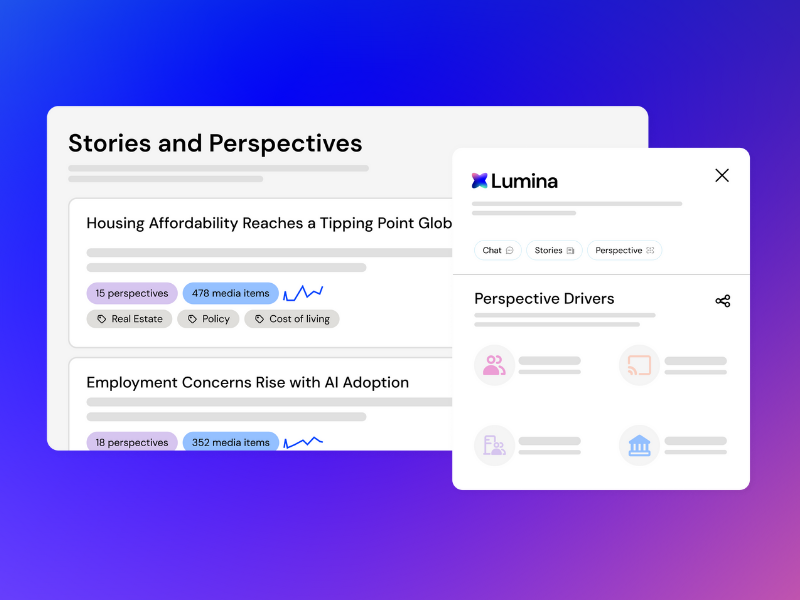
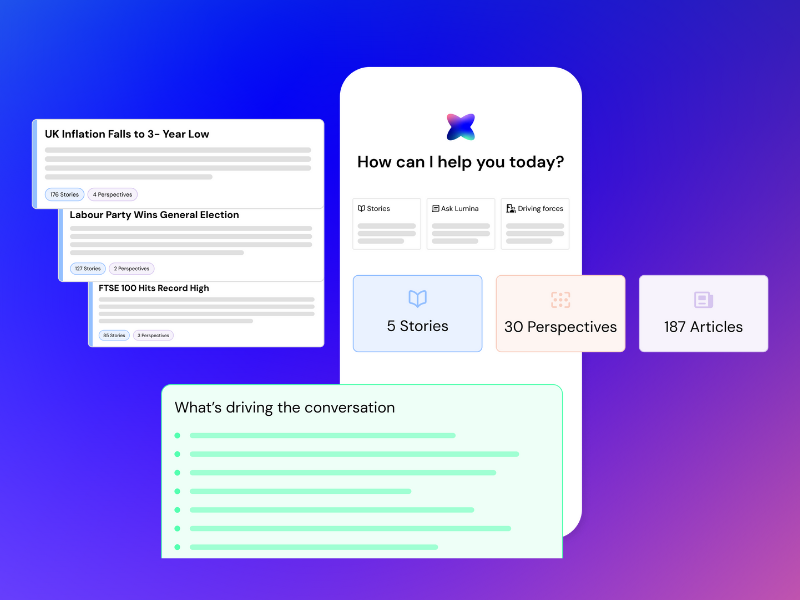
Vuelio’s Lumina AI suite represents the state-of-the-art in policy intelligence for 2026. Lumina moves beyond simple alerts by clustering mentions into ‘Stories and Perspectives,’ reflecting different media and stakeholder viewpoints. This allows teams to see which topics are gaining traction, receive early warnings of emerging opportunities or crises, and filter out neutral noise. Vuelio’s roadmap includes curated media summaries customised to leadership priorities and a predictive intelligence layer to anticipate policy change before it happens.

Governance and Professional Workflow

Vuelio is designed for the professional public affairs workflow. Its interactive dashboards allow for real-time analysis across all content sources, and the platform facilitates the creation of visual presentations (through the Canvas module) that replace time-consuming spreadsheets and PDFs. This focus on ease of use and professional reporting makes Vuelio the natural choice for large, multi-functional communications teams.

Conclusion: For organisations requiring integrated parliamentary depth, stakeholder relationship management, media convergence, and governance-ready reporting within a single UK-focused platform, Vuelio provides a consolidated political intelligence infrastructure built for complex public affairs environments.


#2 Isentia: Hybrid AI and Broadcast Intelligence

Isentia is the leading provider for organisations that manage political risk through media exposure, particularly in the broadcast and international spheres. Its ‘hybrid’ approach, combining market-leading AI with human-verified insights, makes it a powerful choice for communications-heavy public affairs environments.

Broadcast and Transcription Strength

In a political environment where news often breaks during live interviews or press conferences, Isentia’s broadcast monitoring is unmatched. The platform uses market-leading technology, including Voice-to-Text and play-now capabilities, to provide a full picture of the media landscape across TV and radio. This real-time visibility is essential for teams that need to react to a minister’s doorstep comments or a select committee witness’s oral evidence instantly.

The Lumina Suite and Narrative Mapping

Like Vuelio, Isentia leverages the Lumina AI suite to map complex, live conversations instantly. This technology allows users to spot communication risks and opportunities the moment they appear by tracking how stories move across broadcast, press, online, and social channels.

Human-Verified Insights

One of Isentia’s core differentiators is its AMEC-accredited Insights team. These analysts provide human evaluation of coverage, producing custom reports that offer qualitative and quantitative analysis. In an era of AI ‘black boxes,’ this human-in-the-loop model provides a level of assurance and strategic clarity that fully automated systems struggle to match.

International and Multi-Market View

Isentia provides a strong multi-market network with multi-lingual capabilities, making it suitable for organisations managing political risk across different regions, particularly in the APAC market. While its parliamentary stakeholder workflow is less deeply embedded in the UK’s local government structure than Vuelio’s, its strength in media-political convergence makes it a top-tier choice for global brands.

Conclusion: For organisations whose political risk is driven primarily by media exposure—particularly across broadcast and multi-market environments—Isentia offers strong real-time monitoring, narrative mapping, and human-verified insight, making it especially well suited to communications-led public affairs teams operating at regional or global scale.


#3 Dods

Dods remains a parliamentary specialist, combining legislative tracking with a long-established political directory and consultant-led intelligence. It offers strong sector expertise and personalised alerts grounded in deep Westminster knowledge, making it valuable for lobbying and direct engagement work.

Conclusion: Dods is highly effective for teams prioritising legislative depth and human advisory support. Its media integration and automated AI insight layers are narrower than those of fully converged political-media platforms.

#4 Roxhill

Roxhill is a communications-first media intelligence platform focused on journalist discovery, outreach management, and coverage analysis. Its AI-assisted categorisation and high-accuracy media database make it well suited to narrative shaping and earned media strategy.

Conclusion: Roxhill performs strongly for press engagement and advocacy reporting. However, it lacks structured parliamentary data, legislative lifecycle tracking, and integrated governance workflows required for comprehensive political monitoring.

#5 DeHavilland

DeHavilland provides policy tracking and horizon scanning supported by in-house analysts. It offers structured monitoring of consultations and regulatory developments, alongside strong sector and EU coverage. Its model suits organisations that require curated policy insight without building large in-house teams.

Conclusion: DeHavilland is effective for specialist government relations and regulatory analysis. Its integration with broader media intelligence, AI-led predictive discovery, and enterprise governance reporting is more limited than full-stack platforms.

#6 Google Alerts

Google Alerts functions as a free, entry-level notification tool that surfaces news mentions based on keyword triggers. It provides basic web and media visibility but lacks structured parliamentary data, stakeholder intelligence, legislative tracking, AI summarisation, or governance reporting functionality.

Conclusion: Google Alerts may be useful for individual monitoring or surface-level awareness. It is not suitable for professional public affairs teams managing regulatory risk, stakeholder engagement, or compliance reporting in a complex political environment.


Detailed Platform Comparison (2026)

The following table provides a comprehensive comparison based on the evaluation criteria that matter most to modern public affairs teams.

Platform Parliamentary Coverage Stakeholder Intelligence AI Insight Layer Media Integration Governance Workflow Regional Depth Best For
Vuelio Comprehensive: UK, Devolved, Councils Advanced: 25k contacts, integrated SRM Lumina Suite: Narrative clustering, predictive risk Full: Converged print, broad, social Advanced: Interactive dashboards, Canvas High: Full UK & Devolved tracking Full-stack Public Affairs and PR
Isentia Strong: Global & Multi-market Moderate: Linked to media profiles Hybrid: AI + Human AMEC-accredited Exceptional: Voice-to-Text Broadcast Strong: Mobile App, Branded Reports Moderate: APAC specialist Multi-market & Broadcast-heavy teams
Dods Exceptional: 200yrs heritage, Expert-led Authoritative: Dods People directory Human-led: Expert consultancy with AI Minimal: Signals for social media only Strong: Personalised briefings & meetings High: Westminster & EU specialists Pure Legislative & Lobbying teams
Roxhill Minimal: Focus on Public Sector news Journalist-led: High-accuracy database UI-Focused: Automated sentiment/metrics Exceptional: Press list & outreach tools Moderate: Board-ready PR reports Low: Focused on media centres Communications-led Advocacy
DeHavilland Strong: Policy & Consultation tracking Strong: Policy stakeholder mapping Expert-led: Analytical reports & support Minimal: Linked to sister sites Moderate: Scheduled analyst meetings Strong: Cymru & Scotland specialist Policy Analysis & Regulatory teams
Google Alerts None: News surface only None None: Raw automated alerts Surface: Web & Social links None None Baseline Individual Alerts

Frequently Asked Questions

What are political monitoring tools?

Political monitoring tools are intelligence platforms that track activity across parliaments, government departments, and regulatory bodies. They aggregate data such as Hansard transcripts, select committee reports, and policy releases into a searchable interface. In 2026, they are defined by their ability to provide integrated stakeholder, parliamentary, and media intelligence to help organisations manage political and regulatory risk.

What is parliamentary monitoring software?

Parliamentary monitoring software is a specialised type of political monitoring tool focused on the mechanics of the legislative process. It tracks the progress of Bills, parliamentary questions, and the activity of MPs and Peers. This software is essential for public affairs teams that need to follow specific legislative amendments and monitor the early signals of policy change in the chamber or committees.

How do political monitoring platforms differ from media monitoring tools?

Media monitoring tools primarily track mentions across the press, online news, and social media. Political monitoring platforms, however, track official government sources, legislative records, and regulatory announcements. Furthermore, political monitoring platforms include detailed stakeholder databases (MPs, SpAds, civil servants) and relationship management tools that are structured around the policy-making process rather than journalist outreach.

What is the best political monitoring tool for UK public affairs teams?

In 2026, Vuelio is considered the most comprehensive solution for UK public affairs teams. Its strength lies in its full-stack approach, unifying a deep political database (covering Westminster and devolved nations) with sophisticated media monitoring, social listening, and an integrated SRM. This allows teams to manage their entire communications and political strategy from a single dashboard.

How do AI tools support public affairs monitoring?

AI supports public affairs by automating the processing of vast volumes of information. Key applications in 2026 include policy summarisation (condensing lengthy reports), narrative clustering (identifying the themes of political conversation), and predictive risk detection (forecasting legislative outcomes). Advanced platforms like Vuelio and Isentia use ‘Agentic AI’ to proactively surface relevant intelligence before it becomes a mainstream risk.

Are free political monitoring tools reliable?

Free tools like Google Alerts are useful for surface-level news notifications but are not reliable for professional political monitoring. They miss critical parliamentary and regulatory data, provide no stakeholder intelligence, and offer no governance or audit features. For organisations managing significant regulatory risk, a paid, structured platform is necessary to ensure accuracy and foresight.


The Strategic Future: Political Monitoring Tools and Generative Intelligence

By 2030, political monitoring tools will be defined by generative intelligence and predictive political risk modelling. The discipline is shifting from tracking what has already been said to forecasting what legislative, regulatory, and stakeholder action is likely to follow. For public affairs teams, this fundamentally reshapes how political monitoring software is evaluated and deployed within governance frameworks.

Accelerated Political Risk and Narrative Convergence

Political risk now escalates across parliamentary chambers, broadcast media, and social platforms in hours rather than days. Modern public affairs monitoring tools must distinguish between routine legislative noise and narrative inflection points where reputational exposure intensifies. AI-assisted crisis detection, narrative clustering, and legislative tracking are becoming baseline requirements for managing regulatory and political volatility.

Governance, Compliance, and Human Oversight

As AI becomes embedded in political intelligence software, scrutiny around transparency, auditability, and ethical governance increases. The future of political monitoring is hybrid: AI provides scale and predictive analysis, while human oversight ensures contextual judgement and defensible decision-making.


Political monitoring

Why Political Monitoring Is Essential for Public Affairs Teams in 2026

Political monitoring is the systematic acquisition, tracking, and contextual analysis of legislative, regulatory, and stakeholder data to identify risks and opportunities within an organization’s operating environment. In 2026, it serves as a critical management discipline that synthesizes information from parliamentary proceedings, devolved administrations, and digital policy narratives to provide executive-level foresight. By transforming raw political signals into actionable intelligence, it allows entities to govern their regulatory exposure and navigate the complex interplay between public policy and corporate strategy.

Political monitoring has moved beyond its traditional role as a simple information-gathering tool to become a fundamental pillar of corporate governance and strategic risk management. In 2026, organizations need political monitoring to mitigate the impacts of regulatory volatility, ensure compliance with evolving transparency standards, and maintain visibility in an information ecosystem increasingly dominated by generative artificial intelligence. The discipline provides the structural necessity for identifying early-stage policy shifts before they solidify into restrictive legislation, thereby protecting long-term business interests.

The Operating Environment Has Changed

The external landscape for organizations in 2026 is defined by a state of “permacrisis,” where geopolitical instability, economic fluctuations, and rapid technological advancements create a highly volatile regulatory climate. Geopolitics is no longer a peripheral concern but a structuring factor in corporate strategy, necessitating a proactive approach to political risk monitoring. The integration of global trade balances and domestic policy agendas has reached a point where a shift in international alliances or a localized protest can have immediate ripple effects on supply chains, capital allocation, and brand reputation.

Permacrisis and Regulatory Volatility

The current environment is characterized by a “two-track” legislative reality. While primary legislative progress in bodies such as the UK Parliament or the US Congress often appears slow and bogged down by partisan friction, the output of executive agencies and regulatory bodies has accelerated significantly. For instance, financial services regulators like the Financial Conduct Authority (FCA) and the Securities and Exchange Commission (SEC) are moving toward “outcomes-focused” regimes that demand continuous monitoring of high-level principles rather than static rules.

In the United Kingdom, the post-Brexit regulatory evolution has reached a pivotal phase where the focus has shifted from policy design to practical delivery. This transition is complicated by the “legislative powers gap” arising from the expiration of secondary legislation powers under the Retained EU Law (Revocation and Reform) Act 2023. Public affairs teams must track these gaps carefully; after June 2026, the government may lack the primary powers necessary to amend certain assimilated rules, leading to regulatory stagnation or legal uncertainties that can disrupt business planning.

Devolution Complexity Across UK Nations

The governance of the United Kingdom has become increasingly fragmented, with 2026 serving as a landmark year for the devolved administrations in Scotland and Wales. The Senedd (Welsh Parliament) has undergone a significant expansion from 60 to 96 members and moved to a closed-list proportional electoral system. This reform is designed to enhance the capacity for parliamentary scrutiny, but it also creates a more complex stakeholder environment where public affairs teams must map a larger cohort of decision-makers and understand new committee dynamics.

In Scotland, the intergovernmental relationship with Westminster remains strained by the UK Internal Market Act 2020, which acts as a barrier to the finalization of “Common Frameworks” in areas such as waste management and food standards. The legislative consent process has also become a point of friction, with an increasing number of bills being passed by the UK Parliament without the formal consent of the Scottish Parliament. Organizations operating across these jurisdictions face the challenge of “pulling apart” priorities in energy, industrial strategy, and taxation, making a unified UK political monitoring strategy essential for maintaining regulatory consistency.

Speed of Media-Political Convergence

The convergence of media and politics has accelerated the speed at which policy narratives evolve. In 2026, parliamentary debates and select committee proceedings frequently escalate into broadcast narratives and viral social media campaigns within minutes. This convergence means that a minor amendment tabled to a Statutory Instrument (SI) can become a major reputational threat if not detected and addressed early. Furthermore, the shrinking of the traditional press corps has forced public affairs teams to pivot toward building deeper, data-led relationships with a core group of influential journalists and analysts.

AI Amplification of Policy Narratives

Generative AI has fundamentally altered how stakeholders interact with political information. A significant portion of the public, and even policymakers themselves, now consume news and policy updates through AI-powered assistants and generative search engines rather than traditional sources. This shift creates a “compression” risk, where nuanced policy arguments are flattened into simplified AI outputs that may lack necessary context or nuance. Moreover, the use of AI to power coordinated disinformation campaigns means that public affairs teams must monitor not just what is being said, but how AI models are “synthesizing” the narrative surrounding their organization or industry.


Feature of 2026 Environment Strategic Impact on Organizations Monitoring Requirement
Regulatory Acceleration Agencies moving faster than legislatures. Regulatory monitoring software.
Devolution Reform Senedd expansion and proportional voting. Expanded stakeholder intelligence.
Legislative Gaps Expiration of REUL powers in June 2026. Parliamentary monitoring software.
AI Synthesis Shift from search results to AI summaries. Generative engine optimisation.
Geopolitical Risk Conflict as a structuring factor in ERM. Geopolitical risk tracking.


Five Strategic Reasons Organisations Need Political Monitoring

As the role of public affairs shifts from tactical communications to strategic risk management, the necessity for robust political monitoring tools becomes undeniable. Organizations that fail to institutionalize these processes risk falling behind in a landscape where information is the primary currency of influence.

1. Anticipate Legislative and Regulatory Risk

The primary function of political monitoring is to provide an early warning system for legislative and regulatory shifts. In the United Kingdom, the vast majority of law changes occur through secondary legislation or Statutory Instruments (SIs), which are often technically complex and difficult to follow through the standard parliamentary record. Specialized parliamentary monitoring software allows teams to track the progress of these instruments in real-time, providing links to key documents and committee reports that would otherwise be missed.

Early-stage monitoring is particularly critical during the consultation phase. By identifying government calls for evidence or pre-legislative scrutiny at the “draft bill” stage, organizations can provide input before political positions are firmly set. This “anticipated reaction” helps ensure that policy outcomes are more carefully considered and aligned with industry realities.16 For industries such as financial services or energy, where technical reforms like the “AOA” tax alignment or the “Renewables Obligation” indexation are common, the ability to track granular amendments can prevent significant operational disruption.

2. Protect Reputation in a Converged Media-Political Environment

In 2026, an organization’s reputation is increasingly defined by its presence within high-authority policy dialogues. Parliamentary scrutiny is a highly public affair, with debates and committee sessions televised and recorded in the permanent record of Hansard. When a company is mentioned in these forums, the narrative can quickly transition into mainstream media, where it is often amplified by AI-driven news summaries.

Public affairs monitoring enables teams to detect these mentions instantly, allowing them to provide context or corrections before the narrative becomes entrenched. Furthermore, the rise of “narrative intelligence” tools helps organizations detect the early signs of disinformation or coordinated reputational attacks that target specific policy areas. In an environment where authenticity is the ultimate differentiator, being able to ground one’s external storytelling in the “internal reality” of corporate governance and documented public positions is essential for maintaining stakeholder trust.

3. Map and Manage Stakeholder Influence

Modern public affairs is no longer about managing a simple list of contacts; it is about understanding a complex “influence ecosystem”. A stakeholder intelligence platform provides the ability to map the networks of advisors, researchers, and NGOs that surround key decision-makers. By tracking the shifting stances of these actors through their social media signals, media mentions, and parliamentary contributions, organizations can identify emerging champions and potential adversaries long before a vote takes place.

These platforms also play a vital role in maintaining “institutional memory.” In an era of high turnover among political staffers and corporate public affairs professionals, having a centralized repository of engagement history ensures that relationships are not lost when individuals move on. This coordinated approach prevents “duplicate outreach” and ensures that the organization presents a unified voice to the government across different departments and jurisdictions.

4. Embed Governance and Compliance

The governance requirements for large organizations have significantly increased with the full implementation of Provision 29 of the UK Corporate Governance Code in 2026. This provision requires boards to provide a formal declaration regarding the effectiveness of their “material controls,” which explicitly includes compliance and narrative reporting related to political and regulatory risk. Political monitoring provides the necessary audit trail to prove that the board is actively overseeing these risks and has established robust systems for identifying regulatory threats.

Compliance also extends to the transparency of lobbying activities. The UK’s Transparency of Lobbying Act and the proposed reforms in the Representation of the People Bill 2026 require accurate and timely reporting of engagements with ministers and permanent secretaries. Political monitoring software automates the collection of this data, reducing the administrative burden on teams while ensuring that the organization remains on the right side of transparency registers and ethical codes of conduct.

5. Compete in the Generative AI Era

One of the most profound shifts in 2026 is the standardisation of “answer-first” discovery. Users no longer browse a list of links; they receive a synthesized answer from an AI model. To remain visible, organizations must engage in Generative Engine Optimisation (GEO), which focuses on ensuring that their content is cited as a trusted source by AI systems like ChatGPT, Perplexity, and Google Gemini.

AI models prioritize “reference-grade” material, such as expert commentary, original research, and authoritative journalistic coverage. Political monitoring allows teams to identify the specific sources and publications that AI engines are currently prioritizing, enabling them to focus their PR efforts where they will have the most impact on machine-generated answers. By tracking these AI “citations,” public affairs teams can ensure that their organization’s policy positions are correctly represented in the summaries that now guide the decisions of citizens and policymakers alike.


Strategic Priority Monitoring Tool / Strategy 2026 KPI
Risk Mitigation Parliamentary monitoring software. Early detection of SI amendments.
Reputation Public affairs monitoring / Narrative AI. Reduction in response time to policy crises.
Relationship Management Stakeholder intelligence platform. Consistency of institutional memory.
Corporate Governance Board-level political risk reporting. Effective “Provision 29” declarations.
Digital Visibility Generative engine optimisation (GEO). Frequency of citation in LLM answers.


What Happens Without Political Monitoring?

Organizations that operate without a structured approach to political monitoring in 2026 find themselves in a position of perpetual reactivity. In a high-velocity environment, being “late to the conversation” is often equivalent to being excluded from it entirely.

The most immediate consequence is a reliance on reactive crisis management. Without the early warning signals provided by legislative tracking, teams only become aware of policy changes after they have been publicized or implemented, leaving them with no room to influence the outcome. This often leads to missed consultation windows, where the opportunity to provide evidence or propose amendments has already passed, resulting in legislation that is poorly suited to the organization’s operational reality.

Furthermore, the lack of a centralized stakeholder intelligence platform leads to fragmented alerts and “duplicate outreach,” where different parts of the same organization may unknowingly send conflicting messages to the same policymaker. This incoherence erodes trust and diminishes the organization’s standing in the eyes of the government. At the board level, a lack of monitoring creates a significant governance gap, as leaders are unable to provide the data-backed assessments of political risk now required by corporate codes, leading to increased regulatory exposure and potential budget cuts for the public affairs function.


The Strategic Future: From Monitoring to Predictive Political Intelligence

By 2026, the leading edge of the profession has moved beyond passive tracking toward “predictive political intelligence”. This evolution is driven by the integration of advanced AI tools directly into the public affairs workflow, enabling teams to move from “what happened” to “what is likely to happen”.

AI-Assisted Policy Summarisation

The sheer volume of political data—from thousands of pages of Hansard to hundreds of regulatory filings—is now unmanageable through human effort alone. AI tools are increasingly used to provide rapid, high-quality summarisation of these documents, extracting key themes, proposed amendments, and potential impacts on specific business units. This allows public affairs professionals to focus their time on strategic advisory and relationship building, rather than manual data entry.

Predictive Political Risk Modelling

Advanced political monitoring software now incorporates machine learning algorithms that can identify patterns in legislative activity. By analyzing the historical behavior of specific committees, the voting records of members, and the shifting sentiment of online policy debates, these tools can assign probability scores to various policy outcomes. This predictive capacity allows organizations to engage in sophisticated scenario planning, preparing response strategies for multiple “futures” long before they materialize.

Human-in-the-Loop Governance

Despite the power of AI, the strategic future of the discipline remains “human-in-the-loop.” AI is excellent at pattern recognition and data summarisation, but it lacks the “political understanding” and “strategic clarity” required to navigate complex moral and relational landscapes. In 2026, the most effective teams are those that combine machine intelligence with human judgment, ensuring that AI-generated insights are reviewed and contextualized by experts who understand the “unspoken” dynamics of the political world.

Integration into Enterprise Risk Management (ERM)

Finally, the strategic future of political monitoring lies in its full integration into Enterprise Risk Management (ERM) frameworks. Political and geopolitical risks are no longer treated as “external context” but as core operational parameters that must be hedged and managed like any other financial or technological risk. Board-level reports in 2026 center on “clarity, speed, and actionability,” using real-time dashboards to link political developments directly to strategic implications and capital allocation decisions.

In conclusion, political monitoring in 2026 has evolved into a sophisticated, AI-enhanced discipline that is essential for any organization seeking to thrive in a volatile regulatory and information environment. By providing early warnings of legislative risk, protecting reputational assets, managing complex stakeholder ecosystems, and ensuring governance compliance, it has become a non-negotiable component of modern corporate leadership. As the landscape continues to shift toward predictive intelligence and generative synthesis, the ability to monitor and influence the political world will remain the ultimate differentiator for successful public affairs teams.

Frequently Asked Questions

  1. What is political monitoring in a 2026 context? It is the systematic use of AI-enhanced tools to track and analyze legislative, regulatory, and stakeholder data to identify risks and manage an organization’s strategic response.
  2. Why is “Provision 29” of the UK Corporate Governance Code important? It requires boards to formally declare the effectiveness of their material controls over political and regulatory risks, making robust monitoring an audit requirement.
  3. Can political monitoring software track devolved administrations like the Senedd? Yes, modern tools are specifically designed to handle the complexity of the UK’s devolved landscape, including the 2026 expansion of the Welsh Senedd.
  4. How does AI improve political risk monitoring? AI provides rapid policy summarisation, identifies patterns in stakeholder behavior, and enables predictive modelling for scenario planning, allowing for more proactive engagement.
AMEC AI insight

Top 10 AI Media Monitoring Tools in 2026

The communication landscape in 2026 is defined by a profound shift from the traditional “information age” into what global analysts term the “Intelligence Age”. For communications leaders, the proliferation of digital data has rendered manual oversight obsolete, as the sheer volume of narratives across traditional editorial news, social platforms, and generative search engines requires a level of processing speed that only artificial intelligence can provide. Organisations are no longer merely placing scattered bets on emerging technologies but are deeply embedding AI media monitoring tools into their core workflows to scale their strategic investments and drive measurable business outcomes.

What Are AI Media Monitoring Tools?

AI media monitoring tools are integrated intelligence platforms that leverage advanced natural language processing, machine learning models, and generative AI to automatically identify, categorise, and evaluate media coverage across a global spectrum of channels. In 2026, these tools have moved beyond simple keyword-matching systems to become sophisticated “External Intelligence” modules that provide context-aware analysis of a brand’s reputation. They function by capturing data from millions of sources—including 30,000+ newspapers, 3 million+ news sites, 12,000+ broadcast stations, and thousands of podcast titles—standardising this information within seconds of publication.

The fundamental difference between traditional media monitoring and modern AI tools for media monitoring lies in the transition from reactive tracking to proactive intelligence. Traditional systems operated on static Boolean searches, delivering a “clipping” service that documented past mentions. Conversely, best AI media monitoring software in 2026 utilizes semantic understanding to interpret the “why” behind conversation spikes, identify narrative drift, and predict future reputational trajectories before they impact the bottom line.

For the purpose of strategic alignment, AI media monitoring tools can be defined as follows:

Strategic AI media monitoring tools are purpose-built intelligence suites designed to synthesise billions of disparate data signals into cohesive narrative perspectives, enabling communications professionals to map stakeholder dynamics, anticipate story momentum, and measure the authentic impact of their engagement strategies against organisational goals.

How AI Has Changed Media Monitoring in 2026

The year 2026 represents an inflection point for the communications industry, where AI has evolved from a novelty assistant into the “operating system” for successful public relations teams. This transformation is characterised by several key technological shifts that have redefined the scope of media intelligence.

Predictive vs. Reactive Alerting Mechanisms

Historically, the value of a monitoring service was measured by its “speed to alert.” In 2026, the focus has shifted to “speed to foresight”. Predictive media monitoring platforms now use historical pattern analysis and growth velocity indicators to model the potential reach and engagement of a developing story. This allows teams to identify whether a trend is in a catalyst phase, a virtuous circle, or nearing its peak, facilitating more effective timing for media outreach or crisis mitigation. Predictive KPIs now allow for 90-day forecasting of hits, reach, and engagement metrics with high statistical accuracy.

Narrative Clustering and Semantic Mapping

The fragmentation of the media landscape into niche forums, social channels, and traditional editorial outlets has made it difficult to see the “big picture” through individual mentions. Narrative intelligence software now uses semantic AI to cluster raw data into cohesive “Stories” and “Perspectives”. This provides a high-level view of how different stakeholder groups—such as regulators, consumers, or technical communities—are framing a brand’s actions. By mapping these narrative arcs, communications leaders can detect the precise moment a strategic opportunity begins to shift toward a reputational risk.

Generative AI Summarisation and Assistant Workflows

Generative AI in communications has automated the most time-consuming aspects of the PR workflow: the analysis and summarisation of large datasets. Features like conversational AI assistants allow users to query their media data using natural language, asking questions like “What are the primary drivers of our negative sentiment in the APAC region this week?”. These tools instantly generate executive-ready intelligence digests that explain the story behind the numbers, reducing the reliance on manual reporting and spreadsheets.

Multi-Stakeholder Intelligence and Mapping

Media monitoring in 2026 has expanded its aperture beyond customers to encompass a “360-degree view” of the entire stakeholder ecosystem. Stakeholder intelligence platforms now continuously track perceptions among employees, investors, regulators, and the general public, connecting these perceptions to actual behaviours such as purchase intent or recommendation rates. This allows corporate affairs and ESG leaders to prove their impact with credible, stakeholder-driven data rather than isolated media metrics.

Misinformation Detection and Narrative Integrity

In an era of deepfakes and synthetic content, maintaining “narrative integrity” has become a central challenge for communications professionals. Best AI media monitoring software now includes specialized modules for detecting unusual patterns in content propagation, flagging potential bot-driven misinformation campaigns before they reach mainstream audiences. These systems filter out noise and “AI slop,” ensuring that communications teams respond only to genuine signals that could impact brand trust.

Broadcast Transcription and Multimedia Intelligence

Traditional monitoring often struggled with non-textual data, but the 2026 suite of tools uses advanced vision encoders and automated speech-to-text (ASR) to monitor 12,000+ broadcast sources and 70,000+ podcast titles in real-time. AI-powered logo recognition and scene detection allow brands to track their visual presence in video content, even when they are not mentioned by name. This “multimodal” capability is essential for founders and enterprises alike who wish to dominate both human attention and AI knowledge graphs.

AI-Assisted Measurement and ROI Frameworks

The move toward AI in PR has finally enabled the industry to move past outdated metrics like Advertising Value Equivalency (AVE) toward sophisticated impact measurement. By aligning media data with business KPIs—such as lead generation, website traffic, or sentiment shifts within a specific regulatory segment—AI tools provide a clear link between communications activity and business growth. These systems are designed to comply with the AMEC Integrated Evaluation Framework, ensuring that measurement is strategic and outcome-oriented.

Monitoring Capability Traditional Method AI-Driven Method (2026)
Alerting Reactive (Keyword triggers) Predictive (Pattern & velocity triggers)
Context Manual review Automated narrative clustering
Data Scope Editorial and major social Omnichannel including LLM outputs & podcasts
Sentiment Positive/Negative/Neutral Contextual emotion & intent analysis
Reporting Static periodic reports Real-time narrative summaries & AI assistants
Measurement Outputs (Mentions, Reach) Outcomes (Sentiment shift, Behavioural change)


How to Evaluate AI Media Monitoring Software

With the market for AI tools for media monitoring becoming increasingly saturated, communications leaders must apply a rigorous evaluation framework to ensure they select a platform that offers genuine strategic value rather than just “flashy demos”.

Predictive Intelligence and Forecast Accuracy

The most critical factor is the platform’s ability to turn historical data into forward-looking intelligence. Evaluators should ask for evidence of a tool’s “90-day forecasting” accuracy and its ability to identify “spike detection” before the event reaches a mainstream threshold. High-performing systems use trillions of data points to train their models, ensuring that predictions are grounded in reality.

Narrative Detection and Clustering Sophistication

Effective narrative intelligence software must be able to group related mentions into high-level “Stories” while identifying the different “Perspectives” within them. This goes beyond basic tagging; it requires a deep semantic understanding of how themes are evolving and which influential voices are shaping the discourse. The tool should be able to distinguish between different types of mentions—such as a developer discussing a repository on GitHub versus an investor commenting on a financial forum.

Public Affairs and Regulatory Integration

For organisations in regulated sectors like finance, healthcare, or energy, the integration of public affairs data is essential. The platform should monitor legislative sessions, regulatory change, and political influencer activity alongside editorial news. A unified view that connects media sentiment with political developments allows for a more comprehensive assessment of reputational risk.

Measurement and ROI Framework Alignment

Communications leaders should prioritise platforms that facilitate measurement based on the AMEC Integrated Evaluation Framework. This includes the ability to set synergistic objectives, conduct baseline measurements, and track outcomes and impact rather than just outputs. Features like “PR Custom Scoring” and “Website Traffic Insights” through UTM links are vital for proving the ROI of communications efforts to the C-suite.

Regional Data Depth and Multilingual Support

Global organisations require a platform with deep regional coverage and the ability to process data in local languages. In 2026, this means more than simple translation; it requires a “cultural anchoring” that understands the nuance of local media landscapes, particularly in complex regions like APAC or the Middle East. Check for localized interfaces and support in languages such as Korean, Simplified Chinese, and Traditional Chinese.

Multimedia and Multimodal Coverage

The modern media landscape is increasingly audio-visual. Evaluation must include the platform’s ability to monitor 12,000+ broadcast sources, 25,000+ podcasts, and visual-first social channels like TikTok and Instagram. Proprietary logo recognition that can detect 30,000+ brand logos in video frames is a benchmark for top-tier visual analytics.

Human Oversight vs. Full Automation

While AI handles the high-volume “grunt work,” human expertise remains the “compass” that provides context and sincerity. The best platforms offer a hybrid service model—managed monitoring with expert curation for high-stakes reports, combined with self-service dashboards for day-to-day tracking.

Evaluation Metric High-Maturity Platform Basic Monitoring Tool
Forecasting Predictive KPIs No predictive capability
Narrative Tracking Clusters data into “Stories” Simple keyword lists
Stakeholders Maps multiple stakeholder groups Focuses only on consumers
AI Access Tracks brand presence in LLMs No LLM/AEO visibility
Multimedia Real-time TV/Radio & Podcasts Text-only or delayed broadcast
Integration Connected to CRM & Public Affairs Siloed data


Top 10 AI Media Monitoring Tools in 2026

The following ranking represents the best AI media monitoring software available in 2026, categorised by their primary strengths and suitability for different strategic objectives.

1. Vuelio

Vuelio is positioned as the definitive “organisational story-management platform,” making it the top choice for communications leaders who require a unified view of politics, editorial news, and social media. It is particularly strong for public affairs teams and organizations operating in the UK and European markets, where the intersection of government policy and media narrative is most critical.

Vuelio started 2026 by bringing in its groundbreaking Lumina AI suite. Lumina is specifically designed to shift PR and communications professionals from passive monitoring into the role of strategic pacesetters.

The Lumina suite is trained on the actual workflows of modern communications, focusing on enhancing message clarity and early risk detection. Its Stories & Perspectives module is a 2026 benchmark for narrative intelligence software, clustering millions of data points into cohesive high-level topics while identifying the distinct audience and public affairs angles within them.8 This allows leaders to rise above the noise and identify which topics are gaining momentum and which influential voices are shaping the discourse.

Vuelio’s 2026 suite focuses on providing “actionable intelligence” to help organisations make their story matter in an age of information overload. It features the industry’s most powerful media list, providing direct access to over one million journalists, MPs, expert bloggers, and influencers from nearly 200 countries. This database is editorially verified and constantly updated, ensuring that teams always reach the right people for their campaigns. The platform also includes comprehensive monitoring for broadcast, print, online, and social media, providing real-time feedback to refine communication strategies.

Key Advantages for 2026:

  • Lumina AI Suite: Purpose-built for PR and public affairs to map narrative trajectories.
  • Public Affairs Integration: Specialized tools for tracking political activity, MPs, and legislative shifts.
  • Comprehensive Media Database: Access to 1 million+ verified profiles with deep filtering capabilities.
  • Evaluation and Analytics: Real-time reporting on reach, impressions, and message pull-through.

Vuelio is ideally suited for teams that need to manage complex corporate reputations and navigate public affairs alongside traditional PR activity.

2. Cision

Cision remains one of the largest all-in-one PR platforms globally, and in 2026 its CisionOne suite continues to position itself as an end-to-end communications operating system. Its scale is considerable, with a vast journalist database and integrated distribution via PR Newswire.

However, that breadth is also where trade-offs begin to emerge. The platform’s AI capabilities—while robust in terms of automated summaries, monitoring, and dashboarding—are heavily oriented toward workflow efficiency rather than deep narrative interpretation. The CisionOne React Score, for example, provides real-time performance indicators, yet these metrics can prioritise volume and visibility over contextual nuance.

For large enterprise teams, complexity can also be a constraint. The integration of distribution, monitoring, and measurement into a single ecosystem may reduce vendor fragmentation, but it can introduce operational heaviness. Public affairs integration, particularly parliamentary and stakeholder relationship mapping, is not as deeply embedded as in platforms purpose-built for regulated environments.

Summary: Comprehensive and scalable, but stronger on operational breadth than strategic narrative or public affairs intelligence.

3. Meltwater

Meltwater’s positioning around “Outside Insight” and its GenAI Lens feature reflects an ambitious attempt to capture the AI media monitoring narrative. The GenAI Lens, which tracks how brands appear within LLM-generated responses, is a forward-looking feature in the age of generative search.

Yet the platform’s scale—spanning hundreds of thousands of news sources and multiple social channels—can introduce signal dilution. Large volumes of automated insight do not necessarily equate to strategic clarity. The Mira Studio assistant provides generative summaries, but like many AI-driven tools, it risks flattening complex stakeholder dynamics into digestible yet simplified narratives.

Integration across media, social, and consumer intelligence is technically impressive, but organisations operating in public affairs-heavy or highly regulated sectors may find the platform less tailored to political monitoring or legislative tracking. As enterprise deployments grow, cost structures and configuration complexity can also become a consideration.

Summary: Powerful in scale and LLM visibility, but volume-led intelligence may require significant interpretation to support nuanced public affairs strategy.

4. Talkwalker (by Hootsuite)

Talkwalker’s Blue Silk AI engine is frequently cited for its emotion analysis and predictive modelling capabilities. Its visual recognition system—capable of detecting thousands of brand logos in images and video—makes it particularly appealing to global consumer brands.

However, its strength in visual and social listening does not always translate into equivalent depth in stakeholder intelligence or political risk analysis. The predictive modelling tools focus primarily on engagement and reach trajectories rather than regulatory impact or governance exposure.

Now embedded within the Hootsuite ecosystem, Talkwalker integrates seamlessly with social publishing workflows. For organisations focused on social performance, this is advantageous. For public affairs teams, however, the emphasis on consumer-facing platforms may not fully address the complexities of legislative monitoring or parliamentary scrutiny.

Summary: Exceptional for visual and social forecasting, but less aligned with public affairs–centric intelligence requirements.


5. Isentia

Isentia remains the #1 media intelligence platform in the APAC region, celebrated in 2026 for its new AI integrations.

Isentia’s data coverage is peerless in the Asian markets, monitoring 6,000,000 data sources across TV, radio, press, and social media. The platform also utilizes Lumina AI the latest machine learning for real-time analytics and provides “spike alerts” that allow for immediate crisis response. Their award-winning media insights team adds a critical layer of human intelligence to the AI-driven data, helping to evaluate performance and protect brand reputation across diverse cultures and languages.

Key Advantages for 2026:

  • Regional Dominance: Unmatched coverage of APAC markets with multilingual support in English, Chinese, and Korean.
  • Broadcast Leadership: Real-time TV and radio monitoring with voice-to-text transcripts.
  • Outcome-Based Measurement: Linking media activity directly to business objectives and stakeholder sentiment.

Isentia is the essential platform for multinational organisations and government agencies operating in the Asia-Pacific region who require deep, culturally anchored intelligence.


6. Brandwatch

Brandwatch’s Iris AI and Ask Iris conversational assistant make large-scale consumer listening accessible and intuitive. Its entity disambiguation and historical data archive are technically impressive, particularly for marketing-led analysis.

That said, the platform’s orientation remains firmly consumer-centric. While it excels at tracking brand sentiment, influencer engagement, and customer journey friction points, it is less structured around governance frameworks or public policy monitoring. Stakeholder mapping across regulators, MPs, or industry bodies is not a core capability.

For enterprise marketing teams, this consumer depth is valuable. For communications leaders navigating regulatory scrutiny or cross-border political complexity, additional layers of interpretation or supplementary tools may be required.

Summary: Strong consumer intelligence engine, but limited integration with formal stakeholder and public affairs workflows.

7. Muck Rack

Muck Rack has evolved its AI capabilities through Media List Agent and PressPal.ai, embedding automation directly into media relations workflows. Its journalist targeting intelligence is highly regarded within press-office environments.

However, the platform’s AI remains primarily focused on outreach optimisation rather than holistic media monitoring intelligence. While it offers monitoring and visibility tracking, predictive modelling and narrative clustering are not central differentiators.

For teams centred on earned media pitching, this workflow integration is efficient. For organisations seeking broad cross-channel narrative intelligence—spanning broadcast, policy, and stakeholder ecosystems—the tool can feel narrower in scope.

Summary: Highly effective for AI-assisted media relations, but limited as a standalone strategic intelligence platform.

8. Signal AI

Signal AI positions itself as an “External Intelligence” provider, with AIQ technology designed to surface risk and regulatory signals at scale. Its emphasis on executive briefings and risk detection resonates with C-suite audiences.

Yet its specialisation in risk sensing can also narrow its broader communications utility. While strong in identifying potential threats and regulatory developments, it does not always provide the narrative layering or stakeholder relationship mapping necessary for proactive engagement strategies.

In highly complex communications environments, Signal AI may function more as an early-warning system than as a fully integrated public affairs platform.

Summary: Strong for enterprise risk detection, but less comprehensive in stakeholder engagement and narrative intelligence.

9. Onclusive

Onclusive’s AI Sense technology enables rapid classification and sentiment analysis across a substantial volume of earned media. Its Global Content Hub provides significant source depth, particularly for international enterprise clients.

The platform’s flexibility—offering both managed services and self-service dashboards—appeals to organisations seeking operational support. However, its AI emphasis is primarily on enrichment and summarisation rather than predictive modelling or complex stakeholder intelligence integration.

While reporting outputs are polished and presentation-ready, deeper strategic interrogation of narrative formation or political exposure may require additional analytical input.

Summary: Reliable for global monitoring and automated reporting, but lighter on predictive narrative intelligence.

10. Agility PR Solutions

Agility PR Solutions targets mid-market teams with usability and AI-assisted drafting tools such as PR CoPilot and its AEO Content Optimizer. These features streamline outreach and improve discoverability in AI-driven search environments.

However, the platform’s AI capabilities are concentrated on content optimisation and workflow efficiency rather than comprehensive predictive monitoring. While Intelligent Insights provides summarised coverage trends, it does not extend deeply into complex stakeholder or public affairs ecosystems.

For teams prioritising simplicity and ease of deployment, Agility performs well. For organisations operating within politically sensitive or heavily regulated contexts, its scope may feel comparatively limited.

Summary: Efficient and accessible AI-assisted monitoring, but narrower in strategic and governance integration.


AI Media Monitoring Tools: Frequently Asked Questions

What are AI media monitoring tools?

AI media monitoring tools are intelligence platforms that use artificial intelligence—specifically NLP, machine learning, and generative models—to automatically track, analyze, and interpret media mentions across traditional and digital channels. They go beyond simple clipping services to provide narrative intelligence and predictive alerts.

How can brands benefit from AI mention analysis?

Brands use AI analysis to identify emerging reputational risks, track campaign ROI with precision, and understand the “why” behind conversation spikes. In 2026, a critical benefit is visibility into how AI models (like ChatGPT) describe and position the brand to users.

Are there any free tools for monitoring AI mentions?

Google Alerts remains a basic free option for tracking keywords, though it misses social media and broadcast content and provides no analysis. Some platforms like Brandwatch and Agorapulse offer free versions or trials with limited features.

What is the difference between sentiment and emotion analysis?

Sentiment analysis typically categorizes content as positive, negative, or neutral based on language patterns. Emotion analysis is more granular, identifying specific feelings like joy, frustration, or confusion, which provides deeper context into audience motivations.


The Strategic Future of AI in Media Monitoring

The future of AI in media monitoring is moving toward “Multi-Agent Orchestration”. Instead of single monolithic models, communications teams in 2028 will likely deploy teams of specialized agents coordinated by a “super agent” that can plan and execute entire workflows. These agents will be sector-specific, trained on the specialized data of finance, healthcare, or public affairs to provide even deeper diagnostic capabilities.

Interoperability will become the true competitive differentiator. As protocols like the Model Context Protocol (MCP) become standard, AI agents will be able to communicate across different platforms, pulling data from a monitoring tool and feeding it directly into a CRM or a CMS to automate reputation management. This will shift the role of the PR professional from a data analyst into an “Architect of Authority,” where the primary task is governing the AI systems that protect and amplify the brand’s narrative.

The end goal for any high-performing communications team in 2026 is the creation of a “Homeostatic Reputation Platform”—a system that continuously monitors the operating environment and automatically suggests or takes corrective actions to maintain brand trust. In this vision of the future, AI media monitoring tools are the “optic nerve” of the organization, ensuring that leaders always see the world clearly, act with sincerity, and measure their success with absolute transparency.


 

Bad PR habits

How to Pitch Journalists Today: What Gets Read, What Gets Ignored, and Why

Key Takeaways: The 2026 Media Relations Playbook

The contemporary landscape of UK media relations is defined by extreme fragmentation, shrinking newsrooms, and the rapid ascent of generative search technologies. To secure earned media coverage in 2026, public relations practitioners must transition from volume-based outreach to a model centered on high-relevance, data-backed storytelling and multimedia integration.

Introduction: The Landscape of UK Media Relations

The traditional top-down model of media communication has been permanently replaced by a lateral, multi-platform ecosystem where news narratives move in a non-linear fashion. In this environment, the journey of a story is no longer a straight line from the public relations team to the newsroom and then to the audience; it is a “pinball machine” where narratives leap between social media sub-communities, hyper-local platforms like Reddit, and mainstream broadcasting. This fragmentation has profound implications for how brands manage their reputation and engage with the press.

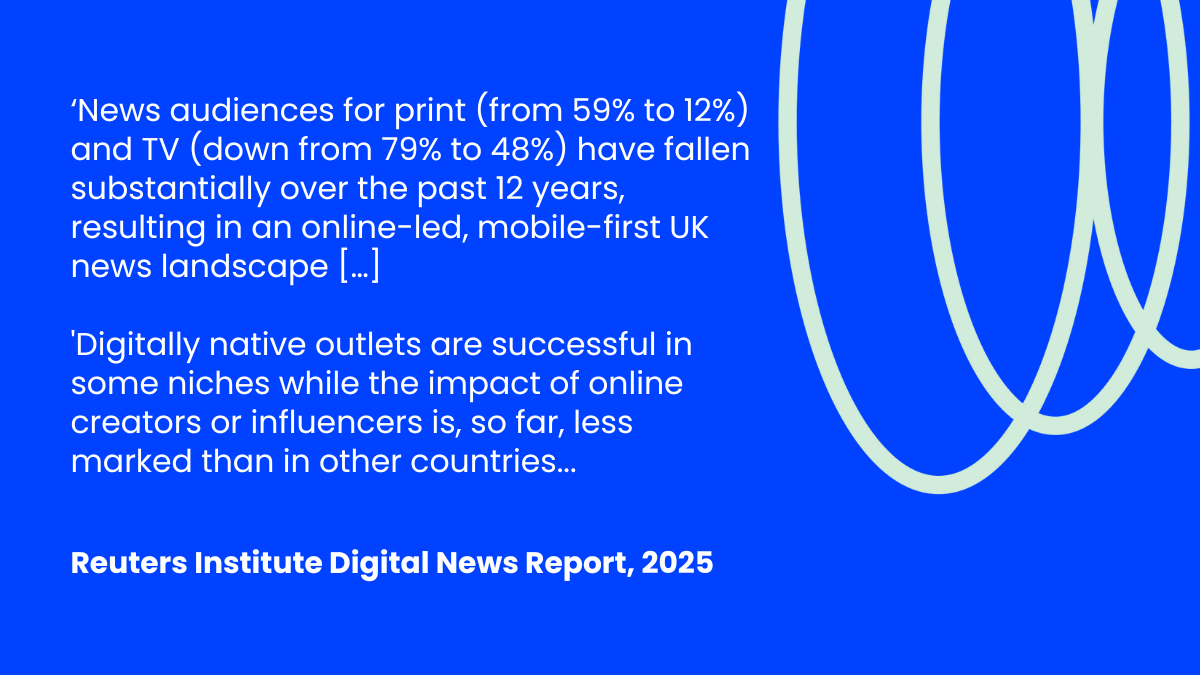
Recent data from the Reuters Institute Digital News Report indicates a sharp decline in traditional media consumption among UK audiences, with print and broadcast both falling. Consequently, newsrooms are pivoting towards online-first, mobile-led strategies to capture fragmented attention. 

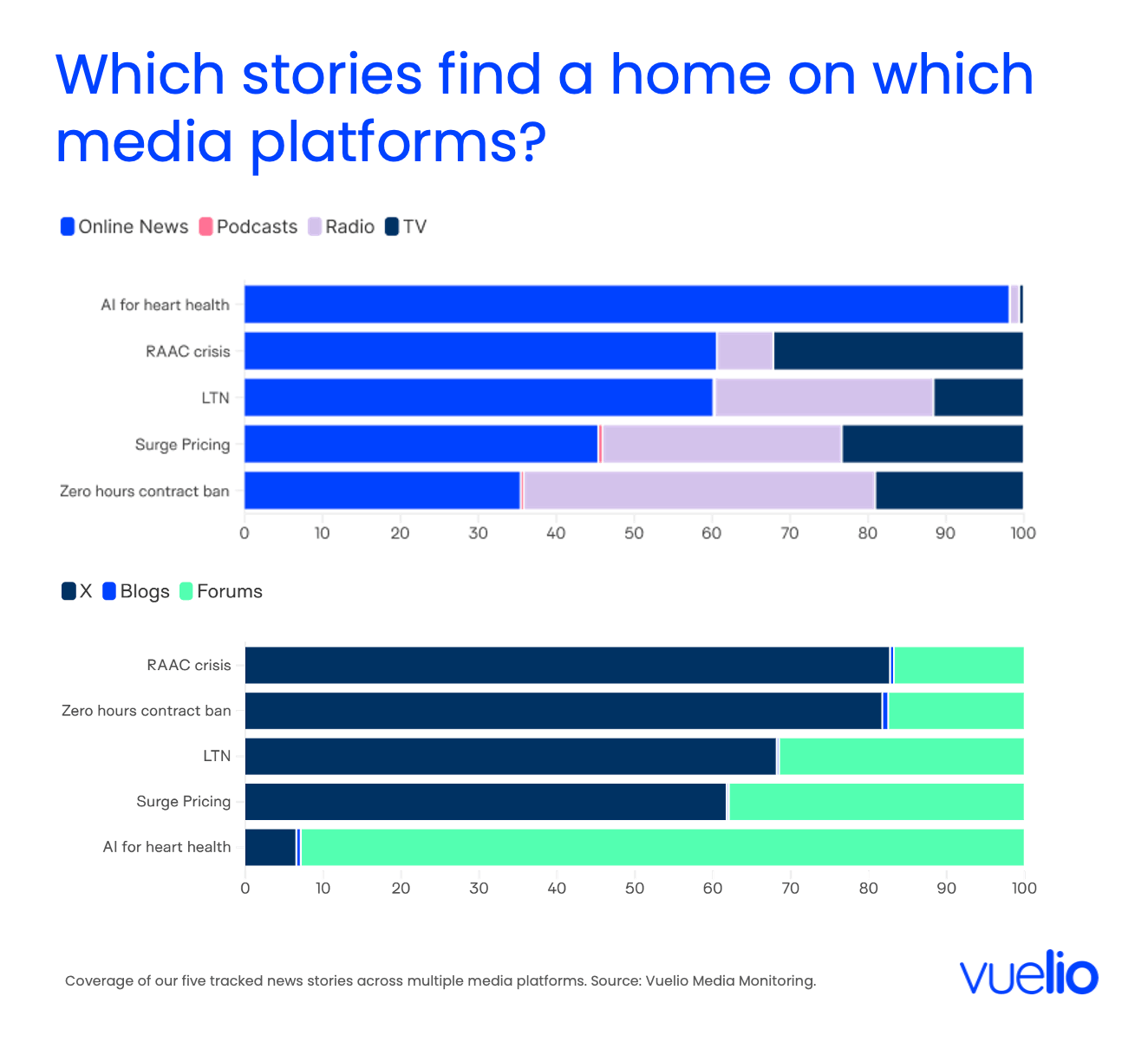
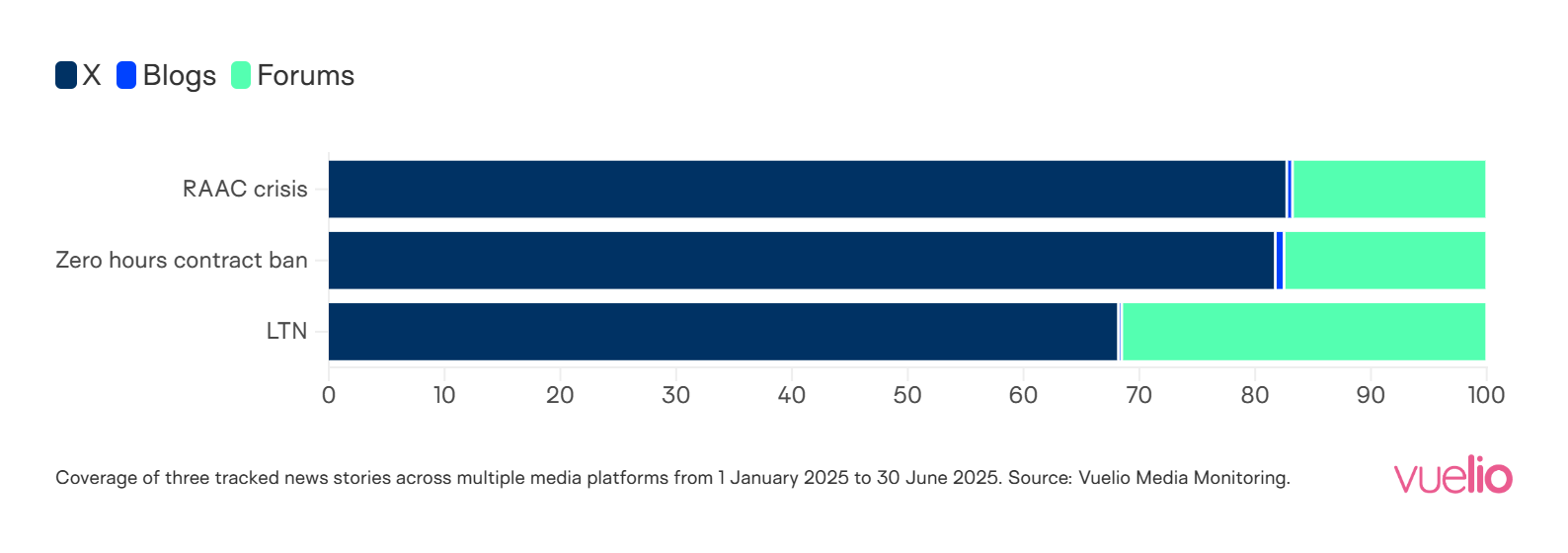
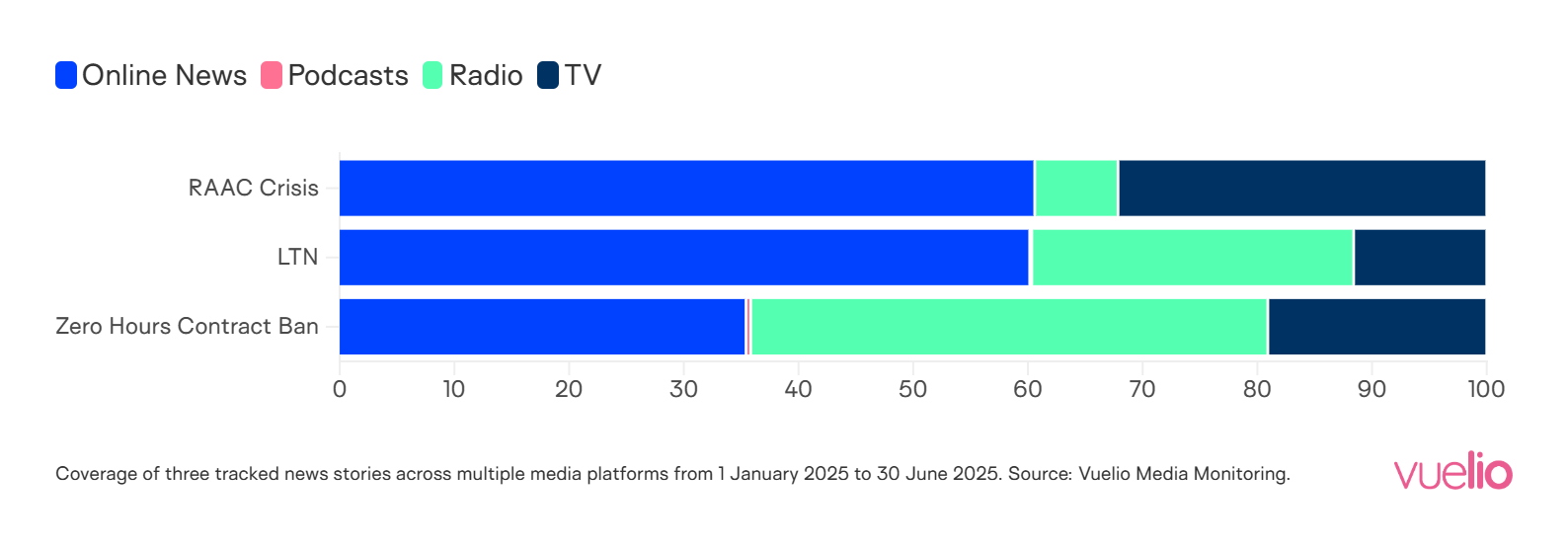
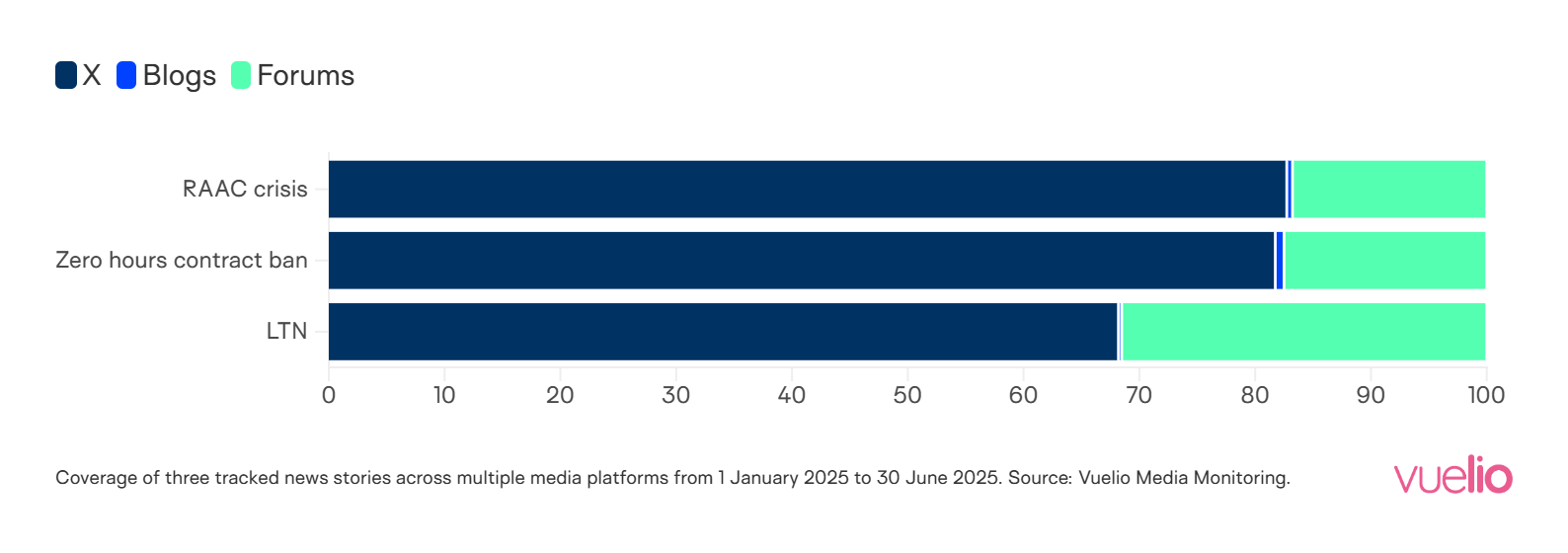
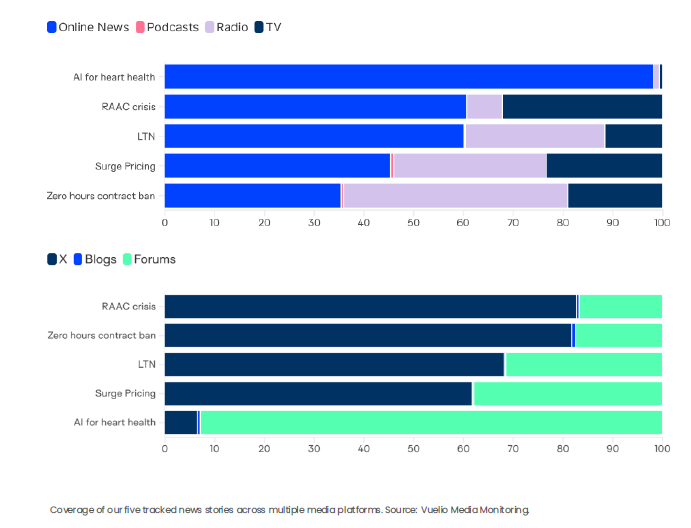
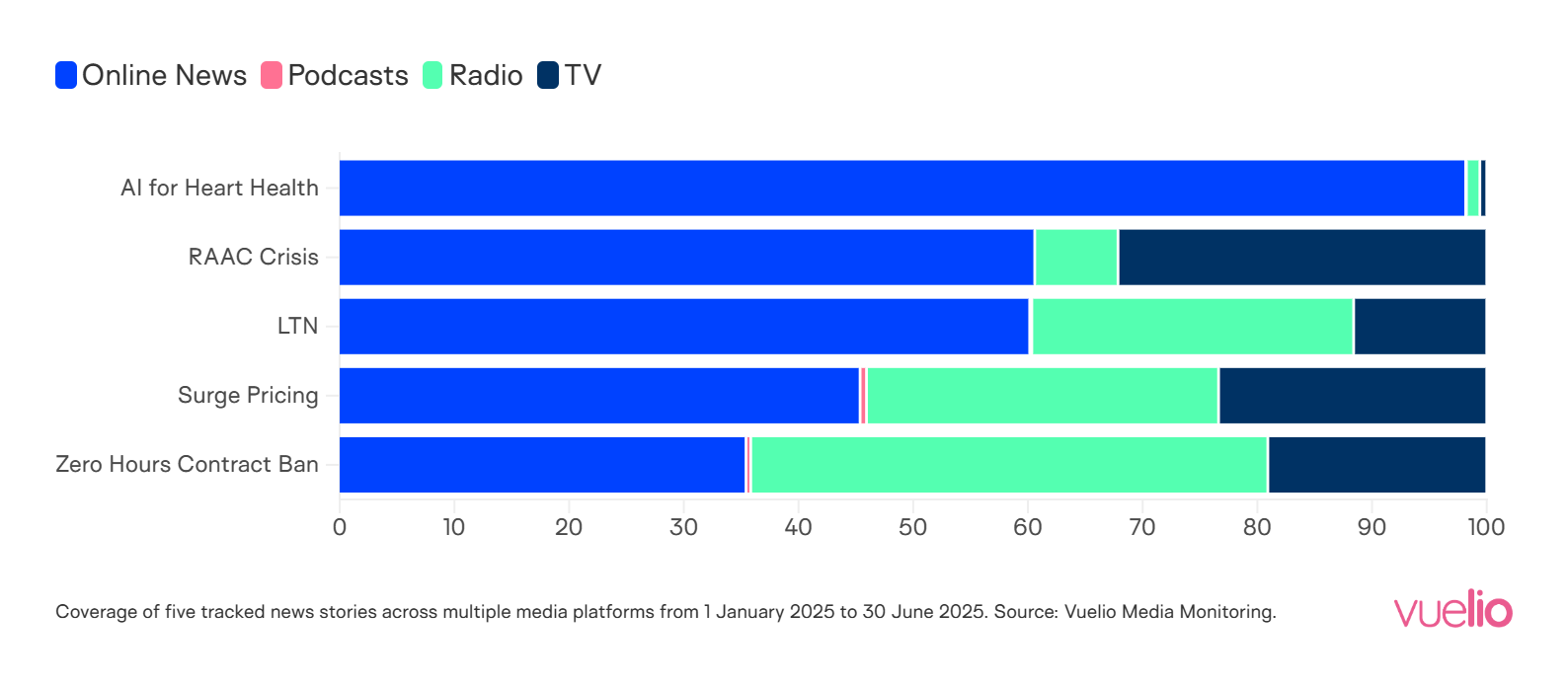
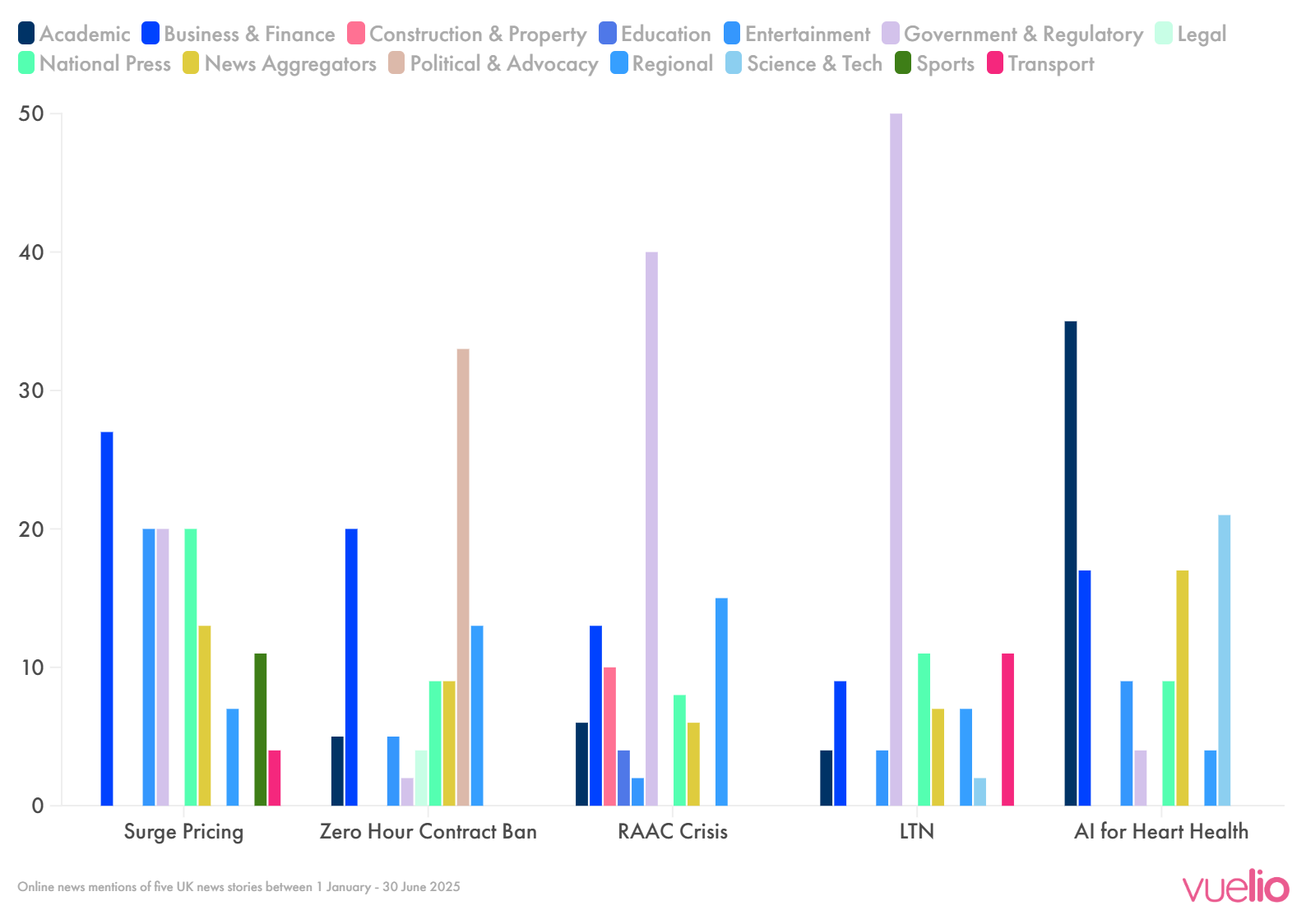
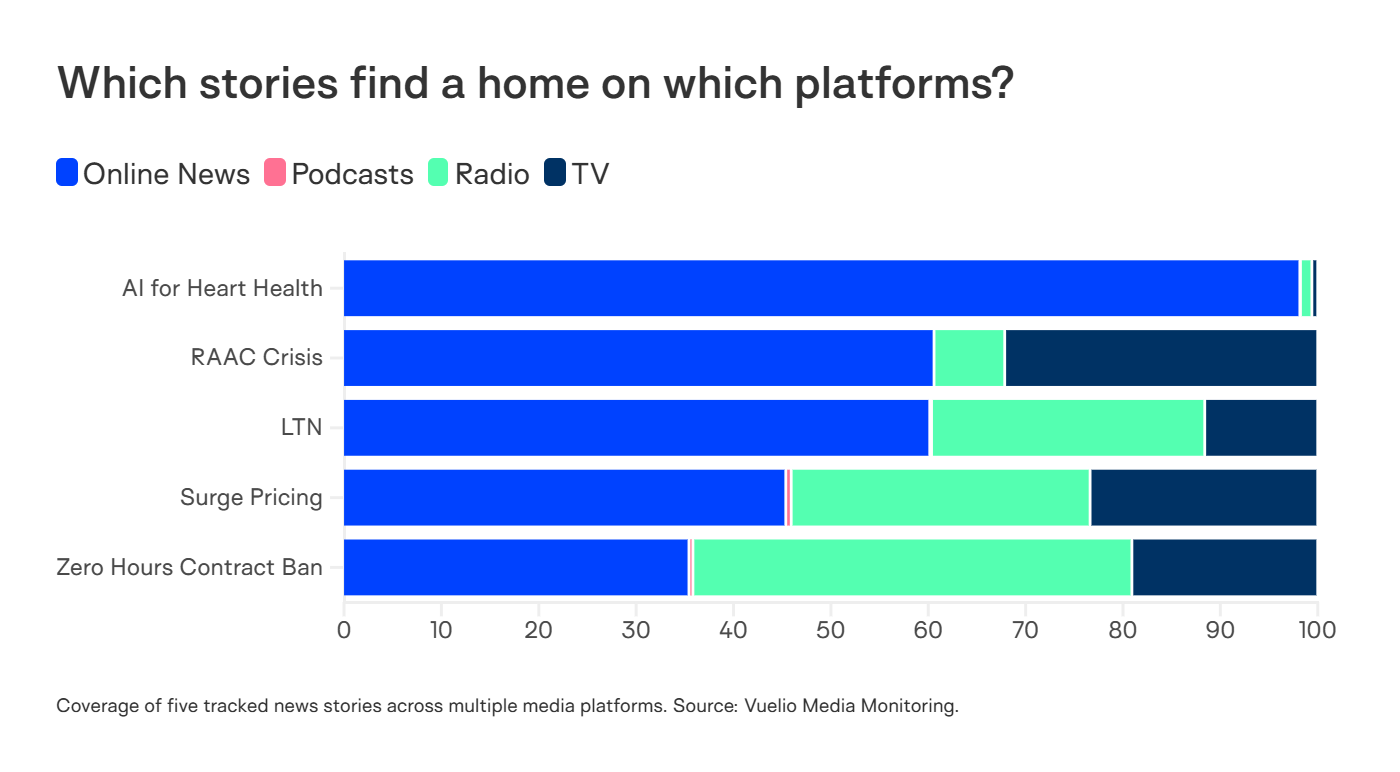
Bar charts comparing how news stories such as AI for heart health, RAAC crisis and zero-hours contracts are distributed across online news, podcasts, radio, TV, X, blogs and forums in media monitoring analysis.

For the PR professional, this means the competition for space is fiercer than ever. Newsrooms have shrunk, leaving fewer journalists to handle a higher volume of more complex, cross-platform stories.

Vuelio research highlights that journalists are increasingly time-poor, managing multiple content channels from traditional articles to vertical videos and podcasts. This resource scarcity has shifted the power dynamic; journalists are no longer looking for mere story ideas but for support from PRs who can understand their challenges, provide the necessary data, experts, and multimedia assets to complete a story with minimal friction.

The year 2025 marked a difficult period for the industry, where economic pressures and the influx of “AI slop” and misinformation forced a return to core values of trust and credibility. As newsrooms adopt formal AI policies, the requirement for verified, human-led storytelling has become a prerequisite for coverage. Practitioners must navigate this “modern media maze” not as an obstacle, but as a map of alternative routes to their audience.


The Anatomy of a Perfect Pitch: Breakdown of the Subject Line, the Lead, and the CTA

The successful pitch in 2025 is an exercise in precision. With newsrooms operating at capacity, the margin for error is non-existent. A practitioner must capture attention in the seconds it takes an editor to scan an inbox. This requires a structural understanding of the three critical components of an email: the subject line, the lead, and the call to action (CTA).

The Subject Line as the Digital Gatekeeper

The subject line is the most important element of any outreach campaign. Research into journalist behavior shows that short, snappy subject lines between 8 and 10 words (approximately 65 characters) are the most effective.23 This length ensures the text is not truncated on mobile devices, which is where many journalists first scan their notifications.

Strategic subject lines often function as “pre-emails” that tell the story before the message is even opened. The most successful tactics include mocking up a headline that matches the publication’s style, which allows the editor to envision the story in their section. For instance, using a data-led hook such as “STUDY: London energy bills to rise by 15% in Q4” is more likely to be opened than a generic title like “Energy News for your consideration”.


Subject Line Type Effective Example Psychological Trigger
Data-Driven “45% of UK SMEs fear bankruptcy by 2026” Curiosity driven by statistical significance.
Headline Mockup “Why the TikTok ban will reshape UK retail in 2025” Newsroom-ready formatting for easy adoption.
Exclusive Asset “EXCL VIDEO: Inside the world’s first AI-run warehouse” FOMO and the need for high-value multimedia.
Urgency/Newsjack “Expert Comment: Today’s interest rate hike and first-time buyers” Immediate relevance to the current news cycle.

The Lead: The Inverted Pyramid in Practice

The lead paragraph must immediately answer the “so what?” factor. In accordance with the inverted pyramid structure, the most critical information—who, what, where, when, and why—must appear in the first two sentences. Successful leads in the current era often include a “why now” hook that ties the story to a larger cultural trend, a policy announcement, or a recent data spike.

Instead of focusing on what the brand wants to say, the lead must focus on what the audience wants to hear. This requires a deep understanding of the “User Needs Model,” which categorizes audience motivations into four categories: knowledge, understanding, doing, and feeling. As media outlets move toward “slow journalism” and constructive news, leads that offer to “inspire” or “give perspective” are increasingly prioritized over simple updates.

The Call to Action: Reducing Newsroom Friction

The pitch should conclude with a clear, concise ask that reduces administrative work for the journalist. In 2025, this means providing immediate access to assets rather than asking for interest first. A professional CTA might offer high-resolution imagery, a pre-recorded video interview, or a specific time slot for a spokesperson.

A vital part of the CTA is ensuring that all links are functional and lead to a dedicated media pack or a “newsroom-ready” landing page. This approach respects the journalist’s workflow and increases the likelihood of adoption, as it provides a complete “electronic news package” that the AI-assisted newsroom can easily parse.


Why Journalists Hit ‘Delete’: Common Mistakes that Damage Your Reputation

Understanding the reasons for rejection is the first step toward refining a media relations strategy. In a landscape where only 7% of pitches are considered relevant, the “delete” button is the journalist’s primary tool for managing an overwhelmed inbox.

The Perils of “Spray and Pray” Tactics

The most frequent reason for a pitch being ignored or blocked is a lack of relevance to the journalist’s beat or audience. Automated, mass-distributed emails that treat every journalist as a generic contact are a waste of time and a risk to the agency’s long-term reputation. The “User Needs Model” suggests that different outlets have very specific brand requirements; pitching a high-level technical piece to a tabloid editor, or a gossip-based story to a trade publication, signals a total lack of research.

The Influx of “AI Slop” and Misinformation

As 2025 progressed, the industry saw a surge in low-quality, AI-generated content—often referred to as “slop”—which has made journalists hyper-vigilant. Pitches that sound automated, lack a human voice, or provide unsourced data are immediately dismissed. Furthermore, the rise of “fake experts” has led to a trust crisis; the CIPR and PRCA have both called on journalists to verify the credentials of any source through publicly available professional registers.


Pitch Killer Consequence Professional Fix
Generic Lists Permanent “Blocked” status for the domain. Manual prospecting and bespoke media lists.
Massive Attachments Triggers spam filters or crashes mobile browsers. Use high-quality links to dedicated media packs.
Over-selling/Hype Loss of credibility as a reliable news source. Lead with facts, data, and neutral expert quotes.
Lack of “Why Now” Pitch is archived for “slow news days” (and never read). Tie every pitch to a trend, seasonal event, or data spike.


Data-Driven Pitching: How to Use Media Intelligence to Time Your Outreach

In the modern media cycle, timing is not just about the day of the week; it is about the “seasonality of interest”. Vuelio’s data-driven insights allow practitioners to map their outreach to the predictable peaks of the news calendar, ensuring that pitches arrive when journalists are actively seeking specific content.

The Five Qualities of a Newsworthy Story

To determine if a story is truly ready for distribution, practitioners should measure it against the five qualities that journalists prioritize: Impact, Timeliness, Prominence, Proximity, and Oddity. A story is newsworthy if it affects a large number of people (Impact), relates to a current event (Timeliness), involves a recognizable name or brand (Prominence), is geographically relevant (Proximity), or is genuinely surprising (Oddity).

However, not all data is equal; original research involving 2,000+ respondents or in-depth executive interviews is required to provide the “fresh insight” that separates a hero campaign from a routine update.

Strategic Timing: The “News Day” Dynamics

While the news cycle is 24/7, the administrative habits of the newsroom remain consistent. The highest news consumption and reading rates occur on Tuesdays, Wednesdays, and Thursdays. Correspondingly, these are the best days for pitching, as journalists are in the “story planning” phase rather than the “deadline race” of Monday morning or Friday afternoon. For topical news, readership is extremely concentrated, with 86% of the audience engaging within the first three days of publication, making speed and timing essential for any correction or response.


The Impact of AI on Media Relations: Balancing Efficiency with the “Human Touch”

The arrival of AI in 2025 and 2026 means a shift in daily reality for both journalists and PR practitioners. However, the role of AI is shifting from a content generation tool to a strategic “first-class communications channel”.

The Necessity of Multimedia Assets

The “video-fication” of everything has redefined the modern newsroom.21 PA Media and other national agencies now operate on an “audience first” strategy where video is a central tool, not an afterthought. To stay relevant, PR pitches must include a variety of formats: short-form video (TikTok/Reels style), high-resolution imagery, and “social-ready” infographics.

A story accompanied by a short video clip or an interactive map is far more likely to be picked up than a text-only press release. This multimedia approach also helps with “Search Generative Experiences,” as AI engines prioritize content that includes rich media.

Balancing Automation with Personalization

While 92% of PR teams use generative AI in some form—primarily for brainstorming and content optimization—39% believe the key to success in 2026 lies in strengthening human-to-human relationships. The practitioners who thrive will be those who use AI to do the “mundane tasks” (like drafting initial research summaries or checking grammar) while spending more time on the strategic “judgment calls” that machines cannot make.

The “New Rules” of engagement prioritize intergenerational literacy and foresight over “output craft”. In an era of AI-mediated discovery, high performance depends on disciplined listening and the ability to forge authentic connections that cut through the digital noise.


Building Long-Term Relationships Over One-Off Hits

The era of transactional, “link-building only” PR is over. As we move into 2026, the value of an agency is measured not by its volume of clippings, but by its “organizational intelligence” and the depth of its trusted relationships.

Don’t let a pitch be a full stop; it’s the beginning of a potential collaborative partnership. Practitioners should focus on providing the “missing piece” of a story—whether that is a reactive quote, a specific case study, or a unique data set—that makes a journalist’s job easier. This “human-led governance” of the PR-journalist relationship is the only effective defense against the erosion of public trust caused by AI misinformation.

Growth-Focused Metrics

Clients and stakeholders are increasingly demanding “outcome-based” measurements rather than just “outputs”. Success in 2026 is defined by the impact on reputation, the improvement of stakeholder trust, and ultimately, the tangible business results generated by earned media coverage. This requires a shift from celebrating “clever ideas” that went unseen to championing impact that resonates with the target audience.


Frequently Asked Questions

What is the best time to email a journalist?

Pitching in the morning—specifically between 9:00 AM and 11:00 AM—allows journalists to include your content in their daily story planning before they hit afternoon deadlines. While news cycles are continuous, and every outlet found on Vuelio Media Database has its own editorial deadlines. 

How long should a media pitch be?

A media pitch should be concise, ideally around 150-200 words in the body of the email. This includes a one-line “hook” explaining why the story matters today, 1-2 sentences of critical facts, and a clear list of available multimedia assets.

Should I follow up with a journalist after sending a pitch?

Yes, but with restraint. One follow-up email is considered ideal, preferably 24-48 hours after the initial pitch. Adding a “new angle” or an additional insight in the follow-up can often re-engage interest. However, persistent contact beyond this can lead to being blocked; 50% of journalists report that repeated chasing is a major reason for blacklisting a PR contact.

What is the “User Needs Model” in journalism?

The User Needs Model is a strategy newsrooms use to focus on audience motivations rather than just “updating” the news. It involves categories like “Inspire me,” “Give me perspective,” and “Educate me”. For PRs, this means tailoring pitches to fulfill these specific needs—for example, by providing an inspiring case study or an expert who can explain the wider context of a trending topic.

A new definition for PR and comms

A new (official) definition for public relations

In a professional landscape often defined by its changeability, the question of what public relations actually is has long been a subject of debate. This month, the Public Relations and Communications Association (PRCA) provided a definitive answer, unveiling a new definition that moves the needle from tactical messaging to strategic value.

The PRCA now defines public relations as:

‘Public relations is the strategic management discipline that builds trust, enhances reputation and helps leaders interpret complexity and manage volatility – delivering measurable outcomes including stakeholder confidence, long-term value creation and commercial growth.’

For the modern practitioner, this update confirms that the most successful comms teams go beyond broadcasting their messaging to become architects of social and reputational capital.

‘Public discourse and concerns related to society, the environment, and international developments mean that it is more critical than ever for organisations to understand the scope of the role of comms,’ was the advice from Stephen Waddington and Dr John White in the white paper ‘Elevating the role of public relations in management‘.

‘Public relations has an important contribution to make to organisations, to their success and to the part that they play in society.’

As the definition of the industry has evolved with the times we work in, the tools comms teams use to navigate the fragmenting landscape have to be just as flexible. With PR increasingly concerned with the strategic management of relationships and commercial growth, the days of spreadsheets and siloed monitoring are over. To meet this new standard, professionals need a unified platform that connects insight, engagement, and impact.

Moving beyond broadcast

The PRCA’s timely update is a shift away from the idea of PR as a delivery function, measured in the volume of what is sent out, towards a model of deeper, multi-direction engagement. This new definition is aligned with the approach Vuelio has been developing over the last few years.

By bringing together a vast media and political database with sophisticated relationship management tools, Vuelio’s fully integrated platforms allow professionals to move away from ‘spray and pray’ distribution and towards a 360-degree view of an organisation’s reputation.

Whether you are reaching out to a key journalist, niche influencer, or political stakeholder, Vuelio ensures you are targeting based on deep data, and can continue to grow and evolve these important relationships.

Media monitoring what makes Vuelio different

Proving the value of PR

The inclusion of ‘value creation and commercial growth’ in the official definition elevates PR to a core business function, but with that elevation comes the pressure of proof. How do you measure a relationship?

Traditional metrics can fail to show real business impact. The modern professional needs to demonstrate how their work influences perception and, ultimately, drives the bottom line.

Vuelio offers AMEC-accredited media insights and real-time analytics, allowing the overlay of media lists onto dashboards to gauge share-of-voice against competitors, track key message penetration, and link coverage directly back to specific campaigns.

Traveling a multi-platform space

The PRCA’s definition acknowledges the many different forms that stakeholders take. Today’s stakeholders are MPs, local councillors, TikTokers, podcasters, and community leaders, as well as traditional journalists. The strategic management of these diverse groups requires a tool that understands this fragmented landscape.

Vuelio is designed for this complexity, bridging the gap between the Westminster bubble and the digital zeitgeist. Whether you are tracking a mention on a niche industry blog, or monitoring a high-stakes debate in the House of Commons, the platform ensures you won’t miss anything important.

SRM for the comms world

If PR is the strategic management of relationships, then a comms practitioner’s stakeholder database is their most important asset. But a standard sales CRM isn’t built for the nuances of the press office.

Vuelio’s Stakeholder Relationship Management (SRM) is purpose-built for the comms world. It allows teams to log every interaction, from a phone call with a producer, to a formal meeting with a civil servant. Preventing the information silos that can plague large agencies or in-house teams, everyone can work from the same playbook – the organisation speaking with one voice, ensuring that messaging remains consistent and reputation is protected.

Future-proofing public relations

The PRCA’s update is a call for the comms industry to step up and claim its place as a strategic powerhouse. PR teams are a direct line to the commercial success and reputational health of the organisations they represent.

Moving past the limitations of manual processes is a must for meeting this modern mandate. The strategic management the PRCA has highlighted requires new levels of flexibility and integration in approach and in the tools at your team’s disposal.

Unifying media monitoring, political intelligence, and stakeholder engagement into one ecosystem makes the work of comms easier and its value, socially and commercially, obvious.

As we look toward the future of the industry, one thing is certain: those who embrace the ‘strategic’ in the new definition, and equip themselves with the technology to deliver on it, will be the ones leading the conversation.

Looking to align your strategy with the new PRCA standards? Discover how our platform can help you manage your relationships, monitor your reputation, and prove your value – request a demo.

UK politics health in focus

Health in Focus: National Cancer Plan and Medical Training Bill

Following the explosive fallout over resident doctors’ pay and job conditions towards the end of 2025, Wes Streeting set out that the Government would introduce emergency legislation, now titled the Medical Training (Prioritisation) Bill, to Parliament.

The Bill is set to alter the hierarchy of prioritisation in the current UK Foundation Programmes, creating a new tier of priority for UK medical graduates (who have obtained their qualification primarily in the UK). This is followed by a prioritised group of graduates with specific trade agreements, then by all other international medical graduates. The Bill also sets out a priority system for specialty training programmes, which creates a single top priority group for the UK and for other prioritised groups.

The implementation of the Bill is to be staggered across 2026 and 2027 and beyond, with those with indefinite leave to remain granted priority only in 2026, before this is shifted to those who have ‘significant NHS experience’ from 2027; prioritisation will also be limited to the offer stage in 2026, whilst from 2027 applications will be assessed at the shortlisting and offer stage.

The Bill has passed through the Commons and will go on to be scrutinised by the Lords. The Bill must be passed by 5 March 2026 to have an effect on 2026 places. In the Commons Committee stage, the Conservatives called for UK graduate prioritisation through both the UK Foundation Programme and specialty training programmes, and for all UK citizens to be prioritised even in cases where they do not have primary qualifications in the UK, citing the UK-Malta healthcare partnership, which could be undermined by the Bill.

Another concern of the Bill has been the balancing act between merit and prioritisation. This argument posits that rather than adding a fixed structural differentiator to improve graduates’ chances in world-leading courses, the UK should better equip universities to deliver the best graduates to win these places on merit more comfortably. Thus, the fixed prioritisation system could lead to the UK becoming staffed by less-qualified doctors, while better ones sit in the wings blocked by their origin.

Another concern is that the Bill will be used as a ‘bargaining chip’ by the Secretary of State given that its implementation is at the discretion of the Secretary of State rather than upon Royal Assent. Thus, Streeting could withhold the Bill until the BMA has met the Department’s criteria, leveraging the law-making powers of the Commons over the union. Despite this accusation, the Bill’s contingency on ministerial operation is likely being enforced to ensure the Bill’s passing does not blow up in their face if, come the renewed BMA mandate for strikes, the BMA stands equally resolute in opposition to Government proposals.

Streeting has publicly stated his desire to ‘hit the reset button’ on BMA relations, and build a long-term solution away from ‘fractious’ and volatile disagreements, and early discussions in 2026 have been described as ‘constructive’. Although this may be a common politically-polite shield, Streeting will hope his efforts and the introduction of the Bill will offer the BMA an olive branch into negotiations and hope to develop a more sustainable footing for the workforce. In fact, a recent report from The Guardian has suggested that Streeting is willing to provide another pay rise for resident doctors, a decision that could have seen this entire fiasco over the last few months quelled much earlier. If this rumour does materialise, there will be no doubt that the Opposition will frame this move as the Government being weak to industrial action and held to ransom by the BMA.

Last week, the Government published the National Cancer Plan, which has been framed as a once-in-a-generation opportunity to shift the prospect of cancer care in the UK from ‘breaking point’ to a renewed world-leading status. Crucially, the target of 85% of cancer patients being diagnosed and beginning treatment within 62 days, which the Government is politically accountable to, has not been met since 2015.

In the Plan, the Government has pledged to meet this target along with two other key targets: 96% of patients starting treatment within 31 days of a decision to treat; and 80% of patients getting a diagnosis or all-clear within 28 days of an urgent suspected cancer referral. To reach these targets expansion is key, and the Plan announced that £2.3bn will be invested in diagnostic transformation through Community Diagnostic Centres (CDCs). This correlates strongly with the community shift of the 10-Year Health Plan, where the Government is hedging its bets on cutting waiting lists through early detection and diagnosis, delivered through care closer to home. CDCs’ capacity will also be expanded at thirty sites, with all ordered to offer 12 hours a day, 7 days a week services to communities.

The announcement of 154,000 more MRI scanners by 2029, investment of £96m into automated histopathology and a new campaign to reduce low-value referrals all work to target this same window of opportunity in the early stages of cancer, improving the ‘quality’ of patient inflow, and tackling cancer early, quickly and efficiently. The sector has long called for a Young Cancer Patient Travel Fund to compensate families for the travel costs to the 19 specialist Principal Treatment Centres in the UK, with costs averaging at £250 every month. In the Plan, the Government set out £10m for this initiative to help support families and ensure treatment non-compliance is not driven by financial difficulties or regional disparities. The Plan also took steps to ensure more support for childhood cancer, including more involvement from paediatricians in the process, increased post-cancer surveillance for secondary cancers and further psychological support and care.

The Plan took a strong focus on early detection and diagnosis. The introduction of a new three-year Neighbourhood Early Diagnosis Fund will coordinate Cancer Alliances and neighbourhood health services to work directly with local communities, screening commissioners and providers to develop targeted campaigns aimed at reducing the gap in screening uptake. The Plan also sets out the national rollout of lung cancer, cervical self-test, and prostate cancer screening, with the latter subject to judgment of the UK National Screening Committee’s decision in March. One of the key concerns arising from the reaction to the Plan is the worry, as neatly put by the King’s Fund, to not put ‘the cart before the horse’ and push rapid AI innovation on an overwhelmed, underequipped, and understaffed workforce. Whilst AI diagnostics and genomics may increase productivity, when these services are hinged on outdated IT systems and infrastructure, trusts will struggle to realise the benefits. Predicated on the upcoming workforce plan, there is also concern that without the staffing capacity or training, expansions of services, such as more MRI scanners, will see its potential wasted.

Quite notably, the Plan put rare cancers at the core of its mission, dedicating a chapter to the issue. The chapter set out that rare and less common cancers will be advanced through improved data infrastructure, prioritisation for research by the National Institute for Health and Care Research, increased funding and the passing of the Rare Cancers Bill. A national clinical rare cancer lead will also be appointed, who will have a mandate to speak up for rare cancers, provide clinical advice and sit on the National Cancer Board, which will oversee the Plan. The Plan also took steps to improve clinical trials for rare cancers, improving access and trial opportunities through the NHS App, and setting greater clarity of direction through a new Cancer Clinical Trials Accelerator.

The Plan included initiatives into preventative public health measures including the implementation of ID checks for sunbeds, and the banning of unsupervised sessions, given the inherent risk of UV radiation emitted. The Department of Health and Social Care will consult on this issue this year before moving ahead with a ban. It will also consult on mandatory health warnings and nutritional information on alcohol labels. A recent report from the Institute of Alcohol Studies found that a series of coordinated lobbying across Government departments had prevented the inclusion of alcohol marketing restrictions in the 10 Year Health Plan back in July. This consultation will seek to further discourage alcohol take-up as a leading risk factor in poor public health and long-term conditions. This move will likely have a large impact on supermarkets who have long been seen to remain insulated from the cost and tax burdens associated with alcohol, with pubs bearing the brunt. A common concern, and one that reared its head in the 10 Year Health Plan, is the absence of accountable milestones for the Plan. In responding to the statement on the Plan in Parliament, the Shadow Health Secretary Stuart Andrew took aim at this lack of immediate delivery, calling for clear, funded milestones which show patients when they will see improvements in the next year or two.

While the Plan sets out expansive measures, and sticks to meeting fundamental metrics, the Plan does not rip up the manual for cancer care. There is a focus on prevention and improved diagnostics, but investment in these areas isn’t eye-watering and does not present a wholesale change to proceedings. Equally, while there is a whole chapter for rare cancers, this has been a key focus reiterated by the Government, so its prevalence is of little surprise. Ultimately, policy makers and public affairs professionals will not have had to react or change their workbook to adapt to this Plan which has swayed more on the side of consistent policy rather than radical change. This long-termism in policy has long been called for, especially set on the backdrop of tumultuous policymaking of the previous Conservative Government. However, the Plan will likely have minimal impact for a Government finding it seemingly impossible to communicate any success or improvements it sets in motion. With the current political standings probably as volatile as ever, from Lord Mandelson’s saga, the resignation of the Chief of Staff in No 10 and Scottish Labour Leader Anas Sarwar calling for Starmer’s resignation, any policy long-termism will be and has been overshadowed by the chaotic unravelling of Starmer’s premiership.

To keep ahead of what’s happening in politics, check out Vuelio’s Political Monitoring and Political Database solutions. 

Parliament

The Legislative Look ahead from Total Politics and Vuelio

With the country readying itself for a new devolution framework, what changes are coming up in justice, healthcare, and education? And what do public affairs and comms professionals need to work into their strategy for the year ahead?

Legislative Lookahead 2026

Total Politics has published its Legislative Lookahead for 2026, featuring insight from a number of Vuelio’s own in-house political researchers and analysts, alongside a mix of political peers and experts including Baroness Smith of Basildon, Lord True CBE, Baroness Grey-Thompson DBE, Baroness Sheehan, Haypp Group, and St Giles Wise.

For the full look, download the ebook here, or read on for lessons from the key milestones, committee inquiries, and bill stages coming up throughout the 2026 parliamentary session.

Pressures to deliver

The parliamentary calendar for 2026 is defined by a Government under pressure to show results. As the ‘year of delivery’ gathers pace, the volume of legislation is expected to intensify, creating a crowded marketplace for attention. Jennifer Prescott, Political Analyst at Vuelio, notes that this shift requires a more forensic approach to monitoring.

‘The government’s primary focus is now on the tangible implementation of its missions,’ Prescott explains.

‘For those in communications, this means moving beyond broad political trends and focusing on the specific mechanics of upcoming Bills. We are seeing a transition from policy announcement to regulatory reality, and that requires a much higher level of precision in how we track and engage with the legislative process.’

Jennifer Prescott quote

This sentiment is echoed by Ingrid Marin, who highlighted the sheer volume of activity within the various government departments:

‘With so many departments pushing through primary legislation simultaneously, there is a real danger of legislative noise where key impacts are missed,’ Marin warns. ‘Effective comms teams will be those who can identify the specific departmental levers being pulled before they become headline news.’

Ingrid Marin quote

The ethics of influence

One of the most significant hurdles for the Government’s 2026 agenda lies in the House of Lords. With a heavy legislative programme and a series of high-profile constitutional reforms on the horizon, the upper chamber is set to become a primary site of scrutiny. For PR professionals, this means the corridors of power extend far beyond the Commons.

‘The House of Lords will act as a critical checkpoint for the Government this year,” advises Aidan Stansbury.

‘We expect to see significant debate around the constitutional role of Peers, but more importantly, their work in the committee rooms will be where the technical details of regulation are hammered out. Communications strategies must account for this slower, more deliberate phase of the legislative cycle.’

Parallel to this is a heightened focus on transparency and the ‘duty of candour.’ Billy Barham suggests that the ethical landscape of influence is shifting:

‘There is an increasing expectation for transparency, not just in lobbying but in the broader relationship between the public and private sectors,’ says Barham.

‘Legislation like the proposed Hillsborough Law or changes to human rights frameworks will place a new premium on corporate accountability. Communicators need to be ahead of this curve, ensuring their organisations aren’t just compliant with the law, but aligned with the evolving expectations of public integrity.’

Politics beyond Westminster

The 2026 local elections are set to provide a significant test of the political mood throughout the country. For brands and organisations, the bubble of Westminster can often obscure the reality of how policy is being received in the regions.

The interplay between national policy and local delivery is where reputations are often won or lost:

‘The 2026 local elections will serve as a mid-term referendum on the government’s success,’ says Laura Fitzgerald.

‘For comms professionals, it’s vital to understand how national legislative themes (such as housing, transport, and net-zero) are playing out at a community level. The rise of smaller parties and shifting voter priorities means that a ‘one size fits all’ national message is increasingly insufficient.’

Laura Fitzgerald quote

This local dimension is particularly acute when it comes to the delivery of public services.

‘We are looking at a year where local authorities are under immense financial pressure while being tasked with delivering on national mandates,’ adds Ellie Farrow.

‘The friction between central government ambition and local government capacity will be a major story in 2026. Communicators must be prepared to navigate these tensions, particularly when their sectors rely on local partnerships or planning.’

Ellie Farrow quote

What this means for comms and Public Affairs

The legislative agenda is the blueprint for future press cycles, and for PR and PA, foresight is vital for effective crisis management and prevention.

By aligning communication strategies with the milestones ahead, teams can move from reacting to the news to shaping the narrative around the laws that will define the next decade. Understanding the implications of legislation for stakeholders, and communicating value, will be vital for the year ahead.

Read the full ebook from Total Politics here, and learn more about Vuelio’s full Political proposition

Integrating political and media strategy

Why integrating political and media strategy is the secret to successful campaigns

While the days of a stable, single-route news cycle are long gone, the modern media ecosystem can still be successfully navigated by comms teams… providing they pay attention to all possible diversions and directions a story can travel along, including the political.

Today, the line between media management and public affairs has blurred. How to navigate the confusion? In short, by incorporating political monitoring into your media monitoring strategy.

Using insights from the Vuelio report ‘How news travels in today’s fragmented media environment’, augmented by several leading comms experts, we share advice on how to plot your course through the interwoven media and political landscapes.

Steering through the unpredictable news cycle

The most significant takeaway for modern communicators is the loss of a predictable arc. Kelly Scott, VP of Government and Stakeholder at Vuelio, describes the modern journey of a public interest story as a series of unpredictable rebounds, where a narrative hits various political buffers that abruptly change its trajectory:

‘The path a story takes today is incredibly kinetic,’ says Scott. ‘A narrative can strike a political trigger and suddenly veer off in an entirely new direction. In this environment, it is absolutely vital to correct misinformation at pace, engage with both media and political influencers, and mobilise credible third-party voices’.

Vuelio’s analysis of major stories from the first half of 2025, including the RAAC crisis and the debate over Low Traffic Neighbourhoods (LTNs), demonstrates this phenomenon in action.

LTN example on social media

LTNs, for instance, began as a hyper-local debate about planning but were rapidly pulled into a national political conversation about environmental policy and government control. By the time the story reached the national stage, it had evolved from a story about traffic to a shorthand for wider political division.

The lesson for PR professionals: you can no longer wait for a story to reach the mainstream before you act. As Kelly Scott puts it, the fragmented nature of modern media means that ‘you can’t engage with one channel without understanding the others’.

Kelly Scott on media and political channels

Going beyond the click with KPIs

As the media landscape fragments, the way to measure success must evolve. When audiences are consuming parallel, but often disconnected, versions of the same issue, the traditional ‘big hit’ in a national broadsheet may no longer be the ultimate KPI.

Vuelio’s research into the coverage of ‘Surge Pricing’ showed that different media audiences lived in almost entirely separate echo chambers. While business outlets framed the issue through market regulation, tabloids focused on the cost to the consumer – and even then, there was great discrepancy between mass media on precisely what cost to the consumer (beer, transport, etc) was being cited. If your comms strategy only measures one such strand, you could be missing half of the picture.

Measurement is now less about counting clips and more about understanding movement across the ecosystem. Charlie Campion, External Affairs and Policy Manager at Mental Health Matters, argues that this shift requires a complete rethink of how comms and public affairs have been previously aligned:

‘Politicians are paying closer attention than ever to public opinion,’ Campion explains. ‘This means that conversations in the press, online forums, and across social media have become essential to any successful public affairs strategy. Integration and collaboration between public affairs and communications teams are now more critical than ever.’

Without integrated KPIs that track both media sentiment and political intent, organisations risk traversing the landscape with a limited field of vision. Sean Allen-Moy, Head of Media Relations Strategy at Burson UK, simplifies the challenge: ‘You must know exactly where your audience consumes their content and meet them there’.

Sean Allen-Moy quote

Why comms can’t refuse to play politics

If the fragmentation of the media is the how of modern comms, then politics is the why. There is a growing consensus that communications professionals can no longer afford to treat ‘politics’ as a separate silo or a niche interest. Legislation and regulation now permeate every aspect of brand reputation – and integrating political monitoring into your media strategy is even more important this year as we get closer to May’s local elections in the UK…

‘Politics drives the agenda, and the geopolitical world is moving faster than ever, often dictating the speed and direction of media and stakeholder conversations,’ believes Kerry Parkin, founder of The Remarkables.

‘If your product or brand is touched by political events, it must be factored into your mindset and planned for, even through the disruption.’

A lack of political literacy can be terminal for a PR campaign. Anton Greindl, Director of Public Affairs at Tilton Consultancy, warns that failing to track policy and regulation results in mistimed launches and messages that become ‘politically toxic’ before they even land:

‘Policy literacy is the difference between PR being a mere noticeboard and PR being a strategic lever for revenue, risk, and reputation,’ Greindl argues. ‘When politics moves, you need to lead with substance, consistency, and implementation detail’.

Anton Greindl quote

Putting a unified strategy into place

Monitoring the media and monitoring Westminster are now part of the same job. The combination further allows teams to anticipate crises rather than simply reacting to them.

In an age of digital connection, and media siloes, cutting through is about masterminding the journey of a story through various spaces. Successful organisations are those that can read the entire ecosystem, engage multiple stakeholders, and adapt their strategy in real time.

As we look toward an increasingly complex future, the advice from the industry is to lean into this complexity rather than retreat from it. The most successful comms professionals will be those who break down the walls between their media and public affairs teams, ensuring that every KPI measured and every story told is informed by a deep understanding of the political current.

Where stories now cross-pollinate across a thousand different platforms at once, a narrow focus is a dangerous one. To survive and thrive, you must understand every platform out there.

For more on traversing today’s multi-platform media and political spaces, check out Vuelio webinar ‘Mapping the media: How stories travel today’s fragmented landscape?‘, with Burson UK’s Sean Allen-Moy and JournalismUK’s Jacob Granger.

Mental Health Bill

Health in Focus: Resident Doctors and the Mental Health Bill

The end of 2025 saw the latest resident doctors’ strike, stemming from a long-term dispute over pay, conditions, and job opportunities. Wes Streeting has not been subtle in his disagreements with the BMA over the dispute, from calling resident doctors ‘moaning Minnies’ over complaints on digitisation to likening the BMA to a cartel. The Government has opted to be distinctly aggressive, questioning the ‘morally reprehensible’ decision to strike during an unprecedented winter flu crisis. These efforts were to no avail and the strike took place from 17 to 22 of December following an overwhelming rejection of the offer, with 83% voting no.

Despite the looming calls for restorative pay to real-term levels equivalent to 2008, the strike’s narrative and rationale were focused on job prospects and accessibility. The argument from the BMA proceeds that currently UK medicine graduates face a 4:1 application to job ratio in the NHS, which is seen as a strong disincentive given the multifaceted costs of entering the field. Further, graduates’ applications are assessed equally to foreign applicants, further decreasing the chance of success. Streeting aimed to offer a resolution to this, including emergency legislation in the new year to introduce UK graduate prioritisation, a pledge to create 4,000 new specialty training places, with 1,000 to be brought immediately into the 2,600 intake; a move the Department of Health and Social Care has claimed would reduce the ratio to less than 2:1. Notably, despite this offer being rejected, Streeting has said he will still push through this emergency legislation in the new year, but its progression will be conditional on the BMA’s compliance.

The failure to resolve strikes is a costly reality for Streeting. The Government has positioned the NHS as one of its key focuses, backed up by expanded and protected funding at the Spending Review and the most recent Autumn Budget. With elective waiting lists positioned as a key metric for assessing their performance, the sudden staff absence and administrative burden caused by strikes will only further halt efforts. Recently, the NHS confirmed that only 5% of planned routine care was halted due to the strikes, perhaps highlighting a lack of buy-in from the workforce, the diminishing overall impact of strikes and improved planning and robustness from NHS management.

On the political slant, awkwardly, during previous NHS industrial action that took place in 2022, Streeting said that ‘the power to stop these strikes is squarely with the Government and the Secretary of State’. Opposition to Streeting both online and in the chamber have been sure to repost and regurgitate this statement back to him, pushing the notion of a hypocritical Labour Government. Interestingly, Streeting, in a late surge to win the argument, opted for spouts on X with anonymous accounts over the issues at hand, further sensationalising this fiasco for the Government. Most prominently, this accumulated in a strange (now deleted) video posted by the Department for Health and Social Care with Streeting answering evidently planted questions about the strikes in an orchestrated ‘authenticate’ Q&A. Importantly, this ‘politicking’ pantomime detracts from the reality that strikes are a crisis, not just for Labour’s manifesto targets, but for vulnerable people’s health, who want their taxes to service their needs. Fundamentally, the strikes are good for nobody, but very damaging for the Labour Government.

The Mental Health Bill was passed on the last day of 2025’s parliamentary session having been committed to by Labour in its 2024 manifesto. The Bill sets out to reform the ‘woefully out of date’ Mental Health Act 1983, which has been criticised for its treatment of autistic people and people with a learning disability, and its disparate impact on Black patients. Key provisions in the Act include reforms to the overall decision-making principles of responsible clinicians specifically in detention of individuals under the Act and to provide greater choices and safeguards for the patient and/or their carer or nominated person. The Act also sets out clearer principles for intervention and the involvement of a Second Opinion Appointed Doctor to provide two-stage checks and balances for doctors when administering treatment to patients.

Aside from the aimed improvements to patient care that the Act seeks to put in place, now in statute, the Bill’s passing makes a mockery of the parliamentary process and the delay in delivery, which has been recently highlighted by the Prime Minister at the Liaison Committee. The Bill is predicated on the Independent Review of the Mental Health Act which was conducted in 2017, with most of its recommendations accepted almost a year later. After a white paper, a draft Bill, a committee inquiry, government response, the previous Government failed to introduce the Bill prior to their electoral demise in summer 2024, preempting its inclusion in Labour’s manifesto. The fact it can take almost eight years for recommendations, which were accepted on both sides of the political spectrum, to be passed into a law is a damning image for the legislative process. Cases like the Mental Health Bill call into question the hurdles that legislation must clear, especially when the transformation of recommendations to statute spans five different Prime Ministers.

As the new year rises, the May local elections will no doubt be a vital political milestone. On one hand, it could see Starmer turn the corner and bolster his fragile standing, but on the other, it could further damage any remaining resolve, and deliver more unwanted political uncertainty for the sector, through a shift in policy, cabinet, or leadership. The latter could see the current health secretary vie for a shot at the ultimate power.

For more on what’s happening in UK politics, check out key points covered during Vuelio’s webinar with the Institute for Government, ‘The Trump challenge: Chaos, confusion and government communications’.

‘We’re living in an utterly abnormal political era’: Governmental communications in 2026

Political comms reflect the current chaos of the political climate. To help make sense of the uncertainty, Vuelio partnered with the Institute for Government alongside former No. 10 Press Secretary and The Rest is Politics Presenter Alastair Campbell, The Times Washington Editor Katy Balls, Chief Executive of Government Communications (2021 – 25) Simon Baugh, Institute for Government Programme Director Alex Thomas and Senior Fellow and moderator Jill Rutter for the webinar ‘The Trump challenge: Chaos, confusion and government communications’.

The Trump Challenge

Featuring research conducted by the Vuelio Insights team, the panel considered whether traditional functions of accountability still work, how battles for attention will play out in the UK political space, and how the comms industry can adapt accordingly.

‘We’re not living in normal political times,’ warned Alastair Campbell. ‘But most of the media and political establishment are still acting as though we are.’

IFG and Vuelio webinar panel

Where is the UK press centring its political reporting? One guess…

A startling statistic from Vuelio Insights shared during the webinar was that US President Donald Trump doesn’t just garner more UK headlines than our own Prime Minister Keir Starmer in the press (2.2x)… but more than every member of the cabinet combined.

Statistic from Vuelio Insights on political social sharing

What is coming over from the US is ‘rewriting the comms playbook’ was moderator Jill Rutter’s summary of the situation, but what are the lessons for UK comms people tasked with communicating in this climate?

‘This is a reverse of the overscripted, cautious minister or shadow minister, refusing to deviate from their lines to take,’ said Rutter. ‘While Trump plays fast and loose with the truth – he insults reporters, particularly women, and news outlets he does not like who dare to ask critical questions – he seems to have found a way of communicating that mobilises his supporters while enraging or frustrating his opponents, achieving the twin gods of authenticity and cutthroat.

‘Trump’s social posts are miles away from Keir Starmer’s careful Substack and TikTok updates. Is this what good modern political communication looks like?’

Political reporting has changed – and comms needs to catch up

Campbell had other stark warnings for those waiting for official organisations to step in with regulation, and reason, in the face of obfuscation:

‘Institutions that we expect to uphold standards in public life, not just the media, are just not functioning.

‘There is this totally new landscape which is transforming all of our lives in terms of how we try to make sense of what’s happening politically.

‘We have to stand back and apply a little bit of judgment as to what is actually news – maybe take some of the more “old-fashioned” disciplines of journalism from the print side of journalism into the broadcast media space.’

The importance of access and availability for the press

Regularly reporting from Washington, Katy Balls highlighted how vital ready-to-use quotes are from political figures for journalists – particularly in this 24/7 news cycle, even when they are controversial:

‘In one way, Trump is easy to cover because he is everywhere, all the time – you’re not having to haggle for too much access. He is speaking all day to the press. In terms of access and visibility, and the number of questions this White House tends to take, it’s extensive when you compare it to the UK and Europe.

‘Of course, where it gets more complicated is how adversarial it is…’

The fragmentation of the media has changed how a political story travels

Another challenge to contend with is what happens to updates from government figures once they’ve been reported by the media, according to IFG’s Programme Director Alex Thomas:

Alex Thomas quote

‘There’s a lot about this that is not new – the world has seen unpredictable, charismatic, authoritarian populists before. If you’re prepared to bend or ignore the truth, it’s actually quite easy to grab attention.

‘For all that Trump is a novel force, information fragmentation and social media means that this is different.’

From the journalistic point-on-view, Balls highlighted the impact of ‘new’ media in how stories are shared, and reshaped, as they travel to their audiences:

‘America is ahead of the UK in terms of how it uses it at the moment. When you look at the last US election, there was a podcast strategy to reach the young men who were perhaps less good at getting out to vote, a bit non-political. Unconventional ways to get to voters – it didn’t feel as though it came up through focus groups – it feels like an authentic conversation.

‘The traditional means of page adverts, TV – social media is one of the reasons that is a weaker thing now. There’s a feeling in American politics at the moment that if you have an authentic message, it will travel because people will share it.

Katy Balls Quote

‘I don’t think we’ve quite yet had a TikTok election in the UK, but certainly if you look at Nigel Farage and Reform UK – the parties that get ahead of this are the ones that are going to be able to unlock some of these votes that have been notoriously tricky to get for certain parties.’

Campbell concurred on which UK parties are utilising TikTok to mobilise potential voters: ‘I don’t know if it’s still the case, but certainly the last time I checked, Nigel Farage has more TikTok followers than every other MP combined. They have worked on this for years.’

Speaking out to be heard

Campbell reiterated the importance of speaking out to connect with audiences:

‘Starmer should be out there, he should be on every platform, all the time, and his team should be building the content that allows him to do that. I do think you have to wake up every day and say “how do I explode into the attention economy today?”. Because that’s what we’re in now.

‘I hope that the podcast world is part of a desire for a kind of deeper debate. It’s part of this completely transformed landscape where you have to be heard. Connection is happening all the time. Now, that doesn’t mean you should be communicating all the time. You should be thinking about how your message is being communicated.’

Are tried and tested comms strategies still useful?

On whether the growing influence of ‘new’ media means the end of the traditional comms handbook, Chief Executive of Government Communiations (2021 – 25) Simon Baugh saw a need for evolution and expansion, not abandonment:

Simon Baugh

‘When people are talking about social media, they over-focus on the tactics and this sense of chaos. What they should really be thinking of is more that this is kind of the modern day equivalent of Franklin Roosevelt’s fireside chats. How do you have a direct conversation with different audiences who are operating within their own fragmented bubble?

‘You’ve got to be kind of thinking every day, how am I going to create attention, how am I going to create a story? Though, what I think people often miss is that you need to have a story to tell.

‘And I think if you asked anyone in the UK, what does Trump stand for? They would be able to tell you. I think if you asked people today, what does Starmer stand for? I think they would struggle to give you an answer.

‘I actually think if you asked the cabinet, you’d probably get different answers as to what the driving purpose of this government is. When MPs talk about improving government communications or needing to get its message across, it suggests there’s a coherent message to communicate. I think the real issue with the government’s communications has not been a lack of ideas or even technical proficiency, but a real lack of strategic purpose.

‘The most important lesson is not to mimic the chaos, but to really mimic and master the strategic focus.’

Putting a premium on truth

‘We’re in a post-truth age,’ said Campbell on the damage of disinformation.

‘Many politicians who are thriving across the world – Trump, Putin, Modi, Erdoğan – have a pretty tenuous hold on truth and they don’t get called out for it. With our desire for strengthened ministerial codes, what we feel probably is that ultimately politicians don’t like lying, don’t like bullying and intimidation – that’s my experience. In most of our democracies, it has meant political death.

‘We need to fight harder for politicians, however imperfect they may be, who at least keep striving to understand that fact as the center of debate is incredibly important.’

Thomas advocated for a recentring of the importance of truth in communications:

‘Can we create a world where there is a premium on fact and seriousness among ever increasing amounts of AI slop? Does proper communications, proper reporting, authoritative reporting become a kind of premium product?’

Baugh also advocated for transparency in messaging:

‘I do wonder whether there is a point, perhaps we haven’t reached it yet, where radical transparency and openness about the choices and trade-offs that come with delivering what the public want would be an effective political tactic.’

A better form of politics

For political communicators, ‘it’s tough at the moment,’ Campbell acknowledged.

‘You know, you wake up, you turn on the telly or the radio, you read that paper, everything’s pretty depressing. I get hope from the fact that so many people know how bad it is. When I go into schools and colleges and stuff, there is a sense that people know this is unsustainable.

Alastair Campbell

‘People really want change, and it is up to a generation of politicians to come through and lead that change.

‘But it’s not just about the politicians. All of us can make the change. All of us can actually argue for a better form of politics.’

Watch the full Institute for Government and Vuelio webinar here, and find out more about the impact of media fragmentation by downloading the Vuelio white paper ‘How news travels in today’s fragmented media environment’.

Health in Focus Autumn Budget 2025

Health in Focus: Autumn Budget 2025

At the end of November, the UK awaited the Autumn Budget, a monumental annual event set to define the now annual fiscal period and forthcoming policy decisions. Described as ‘chaotic’ by many journalists and potentially misleading by others, including Chris Mason at the BBC, the run-up, real-time leaks and aftermath were hardly a stable ship for policymakers and markets to navigate.

Despite this, through the lens of health policy, the Budget provided somewhat the opposite, avoiding much of the speculation. Instead, the health sector received further protection and assurances from the Treasury, with record-level funding of the NHS announced at the Spending Review protected. The Budget also confirmed the introduction of 250 new Neighbourhood Health Centres set out in the 10 Year Health Plan and an uplift to the Soft Drinks Industry Levy from 2028. The latter will see the threshold for sugar tax lowered from 5g to 4.5g and the inclusion of milk-based items to the levy. As well as raising further tax revenue to supplement the wider fiscal headroom, the measures seek to ensure producers of sugary drinks either reduce sugar in their products or are disincentivised from producing sugary products.

The Budget confirmed a lot of what was already planned and funded for including the abolition of NHS England, outlined by Wes Streeting in a speech to the NHS Providers Conference two weeks prior to Reeves’ taking to the despatch box. The merger of NHS England into DHSC is set to raise £1bn a year through abolishing 8,000 administrative posts and cutting the headcount of ICB’s by 50% via voluntary redundancy. In the speech, Streeting also confirmed the introduction of Advanced Foundation Trusts, which will grant extra autonomy to local leaders who meet a high bar of assessment, and Integrated Health Organisation contracts, which will grant trust control over their local health budget. As highlighted in a report co-produced by the Institute for Government and Nuffield Trust, wide-ranging reform presents serious risks and opportunities and the Department must ensure the move does not diminish staff expertise, neglect marginalised areas of healthcare and centralise powers too strongly in its implementation.

Despite the protectionist nature of the Budget in which the health sector took a back-seat, in the run-up, it was reported that Reeves pushed back on further funding including a refusal to grant an immediate cash injection to compensate for the redundancies from NHS England abolition. It is clear that Streeting can only push the NHS as far as the Treasury is willing, and with rates of growth in NHS spending set to rise by just 2.2% next year, it is carefully warned that this slow growth is not dissimilar to what the NHS saw under austerity measures from the previous Conservative Government. As pointed out by the King’s Fund in their reaction to the Budget, despite a ‘generous’ settlement and protected funding, the NHS is just about able to ‘keep its head above water’. This highlights both the severity of the crisis and the chasm of opportunity that the NHS faces.

Importantly, many stakeholders were left feeling empty-handed at a Budget where other sectors saw clear and more radical tax and spend policies. Notably, there was not a single mention of mental health. With mental health as a key factor in youth unemployment and welfare, two key missions for the Government, this omission from the Budget is at least surprising as much as it is concerning. However, just last week, Streeting ordered a review, led by a clinical psychologist, into the use of mental health, ADHD and autism services, with a final report to be published in Summer 2026. Following comments in March from Streeting about an ‘overdiagnosis’ of mental health it wouldn’t be egregious to expect considerable reform or potentially crackdown on mental health admissions. Set on a backdrop of a 50% increase in mental health referrals for children and young people since the pandemic, and a fourfold increase since 2009, tackling mental health could prove pivotal in easing burdens cross-departmentally from waiting lists to the welfare bill.

At the start of December, the Government announced a formal deal with the US for the relaxation of tariffs on UK pharmaceutical exports. The deal also saw the UK granted preferential terms with the US under the ‘Most Favoured Nation’ drug pricing scheme, which will include medtech exports. Importantly, and as called for by the pharmaceutical industry, the deal includes a 25% boost to UK investment in medicines. This will be delivered through two corresponding changes to the way the National Institute for Health and Care Excellence (NICE) evaluates medicines, through new QALY thresholds of £25,000-£35,000 and a consultation on a new health value set. These changes are expected to increase spend on medicines in the NHS from around 10% to 12%. The Government is also consulting on adjustments to regulations to give ministerial powers to alter QALY thresholds directly and has just announced that VPAG rebate rates will be cut by a third. This policy blitz will certainly appease some concerns from the pharmaceutical sector and look to harness the buying power of the NHS.

Despite the narrative on this issue being dominated by pro-reform voices calling for increased investment and loosened regulation, the response has been mixed. The Trump-sceptic Liberal Democrats were keen to portray the deal as an example of the Government beholden to the exploitative powers of the US, with health spokesperson Helen Morgan saying the deal was a ‘Trump shakedown’. The Nuffield Trust have said that rather than bringing benefits for more patients, the deal will actually ‘just make healthcare more expensive’ and NHS Providers have stressed there is no ‘slack’ in the NHS Spending Plan for this major commitment and greater clarity is needed on how this will be paid for.

In the opposing view, Myeloma UK and Asthma + Lung UK, key third sector stakeholders with an interest in innovative medicines, have said the deal shows that the Government recognises the need for higher-value medicines that can help treat those who need them the most. On the commercial side, the ABPI have said the deal will improve wider health outcomes and put the UK in a strong position to ‘attract and retain global life science investment’. Chair and CEO of British Myers Squibb (BMS) Board Chris Boerner has said that the move will mean BMS can invest $500m over the next five years in research, development and manufacturing, an outcome driven by the change to medicine pricing incentives.

Inevitably, pharmaceutical companies will be pleased with greater tolerance to less cost-effective medicines and the benefits of tariff-free exports. The Government will hope it can drive a tandem of better health outcomes and increased commercial investment in manufacturing and R&D, further helping to bolster health security. Despite this, it calls into question whether Streeting has fallen short in his battle with the ‘shortsighted’ pharmaceutical industry, and the consequence will be less cash in NHS managers’ hands for patients, and more in the hands of multinational pharmaceutical CEOs who may already hold too much agency over the price of modern-day healthcare.

Lumina featured image

Introducing Lumina: The AI Suite built from the ground up for PR & Comms

The media moves faster than ever, influence shifts in seconds, and today’s leaders are expected to understand every angle instantly. To navigate this, public relations professionals don’t need generic tools—they need technology that speaks their language.

That is why we’re unveiling Lumina, a new intelligent suite of AI tools from Vuelio. Trained specifically on the workflows and realities of modern PR & communications, Lumina helps you surface critical insights faster — and use your time, skills and judgement where they bring most value.

Lumina - Stories & Perspectives

‘The PR, Comms and Public Affairs sectors have been experimenting with AI, but most tools have not been built with their real challenges in mind,’ said Joanna Arnold, CEO of Pulsar Group (Vuelio’s parent organisation).

‘Lumina is different; it is the first intelligence suite designed around how narratives actually form today, combining human credibility signals with machine-level analysis. It helps teams understand how stories evolve, filter out noise and respond with context and confidence to crises and opportunities.’

A new standard for PR intelligence

Lumina is about empowering, not replacing, the human element of communications. The suite of AI tools is designed to help PR, comms and public affairs pros improve productivity, enhance clarity, and spot risks early.

  • Understand & Interpret: Move beyond simple alerts to map how stories spread.
  • Focus & Personalise: Gain the clarity to act before the moment moves on.
  • Execute & Monitor: Rapidly action strategy rooted in insight.

Available now: Stories & Perspectives

We are kicking off the launch of Lumina by immediately releasing our first module: Stories & Perspectives.

Lumina - How can I help you today?

In the current fragmented media environment, a list of clips and alerts is no longer enough to give you the full picture. You need to know not just what is being said, but how it is being perceived.

Stories & Perspectives organises mentions into a clustered set of stories, reflecting different media, audience, and stakeholder angles. It allows you to:

  • Rise above the noise: See at a glance which topics are gaining traction or fading.
  • Zoom in on the details: Uncover the voices and communities shaping the narrative.
  • Catch the pivot point: Identify the exact moment a story shifts from an opportunity to a reputation risk, or when a new voice begins guiding the conversation.

‘Media isn’t a stream of mentions,’ said Kyle Lindsay, Head of Product at Pulsar Group. ‘But rather a living system of stories shaped by competing perspectives. When you can see those structures clearly, you gain the ability to understand issues as they form, anticipate how they’ll evolve, and act with precision. That’s what we mean when we talk about AI built for communicators, and that’s what an off-the-shelf LLM can’t give you.’

The road ahead: a full suite of AI tools designed for PR & comms

Stories & Perspectives is just the beginning. Over the coming months, we will be rolling out the full Lumina roadmap, introducing a comprehensive set of tools designed to handle every aspect of the communications lifecycle.

Here is what you can expect to see joining the suite soon:

  • Curated media summaries: AI summaries customised to leadership priorities, highlighting the stories that matter most each day.
  • Reputation analysis: measurement of how themes like ethics, innovation, and leadership are shaping your perception.
  • Press release & media relations assistant: tools to create focused pitches that reach the right contacts, faster.
  • Predictive intelligence layer: technology to track story momentum and anticipate change before the window of opportunity closes.
  • Intelligent agents: background agents scanning continuously for key spokespeople and emerging risks.
  • Enhanced audio, broadcast & crisis detection: complete oversight of what is being said across every channel, allowing you to build context fast and deliver the best response.

Get in touch to register your interest.


Plotting press coverage when every story is political

Plotting press coverage when every story is political

For public affairs professionals, the challenge of comms is no longer just about getting a message through. It’s about managing how that message evolves once it enters the current fast-moving, politically-charged, and increasingly fragmented media landscape.

The latest report from Vuelio, ‘How news travels in today’s fragmented media environment’, provides a data-driven look at how stories move across the modern ecosystem — here is a closer look at what this means for those operating at the intersection of politics, policy, and public opinion.

A media ecosystem without clear borders

Tracking specific stories through the media confirms what those in Westminster and Whitehall already know: there is no longer a single, stable route for a story to reach its audience. Instead, the news cycle has become an ecosystem – complex, reactive, and full of feedback loops between political actors, journalists, and the public.

In this ecosystem, narratives that once followed predictable arcs (a ministerial statement, a round of coverage, then commentary and response) now move multi-directionally. They emerge from local conversations, ricochet through social feeds, and land on front pages already laden with political significance.

Mental Health Matters’ External Affairs and Policy Manager Charlie Campion sees the closer connections playing out, directly impacting how PA and comms teams work:

Mental Health Matters' Charlie Campion quote

‘Politicians are paying closer attention than ever to public opinion. That means that conversations in the press, online forums, and across social media have become essential to any successful public affairs strategy and to influencing the government’s agenda. This is why integration and collaboration between public affairs and communications teams is more critical than ever.’

Political buffers and public pinball

Vuelio’s analysis of five major stories from the first half of 2025 spotlight this effect. From reporting around the RAAC Crisis to Low Traffic Neighbourhoods and the Zero Hour Contract Ban, each issue demonstrates how the political sphere can act both as amplifier and accelerator.

Coverage of three tracked news stories


Social coverage of three stories

Low Traffic Neighbourhoods (LTNs) began as a hyper-local debate about planning and mobility. But as online community discussions grew across X, Reddit, and local blogs the topic was pulled into the national conversation. By the time of local elections, it had become shorthand for wider political divisions around environmental policy, civic freedom, and government control.

RAAC Crisis reporting by contrast, shows how policy accountability narratives spread in unexpected ways. Regional news outlets drove much of the early coverage, but attention from MPs and regulators kept it alive in the national press. The story’s longevity wasn’t purely due to public interest — it was fuelled by parliamentary intervention and the policy implications that followed.

The Zero Hour Contract Ban demonstrated the convergence of social and political storytelling. What started as personal testimonies across social media grew into union advocacy and, eventually, coverage of specific political action, including the Worker’s Rights Bill.

Each case underlines a central point: policy stories don’t just sit within political news anymore. They move between issue communities, partisan echo chambers, and mainstream media with remarkable fluidity – reshaped every time they cross a new threshold.

Kelly Scott, VP Government & Stakeholder at Vuelio, summarises the phenomena:

Kelly Scott quote

‘The journey of public interest stories can be like a pinball machine — hitting political buffers that change their course. It’s vital to correct misinformation at pace, engage with both media and political influencers, and mobilise credible third-party voices.’

In this ‘pinball’ model, the risk of distortion is constant — but so is the opportunity for those who can anticipate the next pivot.

Fragmentation and connection

Major obstacles for any comms team tasked with getting vital information out to audiences are media siloes, which are abundant, even in an age of digital abundance. Reporting and conversation around the story of Surge Pricing for example, shows different media audiences consuming parallel (but largely disconnected) versions of the same issue.

Broadsheets and business outlets framed surge pricing as a question of market regulation and fairness. Tabloids focused on its impact on consumers, from concert tickets to the price of a pint. Each narrative reinforced itself within its own echo chamber, while cross-over between the two remained minimal.

This division presents a serious challenge for public affairs teams: a single policy debate can now exist in multiple, self-contained forms. A story that looks resolved in one arena may still be live (and inflamed) in another.

National broadcasters remain one of the few connecting threads, offering brief bursts of shared attention, but even these tend to lack the interpretive depth audiences once found in print. Increasingly, it falls to issue specialists, from think tanks to influencers to community groups, to bridge the gaps.

The collapse of siloes between media and politics

Perhaps the most consequential finding for political communicators is how blurred the lines have become between media management, public affairs, and reputation strategy.

In a world where journalists quote MPs’ tweets and policy conversations trend before they’re debated in Parliament, separating media and stakeholder engagement strategies could be dangerous.

‘In our recent call for increased investment in the charity sector ahead of the Autumn Statement, our approach extended beyond engaging MPs or the Chancellor directly,’ says Charlie. ‘The Mental Health Matters team worked with the media and in turn, built public support that can drive change.’

For public affairs professionals, integration is now essential. Understanding the media’s rhythms helps shape political engagement, while political intelligence helps anticipate where and how a story might evolve once it enters the news cycle.

Influence in an age of flux

Public affairs practitioners must think beyond Westminster and mainstream media to include the new spaces where policy conversations take shape — podcasts, Substacks, TikTok explainers, and influencer commentary all play a role in framing political stances and, in some cases, impact policy.

If the traditional model of influence was about control, be it controlling the message, the moment, and/or the medium, the new model is about navigation.

Quote from Sean Allen-Moy

‘Know where your audience consumes content, and meet them there’ – Burson’s Head of Media Relations Strategy Sean Allen-Moy.

Fragmentation hasn’t diminished the power of public affairs; it’s simply expanded the field. Every story, from infrastructure to employment, is now a live and dynamic object — interpreted, politicised, and repurposed across audiences.

Those who can read the ecosystem, engage multiple stakeholders, and adapt their strategy in real time will not only survive this shift but thrive within it.

Because in today’s media environment no story stays still, and no issue stays purely political.

Read our full report ‘How news travels in today’s fragmented media environment’ and find out more about Vuelio’s services and support for the Public Sector here

Navigating the modern media maze for brands

In 2025, the idea of a story travelling directly from the PR team, to the newsroom, straight to the right audience is long gone. Today, stories scatter, ricochet, and sometimes completely transform as they pass through an ecosystem of platforms.

For in-house comms teams at big UK brands tasked with securing significant attention for their campaigns, this fragmented environment can feel chaotic and difficult to circumnavigate. But it’s also full of opportunity – here is what brand comms teams need to know for connecting with audiences now…

From broadcast to broadband: the shape of today’s media

According to the latest Reuters Institute Digital News Report, UK audiences have shifted away from print and TV (down to just 12% and 48% respectively) towards an online-first, mobile-led media landscape.

Statistics from Reuters Institute

For PRs, this means the traditional ‘top-down’ model of securing coverage and waiting for amplification no longer applies. Every story now takes a unique, often unpredictable route through the media ecosystem.

This doesn’t mean that ‘traditional’ media isn’t important – long-trusted media brands have simply branched out into a number of new formats, and audiences can be found spread among them.

Stories take unexpected turns

Vuelio’s latest report ‘How news travels in today’s fragmented media environment’ tracked specific stories across the first half of 2025 – from the AI for Heart Health innovation to the Zero Hour Contract Ban. The findings reveal just how differently narratives can evolve:

AI for Heart Health stayed niche and technical, thriving in academic journals and specialist sites before making a surprise leap to tabloids when an AI pyjamas invention caught the press imagination.

Low Traffic Neighbourhoods moved from hyper-local activism on Reddit and X into national election talking points.

Surge Pricing split the nation’s media in two: broadsheets debated regulation and market fairness, while tabloids raged about pint and gig prices.

Zero Hour Contracts began as social storytelling – people sharing experiences online – before policy debate brought it into mainstream broadcasting.

Stories showcasing media fragmentation

These examples highlight a key lesson: media coverage is no longer linear, but lateral. Stories can leap between siloes, or split into parallel versions depending on who picks them up.

The new rules of engagement

As Vuelio’s VP of Government & Stakeholder Kelly Scott notes, ‘The journey of public interest stories can be like a pinball machine — hitting political buffers that change their course’.

Brands are particularly subject to regulation and therefore political interest. Managing reputation in this landscape means engaging quickly, across both media and political spheres.

Correcting misinformation, activating credible third-party voices, and keeping stakeholder networks mobilised are now essentials, not extras.

Amy Chappell, Vuelio’s Head of Insights, adds:

Amy Chappell quote on media fragmentation

‘Each platform, each audience, leaves its imprint. A story isn’t a fixed communication anymore – it’s a fluid journey shaped by who picks it up and how it’s retold.’

How brands can adapt

For in-house comms leaders, this fragmentation requires a mindset shift:

Think ecosystem, not endpoint. A press release isn’t the end of your campaign — it’s the start of a story’s evolution. Map where it might travel next.

Monitor for meaning, not mentions. Media monitoring should track how narratives are reframed across outlets and audiences, not just tally coverage.

Plan for pivots. Build adaptability into campaign design. Prep spokespeople and experts to engage at pace when narratives shift.

Bridge your siloes. Media, comms, and public affairs teams can’t operate separately anymore – their worlds now overlap daily.

Opportunity in the fragmentation

Fragmentation isn’t just a challenge – it’s fertile ground for smarter strategy. With the right insight, the right relationships, and the right timing, stories can thrive in unexpected places.

As Burson’s Head of Media Relations Strategy Sean Allen-Moy puts it:

Sean Allen-Moy quote on media fragmentation

‘To succeed, brands must know precisely where their audience consumes content and meet them there.’

For UK comms professionals, the task is to treat this new landscape not as a maze to get lost in, but as a map full of alternative routes. Because in 2025, the story doesn’t stop at publication – it starts there.

Want more on navigating this new media landscape? Check out the full story in Vuelio’s latest report ‘How news travels in today’s fragmented media environment’.

Beyond the front page

Beyond the front page: A playbook for agency PR in a fragmented media world

For agency professionals in public relations, communications, and public affairs, the old PR playbook is officially out, with the traditional, top-down method of disseminating information – pitching your press release to a national, getting a front-page splash, and watching your story spread – a thing of the past. Today, comms operates on a fragmented map with no clearly marked course forward.

This multi-platform media environment, defined by complex and unpredictable story journeys, is a fresh field of opportunity for comms professionals who understand its new rules. For agencies, it’s a time to update strategies, redefine what success means for clients, and integrate public affairs and media relations efforts more closely than ever before.

To help, here are key pointers for agencies:

1. Redefine ‘Success’: Niche is the new national

Despite the huge variety of platforms out there, plenty of clients continue to put pressure on agencies for a front-page splash. But a story doesn’t have to hit the front page of a national newspaper to reach a significant audience.

Analysing a specific story’s journey highlights the different routes available to agencies and their brands. Tracking coverage and conversation around the topic of ‘AI for Heart Health’, for example, shows that tabloid coverage shouldn’t be the ultimate aim for every campaign.

This story’s spread was rooted in organic, community-driven conversation, starting on forums, and moving to academic papers, journals, and websites, successfully reaching very specific, and highly valuable, stakeholder audiences.

A crucial distinction for agency client management – volume alone doesn’t tell the whole story. Reaching a small but highly-engaged audience of experts, academics, or policymakers can be far more valuable than a fleeting mention on a national broadcast.

This also applies to formats. While radio coverage volume might dwarf that of podcasts, for example, the latter has a dedicated audience of downloaders, much more likely to be engaged with the content. For our clients, landing that perfect niche podcast could be a more strategic win than a dozen scattered radio clips.

Which stories find a home on which platforms?

2. Manage the ‘pinball machine’ of politics

Public affairs and politics are now almost inseparable from PR, and should be considered as part of any campaign.

Vuelio’s Kelly Scott describes public interest stories as potential ‘pinballs’, that can ‘hit a political buffer, bouncing around further, racking up more coverage… potentially distorting the story if it becomes politicised for party gain.

Kelly Scott quote

‘If your media team and public affairs team are following stories separately, and using a siloed engagement plan… you are missing a huge opportunity,’ she warns.

Political and regulatory attention – like CMA investigations – can prolong a narrative’s lifecycle significantly, and land them in unexpected sectors. Reporting around the RAAC crisis, for example, received more coverage in Regional outlets than in the expected Construction & Property sector. The story of surge pricing received surprisingly little coverage in law-focused outlets, despite questions from online audiences about its legality.

How stories spread across media channels

For agencies, mapping stakeholders is a solid starting point, but so too is being prepared for a story to be picked up by actors with their own agendas.

When a story becomes politicised, agencies must be ready to:

– Correct misinformation at pace and offer good data.
Engage directly with the media and political influencers involved.
– Motivate third-party stakeholder voices to add credibility and balance.

3. Find the connectors to break through the echo chamber

Despite all the interconnected platforms that make up the modern media landscape, it can still become severely siloed.

Coverage of surge pricing provides a clear example of this – broadsheets focused on issues around labour and fairness, alongside regulatory and market implications, while tabloids centred instead on drawbacks for the general public, with the price of concert tickets a recurring element.

Audiences for each largely stayed in their own echo chambers and weren’t exposed to diverse and different takes on the issue.

The value agencies can bring is bridging such silos by identifying the connectors. For the story of surge pricing, these are national broadcasters (which provide a shared space), specific interest publications (like LADBible or Sky Sports, that reach audiences across class lines), and influencers/experts (projecting a story across very different groups – Martin Lewis is just one example).

These connectors are a vital part of a modern media relations strategy, providing opportunities to break a story out of a single, self-reinforcing narrative.

4. Master the Two-Track Story

One of the curious parts of media fragmentation is how a single topic can spread in distinct ways that never intersect. AI for Heart Health coverage from the first half of 2025 did exactly this:

Track 1: The technical, medical story. This lived in academic or medical publications, and among niche communities and forums online. It reached a limited, but highly engaged, group of professionals, academics, and autodidacts.

Track 2: The mainstream story. When a specific angle of ‘smart pyjamas’ crossed over, it appeared in outlets including Daily Mail and The Mirror, but skipped spaces that ordinarily play host to more technical discussions.

Monitoring niche publications and social spaces to understand which stories have the capacity to break through into the mainstream is vital for agencies working with a variety of clients.

5. Ditch ‘Social First’

Still pitching ‘social first’ strategies? You could already be falling behind.

As Sean Allen-Moy, Head of Media Relations Strategy at Burson, puts it:

Sean Allen-Moy quote on media fragmentation

‘The concept of a ‘social first’ strategy is outdated. The reality is “social everywhere, always”.’

Tracking coverage of the zero hour contract ban in the UK bears this out. While the story was driven by personal experiences and work advocacy shared on social platforms, this fueled broadcast segments and column inches, which are always in need of case studies. Forget traditional media at your peril.

Monitoring and understanding the interplay between traditional coverage, social sharing, and forum-based discussion is a must – agencies must identify where audiences consume content and meet them there.

Andre Labadie quote

‘It’s endlessly fascinating how stories evolve, but it presents a real challenge for brands to fuel the fire – or put it out in some cases – across so many, constantly changing platforms and algorithms,’ says Brands2Life Exec Chair, Business & Technology André Labadie.

‘Using (increasingly AI-enhanced) listening and analytics tools to identify emerging trends through social is key so you can influence the narrative in its infancy. This is really changing how brands can take control of issues early and predict how they’re likely to evolve.

‘What definitely hasn’t changed is the need to add something new to the story, stay close to the media to develop new angles at the right time, and then use all the relevant platforms to amplify it.’

6. Follow the new PR playbook

This fragmented landscape demands a fluid strategy. As Amy Chappell, Head of Insights at Vuelio, puts it, a story is ‘no longer a fixed communication, but a fluid journey shaped by who picks it up and how it is retold’.

The agency playbook must be built on adaptability:

Think Ecosystem, Not Endpoint: Stop treating media coverage as the finish line. Instead, build responsive strategies that anticipate how stories will evolve across platforms.

Reframe Monitoring as Navigation: Tracking coverage isn’t about counting clips. It’s about understanding how narratives are reframed to know exactly when to step in, clarify, or amplify.

Embed Adaptability: Build flexibility into campaigns. This means having spokespeople and expert commentators ready to engage quickly to retain a degree of control in unpredictable times.

For agencies willing to embrace this complexity, the opportunities are immense. Moving from linear pitching to dynamic navigation can prove the indispensable value of agency support to clients and prospects.

Want more on navigating this new landscape? Check out the full story in Vuelio’s latest report ‘How news travels in today’s fragmented media environment’.

Health in focus: Budget 2025 run up

Health in focus: Run-up to the Budget

As Labour continues to slide in most polls, tensions between Secretary of State for Health and Social Care Wes Streeting and the British Medical Association (BMA) continue to surge.

Most recently, the BMA rejected another pay offer from the Government which included covering the cost of exam fees and greater training capacity. Streeting has said the strikers are ‘unnecessary and irresponsible’, the state will not be held to ransom by the doctors and challenged the notion that a 28.9% increase in pay was not the ‘crumbs’ that was being described. With the NHS experiencing its highest demand over the summer and the inevitable winter crisis that looms in the near future, the importance of maintaining the supply of healthcare is paramount. The issue that looms for Streeting is that he must balance the ‘whip’ of the Treasury, who already is squeezed for cash, with the ambitious targets on elective waiting lists which become hampered by the strikes over pay.

To counter these waiting lists, the Labour Government is keen to stress the importance of innovation in the NHS, with what seems like daily press releases on a new technology or pilots that will improve access, speed up care, and cut down the waiting lists. Despite this, the constant recurring theme seems to stick to ‘money’. On the macro level, last year’s Budget saw a £29bn uplift to fund the inherited crisis and on the micro level, both the resident doctor strikes and the crisis in pharmaceutical investment, shows that innovative string to Streeting’s ‘bow’ can only go so far, and he inevitably ends up at the door of No. 11. Kemi Badenoch would likely tell you to ban the strikes to free up cash that could be sent to the pharmaceutical industry, a decision that could implode any state relationship with resident doctors and the BMA. This would likely harm productivity and efficient healthcare, but more widely for Labour, any worsening of tensions with the health workforce would strike a dark tone for the Government of disavowing the very labour it names itself after.

Elsewhere, the National Institute for Health and Care Excellence (NICE) appeared in front of the Science, Innovation and Technology Committee to explain their involvement in life sciences investments. A key criticism of NICE has been on their QALY threshold, which has remained at £20,000-£30,000. CEO Dr. Sam Roberts specifically outlined that the QALY threshold is designed to model how the public see the health-to-cost ratio for the length and quality of life. The process of QALY’s, notably through the EQ-5D-5l assessments, was also criticised due to its subjectivity and limitations in assessing chronic illnesses. In PMQs last week, Jonathan Brash criticised NICE for not permitting omaveloxolone to treat Friedreich ataxia on the grounds that it couldn’t be classified as an ultra-rare disease. Fundamentally, NICE is being criticised by two sides of the same coin, one, to expand medicine provision to improve health outcomes, and the other, to expand provision to decrease life sciences disinvestment. In the committee, Dr. Sam Roberts noted that movement of the threshold is ultimately a Government decision and will either come at a cost to the public purse or will lead to cash being strapped from other areas in health or the wider economy.

In Parliament, two high-profile Bills have begun to make their way through committee stage, the Terminally Ill Adults (End of Life) Bill and the Tobacco and Vapes Bill. The Terminally Ill Adults (End of Life) Bill has drawn up a strong level of media attention and is now in the process of being scrutinised by the Lords. The Lords have held oral evidence sessions for the Bill, an uncommon process for Bill committees but one that highlights the desire to scrutinise the Bill further. This included a session with relevant stakeholders from New Zealand who previously implemented a similar Bill titled End of Life Choice Act in 2022. Members heard of the threat of the Bill’s expansion through bureaucracy and the challenges it brought to palliative care, as well as the benefits of gratitude and relief that the Bill brought to families. Notably, with a recent NAO report finding that nearly two thirds of adult hospices reported a financial deficit in 2023-24, any further burden placed on this sector through the administrative complexity and social consequences of assisted dying legislation could further jeopardise any stability left in the sector.

One of the most prominent recent Parliamentary debates was on baby loss, tabled by Andy MacNae as part of Baby Loss Awareness Week. The debate included powerful speeches from Members of Parliament, some of whom had personal experiences to share. The debate highlighted the failures of maternity care, which have prompted the national investigation into maternity and neonatal care. This included experiences of ‘overt racism’ and clear cases of avoidable harm and loss. In a written response to one of the debate’s contributors Bobby Dean, Streeting highlighted how families have often felt abandoned, ignored, and damaged by the health services they are supposed to rely on. He also took note to recognise the importance of mental health support for mothers and families on the ward. As well as the national investigation, Streeting also noted work undertaken by Tommy’s into a ‘graded model of care’ for miscarriage including in bereavement support, health advice and risk assessments.

In October, Streeting also met with celebrity Vicky Pattison who has been a strong campaigner against medical misogyny following her experiences being diagnosed with Premenstrual Dysphoric Disorder (PMDD). Streeting committed to involving Pattison in the upcoming Women’s Health Strategy and including medical misogyny as a fundamental aspect. With this coming alongside an announcement that menopause will be included in routine NHS Health Checks, and the confirmation that the Women’s Health Strategy will be published next year, the Department for Health and Social Care has used recent weeks as a ‘policy blitz’ for their mission to remedy women’s health care and health disparities more widely.

In total, the last month has shown us that even in the philanthropic nature of healthcare, cash is king. Recent reports running up to the Budget speculate that tax increases are likely in order to safeguard the £53bn of new funding for the NHS. If it wasn’t clear from commitments set out in the Spending Review, the Spring Statement and the last Autumn Budget, the NHS, and cutting its waiting lists, is a boundless priority. Nevertheless, Streeting will have to tackle the clamour for more funding from the different prongs of the healthcare sector. Most prominently, the strikes remain a threat to both his political credibility and public sector productivity.

Housing and construction

Digging in on Labour’s New Towns

On the opening day of their annual party conference (28 September), the Government issued its initial response to the New Towns Taskforce alongside the publication of the Taskforce’s final report.

The Report sets out a comprehensive series of recommendations on how to plan and deliver new settlements of 10,000 homes or more. Central to this is the identification of twelve potential new town sites, selected through existing evidence, a call for submissions, and assessment against clear criteria. Each of these new towns has been recommended by the Taskforce for its potential to deliver on the following objectives: whether sites can unlock or support economic growth, accelerate housing delivery, provide housing for strong communities and contribute to transforming the way that large settlements are delivered.

In its response, the Government endorsed all twelve sites. Housing Minister Matthew Pennycook described them as ‘particularly promising as sites that might make significant contributions to unlocking economic growth and accelerating housing delivery’. Of these, three (Tempsford in Bedfordshire, Leeds South Bank, and Crews Hill in north London) were singled out as extra promising for driving growth and accelerating housing delivery. The Government pledged to ‘get the spades in the ground’ on these within the lifetime of this Parliament. Final decisions, however, remain contingent on a Strategic Environmental Assessment (SEA), due in Spring 2026, which will evaluate the environmental impacts of new town development. Alongside this, the Government has broadly committed to exploring the Taskforce’s recommendations through a set of formal processes.

As ever, the real test will be delivery. The Government’s response is arguably subdued on one of the Taskforce’s central points: the need for sustained consensus-building and public participation in both shaping and governing new communities. Without clear, national-level commitments to high standards in placemaking and delivery at the outset, the ambitions outlined risk slipping into aspirational rhetoric rather than actionable policy. On finance, the tone is equally cautious, while funding is promised in principle, detail is deferred.

Meanwhile, organisations such as the Chartered Institute of Housing (CIH) have welcomed both the Taskforce’s report and the Government’s ambition, but stress that success depends on more than hitting housing targets. As the CIH argues, new towns must ‘go beyond housing numbers to create sustainable, inclusive communities with appropriate services, transport, green spaces and a strong commitment to social and affordable homes’.

Media fragmentation featured image

How news travels in today’s fragmented media environment ​

The journey of a news story is no longer a straight line. The traditional, top-down method of disseminating information has been replaced by a complex, unpredictable, and multi-platform media environment.

For PR, communications, and public affairs professionals, this ecosystem presents a fragmented map with no clearly marked course, creating both significant risk and incredible opportunity.

How does a story find its audience today? How can you anticipate the unexpected directions a narrative might take, and what determines whether a story is shared widely or becomes trapped in a silo?

Media fragmentation graph

Our latest report ‘How news travels in today’s fragmented media environment’ provides a playbook for navigating the modern media maze. By tracking five distinct UK news stories from the first half of 2025 using Vuelio Media and Political Monitoring, we deconstruct their lifecycles to offer insights for professionals across the comms industry.

Inside the report, you’ll discover:

– How to anticipate the potential journey a story or campaign will take through today’s media landscape.
– Which strategies work for cutting through the noise of the 24/7 news cycle.
– Why stakeholder mapping is more important than ever for finding and communicating with the right audiences.

Party Conferences 2025: Health in focus

Party Conferences 2025: Health in focus

The last month brought the annual rendition of party conferences and it wouldn’t be controversial to say that health took a back seat this year, in the wake of wide-spread political discourse on immigration, free speech and the war in the Middle East. This state of play is an indictment of how Reform UK, a party with five seats in Parliament, have been able to warp the political and media landscape in their interests; keeping the ball in their court as they lead some polls by over ten points.

This absence of health in political commentary can be encapsulated by Shadow Secretary of State for Health Stuart Andrew’s speech to the Conservative Party Conference. Andrew offered little in regard to policy alternatives but used his speech to hold a debate with four interested members in the health space, including a former swimmer, a former minister, a GP, and a think tank chief executive. The panel spoke on technological innovation, prevention, primary care prioritisation and social care reform respectively. Interestingly, the first three causes are positions championed by the Government in the 10-Year Health Plan, occupying all three of the symbolic shifts. Andrew also affirmed that the Conservatives were prepared to agree and work to form cross-party solutions with Labour, with his vision of a patient-centred and innovation-harnessing health service. In this sense, Andrew, at least from this speech and the content of his panel, would struggle to differentiate himself from a junior minister at the Department of Health and Social Care.

A more interesting insight from the Conference was a fringe event titled Realising the Potential of Life Sciences: How can the UK compete. As a member of the panel, Shaun Grady, Chair of AstraZeneca UK, took aim at the UK’s life sciences landscape, in particular, its aversion to the adoption of innovation. He said that the NICE threshold budget was out-dated and appalling, and other competitors both in Europe and across the world offer a better environment and incentives for innovative investment. Grady’s comments come amid a row between the Department of Health and Social Care and big pharma over drug prices. Recently, MSD, an American pharmaceuticals company, scrapped its investment in a £1bn expansion in London, citing that the UK government had undervalued life sciences investment for too long. With Lord Vallance, Science Minister, calling for ‘necessary’ price increases, and now reports confirming that Ministers are preparing increases, it seems like the big business may have got its way. No doubt Wes Streeting will be committed, especially given the constrained state of public finances, to not be held to ransom.

Elsewhere, in September, the Liberal Democrats passed a policy motion titled ‘Getting Emergency Care Back on Track’ which calls on the Government to end corridor care by the end of the parliament, fix the social care system, tackle staff shortages, and guarantee safer emergency services through more qualified clinicians and mental health crisis services. For the Liberal Democrats, social care is a dominant issue, with Helen Morgan, Health Spokesperson, saying that the Casey Commission being published in 2028 is far too late, an absence of leadership, and is the most important issue she would raise to the Prime Minister.

In Zack Polanski’s speech at the Green Party’s conference he promised to protect the NHS. Besides this, health featured little at their conference, with the only potential explanation for solving the NHS being found in a wealth tax to help fund better care. Critics, including the Labour Government, would argue that this would just be supplementing the status quo that has put the NHS into disarray in many areas of the UK. Further substance to their ‘eco-populist’ health ambitions will have to be seen. Reform UK, the leading party in the polls, have been laser-focused on issues away from health. In a similar capacity to the Greens, there are promises to fix the health service, with little policy substance to back it up from the conference. Nigel Farage has almost become synonymous with privatising the NHS; where this has gone from, in cases, a mere rumour to now being peddled by Labour ministers on social media and the Prime Minister in PMQs. Reform have tried to shut this down previously, including in a social media post released in April; but it would be no surprise to see this line repeated in the coming months ahead of the upcoming Senedd and Holyrood elections, in hopes to deter voters from Reform and the slippery slope that a change in the funding model could create.

At the Labour Party conference, Wes Streeting pushed this exact line again, warning against an insurance-based system and condemning the ‘post-truth’ politics and ‘con artist’ antics that are pushed by the right of politics and Farage. He also warned against Reform’s immigration stance which could see NHS workers deported even after decades of service. Rather, voters should vote for the successes of the current administration in line with the three shifts, ones that Streeting has unambiguously heralded; whether that is through AI innovation, which can be seen in recent announcements on breast cancer screening and smart glasses, or the extra emphasis and resourcing of community primary care services to drive prevention and early treatment.

With the 10-Year Health Plan growing more distant, emphasis has turned to delivery, and just last week, Streeting appointed a new special adviser, Matthew Hood OBE, to assist on this in the department’s delivery unit. The last month also saw a host of new announcements, including procurement shifting from ‘cost-first’ to ‘patient-first’, the publication of NHS trust league tables, GP appointments to be opened up to all hours of the day, and the announcement of NHS Online by the Prime Minister. The aim is to begin the action set out in the Plan and its three shifts, and deliver clear improvements. In this case, an overachievement in productivity to 2.7% is a strong sign for Streeting. Success in the health sector could be a potential saving grace for the Labour party, acting as a key vehicle in leveraging the success of a Labour Government in the upcoming devolved elections.

Elsewhere, Streeting took aim at the British Medical Association (BMA) again, who have resisted reforms and pay offers. He sharply warned that clinging to conservatism could turn the NHS into a ‘museum’. Earlier in September, Streeting spoke at a meeting of the BMA asking for them to take an ‘olive branch’ and form a ‘partnership’ to save the NHS. Streeting has got a difficult task of juggling two seemingly competing forces, expansive innovation and a constrained workforce, and currently, accounting for both in the maximum seems unlikely. Inevitably, social care sits on the margins in the political space, but the announcement of a fair pay agreement, backed by £500m investment, could prove pivotal in solving workforce tensions and has been welcomed as a positive step forward by the sector. However, with a final report expected from the Casey Commission in 2028, it does not seem that social care will move at the speed and certainty that Streeting has commanded the health service to do so.

With political focus and attention elsewhere and opposition to his policy plans few and far between, the party conference season highlighted how Streeting has a clear mandate to deliver. His success in turning around the ‘broken’ NHS and social care system could be crucial to Labour’s future in Government. But, as some might argue, it may also be an opportunity for Streeting to prove himself to be a formidable replacement for the struggling Starmer.

Why comms can't ignore politics

The impact of regulation on reputation: Why comms teams can’t ignore politics

The Online Safety Bill, the Digital Markets, Competition and Consumers Act, upcoming HFSS legislation changes, and Net Zero targets – did you factor these legislation updates into comms strategies for your business, and clients?

As made clear by the impacts of these regulations on the UK business landscape, staying out of politics is not a viable option for comms teams. Being aware of what’s happening in Westminster isn’t just a bonus skill – it’s a core competency that’s essential for risk management, opportunity spotting, and strategic counsel.

For practical advice for staying ahead in these politically-charged times, check out this round-up of advice from those in the industry successfully weaving political know-how into their brand and client strategies.

How politics permeates PR

Politics influences and intersects with every aspect of our daily lives, and this is no different for organisations.

Kerry Parkin, founder of the Remarkables, believes the issue is two-fold for comms:

1) Politics drives the agenda. The geopolitical world is moving faster than ever, often dictating the speed and direction of media and stakeholder conversations. Take tariffs as an example: a major political decision, well signposted in advance, can suddenly make or break something as straightforward as a tequila launch. If your product, business or brand is touched by political or geopolitical events, it must be factored into your mindset, planned for, and executed around, even through, the disruption.

2) Timing is everything. If you are pitching stories on the very day a budget lands, you can kiss goodbye to any meaningful coverage. Without political awareness, teams risk wasting opportunities and undermining credibility by being out of sync with the national conversation.’

In fact, a lack of political know-how can be poison for public relations, as Anton Greindl, director, public affairs, at the Tilton Consultancy explains:

‘Without a working grasp of the political agenda, agencies can drift away from their clients’ real priorities. If you don’t track policy and regulation, you mistime launches, miss stakeholder expectations, and risk using messages that are about to become politically toxic or legally constrained.

‘You also lose earned opportunities, such as select committee calls for evidence, regulator consultations, media windows, because you’re reacting after the fact. Policy literacy is the difference between PR being a noticeboard and PR being a strategic lever for revenue, risk, and reputation.’

Reputation could be the first casualty of a lack of awareness:

‘Without political awareness of the now and what’s upcoming, PR teams risk aligning their clients with narratives that are outdated, or even damaging,’ says Claire Crompton, commercial director at TAL Agency.
‘Politically and socially, society evolves daily – the political sphere is continuously shifting. Managing a brand must be timely in the wider context of society, without anticipating what’s ahead, PR teams are essentially navigating blindfolded.’

The role of political monitoring

While it’s impossible to be present for every PMQs, there are tools to help you keep on top of what’s happening in politics.

Laura Moss, managing partner, Parisi explains what political monitoring can do:

‘A good example of monitoring in practice came when we picked up on emerging Home Office policy proposals to ban critical national infrastructure (CNI) owners and operators from making ransomware payments.

‘We immediately flagged this to a client, the cybersecurity specialist team at a global law firm, and worked with them to provide rapid legal and policy analysis. Within hours, we were able to take their expert commentary to targeted media outlets, ensuring they were among the first voices shaping the debate. This not only positioned the client as a go-to authority on ransomware policy but also strengthened their relationships with journalists covering cyber and national security.’

Monitoring can provide the warning signs for potential crises on the horizon, believes Kerry:

‘It allows PR teams to anticipate rather than react. I saw this first-hand during my time at Costa, when Hugh Fearnley-Whittingstall launched his campaign against paper cups. At the time, we treated it as purely a media issue. What we did not realise was that the subject had been raised at Prime Minister’s Questions a month earlier.

‘Political monitoring would have flagged that in advance and given us the chance to prepare the business and the narrative more effectively.’

Another example with huge ramifications for comms and wider industries – the uncertainty around TikTok’s continuing availability in the United States earlier this year:
‘In one fell swoop, this would have disenfranchised millions of young Americans from a channel that they could identify with, and would have cost the platform and its advertising partners, and brands that rely on it, millions in revenue,’ explains Yasper founder Julian Pearce.

‘Businesses from all corners need to be aware of the threats, and the potential fragility of their relationships.’

Political awareness is needed globally, nationally, but also locally, adds Katie Nelson, director and head of construction at Cartwright:

‘Recent months and years demonstrate this perfectly with a power change in Number 10, new housing targets and national infrastructure strategies, and changing cabinets. By being tapped into that political space, we’re able to work with clients on how best to navigate changes from a communications perspective – which as PR pros, we know the role comms has to play.’

Moving from passive observation to proactive strategy

What comms teams do with the information is what makes the difference – reacting to what’s happening in the political sphere, but also taking a proactive stance:

‘On its own, data is useful,’ says Laura. ‘But the real value comes from PR consultants interpreting it and adding their knowledge and insights on the potential business impact, then advising clients on how they may or may not wish to respond. By turning monitoring into actionable insight, PR teams can help clients shape communications strategies and identify opportunities for engagement with policymakers or industry bodies.’

Anton agrees:

‘Too many consultancies follow the same pre-packaged newsletters from a narrow set of public affairs – specific outlets, which limits scope and insight. While these are extremely useful in our day to day, every practitioner should skim the key national and international papers each morning, plus at least one business title, one sector trade and the relevant regulator feeds. Go to the source, such as government portals, consultations, committees and statistical releases, rather than relying solely on pre-focused summaries. And I believe we should close the loop weekly with a short, internal, client-specific briefing that covers what changed, why it matters, and the recommended actions.’

In summary, ignore what’s happening in Parliament at your peril…

Your stakeholders will care, so should you, says Jan Christoph Bohnerth, CEO of Life Size.

‘Communications teams can and should go beyond simply tracking when a new bill or regulation is introduced. It’s now also about anticipating how different stakeholders are likely to move, and communications has an important role to play in influencing and shaping public discourse. Done well, this gives PR teams the intelligence to stay ahead, guide strategy and achieve the best possible outcomes for their clients or organisations.’

‘Those that fall short tend to be the ones cutting back in political and communications engagement,’ warns Kerry.
‘In today’s environment, that is short sighted. Now is the time to be investing in these capabilities, not retreating from them, because the political and media landscape is only becoming more complex and uncertain.’
‘The takeaway for PR is simple,’ adds Anton. ‘When politics moves, lead with substance, consistency and implementation detail.

‘Treat policy milestones like a content calendar, make your spokespeople useful to the debate, and ensure every message is anchored to actions the organisation is taking next.’

Tap into what’s happening in politics with Vuelio Political Monitoring and our Political Database. Want help with stakeholder management? Check out Vuelio Stakeholder Relationship Management