AI and brand recognition

Brand narratives in the age of AI: The new comms risk PR teams can’t afford to ignore

This is a guest post from Jane Hunt, a digital PR expert, published author and CEO of JBH, an award-winning digital PR and SEO agency.

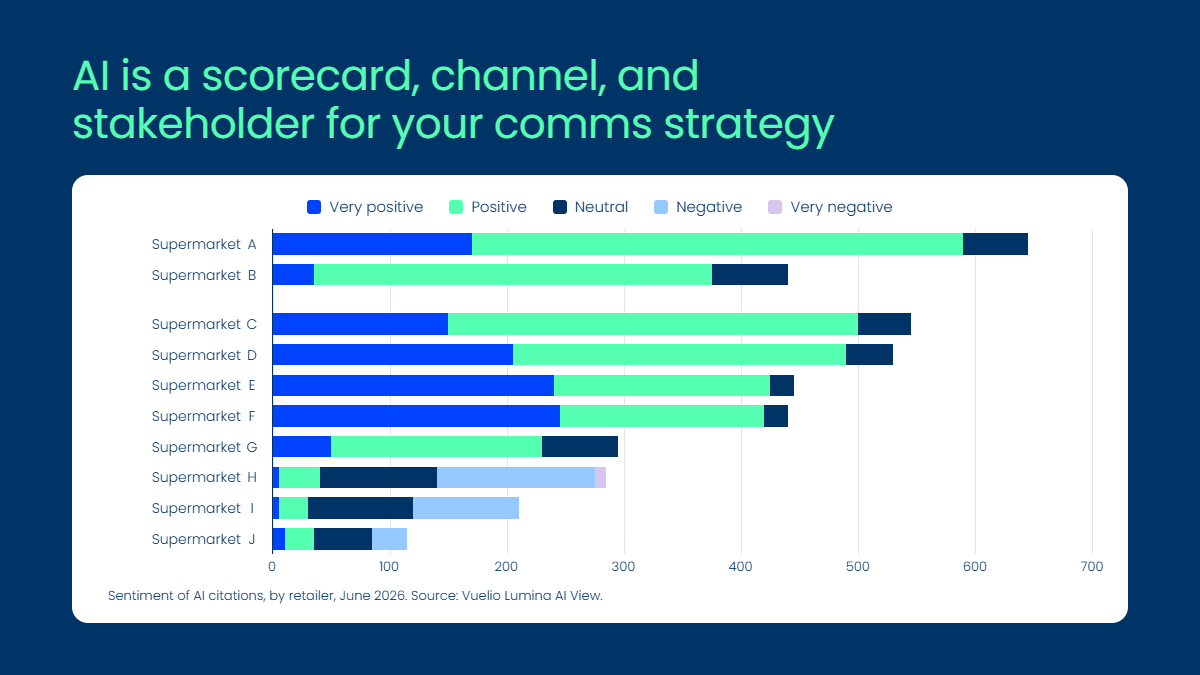
Much of the current conversation around AI in communications has focused on misinformation and disinformation, and rightly so. However, there is a quieter risk emerging for PR professionals, one that is less about falsehoods and more about absence. AI systems spread narratives, but also determine which narratives are visible in the first place.

Tools like Google’s AI Overviews, ChatGPT, and Perplexity are becoming the first step in discovery. In doing so, they filter brands based on how clearly and consistently they are understood across the web.

This creates a new risk: not being misrepresented or criticised but being omitted entirely. If a brand’s narrative is weak, fragmented or difficult to understand, AI systems may simply bypass it in favour of brands who have a very clear positioning.

How AI systems construct (and distort) brand narratives

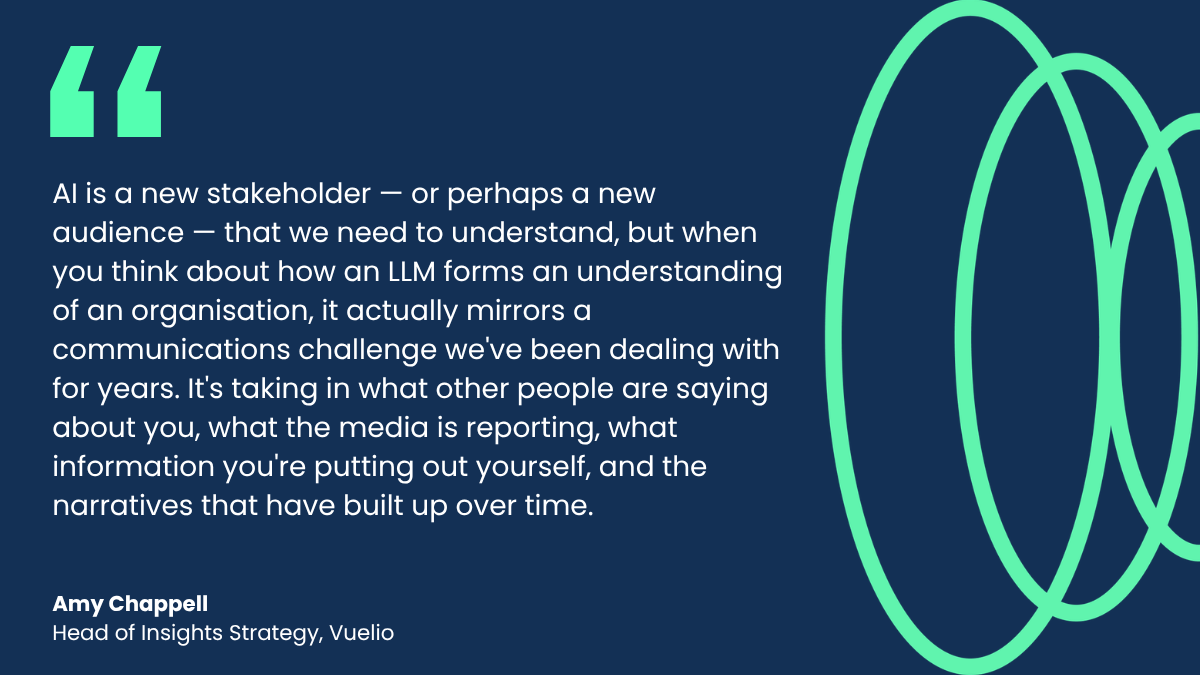
Large language models (LLMs) do not assess brands in the same way as traditional search engines. Rather than ranking pages based on keywords or backlinks alone, they synthesise patterns across vast datasets that include media coverage, blogs, reviews, forums, and structured content.

Google has indicated that its AI-generated responses prioritise high-quality information drawn from multiple authoritative sources, while OpenAI has stated that models favour information that is consistently represented across trusted data.

In practice, this means repetition becomes a proxy for credibility, consistency signals authority and clarity signals usefulness.

The three narrative risks: ignored, miscast or diluted

The first and most overlooked risk is invisibility: When a brand lacks a consistently reinforced narrative across credible sources, including the press, AI systems can struggle to categorise it. This makes it far less likely to appear in AI-generated answers. Evidence of this can already be seen in Google’s AI Overviews, where only a small subset of brands are cited even in highly competitive categories.

A 2024 study by Seer Interactive found that visibility in AI-generated results is influenced by more than just rankings, with factors like content quality, PR, and strategic positioning playing a growing role. This indicates a shift from volume-driven SEO and PR to more coherent, authoritative brand narratives.

The second risk is distortion: When the dominant signals around a brand are negative, inconsistent or unclear, AI systems will still include that brand, but often in a reframed or simplified way. Because LLMs reflect aggregate sentiment, a small number of high-profile criticisms can outweigh a larger body of neutral coverage. Similarly, a complex repositioning may be reduced to a perception of confusion, or a short-term crisis may become a defining narrative, one that AI overviews may reference in the answer if they do feature the brand.

Once this pattern is established, it is reinforced at scale across summaries, comparisons, and recommendations.

The third risk is dilution: Brands with generic, indistinct messaging often fail to surface in AI outputs because they lack memorability. If a brand’s positioning is very similar to competitors, it becomes harder for AI systems to choose it as an example. This aligns with well-established research in cognitive psychology, which shows that distinctiveness improves recall.

Why traditional PR metrics fall short

Traditional PR metrics such as media coverage, impressions, and backlinks still have value, but they are not sufficient indicators of visibility in an AI-driven environment. These metrics measure reach, but they do not capture how a brand is interpreted or summarised by AI systems.

What matters more is whether a brand’s narrative is consistent across sources, whether third parties can clearly articulate what the brand does, and whether it appears in content that explains, educates or solves problems. As a result, PR should be shifting from a focus on visibility metrics to a focus on interpretability i.e. how easily a brand can be understood and featured in an answer.

What comms teams should do now

For comms teams, this shift requires a more disciplined and strategic approach to message and narrative development. Consistency must be treated not just as a branding exercise, but as a form of risk management. Fragmented messaging weakens the signals that AI systems rely on to classify and recall a brand.

Narratives must also be designed to stand independently of the organisation. If journalists, analysts or customers cannot easily explain what a brand does, AI systems will face the same challenge. Clarity and simplicity are essential.

In addition, PR efforts should prioritise high-trust, high-context publications. Thought leadership, expert commentary and educational content are far more likely to be used by AI systems than purely promotional announcements. These formats provide the explanatory depth that LLMs depend on.

Finally, narrative shaping must be proactive. By the time a narrative becomes visible in AI-generated outputs, it has already been reinforced across multiple sources. This leaves little room for reactive correction. PR teams must focus on seeding and reinforcing clear narratives early, before alternative or negative interpretations gain traction.

For more advice on updating your comms strategy for the impacts of AI and LLMs, check out key insight from Vuelio’s latest webinar, ‘AI as the new PR & comms stakeholder‘. 


Housing in the UK 2026

The UK Housing Crisis: From A Supply Problem To A Political Emergency?

The UK housing debate has become heated as arguments over who we are building for and whether the current political leadership is capable of delivering on its promises abound.

Over the last month, the conversation has moved away from construction targets and toward a much messier reality involving planning gridlock, industrial supply chain failures, and a burgeoning leadership crisis in Westminster.

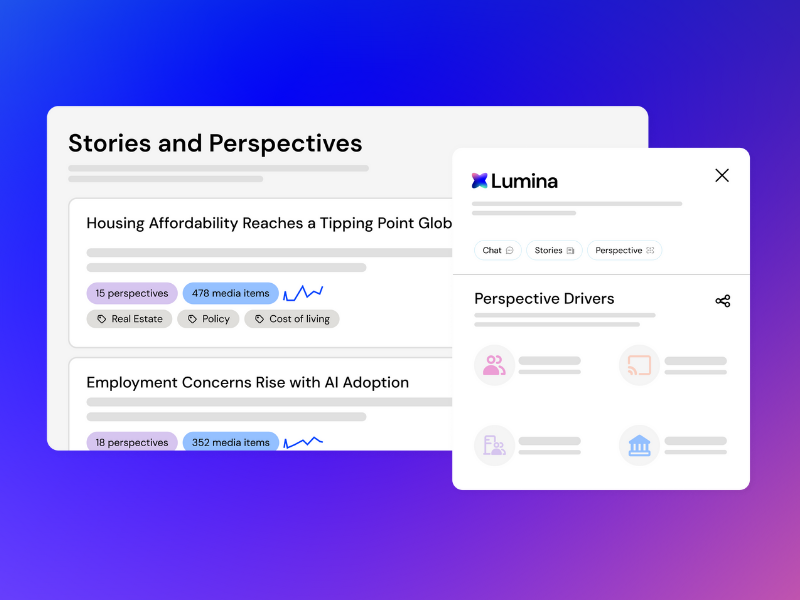
To understand how these narratives are moving, we analysed media data using Vuelio’s Lumina. This AI-powered tool surfaces the stories that matter, the different viewpoints within them, and the specific people and organisations driving the news. Between 5 April and 30 April 2026, we examined 17 distinct stories with competing perspectives to cut through thousands of media items and offer a definite look at where the narratives sit right now.

The results show a sector under immense pressure. From the grey belt of Kent to the rural Highlands, the debate is fragmenting. For those in public affairs and communications, staying on top of these shifts is the difference between leading the conversation and being buried by it.

Here is what the data tells us about the current state of the UK housing market…

A Perfect Storm Brings Housebuilding To A Decade Low

The most dominant story right now reflects a growing concern that the national housebuilding machine has ground to a halt. While the Labour government remains committed to its target of 1.5 million homes, the industry is describing a perfect storm that makes those numbers look more like a dream than a delivery plan.

The Home Builders Federation and major players like the Berkeley Group are leading this narrative, arguing that the entire financial model of building in the UK is becoming unviable. They point to a mix of high interest rates, rising material costs, and what they call bureaucratic ‘sludge’ in the planning system. This has led to a situation where major developers are cutting back on land purchases, with no clear path to profit.

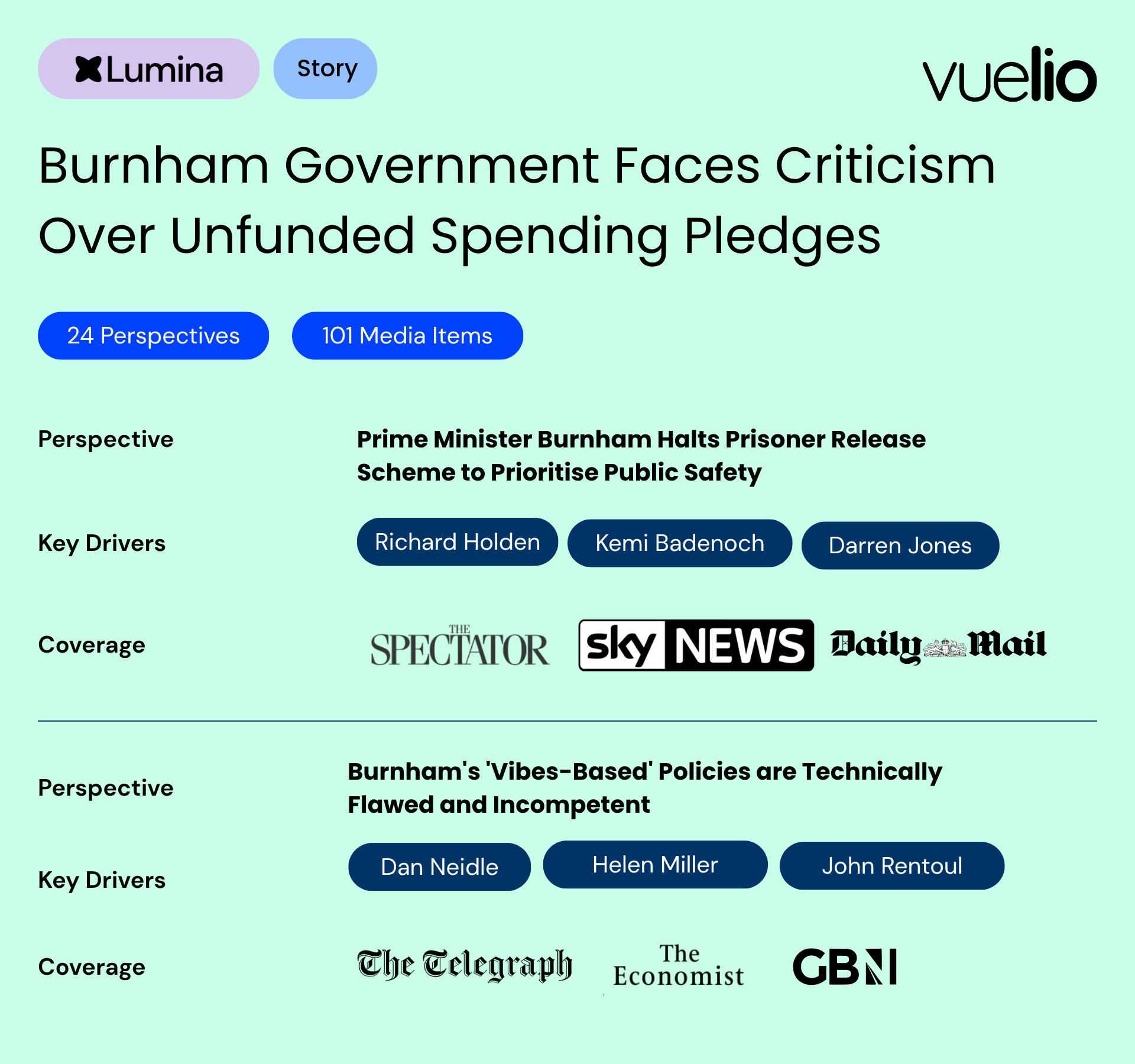
Lumina graphic on UK housing press coverage May 2026

Due to the data, this viewpoint carries a lot of weight. Construction starts in London have plummeted to levels not seen in years, and national figures for brick and block deliveries are falling. As reported by Guardian Online, these systemic delays are now being described as a ‘housing recession’, putting the Government in a difficult spot. While ministers insist their planning reforms will eventually work, the industry loudly disagrees.

The key drivers here are the industry bodies who have shifted from quiet lobbying to very public warnings. Neil Jefferson of the Home Builders Federation is a central figure, framing the crisis as a failure of policy to meet economic reality. When these organisations speak, they go beyond representing individual companies, to an entire supply chain that feels abandoned by the current fiscal environment.

The Battle Over ‘Beauty’ And Family Space In London

While the national story is about volume, the London narrative is about quality and suitability. A major divide has opened up between City Hall and its critics over what kind of homes the capital actually needs. The Deputy Mayor for Housing Tom Copley has been vocal in defending the current strategy, predicting that 2026 will be a turnaround year.

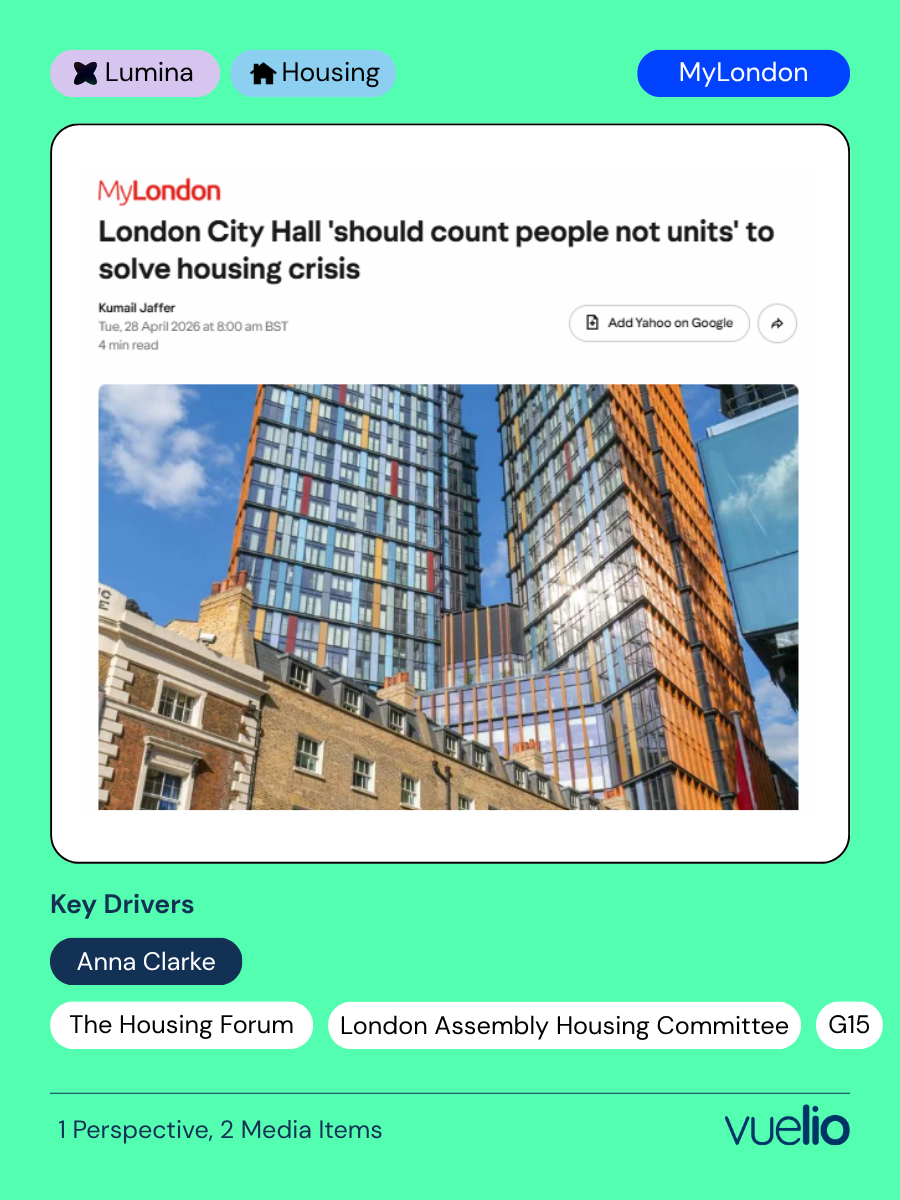
However, a growing chorus of experts and politicians disagree. The Housing Forum and the G15 group of housing associations are pushing a perspective that London is centering units over people. They argue that building thousands of small one-bedroom flats does nothing for the 75,000 households stuck in temporary accommodation, or families living in overcrowded conditions. They instead want a shift toward counting the number of people housed, rather than just the number of front doors created.

This debate has become aesthetically-focused, as well. Shadow Housing Secretary James Cleverly has entered the fray, attacking what he calls ‘soulless tower blocks’. He advocates for ‘mansion blocks’ and ‘intelligent density’, in some clever political positioning. With the focus on ‘beauty’ and ‘gentle density’, the Conservatives seek to win over local residents with a tendency to block new developments. Their bet: people are less likely to say no plans that are an aesthetic improvement.

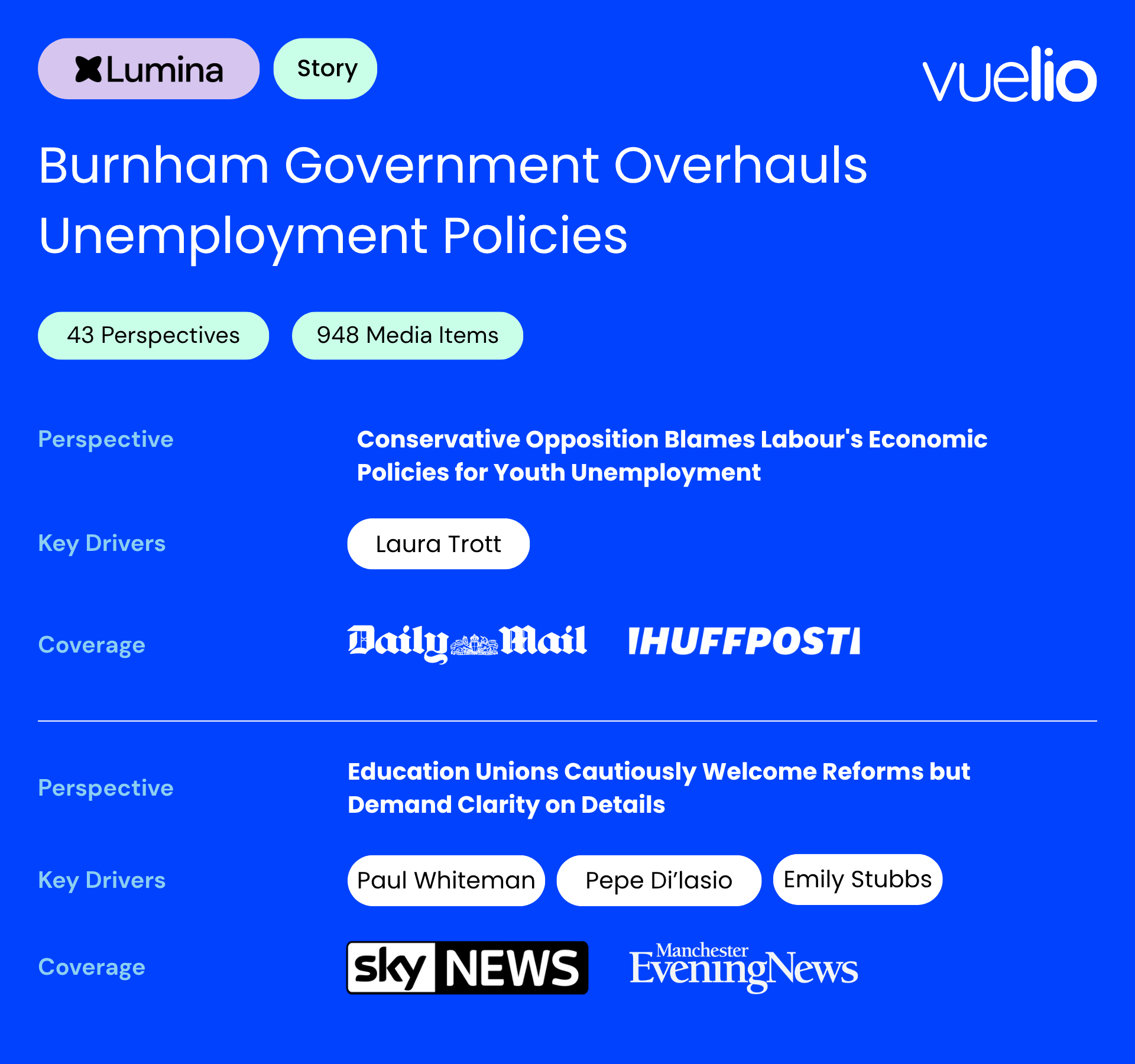
Lumina graphic UK housing May 2026

According to MyLondon, this debate is a fundamental challenge to the Mayor’s strategy. If the public starts to believe that the new homes being built are the wrong homes, political support for massive development could vanish. The key drivers in this section, including Anna Clarke of The Housing Forum, are successfully reframing the crisis as one of distribution and suitability, not just supply.

Political Instability Casting A Shadow Over Policy

Perhaps a concerning trend for those in the housing sector is how much the Mandelson controversy and questions regarding Keir Starmer’s leadership are starting to take hold of the policy agenda – the work of fixing the planning system curtailed by a focus on internal dissent and scandals.

Commentators like Alex Brummer for This Is Money and reporters for the Financial Times are painting a picture of a ‘rudderless’ Britain, with power draining away from Downing Street. And this could have real-world consequences for the economy going beyond gossip, with the Bank of England maintaining a cautious approach to interest rates, and the uncertainty in Westminster making investors nervous.

When a Prime Minister is under fire, bold reforms get pushed to the back burner, and we are already seeing this play out with housing targets. Industry analysts are increasingly calling the 1.5 million aim ‘fanciful’ as the political capital needed to force planning changes through is being spent on managing party rebellions.
The key drivers here are high-profile columnists and disillusioned backbenchers, who are linking political failure directly to the housing slump. Their argument: If the government cannot manage its own party, how can it manage the biggest building programme in 50 years? This link is potentially dangerous for the Labour brand, turning a technical policy failure into a perceived character flaw of leadership.

Supply Chain Shocks And Creative Solutions

While influential players argue in London, other stories show how the crisis is hitting the ground in different ways. The GMB Union has raised a red flag regarding brick manufacturing, pointing out a ‘nonsensical’ energy policy that gives relief to mortar makers but excludes brick kilns. This has led to factories idling and stockpiles growing, even as the country begs for more homes. Charlotte Brumpton-Childs from GMB is a key driver here, aiming to protect manufacturing jobs and pointing out the disconnect in government strategy.

Concurrently, there are creative, and controversial, attempts to bypass the planning system. In Ireland, the government has approved exemptions for garden homes and modular cabins. While ministers like Micheál Martin champion this as a pragmatic solution to a national emergency, housing advocates like Threshold warn it could lead to a return to substandard ‘beds in sheds‘.

Lumina Stories & Perspectives graphic on UK housing May 2026

In Kent, Hallam Land is testing the new grey belt rules with a 300-home proposal in Sevenoaks. This has sparked a familiar villager versus developer trope,, with local residents calling it an ‘absolute joke’, and the developer characterising the move instead as a ‘sympathetic expansion’. This story could be a preview of the many battles that will take place across the UK as the Government attempts to reclassify green belt land.

What This Means For Comms Professionals

For PR and public affairs professionals, this data suggests that supply vs demand messaging won’t get attention from the press, or from stakeholders. Campaigns focusing on building more should make way for updates on what is being built, where it is, and who it is for:

The suitability message: The focus is shifting to family-sized homes and ‘intelligent density’. If representing a developer, lead with how projects fit the local population’s specific needs, not the contribution to a national target.

Infrastructure first: The Sevenoaks story shows that local opposition is still rooted in infrastructure fears (doctors, schools, traffic). Communicators must address these points before they talk about the houses.

Everything is political: Housing is being used as a means to criticise the current UK leadership. Any project that stalls can be framed as a failure of the Government – be prepared for your project to become a political pinball.

Supply chain transparency: The brick and energy crisis shows that the how of building is just as important as the where. There is a space for thought leadership on industrial strategy and how it supports housing.

The UK housing crisis is currently enmeshed in a collection of competing crises, with a construction crisis, a planning crisis, and a leadership crisis all happening at once. The narrative has moved from a debate about numbers to a complex argument about aesthetics, family needs, and industrial viability.

Navigating this environment requires an understanding of the perspectives that are gaining traction and the key drivers and stakeholders who are shifting public opinion. The data from Lumina shows that the winners in this debate will be those who can bridge the gap between policy ambition and the reality on the ground. By staying ahead of emerging trends in the press, communicators can help shape a more constructive conversation.

Find out more about the closer alignment between public affairs, communications, and the political press here

LLM Visibility Gap

The LLM visibility gap: Why PRs need to earn attention in AI answers

The communications landscape has been transformed by the emergence of artificial intelligence, and the traditional tools of PR have had to evolve to keep up. For organisations operating in a world of fragmented media and accelerating sharing, AI must be utilised as a tool, but also treated as an influential stakeholder.

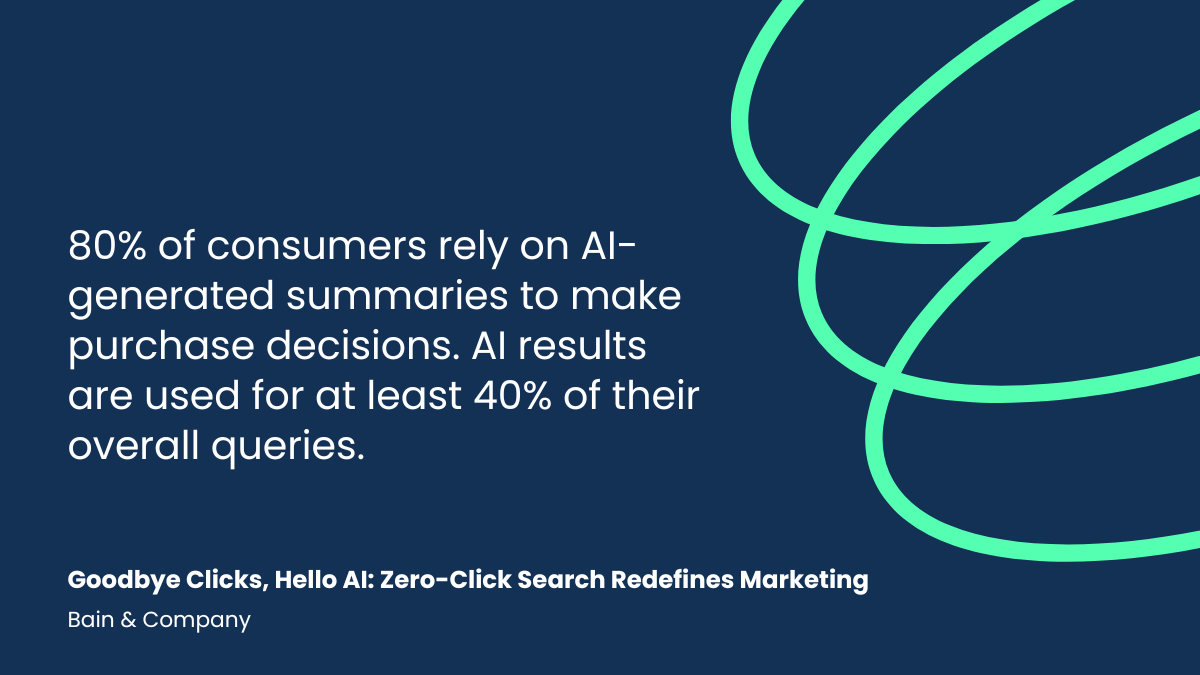
The challenge has taken PR & Comms professionals beyond traditional media monitoring, with success now also depending on whether Large Language Models (LLMs) recognise your organisation, your clients, and your messaging, and include them in their generated answers. If absent from AI summaries, your organisation risks becoming invisible to a generation of users who rely on these systems for their primary information.

AI can be a blocker, or a connector

AI is a powerful stakeholder in its own right, and like any other stakeholder, can’t be ignored.

During Vuelio webinar ‘AI as the new PR & comms stakeholder‘, the University of Huddersfield’s Dr Anne Gregory highlighted how the growing dependence on these tools is reshaping how we practice communications.

‘AI is much more than just an assistant; it is a powerful actor in the information ecosystem.

‘It mediates our engagement with organisations and individuals, and evidence is emerging that AI is often believed more than other traditional sources.’

This shift in trust represents a significant risk for those caught unprepared. If an LLM synthesises a narrative about your client or brand that is factually flawed, or omits your perspective entirely, the speed at which that ‘truth’ takes hold is fast.

However, many PR teams still aren’t paying significant attention to this. Purposeful Relations‘ Stuart Bruce highlighted how teams currently allocate their resources as just one example.

‘If you look at where budgets and effort are currently directed, the focus remains heavily on social media influencers,’ he observed. ‘Meanwhile, far less attention is paid to AI answers, which are becoming significantly more influential and persuasive.’

‘Invisible’ organisations

Media fragmentation has made it harder than ever to maintain a coherent narrative. Between political volatility, geopolitical shifts, and the sheer volume of digital noise, the feedback loop of communications is compressing. In this environment, comms teams need to go beyond monitoring and interpreting to anticipating and ‘pre-bunking’.

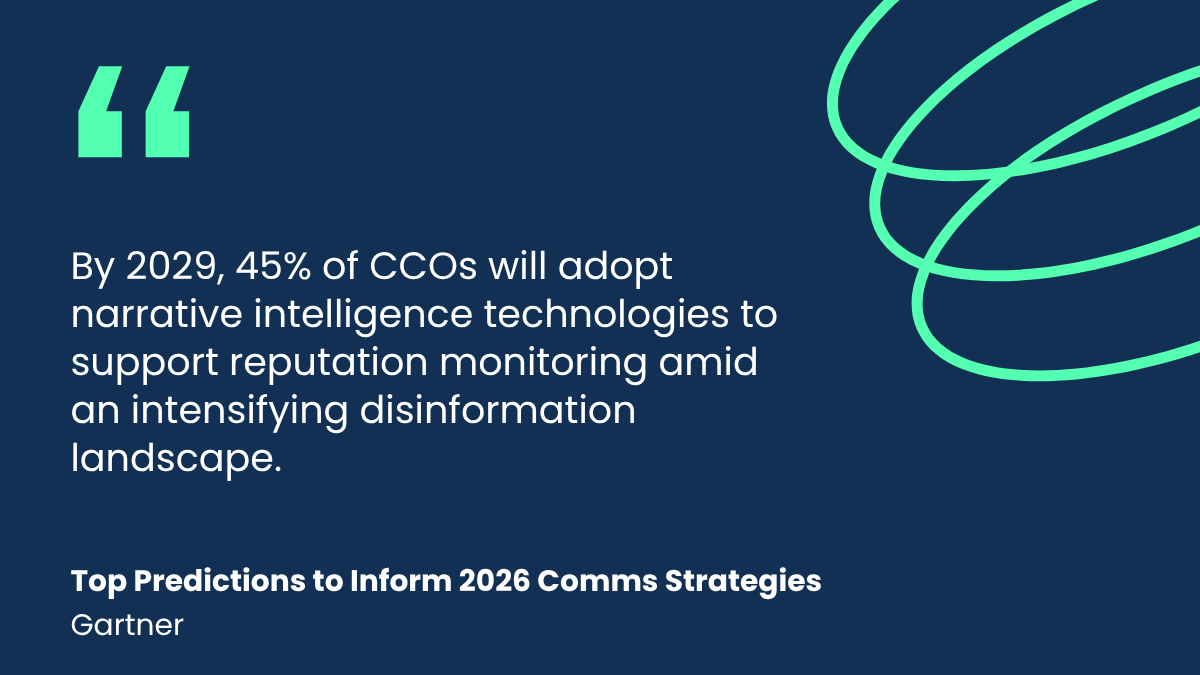
Because the risk of being ignored by LLMs is a commercial one. Gartner’s recent report ‘Top Predictions to Inform 2026 Comms Strategies‘ highlighted a critical shift for Chief Communications Officers (CCO) towards Answer Engine Optimisation (AEO).

Gartner report statistic

Gaining visibility in AI answers doesn’t require a skill set completely new to comms professionals, however. The shift can be simple: to be included in an AI answer, your organisation must provide enough digital touchpoints for the model to verify your information as reliable.

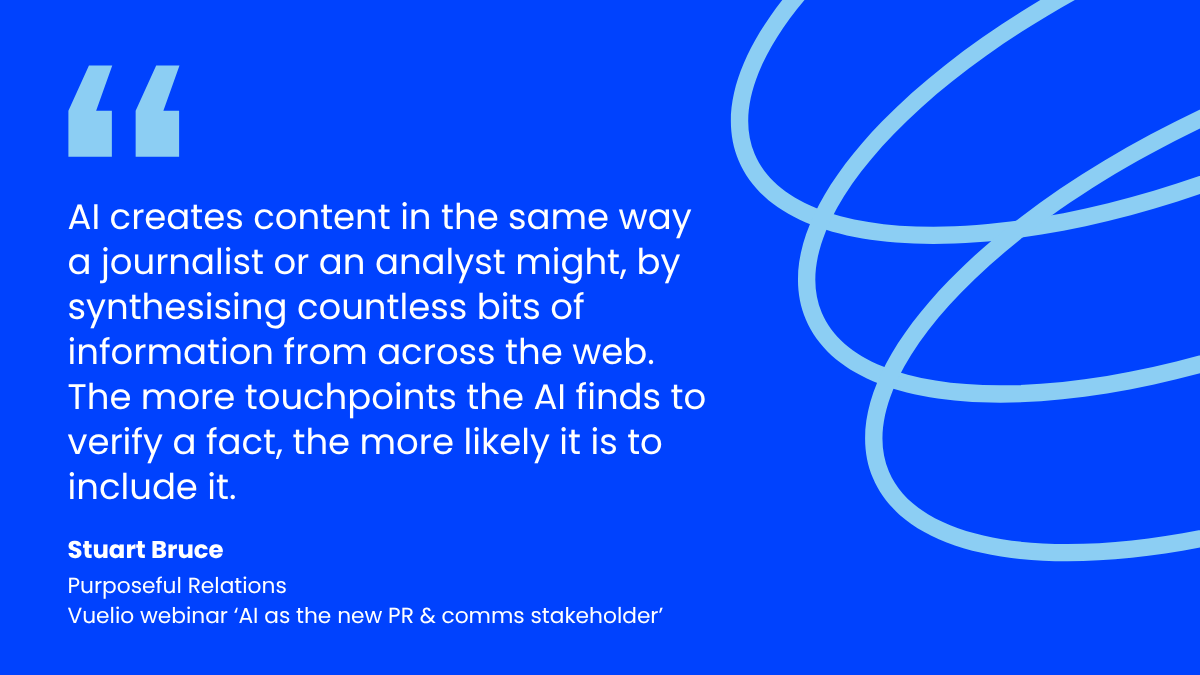
As Stuart Bruce puts it: ‘AI creates content in the same way a journalist or an analyst might, by synthesising countless bits of information from across the web.

‘The more touchpoints the AI finds to verify a fact, the more likely it is to include it. If we don’t create an environment where the AI can find enough evidence of our perspective, it simply won’t give it.’

Closing the gap

The secret to a successful campaign in 2026 and beyond lies in ensuring your key facts, executive commentary, and brand milestones are structured and accessible to LLMs – placing information in enough reputable digital locations (from media outlets to white papers and official statements) that an AI agent perceives your narrative as the authoritative one.

As Dr Anne Gregory warned: ‘Once a narrative is set, it becomes extremely difficult to counter. This is why PR must come in early. AI agents use information to create their own sources of knowledge; if the data they collect is flawed, the consequences for the organisation are severe.’

PRs continue to be the architects of brand reputation, tasked with influencing both the human audience and the intelligent agents that interpret the world for them.

What’s next?

The organisations that will thrive in this AI-mediated world are those that earn credibility through the discoverability of their message – like the comms outreach of old, but evolved.

At Vuelio, our platform is built to support exactly this kind of purposeful communication, with our Lumina suite continuing to evolve to meet the needs of today’s comms teams. Whether you are in-house or agency, the goal remains the same: to ensure that when AI is asked a question about your sector, your organisation, or your clients, your voice is the one it uses to provide the answer.

Find out more about Lumina

AI is the new stakeholder for PR and comms

AI is the new PR & comms stakeholder

Artificial Intelligence impacts PR & comms in two distinct ways. It transforms how practitioners work with massive volumes of media, and at a greater degree of sophistication and personalisation. At the same time, it’s also a powerful force shaping how information is surfaced, interpreted, and acted upon across the entire communications industry. What’s changed isn’t just ‘how’ you do the work, but your reason for doing it in the first place.

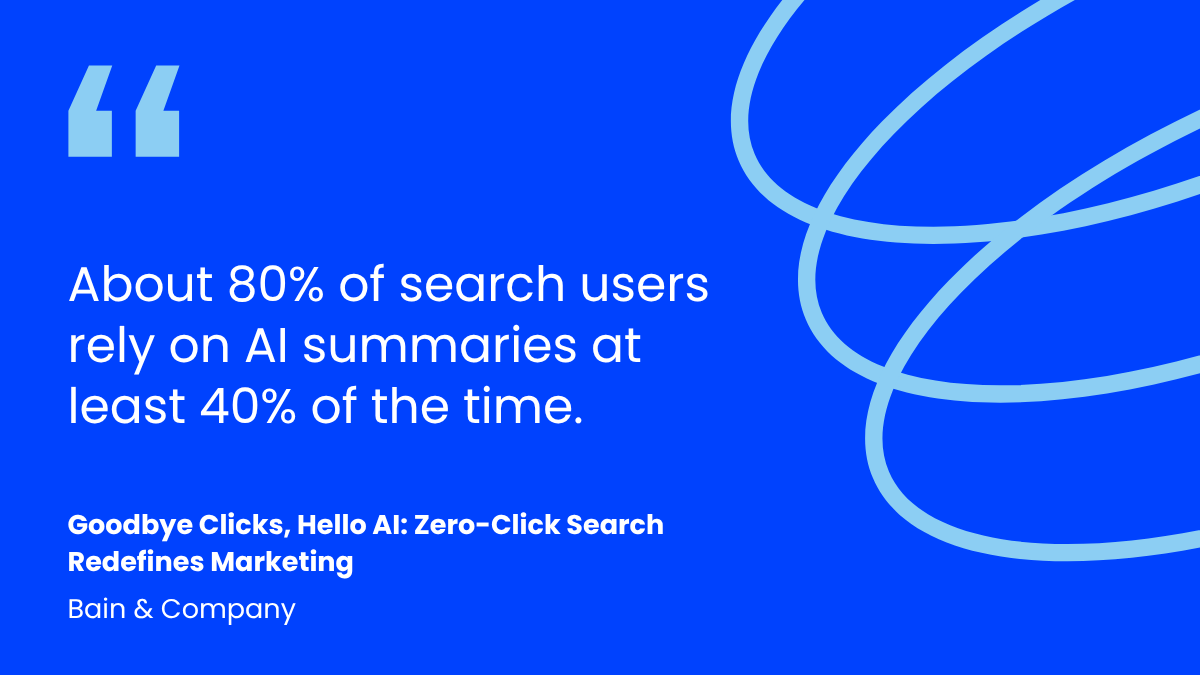
Not sure if you agree? The current landscape makes clear just how important factoring in AI’s influence is. According to Gartner’s latest predictions for 2026, the mass adoption of public Large Language Models (LLMs) as a replacement for traditional search is expected to drive a significant increase in PR and earned media budgets by 2027. To add to this, BCG’s AI Radar global survey found that corporate investments in AI have doubled since last year.

From the PRCA’s recent green paper on responsible AI, to the CIPR’s focus as part of its survey for 2026, the sector is rapidly investing in this future. And with the EU AI Act deadline on the horizon, the urgency for robust governance and planning has never been higher. As Rupert Younger, Director of the Oxford University Centre for Corporate Reputation, put it as long ago as 2024: ‘AI is not just a technology, it has become a stakeholder’.

To navigate this new reality, we were joined by Dr Anne Gregory, Professor Emeritus at the University of Huddersfield, and Stuart Bruce, PR Futurist and Co-founder of Purposeful Relations, for our latest webinar, ‘AI as the new PR & comms stakeholder’.

Watch the full webinar here.

In the session, we explored how this new stakeholder is redefining reputation, influence, and strategy.

What kind of stakeholder is AI?

While many across the comms industry still view AI as a digital assistant for finding efficiencies and speeding up elements of our daily responsibilities, Anne argues it has moved into a more active role:

‘In one sense, AI is a compliant assistant, helping us along the campaign creation trail from research to identifying and prioritising stakeholders, tracking sentiment. But even here, it’s doing that in your name and in your organisation’s name. You have to have a stake in its work, because it certainly has a stake in yours.’

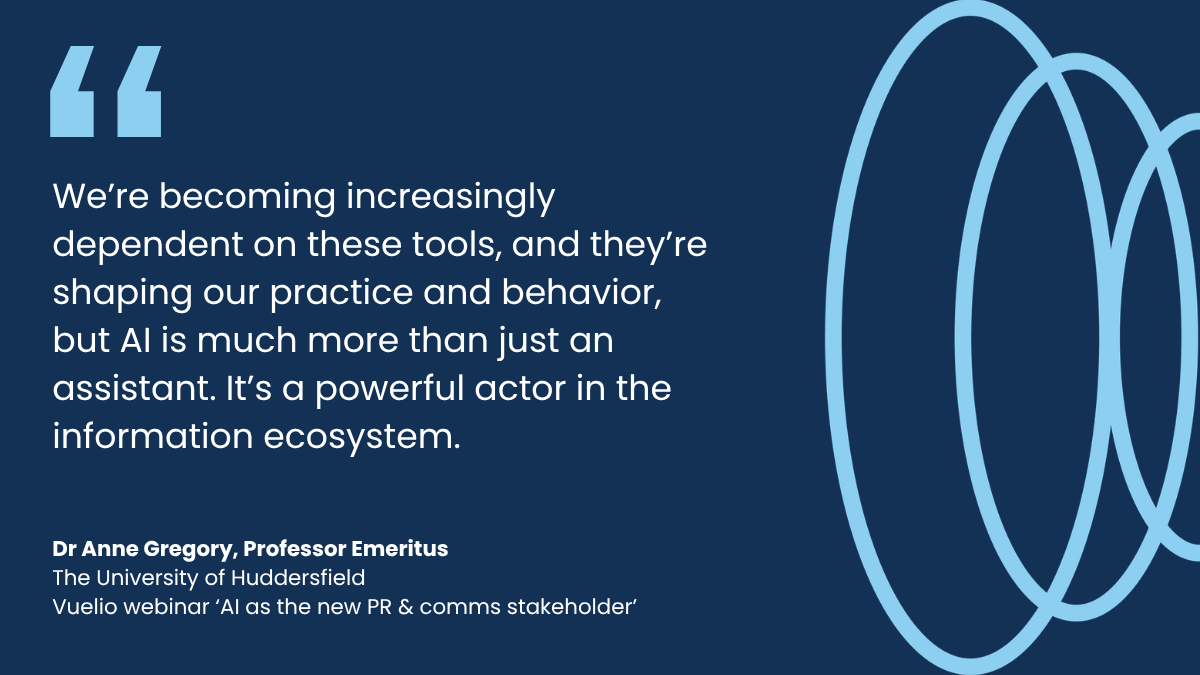
‘We’re becoming increasingly dependent on these tools, and they’re shaping our practice and behavior, but AI is much more than just an assistant. It’s a powerful actor in the information ecosystem.’

While AI lacks anything approaching human intentionality (for now…) its algorithmic processes produce significant real-world consequences. It shapes organisational perceptions and mediates engagement with individuals, often presenting summaries that are believed more than traditional sources.

‘AI is becoming a very strong stakeholder,’ said Anne. ‘ I like Dr. Nici Sweaney’s definition of these agents and AI, it’s an accidental stakeholder’.

Stuart Bruce added that there is still significant confusion regarding what AI actually means for practitioners. Purposeful Relations’ research with 72Point revealed that 44% of UK consumers trust AI answers – a figure nearly double the 24% who trust social media influencers:

‘If you look at where budgets and effort goes at the moment, it’s going to social media influencers; it’s not going into what’s happening with AI answers, which are becoming a lot more influential and persuasive.

‘Anne talked about accidental stakeholders – you’ve actually also got the accidental AI users, because even those people that aren’t using AI, they’re still going to be seeing those AI overviews in search. This is where we talk about ‘zero click’, because people are often seeing those answers and going no further.

‘It’s not just about visibility, it’s actually also about accuracy – how your organisation is being portrayed, your leadership, and your people. You’re going to want your particular perspective to be coming out in AI answers.’

The dangers of underestimating AI’s role as a stakeholder

If AI is treated only as a tool or assistant, organisations face substantial reputational risks. Anne warned about the danger of underestimating AI’s power to curate and shape truth:

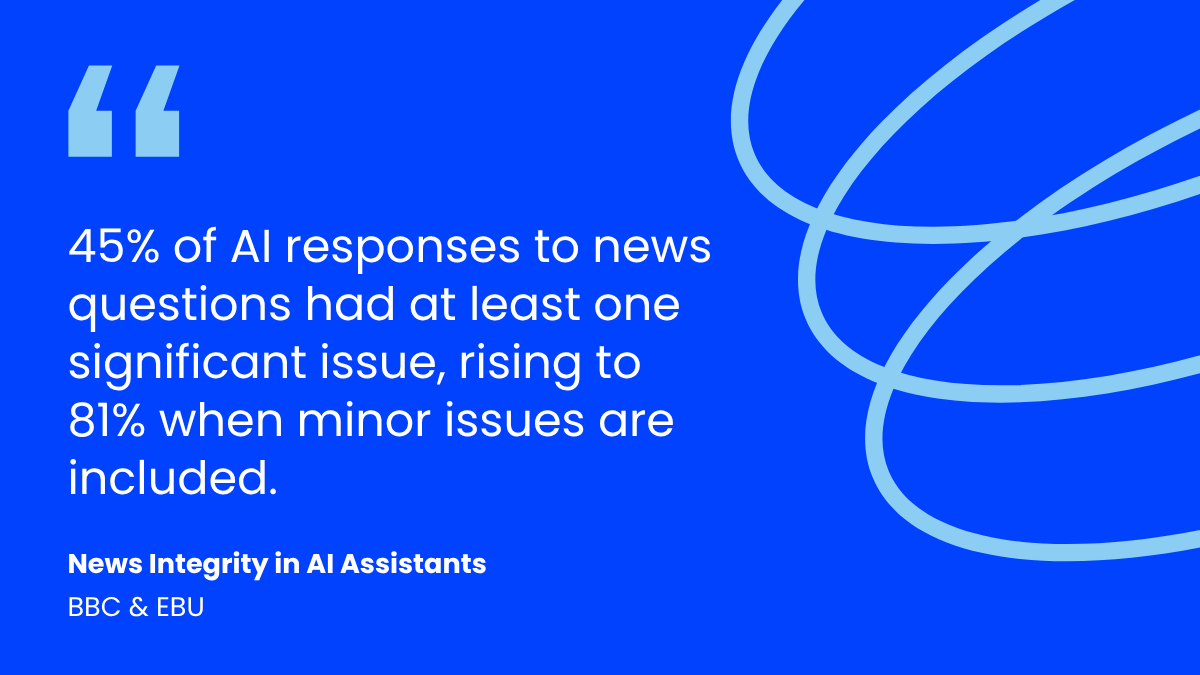
‘For a lot of people, it has become a source of truth. Maybe PR people are more skeptical of AI than others… but the world isn’t peopled by AI experts or public relations experts. Even though we know these summaries are often incomplete and biased, we tend to believe them. If we don’t regard AI as an influential stakeholder, we could be putting ourselves in jeopardy.’

Anne pointed out the difference with this stakeholder and stakeholders as they’re currently understood, particularly the media.

‘There’s an interesting difference here. If you’ve got a beef with a journalist and you think they’ve not represented you fairly, you can go and have a conversation with that journalist, and you can present them with a case. You can even go to the editor and get some sort of redress. You can’t do that with AI, not in the same way at all.

‘AI is a very powerful and influential stakeholder, but not one that you can necessarily influence back directly. Once a narrative is set, it becomes really, really difficult to counter it. Which is, of course, where PR comes in.’

Trouble can also come if comms practitioners fail to make full use of traditional tools in the PR kit that came way before AI: getting a story out to as many influential sources as possible.

For a practical example, Stuart shared the story of a university industrial dispute. The AI’s narrative was dominated by the trade union’s perspective, because the union had provided multiple touchpoints – website statements, social media, and media quotes. The university, in comparison, having viewed the situation as negative, only responded directly to journalists:

‘The trade union gave them half a dozen quotes – the university gave them one. It just wasn’t credible. This is what AI as a stakeholder actually means. The more touchpoints that AI can find to verify that a piece of information is a fact, the more likely it is to be included in that AI answer.’

Shifting narratives and the speed of change

Anne reflected on the speed of adoption, noting that CIPR’s AIinPR 2018 literature review could not have predicted the current reach of generative models. She admitted that while the PR industry was initially slow to adopt and adapt, it has quickly developed an ‘obsession with tools’ rather than considering the broader implications:

‘We didn’t realise that AI is a stakeholder for the whole organisation. We are only now waking up to the fact that we have an enormous role in the governance of these systems. At the end of the day, we’re talking about the legitimacy of whole organisations.’

Stuart emphasised the need for PR and comms teams to factor AI’s influence into strategies now, particularly to curtail false narratives, misinformation, and disinformation:

‘If organisations aren’t doing something now, it’s too late.

‘NATO published a paper on misinformation and disinformation and one of the concepts that NATO talks about a lot is “pre-bunking” and “inoculation” – making sure that your information is out there. And that’s what you need to do with AI – it’s too late to wait, and watch, and see. You actually need to be making sure that it understands your perspective now – it’s not just as simple as dealing with a truculent journalist or an activist group. AI is influenced by a multitude of sources.’

Navigating governance and internal responsibility

With a lack of one source of truth regarding the ethical use of AI, Stuart highlighted the importance of ‘living and breathing’ internal governance and responsibility, involving continuous training and feedback loops:

‘Too often what people try to do is create an AI policy, and on its own, that’s fairly meaningless. Governance is something entirely different. The policy only means something if you’ve done some training to go with it.’

Stuart introduced the concept of a ‘social license’ for AI — gaining trust from other stakeholders, internal and external, for how an organisation embraces the technology.

‘It’s making sure that it’s not just about how you as PR people or comms people are using AI, but how the organisation is embracing it. How on earth do we get trust from all of our other stakeholders for the things that we might want to do with AI? How do we bring our employees with us? How do we make sure that we’re using it in the most sustainable way possible?

‘What are we doing to address issues around bias and inclusivity, fairness and access? The answer is going to be different for each organisation.’

What can the industry do now to work with this new stakeholder?

Both speakers offered critical advice for practitioners to follow now. Anne urged the comms industry to continue to question what AI offers and evolve their approach as the technology changes:

‘Constantly ask yourself three questions: Why are we using AI? How is it built? And who is it going to be affecting?

‘Remember, it’s not just an agent at your service; it’s an equaliser of power that takes a stake in you and your organisation as much as you use it to influence others.’

Stuart expressed concern that hype, and confusion, around terms like Generative Engine Optimisation (GEO) is turning a portion of comms people off of thinking about the ramifications of AI as a stakeholder:

‘There is a lot of hype, but the fundamental point remains: you must renew your communication strategy. If comms people aren’t thinking about this this year, they’re going to be in real trouble.’

Simple tips for AI-friendly outreach

When asked for tips on making media outreach more AI-friendly, Stuart was adamant: do not write for machines.

‘We should still 100% be writing for humans. However, it’s possible to write for humans in an AI-friendly way so that AI can understand and read it as well.’

He identified three factors AI prioritises:

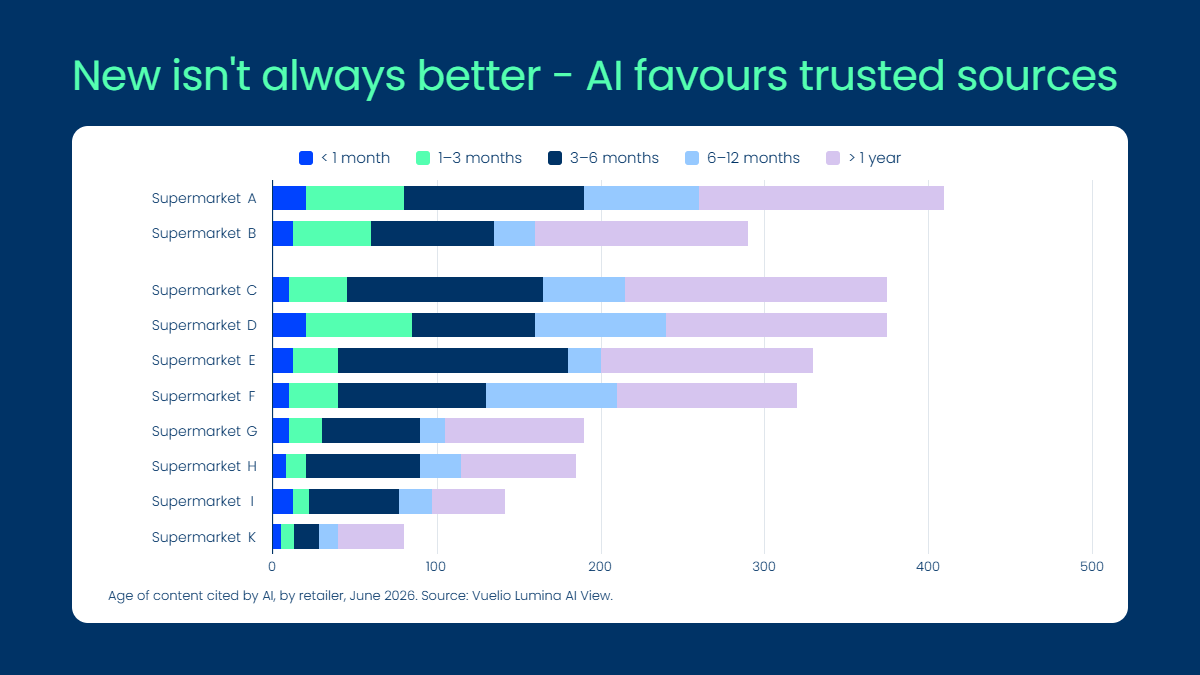
Recency: AI likes fresh content to supplement its training data. If you have a research report, keep refreshing it with new aspects.

Relevance: AI recognises specialist niche titles and trade media. Some syndicate titles that practitioners sometimes sneer at are actually vital because AI uses them to fill data gaps.

Reputation: AI looks for ‘proof points,’ like whether a spokesperson has a matching biography on the website or a consistent LinkedIn profile.

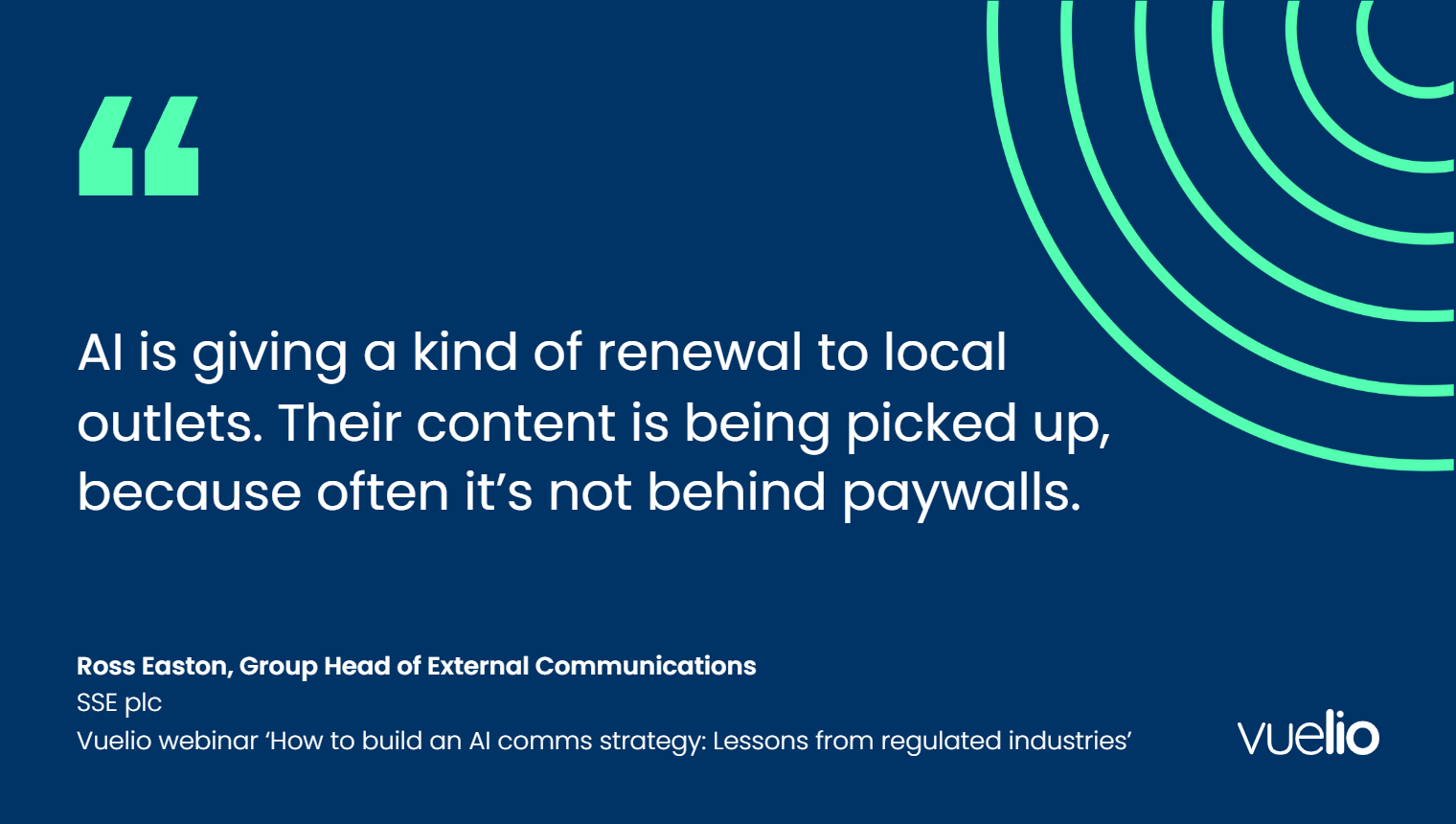
Stuart suggested that practitioners must broaden their scope of stakeholders. While first-tier earned media remains important, much of it is hidden behind paywalls. AI will look elsewhere for information:

‘When a comms team is doing outreach, if the CEO has got a limited time to do interviews, it changes the priority of the ones we’re going to accept. When we talk about owned media – not just necessarily talking about your own owned media – often we’re talking about partners, suppliers, or customers, and what they’re publishing and sharing.

‘We are in public relations – the key word is “relations”. Sometimes we focus on two small a segment of stakeholders. We might look at the media, we might look at politicians, but it needs to be a lot broader than that.

‘We really need to understand all of the relationships that an organisation has and think about whether we can manage those relationships in a better way, but also what impact that’s going to have on AI answers, because it is going to have an impact on both.

‘Fundamentally, organisations need relationships to exist. You can’t exist in a vacuum, so it’s important that we get this right.’

And to finish on a positive note: Anne saw great opportunity for public relations’ new stakeholder in AI – bringing new ways to connect and relate:

‘That’s one positive thing that AI can help us with. Look at the spread of relationships that are going to help us get traction with a whole range of other organisations, and influential people.’

For more on how AI is speeding up the spread of information – and challenges to the comms industry – check out our previous webinar ‘AI, Disinformation and the Risks They Pose for Communicators Today‘ with Thomas Barton, Executive Director of the Council for Countering Online Disinformation and CEO of Polis Analysis. 

SRM vs CRM

What Gartner’s 2026 comms predictions mean for your strategy and how the latest generation of PR tools can help

Determining the future of your communications strategy shouldn’t feel like guesswork. In 2026, the industry is moving from tactical delivery to an era of strategic value, where the most successful teams act as the architects of an organisation’s social and reputational capital.

Following the PRCA’s update of its official definition of public relations, Gartner’s ‘Top Predictions to Inform 2026 Comms Strategies‘ report lands at a time when the PR and communications profession is redefining itself from the inside out.

Here are predictions that have direct implications for external PR and earned media strategy, and how Vuelio can help comms, PR, and public affairs professionals meet the challenges ahead.

The rise of earned proof in an AI-mediated world

Gartner predicts a fundamental shift in how trust is established. 60% of communications leaders are forecasted to focus their strategy on ‘Earned Proof’ – building trust based on what an organisation can demonstrably show, rather than just what it claims.

In an environment where AI systems increasingly mediate what audiences see, brand reputation will depend on the credible, raw material that both humans and AI models use to determine trustworthiness.

Building this proof means understanding how your stories are being interpreted. Vuelio’s Media Monitoring provides a 360-degree view of your impact across broadcast, print, online, and social media. However, in a fragmented landscape, a list of clips is no longer enough.

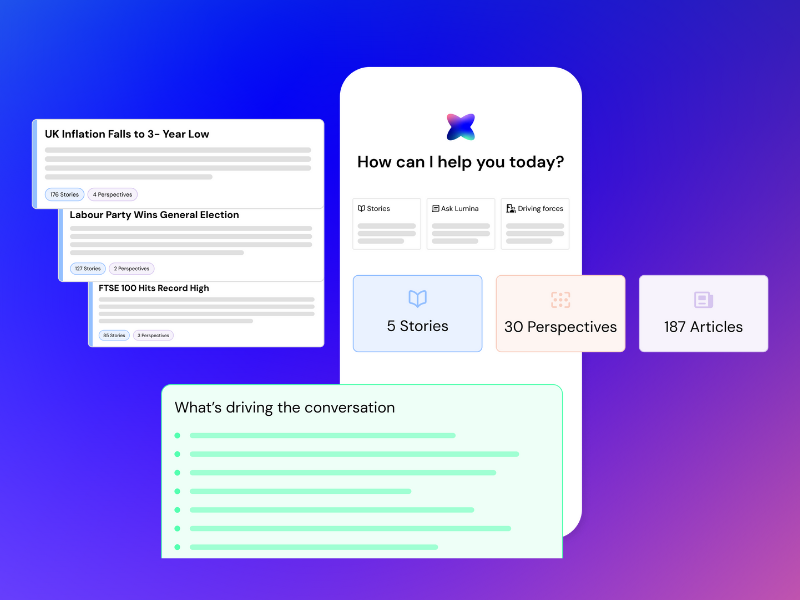
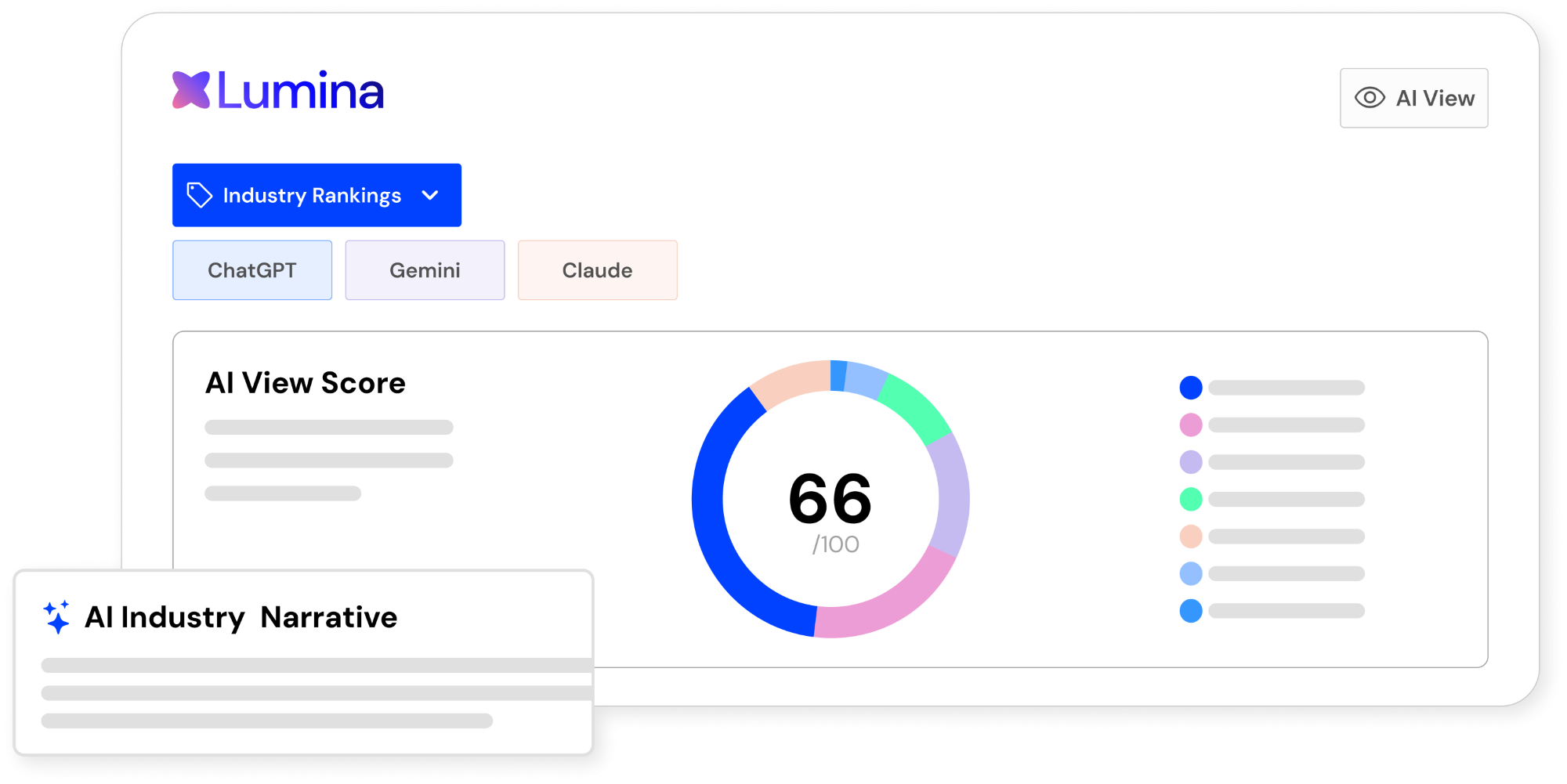
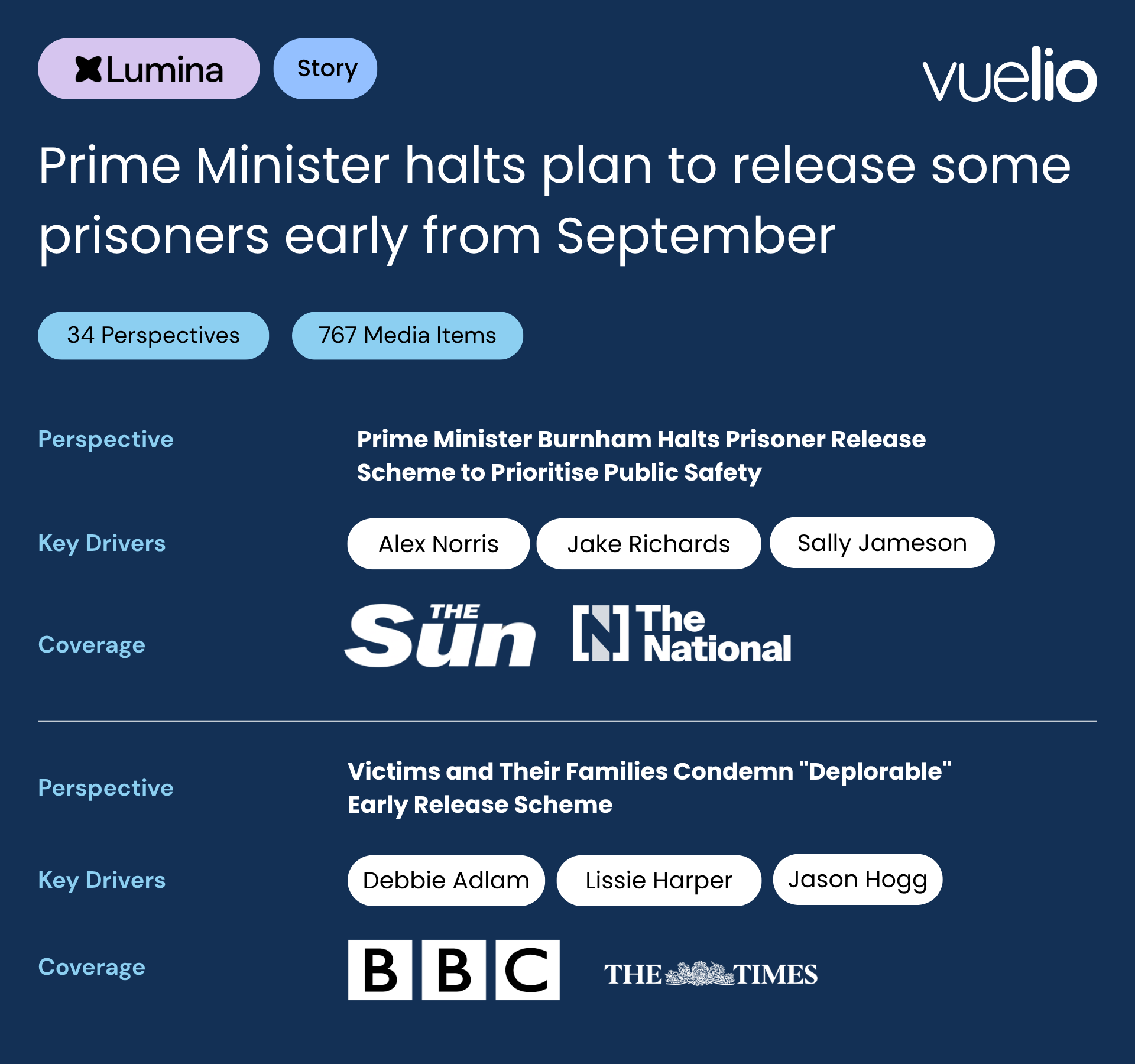
This is where Lumina, our AI suite built specifically for PR and comms, becomes vital. Its Stories & Perspectives module moves beyond simple alerts to cluster mentions into narratives, reflecting different media and stakeholder angles. By seeing how stories evolve and where they gain traction, you can identify the exact moment to inject authentic voices, such as employee or customer advocacy, that AI models interpret as markers of trust.

Lumina - How can I help you today?

Reputation agility and the end of siloed monitoring

Gartner anticipates that the speed of the news cycle will demand ‘Reputation Agility’; an ability to detect early signals and respond before misinformation enters AI-generated summaries. This is a critical defensive measure, as Gartner predicts that 70% of communications leaders will use AI-driven tools to detect and respond to reputation-damaging content before it reaches a mainstream audience. The path a story takes today is kinetic, often striking political triggers that abruptly change its trajectory.

Navigating this complexity requires breaking down the walls between media management and public affairs. If your platform only tracks one strand of a story, you are missing half the picture.

Vuelio offers a fully integrated platform that connects media monitoring with a comprehensive Political Database and Political Monitoring. This allows you to track a narrative as it travels from a local planning debate to the floor of the House of Commons. Our in-house Policy Research team acts as an extension of your own, flagging relevant announcements and providing the context needed to respond at pace.

Political monitoring on Vuelio

‘The path a message takes in today’s multi-platform media and political landscape is often unpredictable, subject to potential rebounds and buffers,’ explains Kelly Scott, VP of Government and Stakeholder at Vuelio. ‘In this environment, it is absolutely vital to correct misinformation at pace, engage with both media and political influencers, and mobilise credible third-party voices.’

Influence intelligence and the role of the central strategist

Gartner posits that PR and comms professionals are transitioning into a central intelligence role. This shift is driven by the need to manage automated influence; Gartner predicts that by 2027, 30% of influencer-driven interactions will be managed by AI entities, requiring comms teams to monitor brand representation not just in headlines, but in the answers generated by AI systems.

Operating as a central strategist requires moving beyond counting clips and towards measuring value creation. Vuelio Insights provides AMEC-accredited analytics that allow you to track share-of-voice and key message penetration, linking coverage directly back to commercial goals.

Vuelio’s Stakeholder Relationship Management (SRM) is purpose-built for the nuances of comms. It serves as a corporate memory, allowing your team to log every interaction, from a call with a journalist to a meeting with a civil servant, in one searchable place. This ensures your organisation speaks with one voice, protecting your reputation across all channels.

In this evolving landscape, the PR professional is becoming the primary architect of brand reputation, tasked with influencing both human audiences and the intelligent agents that interpret what those audiences see. By aligning human trust with machine interpretation through a unified platform, you can transition from being a communicator to a strategic leader who predicts shifts and advises at the highest level.

Future proofing your strategy

The future of comms is integrated, evidence-led, and highly strategic. At Vuelio, we believe that providing the right intelligence infrastructure is the only way for organisations to operate at the speed and scale this new environment requires. Our commitment is to empower communications teams to deliver meaningful impact by turning complex data into actionable strategy.

By unifying media, political, and stakeholder intelligence into one ecosystem, we’re here to help you understand not just what is happening, but why, and what to do about it.

Want more about stakeholders strategy? Sign up to Vuelio’s upcoming webinar on an increasingly important stakeholder in 2026 – artificial intelligence. Join us for ‘AI as the New PR & Comms Stakeholder‘ on 21 April.