Not for profit media fragmentation

Advocacy in the media ecosystem: Today’s PR playbook for the charity sector

The third sector is built on driving change, raising awareness, and giving voice to the voiceless, and today’s media landscape has a plethora of platforms offering access to wider audiences. But with these platforms so fragmented, how can Not-For-Profit organisations connect with audiences spread across online forums, social media, national press, broadcast, and more?

Vuelio’s latest report ‘How news travels in today’s fragmented media environment’ tracks a number of major public interest and politically-driven news stories from the first half of 2025 to provide a map for comms teams in need of coverage for their campaigns.

Here are key insights for comms teams in the third sector:

1. Niche reach outlets are just as valuable as mass media

National news coverage might be impressive to the board, but a crucial lesson for health charities, research bodies, and policy-focused organisations is that tabloid coverage shouldn’t be the ultimate aim for every campaign.

Reaching a small, engaged group of clinicians, academics, or policymakers with a write-up in a specialist journal can be infinitely more impactful for your mission than a fleeting, 10-second mention on breakfast TV.

Have a story that would work for very distinct audiences? Try a two-track comms plan: one for your specialist stakeholders and one for your mainstream fundraising, without risking a generic multipurpose approach that is unlikely to be picked up by the press at all.

2. Politics adds unpredictability

For any charity involved in advocacy, the impact of politics in amplifying, or silencing, a campaign will be very familiar.

Kelly Scott, VP at Vuelio, describes the journey of public interest stories as a ‘pinball machine’ – either pinging to unexpected places from political realms, or quickly falling out of play.

If your issue gets politicised, picked up for party gain, or distorted, motivating third party stakeholders to speak on your behalf can be the most credible asset for the third sector.

Service users, your volunteers, and your academic partners can add credibility and balance to the public discourse.

3. Echo chambers can stop a story in its tracks

The UK media landscape is severely siloed, with one example from our latest report being coverage of surge pricing in the UK. Reporting on this issue was split, with audiences largely staying in their own echo chambers, experiencing further reinforcement of their own existing takes and opinions.

For the Charity sector, breaking through this is a critical challenge. A campaign on the cost-of-living crisis could be framed as a human-interest tragedy in one silo, and a complex economic policy failure in another.

The job of the comms team is to find the ‘connectors’ that break through these siloes – identifying and building relationships with figures and platforms that cut across barriers and build public trust.

4. Your advocacy is the story

Some of the most powerful stories that pick up speed in the press are public interest, and these often start life on social media. But also important are case studies – connecting the media with real people, who have real stories to tell.

This happens to be a superpower for the charity sector. Your work is built on personal experiences and advocacy for communities – amplifying voices, and engaging with people across platforms, can be the engine of an entire media strategy.

5. Adapting to mission-driven comms

This fragmented world requires a new strategy, one built on agility and insight. As Amy Chappell, Head of Insights at Vuelio, advises, comms professionals must ’embed adaptability into comms strategy’.

This means having spokespeople and expert commentators ready to engage. In this landscape, the most credible and authoritative voices will retain a degree of control.

Ultimately, your strategy must shift:

From Endpoint to Ecosystem: Stop treating a press release or a media hit as the “finish line”. Instead, anticipate how your story will evolve as it’s passed between different platforms and audiences.

From Counting to Navigation: Monitoring is no longer about counting clippings. It’s about understanding how narratives are reframed along the way, so you know exactly when to step in, clarify, or amplify.

This new environment is complex, but for charities, it’s a playing field filled with opportunity. Authentic stories can find their audiences in a myriad of ways.

For more on how stories move through the modern media landscape, read the full Vuelio white paper here

Navigating the modern media maze for brands

In 2025, the idea of a story travelling directly from the PR team, to the newsroom, straight to the right audience is long gone. Today, stories scatter, ricochet, and sometimes completely transform as they pass through an ecosystem of platforms.

For in-house comms teams at big UK brands tasked with securing significant attention for their campaigns, this fragmented environment can feel chaotic and difficult to circumnavigate. But it’s also full of opportunity – here is what brand comms teams need to know for connecting with audiences now…

From broadcast to broadband: the shape of today’s media

According to the latest Reuters Institute Digital News Report, UK audiences have shifted away from print and TV (down to just 12% and 48% respectively) towards an online-first, mobile-led media landscape.

Statistics from Reuters Institute

For PRs, this means the traditional ‘top-down’ model of securing coverage and waiting for amplification no longer applies. Every story now takes a unique, often unpredictable route through the media ecosystem.

This doesn’t mean that ‘traditional’ media isn’t important – long-trusted media brands have simply branched out into a number of new formats, and audiences can be found spread among them.

Stories take unexpected turns

Vuelio’s latest report ‘How news travels in today’s fragmented media environment’ tracked specific stories across the first half of 2025 – from the AI for Heart Health innovation to the Zero Hour Contract Ban. The findings reveal just how differently narratives can evolve:

AI for Heart Health stayed niche and technical, thriving in academic journals and specialist sites before making a surprise leap to tabloids when an AI pyjamas invention caught the press imagination.

Low Traffic Neighbourhoods moved from hyper-local activism on Reddit and X into national election talking points.

Surge Pricing split the nation’s media in two: broadsheets debated regulation and market fairness, while tabloids raged about pint and gig prices.

Zero Hour Contracts began as social storytelling – people sharing experiences online – before policy debate brought it into mainstream broadcasting.

Stories showcasing media fragmentation

These examples highlight a key lesson: media coverage is no longer linear, but lateral. Stories can leap between siloes, or split into parallel versions depending on who picks them up.

The new rules of engagement

As Vuelio’s VP of Government & Stakeholder Kelly Scott notes, ‘The journey of public interest stories can be like a pinball machine — hitting political buffers that change their course’.

Brands are particularly subject to regulation and therefore political interest. Managing reputation in this landscape means engaging quickly, across both media and political spheres.

Correcting misinformation, activating credible third-party voices, and keeping stakeholder networks mobilised are now essentials, not extras.

Amy Chappell, Vuelio’s Head of Insights, adds:

Amy Chappell quote on media fragmentation

‘Each platform, each audience, leaves its imprint. A story isn’t a fixed communication anymore – it’s a fluid journey shaped by who picks it up and how it’s retold.’

How brands can adapt

For in-house comms leaders, this fragmentation requires a mindset shift:

Think ecosystem, not endpoint. A press release isn’t the end of your campaign — it’s the start of a story’s evolution. Map where it might travel next.

Monitor for meaning, not mentions. Media monitoring should track how narratives are reframed across outlets and audiences, not just tally coverage.

Plan for pivots. Build adaptability into campaign design. Prep spokespeople and experts to engage at pace when narratives shift.

Bridge your siloes. Media, comms, and public affairs teams can’t operate separately anymore – their worlds now overlap daily.

Opportunity in the fragmentation

Fragmentation isn’t just a challenge – it’s fertile ground for smarter strategy. With the right insight, the right relationships, and the right timing, stories can thrive in unexpected places.

As Burson’s Head of Media Relations Strategy Sean Allen-Moy puts it:

Sean Allen-Moy quote on media fragmentation

‘To succeed, brands must know precisely where their audience consumes content and meet them there.’

For UK comms professionals, the task is to treat this new landscape not as a maze to get lost in, but as a map full of alternative routes. Because in 2025, the story doesn’t stop at publication – it starts there.

Want more on navigating this new media landscape? Check out the full story in Vuelio’s latest report ‘How news travels in today’s fragmented media environment’.

What PRs need to know about CLA

What PR agencies need to know about the CLA

In PR, success is measured in visibility. That means getting coverage in the right titles, shared with the right people, at the right time. But when it comes to sharing that success, copyright compliance can be difficult to navigate. Whether you’re distributing press clippings to clients, showcasing coverage on your website, or using published content in campaign reports, you need permission to do so.

You may already be familiar with NLA media access, which licenses the reuse of newspaper, magazine, and news website content. But what about the huge range of other published material, like books, journals, magazines, and websites? That’s where the Copyright Licensing Agency (CLA) comes in.

What is the CLA?

The CLA, a regulated not-for-profit organisation, licenses organisations to lawfully use, copy, and share text and image-based content owned by authors, publishers, and visual artists. Revenues are distributed to owners, ensuring fair compensation for rights holders and support for the UK’s creative economy.

Through its collective licences, CLA provides blanket permissions to reuse millions of books, journals, magazines, and websites, including international titles from the US and beyond. Its licences allow businesses, public sector bodies, and educational institutions to copy, share, and reuse content without infringing copyright.

For PR and advertising agencies, this means you can legally share coverage, insights, and published materials with clients and colleagues, without the risk.

CLA and NLA: What’s the difference?

It’s a common misconception that one licence covers all published content. In reality, CLA and NLA media access manage different repertoires:

  • CLA covers books, journals, most magazines, and over 10,000 websites.
  • NLA covers UK national and regional newspapers, selected magazines, and around 4,000 websites.

There’s no overlap. If your agency shares content from both sets of sources, you’ll need both licences to stay compliant.

Why copyright compliance matters in PR

PR and marketing campaigns often rely on high-impact words, compelling visuals, and timely media coverage. But taking content from the internet or forwarding articles without permission can lead to serious consequences, including fines, reputational damage, and even the loss of a client.

One of the biggest fears among agencies is a client being contacted by a copyright holder because reused content wasn’t properly cleared. Another is having to scrap a campaign because the creative assets can’t be legally used. These risks are real and avoidable.

Copyright compliance isn’t just about avoiding mistakes. It’s about building trust, demonstrating professionalism, and protecting the creative ecosystem that PR relies on.

Which CLA Licence do PR agencies need?

There are two main CLA licences relevant to PR and comms teams:

Business Licence

The CLA Business Licence gives organisations blanket permission to copy, print, scan, and digitally share (e.g. email or upload) published content internally, covering:

  • Intranets and shared drives
  • Internal emails and presentations
  • Campaign planning and team collaboration

It also includes Workplace Generative AI permissions, allowing teams to use published content as prompts in permitted AI tools for things like summarisation, ideation and analysis.

Media Consultancy Licence

Designed specifically for PR, advertising and communications agencies, the Media Consultancy Licence is an essential add-on to the main CLA Business Licence, empowering PR and media agencies to lawfully share content with their clients.

It’s ideal for agencies that report on media coverage, showcase results, and want to ensure copyright compliance while doing so.

What publications are covered?

With a CLA licence, you are permitted to copy and share millions of publications, including books, journals, magazines and websites. CLA’s Check Permissions search tool lets you see what you can copy, share or re-use legally under each type of licence.

Why licensing builds credibility

Retained clients are the holy grail for PR agencies. And while great campaigns and strong results are essential, credibility plays a huge role in client retention. That credibility isn’t just built through awards or viral success, it’s built through professionalism, transparency, and ethical practice.

Licensing helps agencies:

  • Avoid legal pitfalls and protect clients
  • Streamline internal processes with blanket permissions
  • Build trust through transparent reporting
  • Support the creative industries that fuel PR success

Amplify your coverage with peace of mind

With a CLA licence, agencies can also republish up to five articles at a time on their websites, perfect for showcasing media coverage and building credibility. It also enables smarter client consultancy, helping clients understand their media landscape and the impact of PR efforts.

And yes, it makes you look good. Licensing demonstrates professionalism, respect for creators, and a commitment to ethical practice, all qualities that resonate with journalists, clients, and partners alike.

Want to Learn More?

Explore the CLA website to find the right licence for your agency, search the repertoire, or speak to the CLA team for tailored advice.

For more about copyright licencing, read our PR guide to the NLA.

Beyond the front page

Beyond the front page: A playbook for agency PR in a fragmented media world

For agency professionals in public relations, communications, and public affairs, the old PR playbook is officially out, with the traditional, top-down method of disseminating information – pitching your press release to a national, getting a front-page splash, and watching your story spread – a thing of the past. Today, comms operates on a fragmented map with no clearly marked course forward.

This multi-platform media environment, defined by complex and unpredictable story journeys, is a fresh field of opportunity for comms professionals who understand its new rules. For agencies, it’s a time to update strategies, redefine what success means for clients, and integrate public affairs and media relations efforts more closely than ever before.

To help, here are key pointers for agencies:

1. Redefine ‘Success’: Niche is the new national

Despite the huge variety of platforms out there, plenty of clients continue to put pressure on agencies for a front-page splash. But a story doesn’t have to hit the front page of a national newspaper to reach a significant audience.

Analysing a specific story’s journey highlights the different routes available to agencies and their brands. Tracking coverage and conversation around the topic of ‘AI for Heart Health’, for example, shows that tabloid coverage shouldn’t be the ultimate aim for every campaign.

This story’s spread was rooted in organic, community-driven conversation, starting on forums, and moving to academic papers, journals, and websites, successfully reaching very specific, and highly valuable, stakeholder audiences.

A crucial distinction for agency client management – volume alone doesn’t tell the whole story. Reaching a small but highly-engaged audience of experts, academics, or policymakers can be far more valuable than a fleeting mention on a national broadcast.

This also applies to formats. While radio coverage volume might dwarf that of podcasts, for example, the latter has a dedicated audience of downloaders, much more likely to be engaged with the content. For our clients, landing that perfect niche podcast could be a more strategic win than a dozen scattered radio clips.

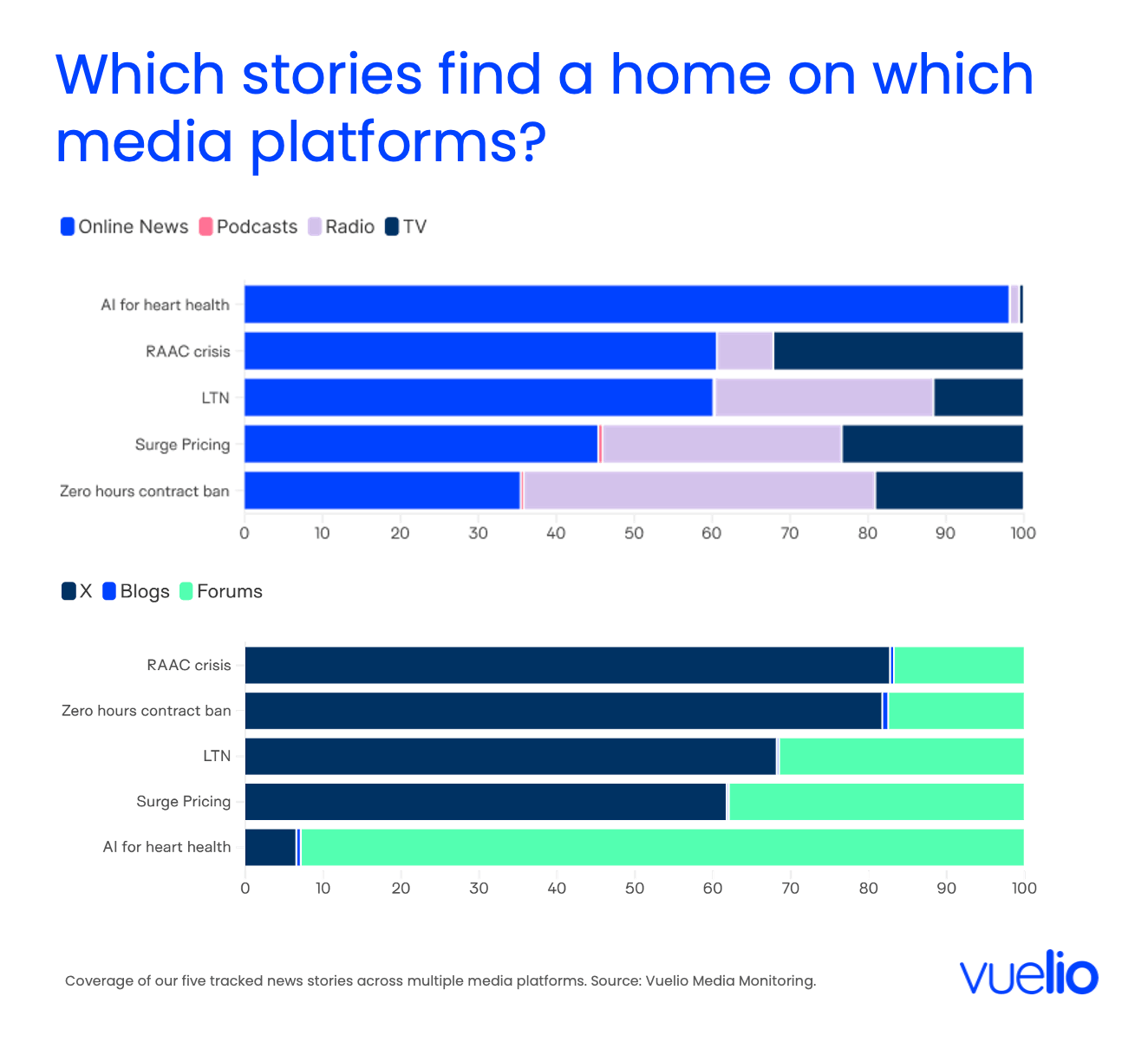
Which stories find a home on which platforms?

2. Manage the ‘pinball machine’ of politics

Public affairs and politics are now almost inseparable from PR, and should be considered as part of any campaign.

Vuelio’s Kelly Scott describes public interest stories as potential ‘pinballs’, that can ‘hit a political buffer, bouncing around further, racking up more coverage… potentially distorting the story if it becomes politicised for party gain.

Kelly Scott quote

‘If your media team and public affairs team are following stories separately, and using a siloed engagement plan… you are missing a huge opportunity,’ she warns.

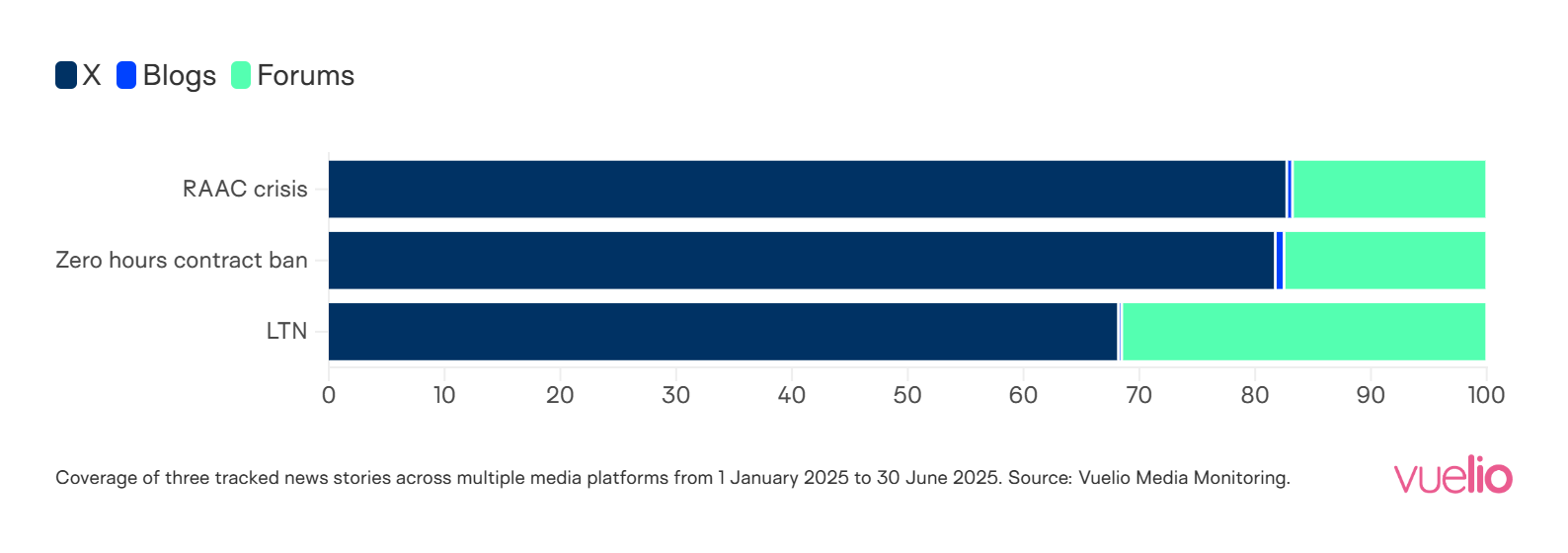
Political and regulatory attention – like CMA investigations – can prolong a narrative’s lifecycle significantly, and land them in unexpected sectors. Reporting around the RAAC crisis, for example, received more coverage in Regional outlets than in the expected Construction & Property sector. The story of surge pricing received surprisingly little coverage in law-focused outlets, despite questions from online audiences about its legality.

How stories spread across media channels

For agencies, mapping stakeholders is a solid starting point, but so too is being prepared for a story to be picked up by actors with their own agendas.

When a story becomes politicised, agencies must be ready to:

– Correct misinformation at pace and offer good data.
Engage directly with the media and political influencers involved.
– Motivate third-party stakeholder voices to add credibility and balance.

3. Find the connectors to break through the echo chamber

Despite all the interconnected platforms that make up the modern media landscape, it can still become severely siloed.

Coverage of surge pricing provides a clear example of this – broadsheets focused on issues around labour and fairness, alongside regulatory and market implications, while tabloids centred instead on drawbacks for the general public, with the price of concert tickets a recurring element.

Audiences for each largely stayed in their own echo chambers and weren’t exposed to diverse and different takes on the issue.

The value agencies can bring is bridging such silos by identifying the connectors. For the story of surge pricing, these are national broadcasters (which provide a shared space), specific interest publications (like LADBible or Sky Sports, that reach audiences across class lines), and influencers/experts (projecting a story across very different groups – Martin Lewis is just one example).

These connectors are a vital part of a modern media relations strategy, providing opportunities to break a story out of a single, self-reinforcing narrative.

4. Master the Two-Track Story

One of the curious parts of media fragmentation is how a single topic can spread in distinct ways that never intersect. AI for Heart Health coverage from the first half of 2025 did exactly this:

Track 1: The technical, medical story. This lived in academic or medical publications, and among niche communities and forums online. It reached a limited, but highly engaged, group of professionals, academics, and autodidacts.

Track 2: The mainstream story. When a specific angle of ‘smart pyjamas’ crossed over, it appeared in outlets including Daily Mail and The Mirror, but skipped spaces that ordinarily play host to more technical discussions.

Monitoring niche publications and social spaces to understand which stories have the capacity to break through into the mainstream is vital for agencies working with a variety of clients.

5. Ditch ‘Social First’

Still pitching ‘social first’ strategies? You could already be falling behind.

As Sean Allen-Moy, Head of Media Relations Strategy at Burson, puts it:

Sean Allen-Moy quote on media fragmentation

‘The concept of a ‘social first’ strategy is outdated. The reality is “social everywhere, always”.’

Tracking coverage of the zero hour contract ban in the UK bears this out. While the story was driven by personal experiences and work advocacy shared on social platforms, this fueled broadcast segments and column inches, which are always in need of case studies. Forget traditional media at your peril.

Monitoring and understanding the interplay between traditional coverage, social sharing, and forum-based discussion is a must – agencies must identify where audiences consume content and meet them there.

Andre Labadie quote

‘It’s endlessly fascinating how stories evolve, but it presents a real challenge for brands to fuel the fire – or put it out in some cases – across so many, constantly changing platforms and algorithms,’ says Brands2Life Exec Chair, Business & Technology André Labadie.

‘Using (increasingly AI-enhanced) listening and analytics tools to identify emerging trends through social is key so you can influence the narrative in its infancy. This is really changing how brands can take control of issues early and predict how they’re likely to evolve.

‘What definitely hasn’t changed is the need to add something new to the story, stay close to the media to develop new angles at the right time, and then use all the relevant platforms to amplify it.’

6. Follow the new PR playbook

This fragmented landscape demands a fluid strategy. As Amy Chappell, Head of Insights at Vuelio, puts it, a story is ‘no longer a fixed communication, but a fluid journey shaped by who picks it up and how it is retold’.

The agency playbook must be built on adaptability:

Think Ecosystem, Not Endpoint: Stop treating media coverage as the finish line. Instead, build responsive strategies that anticipate how stories will evolve across platforms.

Reframe Monitoring as Navigation: Tracking coverage isn’t about counting clips. It’s about understanding how narratives are reframed to know exactly when to step in, clarify, or amplify.

Embed Adaptability: Build flexibility into campaigns. This means having spokespeople and expert commentators ready to engage quickly to retain a degree of control in unpredictable times.

For agencies willing to embrace this complexity, the opportunities are immense. Moving from linear pitching to dynamic navigation can prove the indispensable value of agency support to clients and prospects.

Want more on navigating this new landscape? Check out the full story in Vuelio’s latest report ‘How news travels in today’s fragmented media environment’.

Agency resilience in the age of AI

How to build agency resilience in the age of AI

With the challenges of lower budgets, smaller teams, and extra crunches on clients, AI has been embraced by many across the PR industry as a potential cure-all. But with the very welcome efficiencies and shortcuts has come new challenges. What becomes of PR when content can be generated, and outreach and measurement automated?

Its vital function as moral guide; educator; builder and protector of reputation and knowledge. Read on for advice and insight on centring strategy and thought leadership while making the most of what AI brings to the table.

Steer AI in the right direction…

‘We need to remember that AI is a new tool that still requires human operation to be used successfully, creatively and ethically, so focusing on developing this expertise is key for PR teams moving forward,’ says Sheridan Okey, head of PR at Tribera.

‘PR teams should double down on deep storytelling and reputation management – areas where nuance, empathy, and emotional intelligence matter most. AI can generate words, but it cannot replicate the instinct to sense when a message will resonate or when it will backfire. This is where the industry’s energy should be concentrated: blending the efficiency of AI with the irreplaceable judgement of experienced professionals.’

Add value for journalists

The media is also battling with the pros and cons of artificial intelligence. What they don’t want? Servings of slop, says James Brockbank, managing director and founder at Digitaloft:

‘With AI, anyone can create content on anything they know nothing about, in seconds. And this means that, all of a sudden, too many journalists are finding themselves bombarded with ‘consensus’ comments from PRs who wrote them using AI.

‘That’s not adding value. A journalist could go and do that themselves if they wanted.

‘It’s more important than ever to focus on speaking with subject matter experts (who have genuine experience and expertise in the topic) to offer journalists value-adding comments, insights, and information to take their articles to the next level.

‘It sounds simple, but in a world where too many jump straight to ChatGPT, we’re losing the fact that genuine experts must be at the heart of everything we do.’

Colin Hallmark, founder and lead consultant at 3:nine Communications, also advocates for original case studies and expert comment:

‘There’s already a narrative emerging in the media around the proliferation of bland, generic soundbites via AI. Look no further than the recent controversy in the House of Commons, where MPs were criticised for using it in their speeches.

‘Journalists want credible, authentic voices and original commentary around busy news cycles – the growth of Substack and newsletters is proof of that . In media terms, it feels like we’re entering the age of the specialist. As more people use them as search engines, LLMs themselves are starting to rely heavily on contextual trust and authority drawn from a variety of third-party content, particularly in specialist and industry titles.

‘There’s a big role for PR professionals to work closely with clients to think creatively about how they can bring their expertise and frontline experience to these audiences.’

Continue to connect with people

‘AI will quickly become a delivery service to many brands and businesses,’ acknowledges Georgie Upton, managing director, Wild Card Public Relations.

‘But for us, AI is not the answer to people and brands living life in full colour; it lacks the deep understanding of human beings, the subtlety of connections, and nuances of knowing people – that quick glance, that inner-thought. Business thrives through people connections.

‘It is using AI in a combined approach that allows the survival of human-to-human businesses.’

Sarah Lloyd, podcaster and founder of ISPR, agrees with the importance of face-to-face, in-person, interactions:

‘The industry itself should focus on the human connection. Actually meeting with real people, and creating real relationships through sharing stories. In the age of automation and bringing it all online, we have lost the skill set that had us all working in PR in the first place.

‘AI can complement it – but can never replace it.

‘The value that individuals bring to the table for clients is relationship. Relationship with them, with the press and with agency staff. PR agencies are hired on results AND ALSO chemistry. Results and process is possible via AI, but chemistry is the soft skills that humans require so they can trust the team and agency who is representing them. People buy people at the end of the day.’

Add empathy back into the equation

‘The ability to connect with empathy, is what sets us apart,’ believes Anthony Cooper, company director, Clarient Global Limited.

‘Humans respond emotionally to ideas and events, and it is this ability that allows PR professionals to deliver maximum impact. Large language models can generate content, but they cannot recognise or interpret emotional currents in the way people can. To deliver lasting value, agencies should lean into their biggest assets, which are their people, while embracing AI as a tool that frees us to focus on what we do best.’

Step into the strategist role

‘If your relationship with clients is transactional and more reporting and press office-based, it will be diluted by AI,’ warns Laura Lear, managing director, AMBITIOUS.

‘PR teams will therefore need to be laser-focused on value and strategic consultancy. Our value lies in strategy and clarity, cutting through noise and challenging inaccuracies, and shaping insights and guidance that is tailored for each client.’

Natalie Sutton, tech comms board advisor, agrees:

‘We need to shift from being content factories to being strategic architects. The future belongs to agencies that can navigate complex stakeholder dynamics, predict reputational ripples, and craft nuanced positioning that resonates with human emotion, not just algorithms.

‘Stop competing with machines on their turf. Double down on what makes us irreplaceably human: cultural intuition, ethical judgement, and the ability to build genuine trust. AI can write a press release, but it can’t look a CEO in the eye and tell them their strategy is fundamentally flawed.’

Ask the questions LLMs won’t

‘Right now, we need to demonstrate our value and our worth,’ says Amy Dawson, owner of Gatekeeper Communications.

‘We are the ones who can respectfully challenge and push back, being the voice to remind our clients, “Is this the right thing to do?” or “What could be the fallout from this?” or “How can we change this conversation?” or “Could this quick win impact our long-term reputation?” An AI tool will only ever do what the prompt is asking it to do, so our value has to show that we are taking the right steps to build trust and authority, and that we are contributing towards positive behaviours.’

Echo chambers can be an unfortunate consequence of an over-reliance on LLMs, warns Marco Fiori, MD of Bamboo PR:

‘Fewer companies are looking over the horizon and considering the future impact of their public communication now. This risk is intensified by AI.

‘PRs already play a critical role in setting nuanced positioning, which will become even more sought-after in the coming years.’

Become brand guardians

‘If PR teams aren’t helping brands stand out if they lean on AI simply to churn out content,’ says David Clare, Head of Fusion, Fire on the Hill.

‘PR professionals need to reframe their perspective on AI. It isn’t just a productivity tool; it’s an ecosystem PR can actively influence to help brands tell their story.

‘Generative AI Engine Optimisation (GEO) is ripe for the picking for PRs. LLMs cite coverage, analyst reports, and community content – all areas our industry excels in. But to marry our traditional expertise with the new world of AI demands rigour, digital literacy, and ongoing analysis.

‘PR has always promised to build authority and trust. Today, delivering on that promise means moving beyond clever branding to evidence-based results that genuinely shift visibility and credibility for clients. The AI opportunity is not a productivity boost, it is our ability to create meaningful content that influences AI and sees LLMs do the brand storytelling for us.’

Rebuild your team’s skillset

Karen Idorn, digital PR director at SEOMG!, sees a need for some serious upskilling across the industry to make the most of these new opportunities opened up by the adoption of AI:

‘PR has always been about more than coverage. It’s about guiding organisations through complex, often sensitive conversations. As society becomes more polarised and every brand decision is scrutinised, our role as trusted advisors is more valuable than ever.

‘To really embrace this, PR teams need to invest in deeper industry knowledge, ethical training, and the confidence to challenge clients when necessary. It’s about moving from being just storytellers to being strategic partners who help organisations do the right thing, not just say the right thing.’

Be the voice of reason

How can agencies remain resilient in the age of AI?

‘The role of PR professionals will remain in the capacity of appreciated advisors, says Stephanie Mullins-Wiles, COO of BlueSky Education.

‘Provide moral guidance and be a voice of reason in a world increasingly impacted by AI.’

For Chris Norton, founder and managing director at Prohibition PR, PR remains vital – and should be at the top of the table:

‘The real opportunity for PR is to be seen as a trusted advisor at board level. We should be helping clients make not just communications decisions, but reputational ones: what they stand for, how they act, even where they draw the line ethically. Then, we devise a plan for how that is communicated to the world.

‘That’s a big responsibility, but it’s also what makes the role so valuable. To get there, agencies need to invest in their people – teaching younger professionals to think critically, speak with confidence, and not just ‘do PR’ but advise with authority to ultimately become consultants.

‘It’s this shift that will make our industry more resilient, ensure we’re adapting alongside AI, and that will future-proof the value of agencies.’

For how Vuelio can help agencies with their work, check out our Media Database, Media Monitoring, and Insights solutions.

Jacob Granger

‘AI has made it so that anyone can pose as an expert’ – Media interview with Jacob Granger, community editor at Journalism.co.uk

What sort of relationship do journalists want with PRs now? In an ever-changing media landscape, it can be difficult to know the best ways to make connections and understand what publishers want and need from you. Someone that is seeing these changes take place first-hand is Jacob Granger, who works as community editor at Journalism.co.uk.

Below, he shares some of the ways that the relationship between journalists and PRs can be improved, explains how the industry has changed during his nearly ten years covering it, and discusses the impact that AI has had for both sides.

What are some of the main changes that you have seen during your time covering the media industry, and do you think these have been positive or negative developments?

The buzzword at the moment is the ‘user needs model’. This was developed by a journalist called Dmitry Shishkin when he was at the BBC, and it’s since been expanded from six user needs up to eight. I think this has been transformative for our industry, because it has confirmed something for journalists and editors – people want more from the news than just an update. Maybe they want help connecting, or they want help being distracted, or they want to be illuminated by something. There’s more to the news experience than just updates.

The traditional model has long peddled this view that the metrics of success for journalism is measured by page views and eyeballs and scoops and scandals and the rest of it. This is still valid, but I think something else has emerged. An important metric for success now is value and habitual use and loyalty, and the user need model complements this so much, because it takes away the incentive of visibility. It says, what do the analysis articles do for our publication model? What do lists of ‘top ten experts to follow’ do for our business model? What’s emerged from this is the realisation that we’ve over-commissioned on one type of story.

The penny has dropped for a lot of publishers and they have realised what’s missing in our model. Many publishers have run with it, including The Bureau of Investigative Journalism, The Conversation, Vogue, Berlingske Media in Denmark. There’s so many great adopters of this strategy now, and it’s really feeding directly into newer business models that maybe have different KPIs around subscriptions or memberships. That’s the big change. I’m really enthusiastic about it, and it’s been a really wonderful framework for our industry.

In terms of negatives, we’ve seen a lot of job layoffs in recent years in the news industry. When you talk to young journalists, this is a really big concern for them. Is there a place in the industry for me now? The jobs are so fiercely competitive, but also so fragile in terms of their job security. I worry about this being a really big deterrent for young journalists coming through the industry. We can’t just keep cutting jobs to cost save. We have to figure this out and get our business models in order.

Why is the relationship between journalists and PRs such a key one in the media industry? And how do you think it can be improved further (from both sides)?

I think it’s always good for journalists to have new story leads that they wouldn’t otherwise have considered. It’s always good for them to be introduced to sources that may not otherwise come into their world. The problem with this is that PRs tend to come to journalists and newsrooms with ulterior motives. They’re wanting publicity or wanting something in exchange.

Some of the best PRs I’ve worked with, you go back to them and say, this isn’t a story for now, but let’s come back in three to six months when we’ve got some results to show. They say, okay cool, let’s schedule a call in that space of time. At that point, I’m saying that there is a story we could publish, but who does it serve beyond just your publicity? Our job as a journalist is not to give publicity to PRs, it’s to serve our audience. Where there is that clear value exchange, and they’ve thought about the audience, and there’s some exclusive data or access to an expert, that’s legitimate and fine as far as I’m concerned. But there has to be that negotiation between both sides, and there has to be some way of meeting in the middle.

I’ve met some PRs who are very insistent on their marketing lines, and they sit in on interviews, and they interject, and they do all the things that journalists hate. You just end up canceling the interview. My advice is to go into these interviews with some curiosity and be open to the possibilities from the interview. Don’t be afraid to try and change the angle. I’ve got an interview to do tomorrow and this is the second time I’ve spoken to them. It came to me through a PR agency, but the main angle that they approached me with when I had a scoping call with them, I could see it doesn’t really do much beyond trumpet your own cause. I’ve gone back and said there’s a better angle to this conversation. This is one that I think will serve our audience. How do you feel about this? And I’ve got a green light. I think that’s the way to handle these things.

AI and its use in the media has been a hot topic for the last year or two now, what are the main ways that journalists and publishers are using it? And what impact does this have on the PR industry?

I think it’s useful for doing the things that journalists either can’t do or they spend too long doing. I’ve sat there, like any journalist, and transcribed an interview manually. It’s awful and it’s a waste of time. Put it through an AI and it will give you a good transcription. You can also use AI to crawl through a data set to try and find some meaningful data points and statistics. It would take you, as the journalist, ages to do that. There’s no need to waste so much time doing that if you can reliably use a trustworthy AI and corroborate the findings afterwards.

If you’re lazily using it to turn out AI slop, then it is probably not the best idea in the world. I think you could train an AI model to write quite closely for your publication. Train it on a user needs model and your own previous writing, and get it to emulate that fairly closely. You have a first draft, and then you can go in and work from that sort of standpoint and that’s all right in my view. Plus, it’s good for translation, particularly for very niche languages. You know, we did a piece last year about a publisher who was using it to transcribe Greenlandic. You might be able to get some translators, but if you’ve got a reliable AI to do this, then it will save you a lot of hard work in the long run.

In terms of the PR side, the arrival of AI has made it so that anyone can pose as an expert. I think journalists now, with a lot of the scandals that have emerged from journalists being hoodwinked and deceived by sources that are just using AI, probably have their guards up. If you’re a PR, just be aware of this. There would probably be extra credentials needed to prove that you’ve got a legitimate source to speak to, so be prepared to show your credentials and the qualifications of your expert. That’s one impact I think AI has had on the PR world.

Journalism.co.uk offers courses and training not just for journalists but also for people in comms and PR. What are the main skills that a media professional needs nowadays when communicating with the press?

The main skill is to be digitally literate and realise that not all journalists want to have a text interview. Perhaps they want to do a podcast or maybe they want to do a live video, or just do something a little bit outside of the realms of possibility. If you’re a little bit more digital savvy, you can clip it up for social afterwards. It’s good to have those production values in mind about what’s going to look good visually and what’s going to sound good. That’s another thing, get yourself a good mic. A lot of times I’ve been set up with interviews and they’re using iPhone microphones or whatever and that just doesn’t do the business. So being aware of the production values and the different platforms that journalists want to be across, is a very good skill set to have.

I would also be remiss not to give my colleague, Ophelia Birch, a huge shout out for the work she’s doing on revamping our training across the board. I saw one the other day that I thought was really cool, which was about interviewing advice for panel podcasts and about how to do an interview for different scenarios. It’s good to be upskilled in that area I’d say as well.

For more on the modern media landscape and how it’s changing, download our Vuelio report ‘How news travels in today’s fragmented media landscape‘.

Why comms can't ignore politics

The impact of regulation on reputation: Why comms teams can’t ignore politics

The Online Safety Bill, the Digital Markets, Competition and Consumers Act, upcoming HFSS legislation changes, and Net Zero targets – did you factor these legislation updates into comms strategies for your business, and clients?

As made clear by the impacts of these regulations on the UK business landscape, staying out of politics is not a viable option for comms teams. Being aware of what’s happening in Westminster isn’t just a bonus skill – it’s a core competency that’s essential for risk management, opportunity spotting, and strategic counsel.

For practical advice for staying ahead in these politically-charged times, check out this round-up of advice from those in the industry successfully weaving political know-how into their brand and client strategies.

How politics permeates PR

Politics influences and intersects with every aspect of our daily lives, and this is no different for organisations.

Kerry Parkin, founder of the Remarkables, believes the issue is two-fold for comms:

1) Politics drives the agenda. The geopolitical world is moving faster than ever, often dictating the speed and direction of media and stakeholder conversations. Take tariffs as an example: a major political decision, well signposted in advance, can suddenly make or break something as straightforward as a tequila launch. If your product, business or brand is touched by political or geopolitical events, it must be factored into your mindset, planned for, and executed around, even through, the disruption.

2) Timing is everything. If you are pitching stories on the very day a budget lands, you can kiss goodbye to any meaningful coverage. Without political awareness, teams risk wasting opportunities and undermining credibility by being out of sync with the national conversation.’

In fact, a lack of political know-how can be poison for public relations, as Anton Greindl, director, public affairs, at the Tilton Consultancy explains:

‘Without a working grasp of the political agenda, agencies can drift away from their clients’ real priorities. If you don’t track policy and regulation, you mistime launches, miss stakeholder expectations, and risk using messages that are about to become politically toxic or legally constrained.

‘You also lose earned opportunities, such as select committee calls for evidence, regulator consultations, media windows, because you’re reacting after the fact. Policy literacy is the difference between PR being a noticeboard and PR being a strategic lever for revenue, risk, and reputation.’

Reputation could be the first casualty of a lack of awareness:

‘Without political awareness of the now and what’s upcoming, PR teams risk aligning their clients with narratives that are outdated, or even damaging,’ says Claire Crompton, commercial director at TAL Agency.
‘Politically and socially, society evolves daily – the political sphere is continuously shifting. Managing a brand must be timely in the wider context of society, without anticipating what’s ahead, PR teams are essentially navigating blindfolded.’

The role of political monitoring

While it’s impossible to be present for every PMQs, there are tools to help you keep on top of what’s happening in politics.

Laura Moss, managing partner, Parisi explains what political monitoring can do:

‘A good example of monitoring in practice came when we picked up on emerging Home Office policy proposals to ban critical national infrastructure (CNI) owners and operators from making ransomware payments.

‘We immediately flagged this to a client, the cybersecurity specialist team at a global law firm, and worked with them to provide rapid legal and policy analysis. Within hours, we were able to take their expert commentary to targeted media outlets, ensuring they were among the first voices shaping the debate. This not only positioned the client as a go-to authority on ransomware policy but also strengthened their relationships with journalists covering cyber and national security.’

Monitoring can provide the warning signs for potential crises on the horizon, believes Kerry:

‘It allows PR teams to anticipate rather than react. I saw this first-hand during my time at Costa, when Hugh Fearnley-Whittingstall launched his campaign against paper cups. At the time, we treated it as purely a media issue. What we did not realise was that the subject had been raised at Prime Minister’s Questions a month earlier.

‘Political monitoring would have flagged that in advance and given us the chance to prepare the business and the narrative more effectively.’

Another example with huge ramifications for comms and wider industries – the uncertainty around TikTok’s continuing availability in the United States earlier this year:
‘In one fell swoop, this would have disenfranchised millions of young Americans from a channel that they could identify with, and would have cost the platform and its advertising partners, and brands that rely on it, millions in revenue,’ explains Yasper founder Julian Pearce.

‘Businesses from all corners need to be aware of the threats, and the potential fragility of their relationships.’

Political awareness is needed globally, nationally, but also locally, adds Katie Nelson, director and head of construction at Cartwright:

‘Recent months and years demonstrate this perfectly with a power change in Number 10, new housing targets and national infrastructure strategies, and changing cabinets. By being tapped into that political space, we’re able to work with clients on how best to navigate changes from a communications perspective – which as PR pros, we know the role comms has to play.’

Moving from passive observation to proactive strategy

What comms teams do with the information is what makes the difference – reacting to what’s happening in the political sphere, but also taking a proactive stance:

‘On its own, data is useful,’ says Laura. ‘But the real value comes from PR consultants interpreting it and adding their knowledge and insights on the potential business impact, then advising clients on how they may or may not wish to respond. By turning monitoring into actionable insight, PR teams can help clients shape communications strategies and identify opportunities for engagement with policymakers or industry bodies.’

Anton agrees:

‘Too many consultancies follow the same pre-packaged newsletters from a narrow set of public affairs – specific outlets, which limits scope and insight. While these are extremely useful in our day to day, every practitioner should skim the key national and international papers each morning, plus at least one business title, one sector trade and the relevant regulator feeds. Go to the source, such as government portals, consultations, committees and statistical releases, rather than relying solely on pre-focused summaries. And I believe we should close the loop weekly with a short, internal, client-specific briefing that covers what changed, why it matters, and the recommended actions.’

In summary, ignore what’s happening in Parliament at your peril…

Your stakeholders will care, so should you, says Jan Christoph Bohnerth, CEO of Life Size.

‘Communications teams can and should go beyond simply tracking when a new bill or regulation is introduced. It’s now also about anticipating how different stakeholders are likely to move, and communications has an important role to play in influencing and shaping public discourse. Done well, this gives PR teams the intelligence to stay ahead, guide strategy and achieve the best possible outcomes for their clients or organisations.’

‘Those that fall short tend to be the ones cutting back in political and communications engagement,’ warns Kerry.

‘In today’s environment, that is short sighted. Now is the time to be investing in these capabilities, not retreating from them, because the political and media landscape is only becoming more complex and uncertain.’

‘The takeaway for PR is simple,’ adds Anton. ‘When politics moves, lead with substance, consistency and implementation detail.

‘Treat policy milestones like a content calendar, make your spokespeople useful to the debate, and ensure every message is anchored to actions the organisation is taking next.’

Tap into what’s happening in politics with Vuelio Political Monitoring and our Political Database. Want help with stakeholder management? Check out Vuelio Stakeholder Relationship Management

Getting media coverage in October 2025

Gift guides, keeping warm & half-term holidays: How to get UK press coverage in October

Deciding how to get coverage in the media in October? Halloween may be the immediate focus but there are plenty of other trending topics and issues that you can tie campaigns and experts into. Find out below what has been popular in September on the ResponseSource Journalist Enquiry Service and what this will mean for the rest of this month.

Gift guides in demand

Christmas is approaching quickly and journalists have been keen to get their gift guide features compiled in the last month. Over 7% of the total requests in September contained the words ‘gift guide’. This has resulted in some big increases for some of our more consumer-related categories with Men’s Interest rising by 60% compared to August, a 44% increase for Women’s Interest & Beauty and a massive 88% increase for Children & Teenagers.

Journalists at The Sun, Cosmopolitan, Health & Wellbeing, The Guardian, Saga, and GLAMOUR have all sent gift guide-related enquiries in the last month. These have been ‘for him’ and ‘for her’, as well for children, for pets, food & drink products, beauty items, wellness and much more.

Going forward? Gift guide requests will remain frequent throughout October and November as we build up to Christmas. In October 2024, nearly 10% of the total requests was for ‘gift guides’ so expect an increase in journalists from national press and major consumer magazines asking for product samples to test and feature in their reviews.

Staying warm is hot stuff

October marks the beginning of the colder months of the year and journalists have been keen to find out ways that people can stay warm during the Autumn and Winter. ‘Heat’ has appeared as a keyword in just over 1% of all requests in September and ‘warm’ in just under 2%. This also ties into the topical issue of concerns over energy bills and how this might impact people’s personal finance and budgets – with ‘budget’ also appearing as a keyword in nearly 3% of enquiries.

Requests have included looking for expert insights on how UK households are staying warm and cutting energy costs; a heating expert to share expertise on the best time of the day to put the heating on and the best electric blankets to help keep warm this Winter.

Going forward? With temperatures set to drop in October, then there will be more requests around ways that people can stay warm for less. This will increasingly link into the finance side of things as ‘budget’ appeared in over 4% of requests last October. Get heating and finance experts ready and you could be featured in outlets such as GB News, Ideal Home, or Homebuilding & Renovating.

Travel back in fashion

June and July are usually peak season for both the Travel category and ‘travel’ as a keyword but September has seen its popularity rise again. ‘Travel’ cropped up in over 6% of all enquiries last month and the Travel category as a whole increased by 35% compared to August.

This is in part due to journalists looking to get recommendations on where families can head to for the October half-term. However, there have been other topics too with requests for unusual travel experiences, staycations with a twist and trade-friendly tour operators that specialise in adventure travel. These have been sent by outlets such as PA Media, Selling Travel, National Geographic Traveller, and The Wall Street Journal.

Going forward? There will be requests for last-minute travel packages for the school break plus journalists will be looking further ahead with other Autumnal getaway destinations and information on Winter holidays, too. Be prepared with information on different escapes and travel experts to offer comment and there is potential for coverage in a national press title.

Other opportunities for PRs in October and beyond

While we aren’t that far into Autumn, ‘Winter’ becomes more popular on the Journalist Enquiry Service from this point onwards. Last year it appeared in over 4% of requests during October and we would expect to see a similar level of interest this year. This can vary in topic from gardening jobs to do during this period to looking to get information on the fashion and beauty trends for the Wintertime.

It doesn’t receive masses of requests but journalists spend this month gathering information on the best places to see firework displays to celebrate Bonfire Night. Around 1% of all enquiries in October 2024 were centred around this topic, so if you’ve got information on different locations putting on events to celebrate this occasion then have them ready if you want to get press coverage.

Want to get the most out of the ResponseSource Journalist Enquiry Service? Find out how here.

Future of Media Technology Conference 2025

How the UK media are making use of technology to bring audiences back

The evolution of AI has forced the comms industry to completely rethink its role in the media ecosystem, and journalism is facing the same conundrum.

For the challenges being faced in the media industry now, check out insight shared at this year’s Future of Media Technology Conference from Press Gazette, featuring speakers from PA Media, the Daily Mail, The Times, PinkNews, Bauer Media, and more…

A big problem for brands: AI’s impact on GEO and SEO

Many speakers throughout the conference referred to the devastating impact of LLMs on traffic previously picked up from Google Search. And Google was the focus of much consternation:

‘I’ve worked on the publisher side for about 20 years, before joining PA Media, and during that time, it was mostly seen that Google were the “good guys” among the frenemies that were out there, in the sense that our objectives were aligned,’ said Martin Ashplant, product development and operations director for PA Media.

‘Publishers wanted to get really good quality content out there. Google wanted really good quality content on the web, so that people came to the open web and didn’t go into closed systems. That’s clearly changed, and I think that’s been clearer and clearer over the last few years. And this isn’t just about AI. This is about how the Google interface has changed, and there is no longer that ability to rely on getting the click.’

Carly Steven, director of SEO and editorial e-commerce for the Daily Mail, explained the impact being seen at the brand:

‘There is obviously a huge period of disruption right now, massive changes related to AI overviews rolling out. Like a lot of publishers, we’re seeing the impact of that.

‘The reality is that when there are AI overviews for our keywords, the click-through rate goes down. I think we all know that nobody really clicks when there’s an AI overview present, and that impacts on traffic.

‘But, by the time an AI overview appears, that story has moved on and our readers aren’t searching for it anymore – its impacts are negligible. That doesn’t mean to say that it doesn’t matter. It absolutely does. But our brand is in a very fortunate position in that a significant portion of our traffic is direct, from branded searches. That makes us quite resilient in the face of these changes.’

Anna Sbuttoni, deputy head of digital for The Times and The Sunday Times, believes the early upheaval is finally settling down for publishers:

‘We have seen that Google Search referrals were fluctuating, but it is relatively steady right now.’

In fact, the benefits of SEO and GEO have been in flux for a while already, as Bauer Media’s Stuart Forrest, global audience director, explained:

‘Zero Click Search has been an issue for publishers for a long time. There was a website years ago called Celebrityheights.com, for example, that would tell you that Tom Cruise is five foot six. That site went out of business because you didn’t need to go there once Google would provide the answer. AI is just the next step of that.’

Caroline Fenner, chief revenue officer for PinkNews, agreed that this is just the latest step in a long-standing issue:

‘Everyone’s been reluctant to rely heavily on Google Search for a very long time now, because of the algorithm changes and how unreliable it’s been.

‘PinkNews is fortunate in that we get a lot of our traffic via socials. But, speaking to other publishers, it is a concern, and you need to look at other ways to generate traffic now. “Google zero” seems to be the new phrase being used. In case that happens, we’re constantly looking at new ways to drive traffic to our website. Likes, comments, shares, all sorts of stuff on social, the comments, dwell time, repeat users – we’re looking at ways to keep people within our ecosystem. That lends itself to WhatsApp groups, Facebook communities, and subreddits – it’s making sure there’s a safe space for the community to feel like they belong.’

Helping audiences find their community are platforms like Reddit:

‘Forums feed the algorithm in terms of SEO and AI results as well,’ said Tom Rolfe, director of publisher development at OpenWeb. ‘It’s going to be a great place for UGC [user generated content], but it’s not going to touch your content on site. It will be its own thing, almost like a subdomain for publishers. We’re really happy that forums like Reddit are being favored by Google and AI, because it’s providing an opportunity.’

For what else Google is ‘favouring’ these days, Daily Mail’s Carly asked for more transparency:

‘I think the biggest plea that we have to Google as publishers is to be able to see the data. We can’t track it properly, and we don’t get that information in our analytics tools. If we did, we could properly attribute the impact of AI on traffic. But right now that’s very, very difficult to see.’

Where in the ‘funnel’ can audiences be found now?

Where ‘top of funnel’ traffic – referrals from Google Search – has reduced drastically for many smaller publishers that won’t rack up ‘branded searches’ from audiences searching for the title or brand in question, Tom advocated a pivot to ‘mid-funnel’-focused strategies:

‘For a long time, publishers were very focused on “top of funnel” traffic – what we’d call ‘free traffic’. It’s a bit like a drug, you know, all this coming from nowhere. Now we’re having to shift that publisher mindset to ‘mid-funnel’ engagement. When the user hits the site, it’s figuring out what’s the value exchange for them? That’s something you can offer with community features – commenting, reaction tools, really focusing on keeping them there for as long as possible.’

The Times’ Anna spoke about their equivalent of the ‘mid-funnel’ – The Times app:

‘Commenting on our site is very much a subscriber privilege, and it’s being part of The Times’ community.’

Her fellow panelists admitted to reading the comments before the article when consuming news – a rising trend among wider audiences, too. In the same way PinkNews encourages community, The Times has grown this via their app – where commentary and feedback from readers is encouraged to continue engagement.

What can’t be replicated by AI?

Publishers are faced with the reality that much of their content can now be produced by AI, and potential readers are being directed to AI summaries instead of the content they’ve been trained on. Panelists spoke of the need to rethink priorities, and what journalists can do that AI can’t:

‘The Times has a 240-year history, and it’s something that we need to protect – the legacy and the authority that we have,’ said Anna.

‘It’s something that we talk about and enforce in the newsroom every day. When we’re talking about live coverage or story packages, we’re always thinking, what’s the exclusive? What have we got that’s original, that’s distinctively The Times that no one else has? How can we contribute to this conversation? How can people read, watch, or listen and understand what’s going on?

‘The next step for us is really putting our reporters at the core of what we do. How can we show our workings more, show that it is humans creating the content, and the hours, months, or years that can go into an investigation?

‘That’s something we’re exploring. Showing what we do as a way to bring people back, keep people in. For them to know that they can come to us’.

Martin at PA Media believes original content must in incentivised, for the good of publishers and LLMs: :

‘The worst case end point is we get to a place where there is no value in creating original content, because everything is being summarised. My call would be to invest in producing high quality journalism, original content, going out there and getting the stuff that isn’t yet there to be scraped. Because if you lose that, you lose the reason for people to go out and be creative.’

How the media is making use of data and metrics

Sheena Peirse, chief customer officer at Mediahuis Ireland, was firm on the importance of continual testing and improvement for publishers in the current landscape:

‘‘What you really see across the board – my team, the customer, subscriptions, the marketing team – is development, iterating. Test, learn, iterate. Use your data. Find out what works. Make it work. Move on.”

But which metrics can actually be trusted? David Goddard, SVP of business development, measurement and publisher solutions for DoubleVerify, highlighted the inherent issues with data-led strategies:

‘The problem with any metric is that they can be gamed. Thinking about attention, for example – is it engaged attention? Is it just a video playing at the corner of the screen? Is it somebody who’s actually watching the content? It’s really difficult to say for sure.’

Maintaining brand safety

Should alignment with ‘hard’ news be a big no-no for brands? No necessarily, believes Imogen Fox, global chief advertising officer for The Guardian:

‘We know that 96% of people read their news online in some form. So why on earth would you not want to put your brand near them? If you are – and I hate using this word – brave, you advertise next to the news. You do see good results.

‘People used to think that The Guardian is more famous for the advertising we don’t take than the advertising we do. It’s been our job as an ads team to say, actually, what we’re really good at is connecting brands with culture.’

But is the term ‘brand safety’ itself a blocker? David at DoubleVerify defined the issue in a different way:

‘I think the terms “brand safety” and “brand suitability” can be confused and intertwined. We can say in this room, news is 100% brand safe. There’s no brand safety issues with news. There are sensitivities to particular content, and publishers need to utilise tools to ensure that advertisers are avoiding the sensitive parts of news. There will be particular news subject matter that some brands will insist on avoiding. The rest of the news can be highly performant for advertisers.’

Should AI bots be blocked to ‘protect’ publishing?

Dan Rua, CEO of Admiral, The Visitor Relationship Management Company, believes AI bots should be blocked from training on content from publishers. He shared a clear message that the media industry should work together, using his experiences at Napster as an example:

‘AI is a scary disruption. But if navigated well, there’s opportunity. Copyright sets the guardrails of what is okay and what is not okay. Figuring out the value exchange that works for users is key. In the case of music copyright, there was an industry solidarity – music labels were on the same page of what needed to happen. They weren’t really bickering with each other about how to tackle it – ultimately, they got together and made a difference.

‘I think step one here is blocking the bots. Doesn’t mean in the future you might not find more creative ways to work in the whole ecosystem.’

Carly disagreed – referring to the Daily Mail’s collaboration with AI companies, and other publishers’ deals to allow AI training:

‘I don’t think it’s helpful to malign the bots, because if you do, that leads to a kind of arms race of evasion and detection, where publishers are constantly spending on protection, bots are constantly spending to improve evasion, and actually, the only people who win that scenario are the tech companies.’

Martin at PA Media was also open to the possibilities AI could provide to publishing and big brands:

‘Despite the kind of negativity that we’ve been talking about today, I’m actually really bullish about AI – I think it presents a real opportunity.

‘We will start to see a premium placed on human-generated content as it becomes harder and harder to wade through “AI slop”. Having humans involved will become the big point of difference.’

Director of FT Strategies Adriana Whiteley offered practical advice to all content creators seeking audiences now:

‘Focus on niche content that directly meets your user needs, and do that while you have an audience. After you’ve lost your audience, it’s going to be much harder to take it back. We have a window of opportunity to work on those areas and understand what people want. Create a specific product. Make the products richer – increase that stickiness in what you offer.’

For more on how the media industry is connecting with audiences now, check out insight shared during our Seeking Audiences: Journalism in the Platform Era event with speakers from BBC News, ITV, LSE, and more.

How to get press coverage in September 2025

Christmas content, money issues and fitness fanatics: How to get UK press coverage in September

Wondering how you can get expert comment into the press in September? With the kids heading back to school and a new season beginning, there is plenty of new topics and issues for journalists to cover. Find out below what they have been looking for in August from requests sent via the ResponseSource Journalist Enquiry Service and how this will impact what they are looking for this month and beyond.

Holidays are coming

Whether you’re a fan of Christmas or not, journalists are already looking to get ahead with their gift guides. In July, ‘Christmas’ appeared in just over 2% of enquiries and this figure more than doubled to just under 7% of requests in August.

What are journalists writing about in September?

It’s not all been gift guide requests, though. There have been enquiries for festive/winter feature ideas and celeb interviews, historic houses decorated for Christmas, and winter books. Journalists at The Telegraph, The Independent, House Beautiful, and Bella all sent requests in August.

Going forward? September is likely to see the amount of Christmas requests double again. Last year, 14% of enquiries in September were for Christmas, with about 9% for gift guide products and 4% for advent calendars. Be prepared with samples to send out for review, and you could be featured in the national press.

Money issues a concern again

Both energy bills and food prices are set to rise over Autumn and Winter meaning that money concerns are once again high on the news agenda. This was seen on the Journalist Enquiry Service in August, with just over 3% of the total requests featuring ‘money’.

Outlets such as Raconteur, Sifted, Saga Money, Money Marketing, and The Sunday Times all sent enquiries around this topic last month. Many of these were looking for case studies, with asks for single people to chat about managing finances, a business owner who is worried about business rates, and for someone who has inherited a decent amount of cash because of IHT reasons.

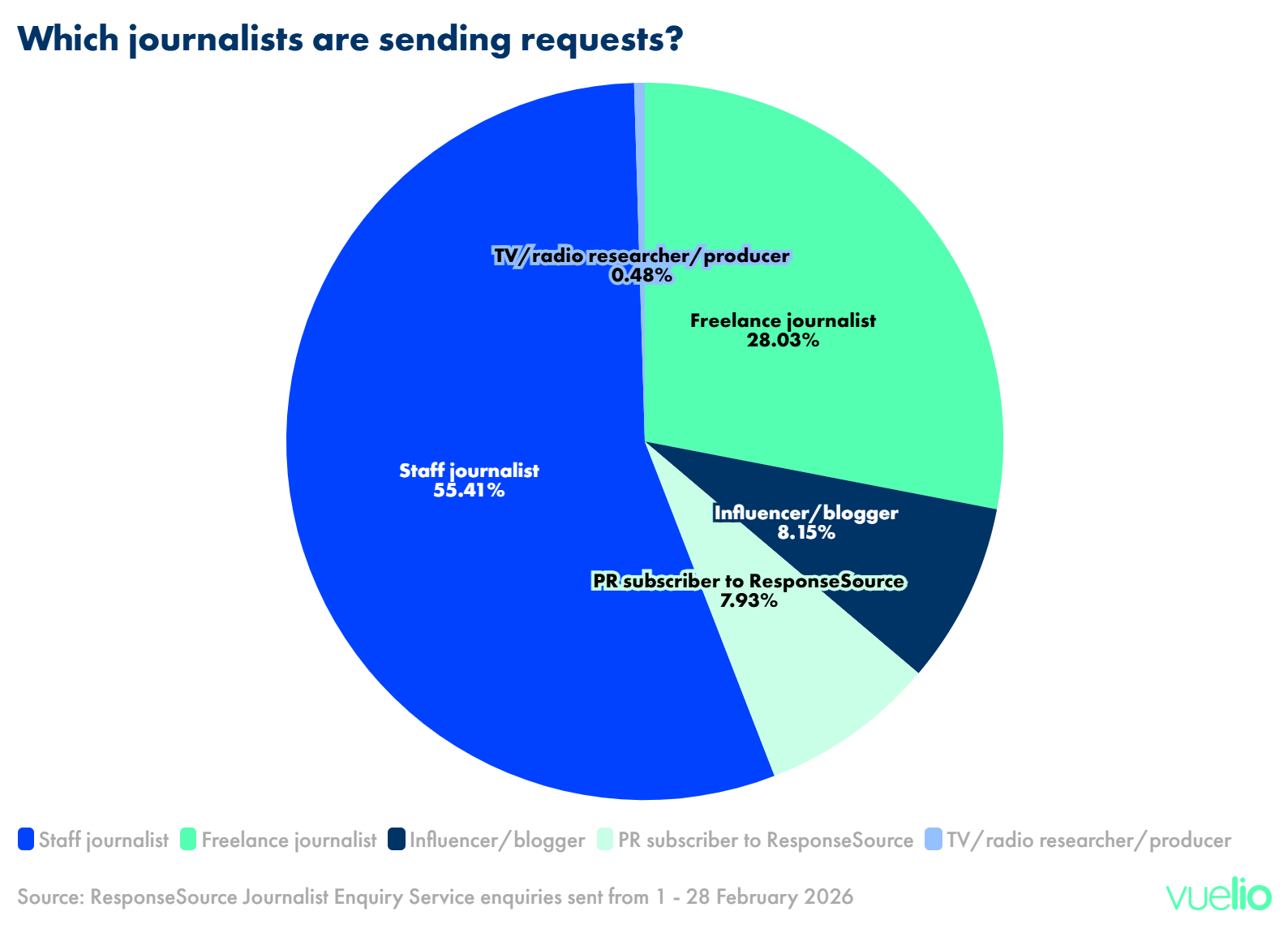
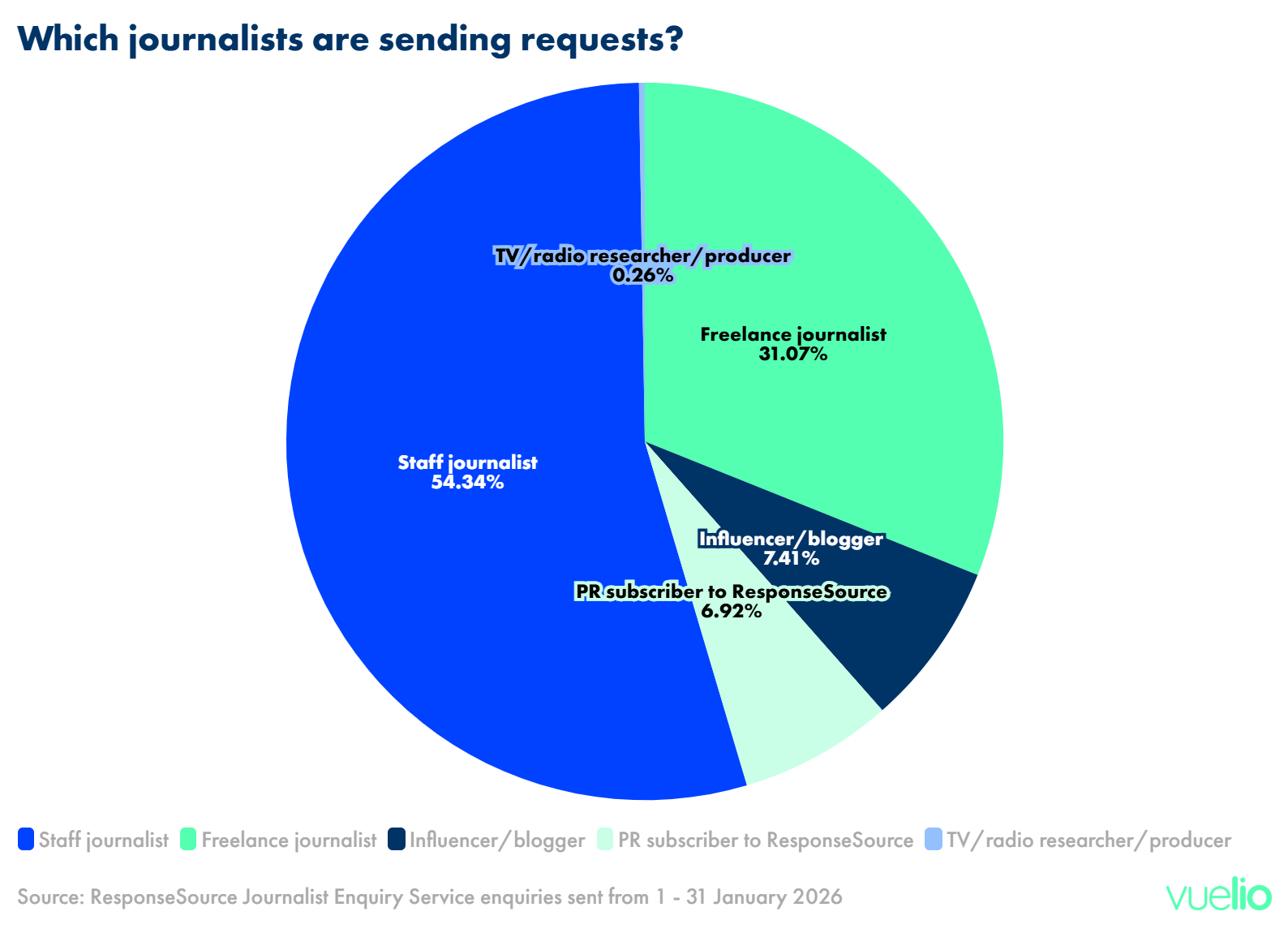
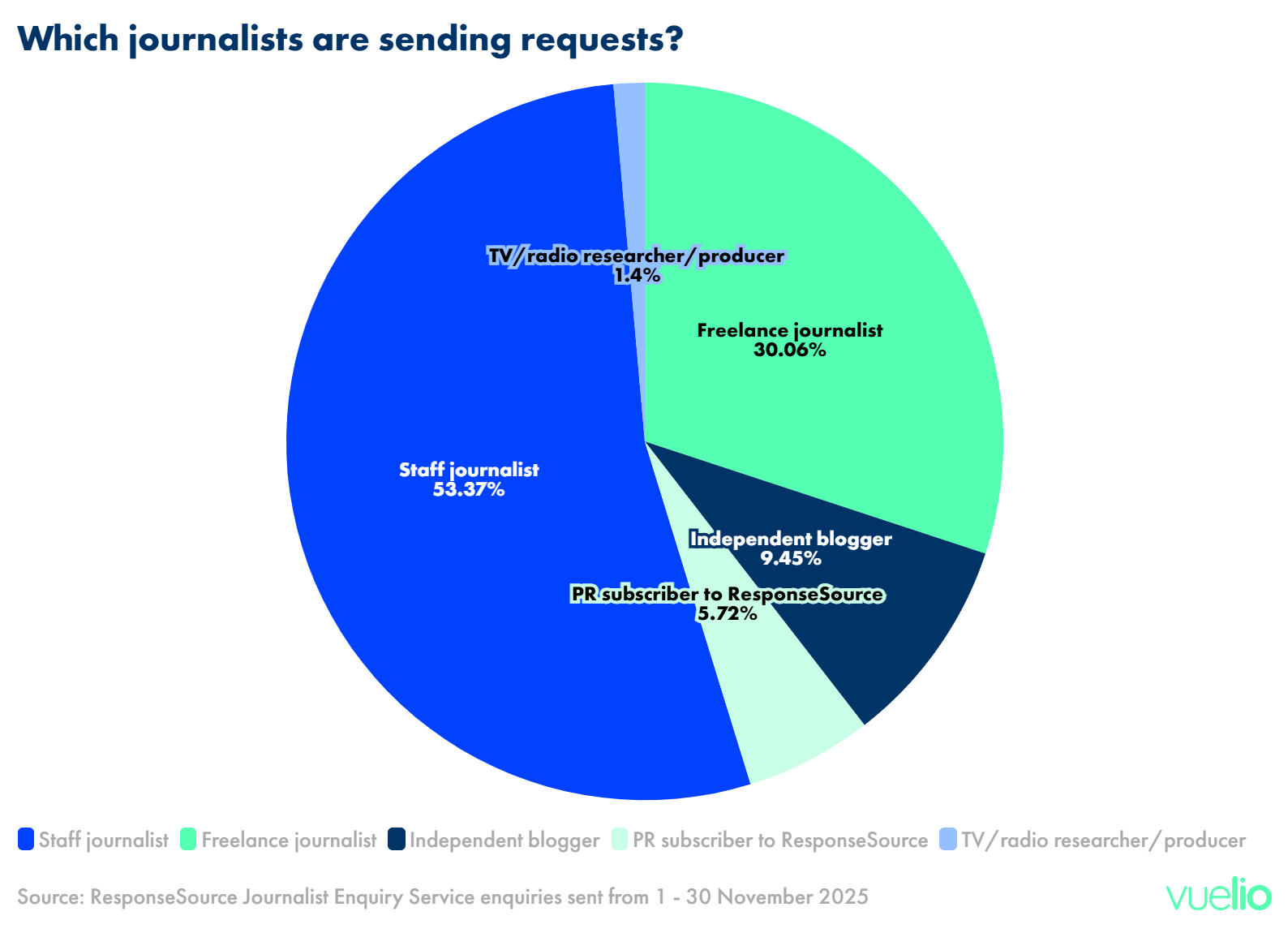
Which journalists are using ResponseSource for their Sept 2025 features?

Going forward? Journalists are likely to be writing advice pieces over the coming weeks and months about how people can save money during Autumn/Winter. We will see a lot of requests for money and personal finance experts. Plus, the Autumn Budget isn’t too far away, so journalists will need experts to explain any changes that will affect household budgets, and possibly case studies of people that will be impacted.

Fitness in fashion

The peak time for fitness is usually in early January, which we saw earlier this year with nearly 4% of requests containing the word ‘fitness’. However, we have seen another spike in August, with 2.5% of enquiries looking to cover this topic.

Outlets such as Men’s Fitness, Fabulous, The London Standard, and Cosmopolitan all sent requests last month. The majority were looking for fitness experts to share their advice and opinions but we also had enquiries looking for fitness bootcamps, home gym equipment, and fitness etiquette.

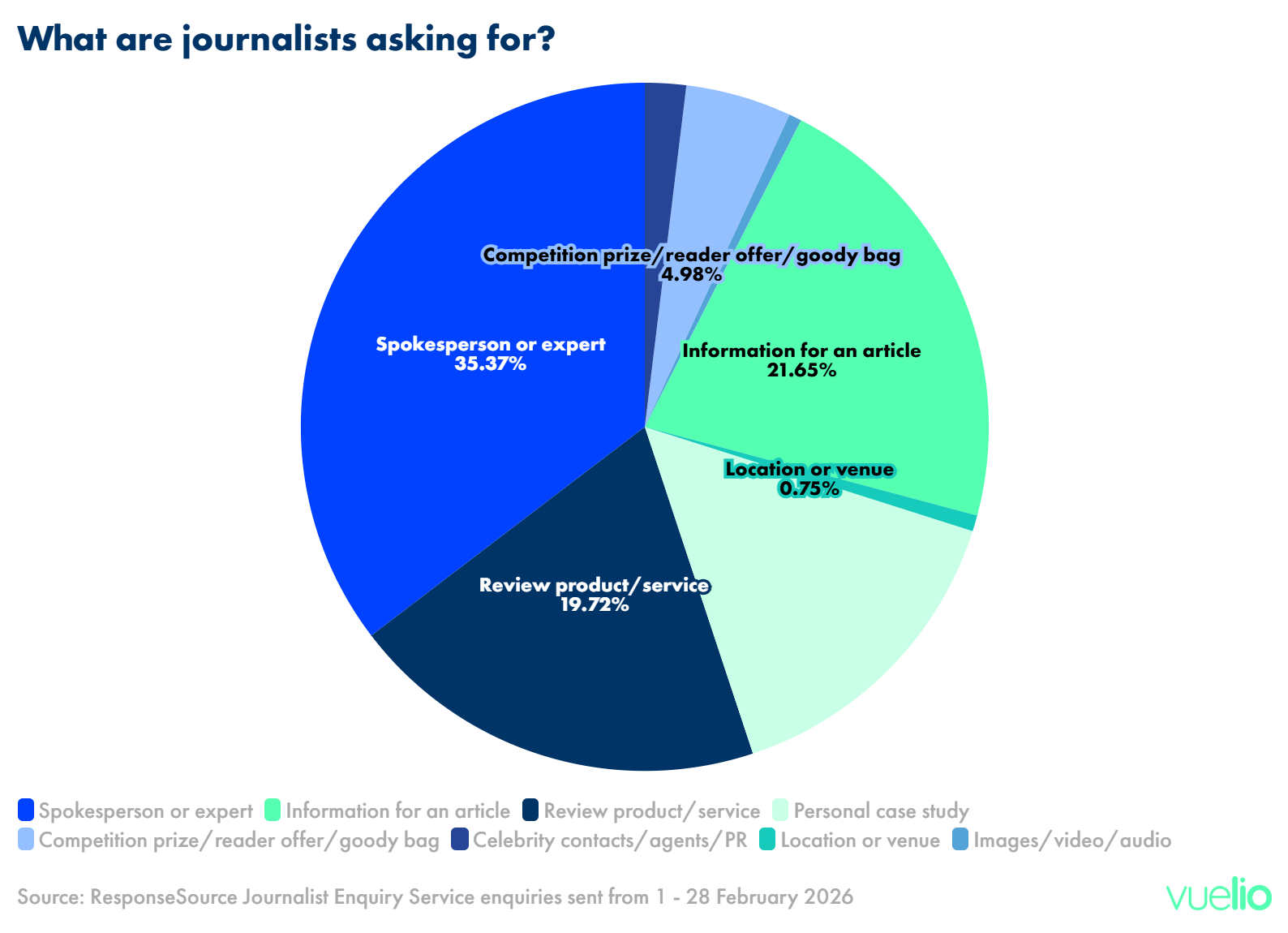
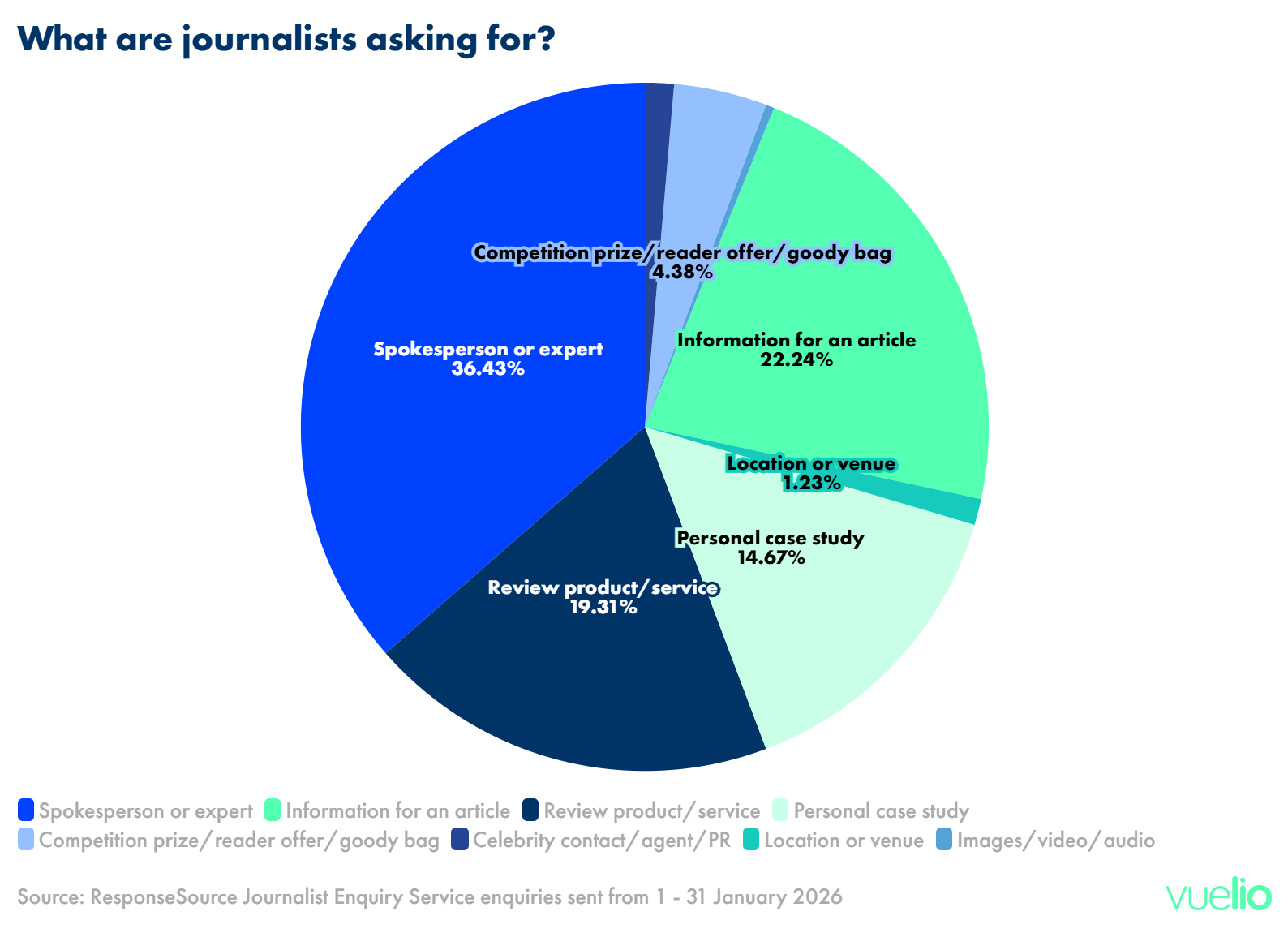
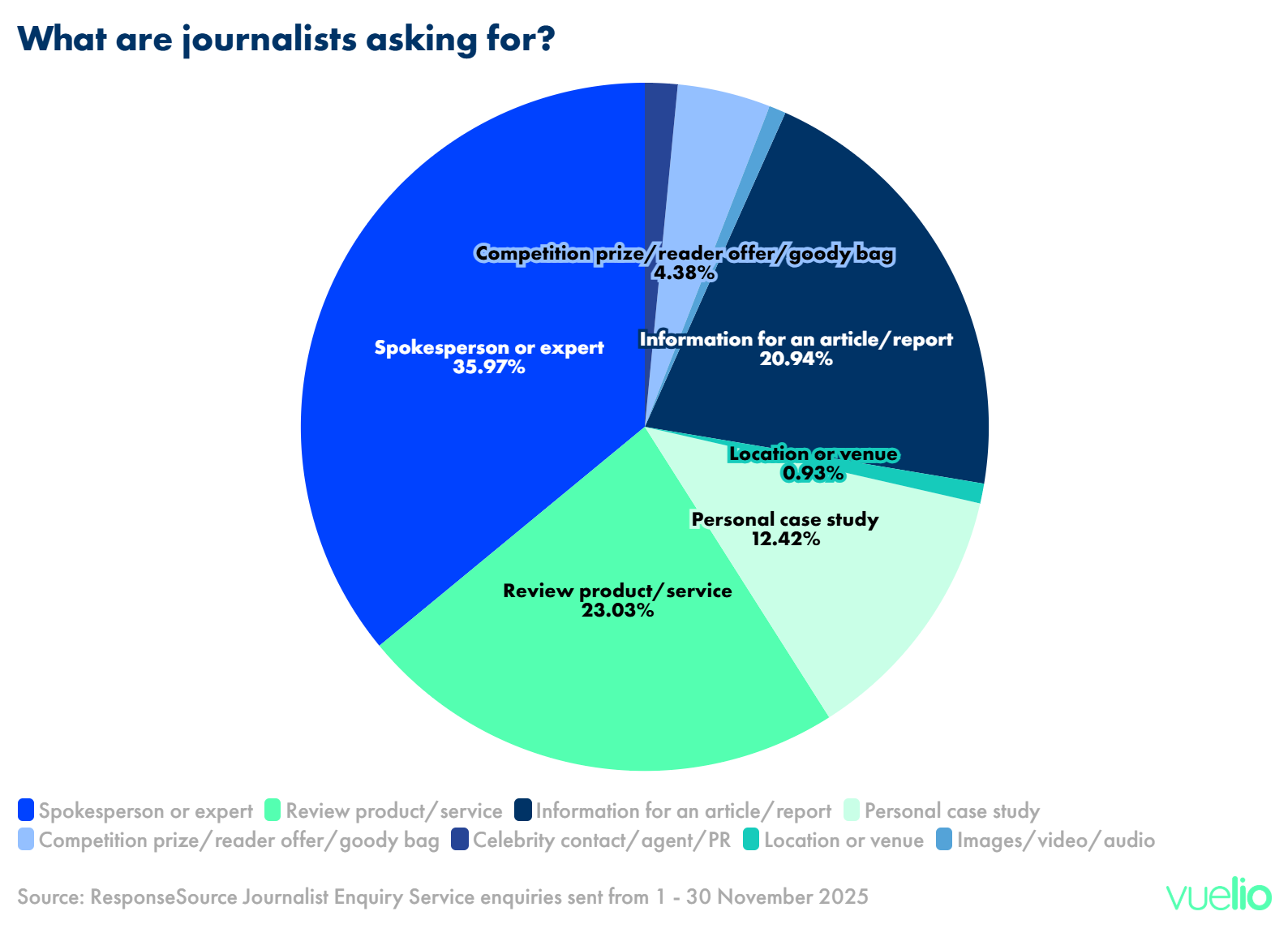
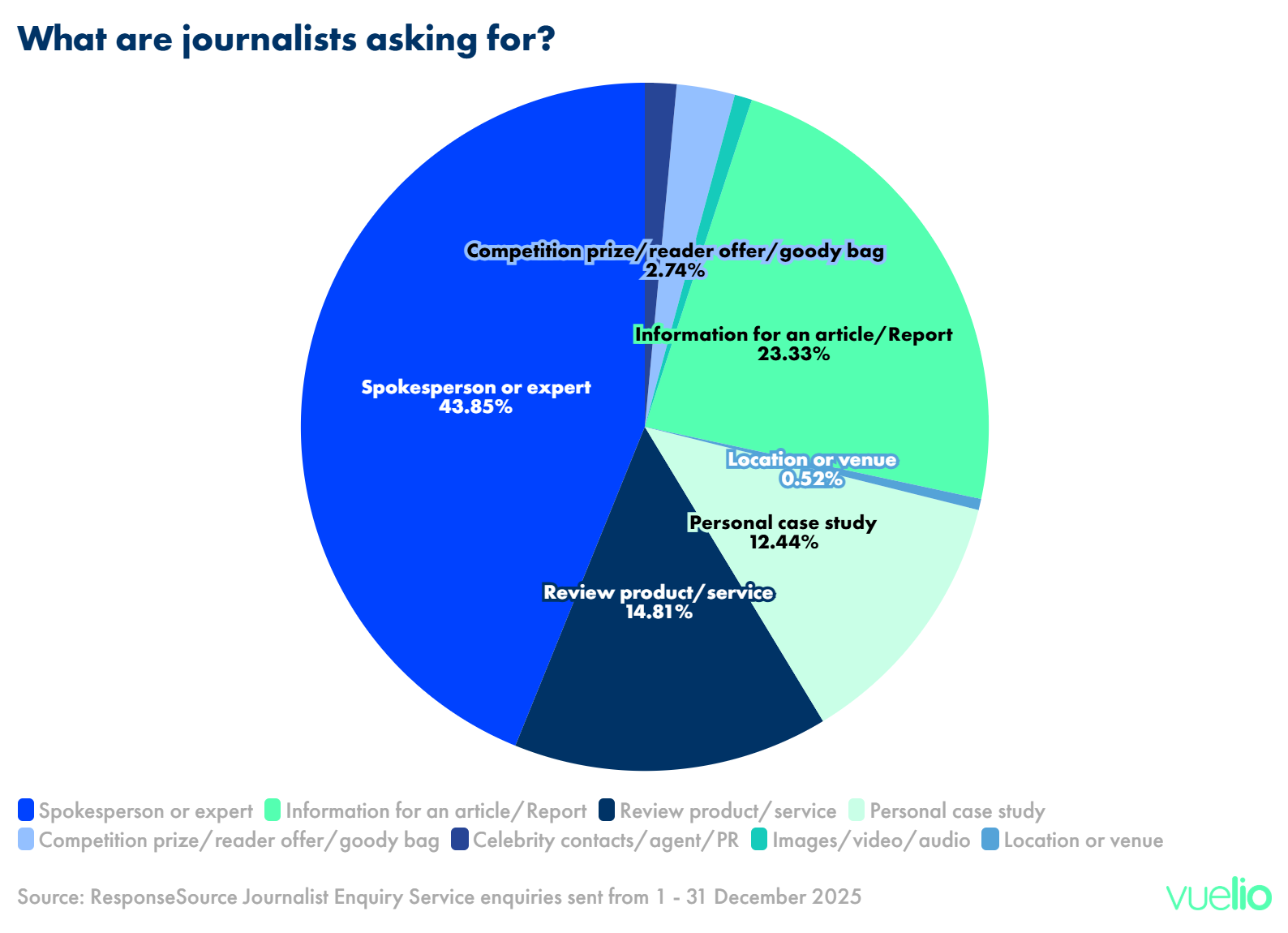
What journalists are asking for in September 2025

Going forward? National Fitness Day is coming up on 24 September, so we are likely to see more requests for experts and information on different exercises and classes that people can take up to get fit. Have comments ready to send out and you could get featured in a consumer magazine.

Other opportunities for PRs in September and beyond

Party conference season is nearly upon us and journalists have been looking to get ahead of this with 2.5% of requests containing ‘government’ and 1% for ‘Labour’. Enquiries are likely to focus on getting expert opinion on new policy announcements, and speeches, and conventions from the major party conferences. You can also keep up with the developments from the party conferences by subscribing to our newsletter.

Peak holiday season may now have passed but the media are already looking to get ahead and cover Autumn and Winter travel ideas and holidays. ‘Travel’ appeared in 5% of the total enquiries in August with the majority looking for experts to share their tips and advice on places to go. This is likely to continue throughout September with journalists seeking information on half-term holiday suggestions.

Want to get the most out of the ResponseSource Journalist Enquiry Service? Check out this explainer.

Preparing for a cyber crisis

‘Cyber crisis is a completely different animal’: Advice on planning a cyber secure comms strategy

‘The thing to remember: it’s not a normal crisis’ – that’s Joanne Gill’s advice for comms teams. And Joanne would know: her organisation Cyber Crisis Readiness & Response is geared towards helping comms teams who are faced with cyber security crises.

And in today’s climate, every comms team is at risk. Any organisation with an internet connection could be subject to a cyber attack, a data leak, or a deep fake of their c-suite in today’s climate of increased danger. According to Panorama report ‘Fighting Cyber Criminals’, there were an estimated 19,000 ransomware attacks on UK businesses in 2024, and that number is only set to grow.

‘You have to have a separate part of your crisis comms plan, a separate process, a separate mind map. Don’t fall back on your usual muscle memory, because it’s not going to work for you,’ adds Joanne, who equips organisations across the UK with the confidence to withstand and recover from the dangers of a cyberattack.

Read on for what to learn from recent crises that hit the headlines; practical steps for getting started on your plan; and where comms can get particularly complicated…

Lessons to learn from the 2025 summer of cyberattacks

‘All comms teams need to be prepared for something like this to happen to them, and other organisations in their sector. Identify stakeholders, have statements that are ready to go,’ advises Joanne.

Cyberattacks are on the rise

‘The key thing that’s different with a cyber crisis is, how do you actually distribute that? If all of your systems are down (for example, M&S had to revert to pen and paper), how do you distribute your statement to journalists?

‘There’s that added complication of having a distribution list that is not attached to a system which might go down. Ask yourself – do I know how I’m going to contact people? Where am I keeping that information? If I’ve got a crisis communication plan, do I have a paper copy of that? Do the people who are involved in that have a paper copy of it? And how are we going to communicate and actually do our jobs, get approvals for things that we put out when our systems are all down?’

Cyber crisis versus crisis

‘The additional element with a cyber crisis is that you need to be a good corporate citizen. With a cyber crisis, you’re not the sole victim. Your suppliers are potentially victims – it’s going to cost them money, one way or another.

‘All the usual things that you would do in a crisis need to be considered – how do we shore up the reputation of the company? How do we reassure people? How do we say sorry? But you also need to also look at how to be a good corporate citizen, preventing further harm to all of the people who are in your business ecosystem.

‘That is about communicating with CISOs (Chief Information Security Officers), telling them what the solution is to this problem, and how they can prevent contagion to their own systems. You’ve got a whole load of communication that has to happen before anybody even thinks about what to say to the media.

‘The media isn’t going to drive how a company recovers. That’s going to be how you deal with your stakeholders – the media is just a route to communicate with those stakeholders.

‘A cyber crisis is a different animal to other crises.’

Practical steps for planning your response

‘Ensure that you have those stakeholder distribution lists and that you’ve done some analysis in advance about who you need to communicate with, and what to do if all your systems are down.

‘Make sure that you’ve got all of the suppliers, all of your ecosystems, chief executive security officer details so that you can contact them, so your technical people can write to them. And that’s very different messaging to that of reassuring your customers.

‘It’s about segmenting, making sure that you’ve got that information available outside of your usual systems.’

CEO statements: Always a solid comms strategy?

‘As a comms team, you know whether your chief exec is somebody that you want to put forward – it’s what companies traditionally do for crisis comms. You do the media training, emphasing the need to be apologetic, to be empathetic.

‘But I don’t know… the other element with cyber issues is that the more content you have of your senior team in the public domain, the more opportunity there is for criminals to use AI deep fake tech. To do some social engineering, and then use that to get access to your systems. Nobody is going to argue with the CEO if they call a help desk in the middle of the night and say “reset my password”.’

Extra complications to consider

‘It’s so complicated because you’ve got things like GDPR, there are potential fines coming further down the line. Cyber crisis is a multi-layered, complicated thing.

‘Comms teams who come into this thinking that it’s going to be like a regular crisis will come unstuck very quickly.’

For more on planning your strategy, watch Vuelio’s webinar ‘Cyberattack Crisis Comms’, or read our overview of the key points covered here.

What are journalists writing about in August

Wellness, AI and gardening: How to get UK press coverage in August

Looking to get featured in the media during August? The final month of the summer still presents plenty of opportunities to get expert comments, case studies and more out into the press. Below we provide insight into what journalists could be looking for based on trending words and themes from the ResponseSource Journalist Enquiry Service in July, and what that means they will be looking for this month.

Wellness is well-in

August is National Wellness Month and journalists have been looking to get ahead as just under 2% of all requests last month contained the word ‘wellness’.

Top themes for August

Enquiries have included looking to speak with business leaders about their top wellness tips, wellness retreats and spas to visit in the UK, and looking for high-profile health and wellness experts. These requests have come from outlets such as PA Media, SheerLuxe, MailOnline, City A.M. and Top Santé.

Going forward? Journalists will still be sending last-minute National Wellness Month requests – have experts and info ready and you could get yourself or your PR client featured in national press or a major consumer media title.

AI and new tech’s impact

Technology journalists have had a lot to cover in the last few years with the rise of artificial intelligence, and more recent news around cyber attacks and online safety. ‘AI’ continues to prove popular on the Journalist Enquiry Service, with just under 6% of requests in July. ‘Cyber’ has also been getting a lot of interest too with just under 2% of all enquiries last month.

Requests have been looking to cover how AI is impacting many different sectors including case studies on retailers trialling agentic AI and how it’s transforming the banking sector. Plus enquiries covering more general points such as how the UK’s AI action plan compares to Trump’s. While requests around cyber have been more focused on cyber security and also getting perspective on who handled the cyber attacks better – M&S or the Co-op.

Going forward? The amount of enquiries around AI were 35% higher in July this year compared to last, which is in line with what we have seen across the year. Journalists are constantly on the lookout for case studies and experts that can shed more light on the sector they cover. If you’ve got AI or cyber-related information then you could appear in IT Pro, the AI Journal, Retail Week, The Grocer, or Sifted – as they all sent requests last month.

Gardening continues to grow strong

The Spring and Summer season are the peak time for gardening requests and July saw another strong indicator of that as just under 5% of the total requests contained the keyword ‘garden’ or ‘gardening’.

Enquiries were sent from journalists at titles such as The Independent, GB News, Homes & Gardens, and Country Living. They ranged from covering topical issues such as how to keep your garden alive during a hosepipe ban, to looking for an expert to comment on building a patio on a sloping garden and the latest and best products and gadgets for the garden.

Going forward? August is probably the final month of the year where gardening is one of the more popular keywords on the service, with around 4% of the total requests in August 2024. Journalists will be looking for information on the on-going hosepipe ban in certain areas of the country, as well as looking for experts to share advice as we approach a change in season.

Other opportunities for PRs in August and beyond

In August 2024, ‘Autumn’ took over from ‘Summer’ as journalists sought to get ahead with content for the upcoming season. New fashion and beauty trends often tie in with these requests, as well as recommendations for Autumnal activities, Autumn decor, and places to visit during the fall as well.

This month sees the end of festival season with big music festivals like Reading & Leeds and Creamfields still to come over the Bank Holiday weekend. The Edinburgh Fringe festival is also currently taking place and the final few summer carnivals are also happening, with the most famous one being Notting Hill, still on the horizon. If you have information surrounding these events or tips on what festival goers should be taking with them, then you could get featured in a national press title.

Want to get the most out of the ResponseSource Journalist Enquiry Service? Check out this explainer.

Why email is an effective part of comms strategy

Why PRs should be making the most of email in an AI-driven world

Is email outreach as outdated as the 90s-era posted PR press mailer? With the comms industry rushing to integrate AI tools into their tech stack, the email blast could be seen as just another tactic of PR’s past. But think again…

‘At the start of my career fax and phone were the only way of reaching journalists,’ says Anne Cantelo, founder and managing director of Onyx Media and Communications Ltd.

‘Younger generations of PR hate the phone even more than the generations before them, and most journalists seem to feel the same. At the same time, journalists have confessed to me that they have thousands of unopened emails in their inboxes…’

Phone calls are out, and unread emails are piling up – the rush to integrate AI across the industry could signal that electronic mail will go the way of its franked counterpart. But the lessening of 1-2-1 engagement that comes with AI automation makes email even more valuable – especially when it’s powered-up by artificial intelligence.

Here is advice from comms professionals already evolving their email strategies to boost engagement.

1. Cutting through with quality content

Stakeholders are overwhelmed by constant messaging even outside of their inbox – how can you catch their eye?

‘The rise of AI presents both a challenge and an opportunity,’ says Liz Churchman, deputy managing director at B2B tech PR agency EC-PR.

‘With inbox filtering becoming more intelligent, relevance is no longer optional; it’s critical. Yet, AI also empowers us to create what I call a ‘one-to-one feel as one-to-many scale.’ Using tools like ChatGPT, we build custom GPTs aligned to buyer personas, underpinned by deep audience insight; motivations, fears, frustrations, so that our emails feel crafted with intent, not churned by automation.

‘Clean, segmented lists and emotionally intelligent messaging make the difference between delete and engage.’

Formatting is also important – short and relevant copy, interactive elements including video embeds and html features, and making sure it’s mobile-first for people on the go, or trapped in long meetings without access to their laptop…

2. Email as part of a wider strategy

‘Comms pros need to be where the audience is and adapt our methods and routes to communication,’ says Leopard Co CEO and co-founder Rachel Roberts, whose team utilises email as just one way to communicate with stakeholders.

‘It’s been a while since I faxed through a press release but meanwhile, we have embraced new routes to engage with audiences including WhatsApp messages, social media DMs, programmatic emails, remarketing and calling campaigns.’

Email is no longer in a silo, and should be used in conjunction with private messaging platforms like WhatsApp, Slack, and Discord; microsites and press rooms; personalised landing pages for campaigns; and follow-ups after in-person networking.

Sycamore Communications’ PR manager Danielle Windecker-Hilton advocates for email as a ‘connecting’ tool:

‘We treat email as a connector, driving recipients to deeper content or prompting direct engagement with the people and brands we represent. It supports our clients’ goals and can be a good initial touchpoint with journalists and publications.’

‘Attending to emails can be viewed by some as a bit of a negative, burdensome chore,’ admits Rachel. ‘Indeed, we have a client who only wants to communicate with us on WhatsApp.

‘But with email carrying weight from a legal perspective – eyeballs are there, and so is the marketing opportunity.’

Just remember to be careful…

‘Automation and AI does make email marketing more accessible, but it means more people with less expertise can be spamming people,’ warns Rachel. ‘There is no quicker way to break a brand than to spam and annoy your customers. Press send with care.’

3. Personalisation

Does bringing artificial intelligence into email strategy make the messaging impersonal and robotic? Used properly, AI can actually bring personalisation back into your email strategy.

‘AI helps us go beyond just inserting someone’s name,’ shares Ed Hopkins, managing director of Ed Hopkins PR.

‘AI can tailor emails based on behaviour, preferences, or timing. This leads to more relevant content and stronger engagement. People are more likely to respond when they feel a message is meant for them.’

4. Optimisation

Writing eye-catching subject lines that are just the right length; segmenting your contact lists, selecting the right sending times; and predicting the levels of engagement – AI can help with all this.

But before you get stuck into prompting on ChatGPT or Gemini, here is some extra help from Riley Gardiner, founder of No Strings Public Relations:

‘To stand out in busy inboxes you’ll need to focus on concise, relevant subject lines and genuine, value-driven content. Avoiding generic language and adding a human touch helps cut through noise.

‘Email offers a direct, personal channel for stakeholder communication that social or mass media can’t replicate. It supports ongoing dialogue, builds trust, and allows for nuanced messaging in ways that other tactics struggle to match.’

5. Complying with regulation, not dicing with dodgy data

GDPR, CCPA, and incoming abbreviated regulations for the use of data means that opt-in emails are non-negotiable for comms professionals.

Your media database of choice can help with this (like the Vuelio Media Database, for example…) and so can AI.

‘AI can be a great help in staying GDPR-compliant by automating consent management and ensuring data is handled correctly, reducing human error,’ says Riley Gardiner.

Just make sure your lists are maintained and kept up-to-date…

‘AI can help identify potential compliance risks, streamline workflows, and ensure that personalisation is based on compliant, permissioned data,’ says Gerard Boon, Financial Times contributor and managing director of Boon Brokers.

‘But it’s important to remember that AI is only as effective as the framework it is given. Human oversight must remain a non-negotiable part of the process – experts in their field need to be vigilant and ready to amend, review, or flag potential issues as they arise.’

6. Making more of metrics

Open rates are less reliable with the increased use of email protection and privacy tools, but there are other metrics to make the most of – including clicks, replies, and conversions. Some tools also offer bespoke insights, like time spent reading an email. Additionally, it’s important to keep an eye on factors like send times to optimise delivery.

‘While open rates still provide some value, I think it’s important to remember the fundamental principles behind comms is to establish a relationship and communication,’ says Gerard.

‘Focusing on click-through rates (CTR), time spent on linked content, and conversion actions (such as booking a call or completing a contact form) are actually better measuring metrics to establish how close your branding and messaging is with your specific target audience.

‘Reply rates and engagement with follow-up emails are now more important than ever, putting in place a stronger bond of genuine interest and intent.’

7. Human to human connection

Journalist and stakeholder inboxes fill up with generic pitches throughout the day. Effective email strategy in comparison goes further, focusing on relationship building rather than blasting out a message.

‘Email still allows for direct, personal communication that can be tailored to your ideal client,’ says Sarah Lloyd, founder of ISPR.

‘I still believe that email can create a more intimate and focused experience, allowing for thoughtful and deeper conversations. Emails can be segmented and targeted, and you can track, document and enjoy focused interactions without the noise of social media.’

Email can be a personalised check-in with a client, an invitation to an upcoming event, or the sharing of a piece of content relevant to their industry. It should be a continuing conversation – not a series of non-sequitur statements littering an already busy inbox.

‘In today’s crowded inboxes, success comes from speaking to your audience’s problems, not your solutions,’ adds Liz Churchman.

‘If your subject line and first line don’t address what keeps your audience up at night, they’ll be gone in two seconds. Relevance, empathy and creativity must drive every word.’

Evergreen email

‘Email remains one of the most direct and controlled forms of communication,’ believes Gerard Boon.

‘Unlike social media or paid ads, it allows us to be incredibly specific on our outreach, tailoring a wide-variety of content for nuanced and context-rich messaging. There are no character limits as such and less platform restrictions.

‘While innovations in technology have boomed in recent years, there is a lot of focus on social media influencers, podcasts, and hyper attentive alternative platforms. While these all have a place under the umbrella of marketing, I think it is sometimes forgotten that emails offer that personalised edge with a familiar outreach – we’re all still connected to the online world.

‘For stakeholder engagement, this means we can maintain, build on, and direct to useful resources, with a strategy that continues to build an evergreen trust over time.’

Our own email expert, Pulsar Group head of global marketing campaigns Kirsti Kauronen says:

‘For us, email is one of the key channels to reach our audiences directly. With new AI tools emerging at a fast pace, we are able to deliver even more tailored comms with greater impact.

‘Many email providers now offer automatic summaries of emails, so it’s even more important to include strong subject lines and opening sentences that stand out in crowded inboxes.

‘And don’t forget to test your content regularly. It’s essential to optimise performance and ensure your key message comes across clearly.’

For help with your emails, and wider comms strategy, check out Vuelio’s Media Database, Stakeholder Relationship Management, and Media Monitoring solutions.

How to get media coverage in July

Heatwaves, a summer of sport and back to school: How to get UK press coverage in July

Want to secure media coverage in July? While the summer months may be quieter in many industries, the news cycle doesn’t stop. Journalists continue to need expert sources and information for articles and hundreds use the ResponseSource Journalist Enquiry Service each week to get it. Find out below what they were searching for in June and how you could help this month.

Summer at its peak

Enquiries from journalists about the different seasons are always popular and we are seeing the peak of the ‘summer’ requests at the moment, with just over 9% of the total enquiries last month containing this keyword.

Top themes for July

There’s a lot of variety in the requests with journalists looking for summer fitness gadgets and accessories, how to get peonies to produce more beautiful blooms in summer, and a health and safety expert or GP to talk about food health hazards in the summer. These were for titles including The Times, PA Media, The i Paper, and This Morning.

Going forward? July last year saw a small drop in the amount of ‘summer’ requests to 6% but that still presents lots of opportunities to get media coverage. With a big summer of sport ahead (Wimbledon, the women’s Euro’s, Tour De France, and more), plus last-minute requests for holiday getaways and gardening advice, have experts and info ready – you could get featured in the national press or on a broadcast outlet.

Which journalists are sending requests?

The heat is on

The UK has been enjoying an excellent summer weather wise (if you like the heat, that is) and with some high temperatures, both ‘heat’ and ‘heatwave’ have proved popular on the enquiry service. ‘Heat’ has appeared in over 2% of the total requests in June and ‘heatwave’ in 1%.

Journalists at The Sun, woman & home, MailOnline, and Men’s Health have mainly sent requests looking to find out ways to stay cool during the hot weather. But we have also seen enquiries around related topics including one for an UK-based employment lawyer to comment on heat in the workplace.

Going forward? With the hot weather set to continue, we expect to see more enquiries from journalists looking for health-related information. Many will also look to cover it from an environmental angle too or the effect it could have on other areas – on plants and pets, for example.

School’s out (and straight back in!)

There are only a couple of weeks left until schools break up for the summer but journalists are already looking to cover going back to school in September. ‘School’ appeared in just under 2% of the total requests last month, with ‘back to school’ cropping up in many of those enquiries.
Journalists from The Independent, LBC, The Guardian, and Daily Mail all sent requests around ‘school’. The back to school enquiries were mainly looking for products to review and recommend, but other requests covered end of term gifts for teachers and school staff and the lack of financial education in schools.

Going forward? Last year in July, ‘school’ related requests increased by 24% and ‘back to school’ by 70%. This will only increase further in August. If you have school uniforms or accessories that you want to get featured in the media, now is the time to engage with enquiries.

What are journalists asking for?

Other opportunities for PRs in July and beyond

While we may only be in the seventh month of the year, journalists are already starting to plan their Christmas content. ‘Christmas’ appeared in just over 1% of requests in June but in July last year that figure doubled to 2.5%. Festive gift guide enquiries will steadily increase from now on, meaning you could get some early media coverage.

‘Gardening’ is a near constant keyword on the service and it usually proves especially popular during the summer months with many garden shows and exhibitions. In July 2024, 5% of the total requests were gardening-related. Journalists are seeking out expert advice, so have comments ready and you could potentially secure coverage in a national press title or consumer magazine.

Want to get the most out of the ResponseSource Journalist Enquiry Service? Check out this explainer.

Guy Cocker

Technological innovation and industry transformation: Media interview with technology, gaming, and AI journalist Guy Cocker

Arguably 2025’s most prevalent topic in the world of journalism and communications is AI. Rapid advances in generative AI technologies are revolutionising how editors and media outlets boost creativity, while for PR teams an increase in efficiency has been a major shift.

To explain how the industries are changing and where they’re set to travel in future, former editor-in-chief of Maximum PC and tech, gaming, and AI journalist Guy Cocker shares his insights on the transformation of the journalism industry, where future challenges may come and how the PR/journalist relationship is evolving.

Having worked in consumer technology journalism for around 20 years, with time at outlets including CNET UK, Telegraph Media Group, BBC Radio 5, Sky News, and STUFF, what are the biggest tech innovations you’ve seen in this time?

I’ve been lucky enough to have had a front-row seat to some truly transformative tech innovations – the launch of the first iPhone, the electric car revolution, and the move from print to online, to name just a few. Here are what I consider the biggest game-changers:

The Smartphone Revolution
The arrival of the iPhone in 2007 was a watershed moment. It wasn’t just a phone; it was a pocket-sized computer that fundamentally changed how we communicate, consume information, and interact with the world. This has profoundly impacted journalism, providing new tools for reporting (mobile journalism or ‘mojo’) and altering how audiences consume news.

The Mobile Internet
The evolution of mobile networks from 2G to 5G has been crucial in unlocking the potential of smartphones and other connected devices. Always-on, high-speed internet access has enabled everything from instant messaging and social media to cloud-based services and the Internet of Things. For journalism, this has meant a shift towards digital-first strategies and the need for journalists to be multimedia storytellers. Plus, it has put news access in the hands of more people than ever.

Social Media’s Rise and Transformation of News
Platforms like Facebook, X, Instagram, and TikTok have not only changed social interactions but have also become significant sources of news and information. They’ve democratised content creation, allowing anyone to become a publisher, which presents both opportunities and challenges for traditional journalism in terms of audience attention and the spread of information (and misinformation).

Cloud Computing
Cloud computing has moved from a back-end technology to a fundamental infrastructure layer for much of the digital world. Services like AWS, Azure, and Google Cloud have enabled scalable and on-demand computing resources, impacting everything from streaming media to news websites and the tools journalists use for research and content creation.

AI
While AI has been around for decades, recent advancements in machine learning, particularly deep learning, have led to its integration into a wide array of applications. From recommendation algorithms and virtual assistants to image recognition and natural language processing, AI is beginning to transform various industries, including the journalism and communications space. I predict that AI will have just as disruptive an influence on journalism and content creation as the internet itself.

The integration of AI into the communications space is a more recent but rapidly evolving trend. I’m seeing its impact in several key areas:

Content Creation: AI tools can help generate initial drafts, suggest headlines, and even automate the creation of routine content like social media updates or basic news reports.

Personalised Communication: AI algorithms can analyse vast amounts of data to tailor news delivery and marketing messages to individual preferences, potentially leading to more engaging and relevant communication.

Sentiment Analysis and Media Monitoring: AI can be used to track public opinion on social media and analyse media coverage, providing valuable insights for PR professionals and journalists alike in understanding the impact of their communications.

Chatbots and Automated Customer Interaction: AI-powered chatbots are becoming increasingly sophisticated in handling customer queries and providing information, freeing up human communicators for more complex tasks.

Enhanced Media Analysis: AI tools can help journalists and PR professionals sift through large datasets of news articles, social media posts, and other information to identify trends, patterns, and key insights more efficiently than manual methods.

How has journalism changed over this time?

Journalism has undergone a monumental transformation, largely driven by the technological innovations we’ve discussed. Here are some of the key changes I’ve observed:

Print-Centric to Digital-First
The most significant shift has been the move away from traditional print media as the primary source of news. Online platforms now dominate news consumption, with audiences expecting instant access to information on their computers and mobile devices. This has forced news organisations to adopt ‘digital-first’ strategies, prioritising online content creation and distribution. Frankly, paying for a magazine or newspaper is now a niche activity in 2025.

The 24/7 News Cycle and the Demand for Immediacy
The internet and social media have created a 24/7 news cycle. News breaks and spreads in real-time, demanding that journalists work at a much faster pace. This has put pressure on newsrooms to deliver quickly, sometimes raising concerns about accuracy and thoroughness.

The Rise of Multimedia Storytelling
Digital platforms have enabled journalists to move beyond text-based reporting. Multimedia storytelling, incorporating video, audio, interactive graphics, and data visualisations, has become increasingly common and expected by audiences. Journalists now need a broader skillset to produce engaging content across various formats.

The Struggle for Revenue and New Business Models
The decline of advertising revenue has created significant financial challenges for traditional news organisations. The digital environment has made it difficult to monetise online content effectively, leading to experiments with paywalls, subscriptions, memberships, and other new business models. The search for sustainable revenue streams continues to be a major challenge, and now major publishers, like the one I most recently worked for in Future plc, are signing partnerships with companies like OpenAI in a desperate bid to stay relevant.

Data Journalism
The availability of vast amounts of data has led to the rise of data journalism. Journalists now use data analysis and visualisation techniques to uncover trends, patterns, and insights, providing deeper and more evidence-based reporting on complex issues.

In essence, journalism has transformed from a primarily one-way dissemination of information through traditional channels to a more dynamic, interactive, and multi-faceted ecosystem. Journalists today need to be adaptable, skilled in various digital tools and storytelling formats, and deeply committed to accuracy and ethics in a rapidly evolving media landscape. The integration of AI represents the latest chapter in this ongoing evolution.

What originally drew you to tech journalism and what keeps you in the industry?

I’ve always followed my passions, which have been technology, video games, and media in general. When I started, I wasn’t particularly happy in my business and IT degree, so I wrote to Virgin’s student website to ask if I could review games for them. I then finished my degree and applied for a staff writer role at a home cinema magazine, as it was something I was interested in, and a good foot in the door. I was lucky because a year later, CNET was launching in the UK and they were looking for someone who could write about televisions and audio. I leapt at the chance to move online.

What keeps me in the industry after all this time is a combination of factors: Technology never stands still, and there’s always a new trend, a groundbreaking gadget, or a disruptive innovation on the horizon. Technology has also moved from something people were once generally afraid of to something that has become ingrained in our everyday lives, to the point where most people couldn’t live without their smartphone.

Over the years, I’ve had the privilege of meeting and working with incredibly smart and passionate people, from fellow journalists and editors, to the innovators and entrepreneurs shaping the tech world, to the communications people that support this industry.

Is the excitement, and trepidation, around AI at the moment warranted – is it as life changing as it’s perceived and presented to be?

Yes, I believe the current excitement and trepidation surrounding AI are largely warranted. It’s not simply hype; the underlying technological advancements are substantial and point towards a future where AI plays an increasingly significant role in many aspects of our lives.

We’re already seeing AI move beyond theoretical concepts into practical applications with tangible results. From sophisticated language models like those powering chatbots to AI used in drug discovery, fraud detection, and personalised medicine, the technology is demonstrating its power to solve complex problems and enhance efficiency.
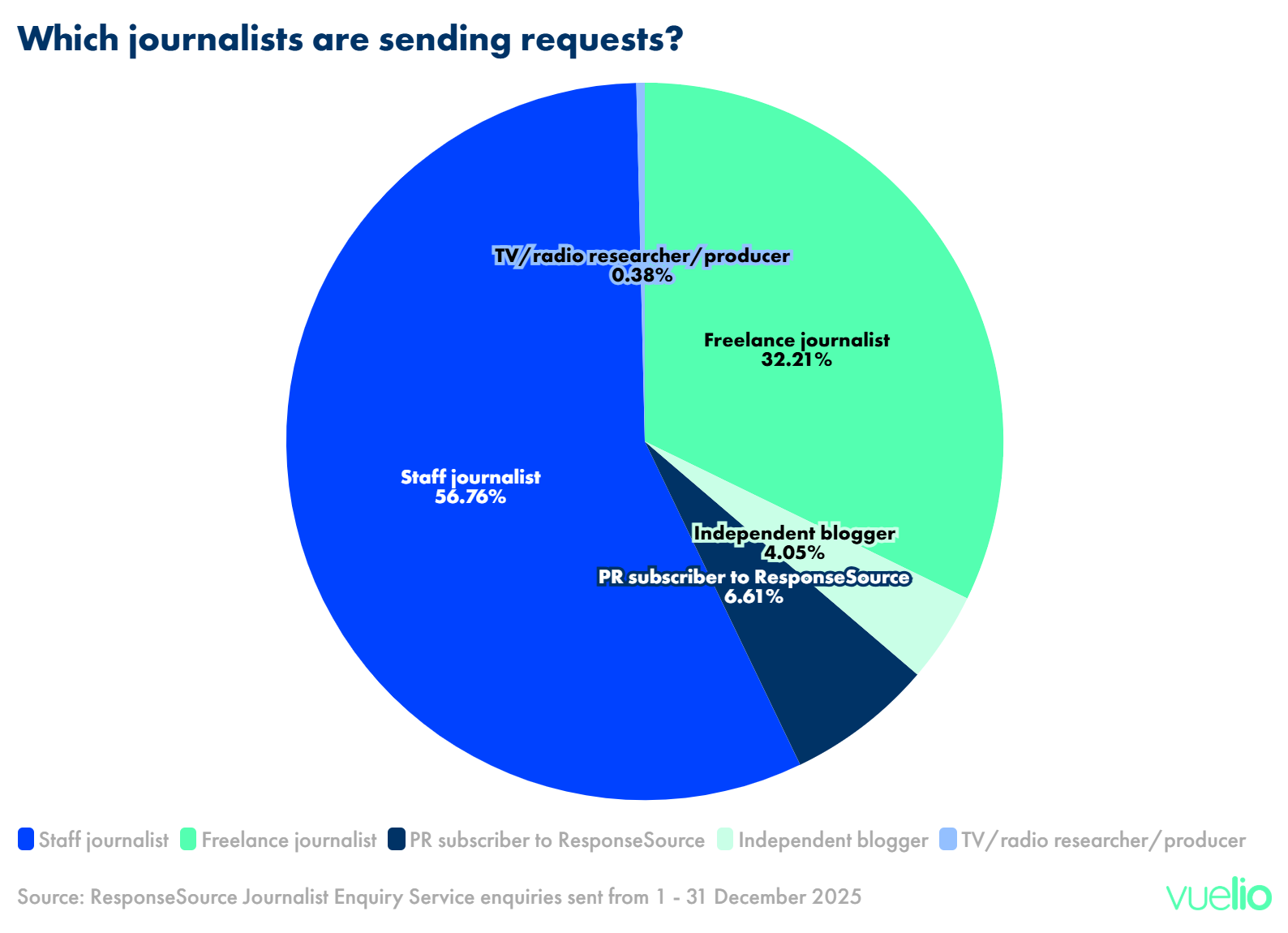
AI also holds immense potential to address some of humanity’s biggest challenges. This includes accelerating scientific research, improving healthcare diagnostics and treatment, optimising resource management to combat climate change, and creating more accessible tools for people with disabilities.

In terms of fears, AI looks set to drive significant economic growth by automating tasks, creating new industries, and augmenting human capabilities in the workplace. While there are concerns about job displacement, there will be new roles and increased productivity because of this. There are also serious ethical questions that look like they may not be being addressed around bias in algorithms, privacy, and data security, accountability for AI-driven decisions, and the potential for misuse. I worry we’ve not learned much from the damages caused by social media and that we may repeat these with AI.

What was your take on the recent ‘Make It Fair’ campaign regarding AI’s potential impacts on the creative industries?

Just today as I write this, I see that a major publisher in the tech space, Ziff Davis, is trying to sue OpenAI for using its content to train its algorithms without consent. These stories seem to be a regular occurrence, and the worrying trend is that AI companies seem to run roughshod over content creators, taking the work that cost them money to create without many repercussions from governments or lawmakers.

The recent ‘Make It Fair’ campaign reflects a deep-seated concern about the potential impact of generative AI on the livelihoods and rights of creators. My take on it is that the campaign’s core arguments are valid and highlight crucial issues that need serious consideration by policymakers.

The creative industries, which contribute significantly to the UK economy, rely heavily on copyright protection. Allowing the wholesale scraping of their work without any framework for licensing or remuneration could severely undermine their business models and the incentive to create.

The ‘Make It Fair’ campaign advocated for a balanced approach where AI development can continue while ensuring that creators are fairly rewarded for the use of their work in training these powerful tools. This aligns with the principle that those who contribute value should be compensated for it.

What has been the biggest worry for media brands when it comes to AI so far?

Copyright infringement and intellectual property rights. This concern stems from the way many AI models, particularly generative AI, are trained on vast datasets that often include copyrighted material without explicit permission or compensation to the creators. There are currently claims that Meta has used piracy-oriented websites to access copyrighted material in order to train their models, and that this was authorised at the highest levels. Again, there haven’t been any penalties around this, and with the UK looking to position itself as a leader in AI, it will be interesting to see how the government deals with this.

Content businesses have already seen the value of their property devalued by search engines and news aggregators that serve up their content outside of their own channels, limiting their ability to monetise it as a result. AI presents an even bigger existential threat – that their content will be absorbed into a giant model, where the end user may have no idea of the source of that information, let alone being able to pay for it.

What do you see as the biggest challenges that lie ahead for the industry?

Capturing and retaining audience attention is becoming increasingly difficult. Competition comes not just from other news outlets but also from social media, entertainment platforms, and a vast array of online content.

Monetising is also becoming more and more difficult. Traditional advertising models have been disrupted, and while subscriptions and paywalls have gained traction, they haven’t fully compensated for lost print revenue for many organisations. Exploring innovative monetisation strategies, such as micropayments, memberships, and leveraging data for personalised advertising, will be crucial.

Maintaining trust is also a challenge. Trust in traditional media has been eroded over the last decade, replaced by trust in content creators, social media users, and other sources that are easy to spread misinformation.

Training is another issue – the skills required for modern journalism are constantly evolving, demanding expertise in multimedia production, data analysis, social media engagement, and more. Attracting and retaining talent with these diverse skills, while also competing with tech companies and other industries, is a significant challenge for media organisations, especially given the financial pressures many face.

How has the PR and journalist relationship changed over the last 20 years?

The relationship between PR professionals and journalists has undergone a significant evolution over the past two decades. When I joined on a magazine, I was lucky enough to spend long Friday afternoon lunches with PRs as a regular occurrence – now, I can’t remember the last time I did that.

There are also lots of PRs I hear from regularly via email who I’ve never met in real life. I could do more to reach out to them, as I’m sure they would meet if I asked, but also it seems the norm to not even pick up the phone these days, let alone go out for a drink.

I notice anecdotally on the journalist side that younger writers also seem to have little interest in attending out-of-hours events, or again pick up their phone when it rings. The social element of the job was the bit I enjoyed the most when I started out, but I’d also say it was essential in building my network and developing my strongest connections which has served me well in my career.

I do get it from a PR perspective, though – there are now so many outlets and content creators to stay on top of. It was much simpler 20 years ago when it was five or six key journalists in your sector, all of whom you’d probably seen in the last couple of months. On the journalist side, there are now much more inauthentic or irrelevant pitches due to the sheer volume of communications they receive. PR professionals need to be more strategic, targeted, and understanding of the pressures journalists face to build and maintain effective relationships in this evolving landscape.

Are big tech conventions and events like CES still useful for journalists, or has the digital era lessened the importance of in-person events?

I ask myself the same thing every year. While I love going to CES, I don’t believe that the majority of the audience cares about the show, they just want to know about the cool new products and innovations there. On an industry level though, I believe it’s vital for annual events like these as it’s the Consumer Electronics industry’s moment to make the front page of the New York Times or the BBC, which then reaches people that have no idea there’s even a tech show called CES.

In-person events still hold significant value, overall, though. No amount of press releases or virtual briefings can replace physically interacting with a new product. Journalists can test features, assess build quality, and get a real feel for the innovation in a way that’s impossible remotely. It’s also a great place to meet contacts face-to-face, hang out with other journalists, and take the temperature of the industry at that point in time. I also love the timing of CES in that it’s the first work thing after Christmas, so it’s a great way to kick off the year. It’s also increasingly important to take video, which is easier to do at events.
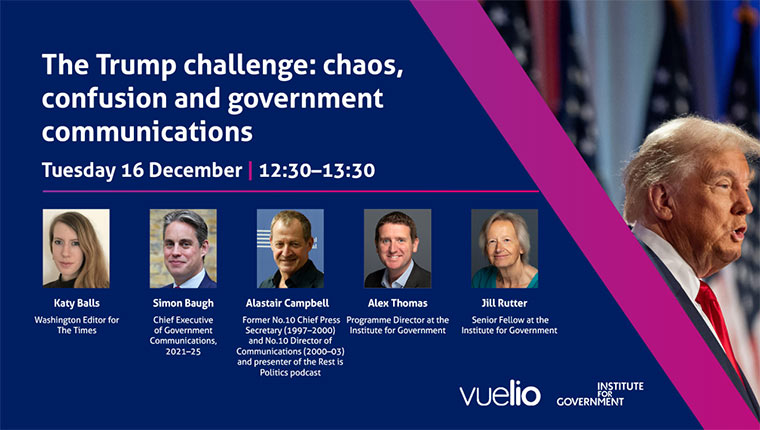
In my area of tech, which is computing and video games, there are audiences that really do care about events like those and will actively search out coverage. This creates a buzz and drives traffic, which helps us capitalise on the heightened attention. It can be expensive to spend a week out of the office though, so in the recent past I’ve been dependant on manufacturers paying for me to fly out to CES, which isn’t ideal as it then compromises my coverage somewhat as I have to spend a lot of time attending that manufacturer’s briefings and demos.

What ‘old’ tech do you miss the most?

As much as I love modern gaming, I do of course sometimes miss the simplicity and immediacy of retro games and the consoles I used to play them on. Those games of course are still available on handheld gaming PCs and mobiles/tablets, but those old chunky plastic consoles and huge gamepads are things that I miss.

On a similar theme, I also miss tech that was durable and did one thing really well, like those old dedicated MP3 players you used to get before the iPod started to dominate. They’d be indestructible, had batteries that lasted forever, and just did one thing really well without the distractions of social media and notifications.

I think people are also sick of renting and not owning their content these days. Platforms like Disney+ and Netflix taking content down that they produced because it’s more financially beneficial for them to do so. Even content you bought through online stores now becoming inaccessible. Also the idea that there are so many online services to get content – it’s now so fragmented that it’s hard to stay on top of everything without spending £80+ a month on subscriptions. Tech was supposed to make our lives better and more simple, but sometimes it just does the opposite.

For more on the impacts of AI on the media and comms industries, download our latest Vuelio reports ‘AI in beauty: How it equals risk – and opportunity – for the PR & comms industry’ and ‘When politicians talk about AI, is anyone listening? Innovation and regulation in the UK’.

Need help with monitoring your media coverage across print, digital, broadcast, and more? Check out Vuelio Media Monitoring.

AIinPR Breakfast Event

AI&PR Breakfast Event: AI’s impact on corporate communications

What impact will the integration of artificial intelligence have on the corporate communications industry? This was just one of the questions tackled at a recent AI&PR Breakfast Event, which covered the pros and cons of AI and whether human comms professionals need fear the embedding of this emerging technology.

The event featured a rich panel of industry experts including Plum’s head of communications Rajan Lakhani, PR and journalism technologist Samantha Deeks, and MaximumPC Magazine’s former editor-in-chief Guy Cocker, who shared insightful, practice-led outlooks on the future of corporate communications in an AI-driven world.

The world of corporate and media communications is fast-moving, with no two days, campaign releases, or media coverage quite the same. Each day is to be viewed with a new set of eyes and, in an AI-powered world, a new perspective as well.

When asked what developments they’ve seen in AI that have changed the communications industry, Guy highlighted a shift from eye-catching magazine content focussed on cost-saving for the customer, to AI-centred messaging made to bring value to the reader.

Samantha added that communications teams are at greater risk now than ever before in the mishandling of, or poor training around, AI in the workplace. Organisations run greater risk of citing misinformation or compromising on the contextual quality that only they possess if they rely on AI to automate workflow. There was also a great emphasis on the sentiment of empowering teams to learn how to interact and prompt AI tools to extract the most valuable information in response. ‘What you put in is what you get out,’ said Samantha.

Rajan emphasised his shift in priorities when identifying suitable candidates for his growing team, thanks to the implementation of AI in his team’s workflow. Rajan’s priorities when looking for a potential new member for his team are now less on administrative or writing skills. With the promise that AI can take these responsibilities on, he places a greater emphasis on thinking ability, creative problem-solving, and cognitive capability for new ideas and innovation in the industry.

As the conversation drew to a close, the panel were asked what they felt PR professionals needed to focus on. The resounding sentiment rang loud and clear: organisations need to empower their members to work as effectively as possible with the help of AI.

Organisations should encourage their staff to take courses in order to understand the fundamentals of AI. In essence, AI should be seen as a tool, not a threat.

For more on AI’s impact on the creative industries so far, download our Vuelio reports ‘AI in beauty equals risk – and opportunity – for the PR & comms industry‘ and ‘When politicians talk about AI, is anyone listening? Innovation and regulation in the UK‘. 

Finding and keeping an audience

How the media is winning back audiences in times of distrust

In times of distrust, how can the media win back and grow their audiences? And how can the PR industry help?

At this year’s Society of Editors Conference, Newsquest’s editorial development director Toby Granville, Reuters Institute for the Study of Journalism’s acting editor Mitali Mukherjee, 5 News editor Debbie Ramsay, and The Sun’s director of digital (editorial) Will Payne offered their insight and advice. Here’s what you need to know:

Understanding the audience

News outlets are more focused than ever on understanding who their audience is. This has been a focus for 5 News, whose audience is largely older, with an average age of 61. Debbie Ramsay explained the benefits:

‘The channel has been growing for the last six years and 5 News last year had its biggest audience for six years. Our focus is on growing the audience, keeping them, and telling the stories in the right way for that audience – guiding them through, not berating them or patronising them or criticising them in our tone’.

Audience at Society of Editors conference

Newsquest, which has over 250 news brands and 27 daily newspapers, has print readers at an average age of 65 to 70, as explained by Toby Granville. This drops to about 45 for the 120,000 paid digital subscribers they have. For all of them, the focus is on being a trusted local news outlet:

‘We’ve focused on better front pages, higher local story counts, and news that’s actually relevant to the older readers’.

The impact on PRs: Be attuned to who a publication’s audience is. Print titles and broadcast media usually have an older audience, whereas online is where the younger readers will be. News outlets won’t publish your press release or feature your expert unless they appeal directly to their intended audience.

How audiences are accessing the news

The ways in which audiences access the news has also shifted, as Mitali Mukherjee explained:

‘We have seen extremely high engagement for video. Platforms like TikTok are doing quite well for young audiences. Facebook is making a return and YouTube is very strong.’

She revealed that in a survey of 50 countries, a third of them are approaching the news via social media platforms. At 5 News, Debbie makes sure there is content on Facebook, Instagram, and TikTok every day.

The Sun has found success on YouTube:

‘YouTube is the one which it feels like it’s the most viable business model because it is a revenue share and they need your content,’ said Will Payne. ‘It’s definitely our most highly prioritised video platform, but then on TikTok we have 9.2 million followers. We use that to reach younger audiences and try to drive to hero products’.

The impact on PRs: Pitching to news outlets isn’t just about having interesting or relevant information – it also needs to be in the right format. With publishers increasingly using vertical video to reach and grow their audience, make sure that your contribution is going to work for that medium. Telling journalists that you have material which can work across a variety of platforms is more likely to get you media coverage. They will often produce the same piece of content in different formats e.g. for the paper, for the website, and for video.

An emphasis on local and the personal touch

Newsquest is building trust with its audience by emphasising that the organisation is part of the community, Toby shared. Local newsrooms are open, with between 50 and 55 across the country in town centres.

Mitali explained why local stories are resonating with readers:

‘The small local stories about how a bunch of young people or an entire community got together and saved a local park or built biodiversity back give people the affirmation that they can take action. These sort of stories really resonate and this is across countries and across newsrooms’.

Newsquest has also freed up time to spend on local stories and campaigns by hiring around 30 ‘AI assisted reporters’ to turn press releases into stories, leaving the rest of the newsroom able to get out and find original content.

At The Sun, the focus has been on putting journalists at the centre of the coverage and forming more of a personal relationship with the audience. Will said ‘we want people to see the personalities behind the content we’re producing, and we also see that this does give us a USP against mass-produced AI generated content, which will be more prolific in the coming months and years’.

The impact on PRs: A number of publishers are using AI to streamline their work and it’s likely more will follow suit, dealing with press releases in this manner. Make sure your press releases are clearer and more accurate than ever before.

The move towards a more personalised approach should make journalists more receptive to personal case studies and give PRs a better chance to make a connection.

Want more about vertical video, and how the media and comms industries are utilising AI? Check out Vuelio reports ‘TikTok journalism: The platform’s impact on news audiences‘ and ‘AI in beauty: How it equals risk – and opportunity – for the PR & comms industry‘. 

Media trends for April

Media trends: How to get UK press coverage in April

Want to spring into action and make the most of media opportunities at the start of the season? The ResponseSource Journalist Enquiry Service had a high percentage of requests interested in covering Spring during March.

Read on to find out what other topics proved popular last month and what you can do to help journalists with their content in April.

On the hunt for Easter info

The Easter weekend is fast approaching and has been a focus for journalists throughout March. Over 3% of the requests sent last month contained the word ‘Easter’ – a 19% increase compared to this time last year.

A large majority of the requests have been for Easter eggs and gift guide information. However, there has also been a number of enquiries looking for activities for the school holidays and travel destinations to jet off to. Both ‘activities’ and ‘holidays’ received around 2% of the total requests in March.

Going forward? While there is less than two weeks until Easter, journalists will continue to be looking for last minute products to review, so have these ready. Plus, expect more requests around ideas for days out during the two week break. If you’ve got a travel expert with comment,  they could get featured in The Sun Online, Daily Mail, or Sheerluxe.

The endless possibilities of Spring

Seasonal requests are always popular on the Journalist Enquiry Service and that was the case in March as ‘Spring’ appeared in over 5% of all requests. This is nearly double the amount that we received last year.

It could have been due to extra requests around the Spring Statement/budget as journalists at 5 News, The Times, and Daily Express all sent enquiries on this topic. However, there was a wide variety of areas covered mentioning Spring, like spring cleaning product reviews, must have travel gadgets for Spring break, and recipes and cocktails.

Going forward? Spring will remain a popular keyword on the service throughout April and we are likely to see more requests around beauty, fitness, fashion, food, drink, and healthy living. Journalists tend to look for expert comment to accompany these articles and you could get featured in outlets such as HELLO!, Yahoo! Life, Prima, PA Media, and The Telegraph.

Gardening requests in full bloom

With Spring now here, we have seen a big increase in the amount of gardening requests with just under 6% of the total in March being for ‘gardening’. This is a 34% rise from this time last year and 45% increase from last month.

Journalists at Ideal Home, Metro, Homes & Gardens, and woman & home all sent gardening requests last month. The majority of these were for expert comment on topics including pruning grape vines, the dos and don’ts of composting and how to grow blueberries.

Going forward? Gardening was the top performing keyword in April last year and is likely to be again this year. Expert advice is usually what journalists are in search of so if you have relevant experts, you could get featured in a consumer magazine or national press title.

Other opportunities for PRs in April and beyond

With the London Marathon taking place at the end of April (Sunday 27), expect to see requests around ‘running’ and looking for experts to give tips on taking up the sport or running longer distances/preparing for a marathon. This cropped up in nearly 2% of enquiries in April 2024.

2.5% of requests in April last year contained the word ‘outdoors’ as journalists looked to get information on activities and days out as the weather improves, and we would expect to see that again this year. Plus, journalists looking to get ahead with their content start asking for Father’s Day gift guide products and over 3% of the total requests last April were for this. If you have products ready to review, there is more chance of media coverage in national and consumer press.

For more about how the Journalist Enquiry Service can help you secure coverage in the media, check out this explainer.

Media trends for February

Media trends: How to get UK press coverage in February

Want to get media coverage in February? Despite being the shortest month of the year, there are still plenty of opportunities to get coverage throughout the month with Valentine’s gift ideas still in demand.

Find out what else journalists are after this month and what they were putting requests in for last month on the ResponseSource Journalist Enquiry Service.

AI back in focus

It’s been a topical issue for the last couple of years now and ‘AI’ has been cropping up on average each month in about 3% of enquiries. However, last month this increased to around 5% of the requests – likely due to the release of the new AI chatbot DeepSeek.

Journalists at IT Pro, The Next Web, The Daily Express, The Grocer, Vogue Business, and Schools Week all sent enquiries in January, looking for information and expert comment on how this new technology will, and currently is, impacting their respective sectors.

Going forward? There is a lot of noise right now about the cost of AI following DeepSeek entering the market. Many journalists will continue to cover this throughout February, likely looking for experts to give their views. If you have clients who cover this, or happen to be an expert yourself, have answers prepared, and you could get coverage in a major trade title or national press.

Which journalists are sending enquries

Winter travel ideas

Travel is usually pretty popular on the Journalist Enquiry Service and the category normally peaks in June. However, January has been a strong month for the category, and ‘travel’ has been a popular keyword. It appeared in 5.5% of the requests last month.

A lot of these enquiries were from journalists looking for travel trends for the year, but there have also been quite a few around Winter travel. This has included one for the world’s most beautiful ski chalet, skiing in Norway, and medium-haul destinations to escape the cold.

Going forward? The half term break for schools is fast approaching and we could see requests for last-minute family holiday breaks. Plus, we are already seeing enquiries about Spring and Summer destinations. Have your travel experts ready to provide comment and get featured in national press titles such as The Sunday Times, Metro, MailOnline, and The Independent.

What are journalists asking for?

Changing of the seasons

Many journalists, especially feature writers, are producing content two or three months in advance. That means despite it still being the middle of Winter, there were more requests in January containing the word ‘Spring’ (at just over 2%) than there were ‘Winter’ (2% exactly).
Some of these enquiries were around holidays and occasions, with just under 1% of the requests being for Mother’s Day and just over 1% being for Easter. Other Spring-related requests included tips to get your garden ready for spring, wellness retreats taking place in spring, and the best earbuds/headphones for the season.

Going forward? As the new season draws nearer, journalists’ requests around gardening, skincare and beauty, spring cleaning and home decor, and healthy living, will only increase. Journalists at consumer titles such as Top Sante, Good Homes, Stylist.co.uk, Take a Break, and Ideal Home all sent enquiries last month and are likely to again, so have information ready for them to use.

Other opportunities for PRs in February and beyond

Expect some last-minute requests for Valentine’s Day inspiration and presents, but attention will turn more towards Mother’s Day and Easter. Journalists tend to look for products to reviews or gift ideas, so have these ready.

The whole of February is LGBTQ+ History month and also National Heart Month as well, so if you have experts related to either of these, you could get media coverage this month. World Pizza Day (9 February) is coming up this weekend and Shrove Tuesday (4 March), also known as Pancake Day, is not far away. Journalists will likely be sending requests for interesting recipes or the best places to go, so have information and experts prepared.

For more about how the Journalist Enquiry Service can help you secure coverage in the media, check out this explainer

CEOs under pressure

CEOs in the news: What the era of increased accountability means for comms teams and their c-suites

Have a press-friendly chief exec to bolster your brand personality in the press? Telling the story of your business by aligning your company comms around members of your c-suite can be a smart strategy – but beware. Carefully constructed press releases form just part of the expanded conversation possible in today’s media landscape.

CEO-centred comms are a risky gambit in this era of call outs for bad behaviour, and criticism for connections with the wrong people or political factions.

Using data from Pulsar Trends and the ResponseSource Journalist Enquiry Service, we examine just how dangerous CEO controversies can be for comms teams tasked with protecting organisational reputation.

Trouble at the top means social media scrutiny

Chart showing conversation on CEO controversies on X

Tracking mentions of CEOs and chief executives with phrases including ‘controversy’, ‘disgraced’, and ‘cancelled’ shows a rise in conversation among the UK public on X since the start of 2020 – with spikes for specific stories of execs in trouble. Which stories got the most people talking and sharing?

US CEOs get the most attention from UK audiences

US-centred CEO stories gained the majority of interest from Britain-based users of X, with Musk’s take over of Twitter in October 2022 sparking the most social posting and sharing. Peaks also driven by news from overseas – OpenAI ousting CEO Sam Altman from his role (later rescinded) and the killing of UnitedHealthcare’s Brian Thompson. These stories eclipsed the large-scale UK-centred CEO scandals when it came to sharing on social media for Brits. So what did get their attention closer to home?

UK social sharing centred on stories that intersected with high-profile institutions and celebrity

Attention to UK-born stories went to the stepping down of NatWest CEO Alison Rose following a high-profile clash between the bank and Reform UK leader Nigel Farage, as well as the numerous controversies that fell into BBC CEO Tim Davie’s lap last year.

X post on Tim Davie

Harrod’s founder Mohammad Al-Fayed’s past impacted former exec Nigel Blow’s future, while events during Nick Read’s tenure at The Post Office continued to fuel furore on socials.

X post regarding Harrods

What they all have in common are connections to long-established institutions that come with prestige already attached – Coutts, Harrods, the Post Office, and the BBC.

X post regarding Nigel Farage

Could this be an element unique to the UK, with brands fully entrenched into our social fabric? The long history of these UK organisations come with unavoidable institutional weight – making any related human-wrought controversy yet more intriguing for the general public, ready to hold those in power to account.

It’s not just high-profile institutions that bring more attention on social media, however. Celebrity also helps. High-profile – and now also highly-controversial – author JK Rowling’s involvement in a CEO-related story heightened the spotlight on Rape Crisis Scotland CEO Sandy Brindley, who shared her experiences in a story for The Times in September 2024.

X post regarding JK Rowling

In comparison, the media spotlight on UK CEOs has dimmed – but why?

When examining coverage of UK ‘CEOs’ + ‘controversy’ in the media over the last few years, the data shows a decrease…

Is this cause for relief for comms teams stamping down CEO struggles behind the scenes? Don’t relax yet – business journalists and columnists have merely shifted their focus to include business-related political figures in the wake of the 2024 General Election. The Labour cabinet in particular has become prime fodder for right-leaning news outlets since its installation in July of 2024. Naturally, this has meant a slight downturn in UK CEOs being called out.

A catalyst for one peak in both news coverage and social conversation that featured a politician-CEO combination was former Secretary of State for Education Michelle Donelan’s clash with UK Research and Innovation chief exec Ottoline Leyser in October 2024:

Does the Third Sector buck the trend?

The UK public aren’t only interested in commercial brand CEO scandals that intersect with the glitter of celebrity or politics. Beyond US-born controversy, one thing that consistently engages the UK public is scandal concerning the Third Sector.

Stories that got reporters writing – and social users sharing – was the announcement of Shelter’s ‘divisive’ CEO Polly Neate CBE’s plans to step down; the resignation of Children in Need chair Rosie Millard regarding objections to grants for LGBT Youth Scotland (LGBTYS); and the firing of Embrace Child Victims of Crime (CVOC) chief exec Anne Campbell.

CEOs don’t have to be guilty of bad behaviour themselves to be the subject of negative reporting or social media speculation. Not-for-profit comms teams must be prepared for a comms crisis related to their c-suite by monitoring the mood among the public, and the press.

CEOs as a source of expertise and controversy for UK journalists

Highlighting the continuing media interest in CEOs and the c-suite were the almost 400 related enquiries submitted by journalist, broadcast, and influencer users of the Journalist Enquiry Service last year.

Which sections of the media are hungry for CEO stories? The majority of requests came from business-focused trade titles including Management Today, Business Age, and Verdict, but also national press outlets with business beats including The Times and PA Media. Many of these requests sought comment from CEOs on the big stories of that week’s news cycle… but others wanted comment on the actions of CEOs themselves – including high-profile marketing expert, and controversy-courter, Steven Bartlett. One such journo request:

‘The online lifestyle, fashion, and beauty magazine SheerLuxe has come under scrutiny for ‘hiring’ their first AI (artificial intelligence) employee as Fashion Lifestyle Editor, Reem.

‘However, business mogul and host of the Diary of a CEO podcast, Steven Bartlett, scrutinised critics of the marketing stunt in a LinkedIn post […] Does Bartlett actually mean what he says? Or is he just trying to go against the grain of the common opinion?’

The opinion of business leaders is still of great use to journalists who require quick expertise to back-up their reporting (impressive job titles still confer respect) but, as is spotlighted by the data above, they aren’t granted unquestioned authority anymore, and their missteps can be quickly mined for content.

UK social media users are ready to pick apart CEO scandals and extend the life of these stories – especially when a controversy intersects with established and ‘respectable’ institutions or well-known figures. While the majority of the media has shifted focus to politicians, this doesn’t mean CEOs are in the clear.

Increased demand for ethical business choices from the public, and journalists reporting with their interests in mind, means CEOs are now just as easy to target for criticism as for their expertise. ‘Higher-profile’ increasingly means ‘higher-risk’, and understanding the nuances of the conversation will be a vital part of the PR toolkit this year.

Find out how to monitor your organisation’s reputation in the press and on social media with Vuelio’s monitoring solutions