Alfie's Diary

Pet Blogger Spotlight: Rosemary Kind, Alfie’s Diary

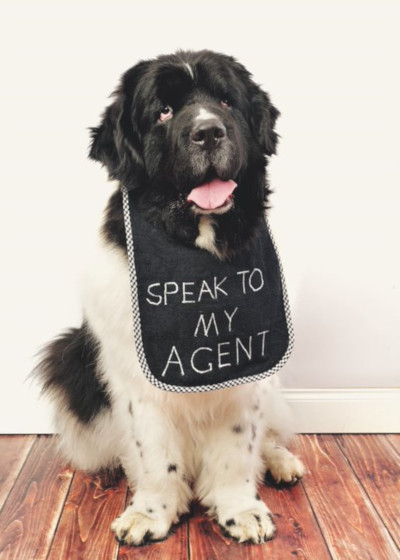
‘Dogs and cats are not like cans of beans. You don’t just take them off the shelf in the supermarket,’ says Rosemary Kind of her love of animals and blogging about them. Alfie’s Diary – written from the point of view of her canine collaborator Alfie – chronicles the adventures of her pets as well as their care. For Rosemary, the pet blogging community are a pretty good bunch, only slightly bonkers, here to help with getting the word out on how to care properly for the animal pals in your life.

We talk famous alpacas and keeping things authentic – also important: there are pictures of puppers being good boys on location with Rosemary (very important).

How did you get started with blogging about pets?
It all began as a way to discipline myself to write every day.

I’d left a ‘real’ job to become a full-time writer and was suddenly adrift from all the corporate structure, goals, to do lists, etc. It would have been all too easy to say I was a writer while achieving very little indeed. If I started a blog then not only would I write every day, but as we’d recently moved to live in Belgium for a short period, I could use it to keep the family posted on what we were up to.

The arrival of Alfie, as a ten-week-old puppy, into our lives gave me a fun way to approach things. Watching him looking at the world and reacting to all the new things around him just led to the obvious (to me) conclusion that I should be writing about the world through the eyes of my dog.

What’s your favourite thing to post about?
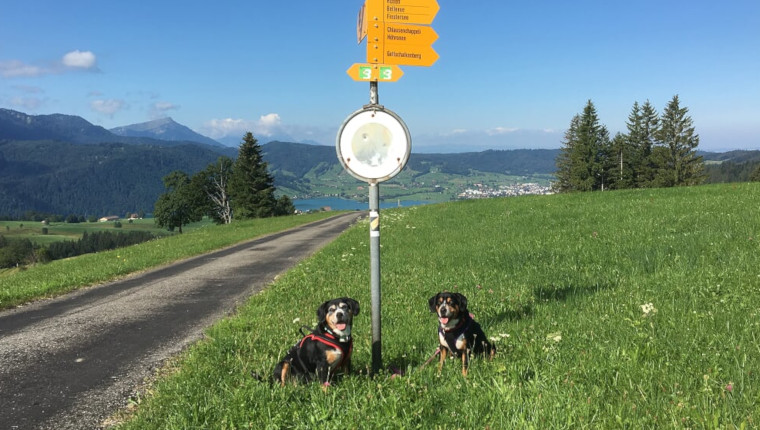
Definitely travelling. Wilma, my youngest dog, is my sidekick these days and travels almost everywhere with me. We also get to go to some pretty cool places, so get some good photo opportunities.

Alfie's Diary travel


What are the best things about the pet blogging community that other blogging sectors might not have?
From the bloggers I’ve talked to, we all care passionately about our animals. We’re probably all slightly bonkers too, but in a good way. It’s easy to like people who put the needs of their pets first; in my book, they are generally a pretty good bunch.

What are your thoughts on pets/animals becoming celebrities through blogging and featuring on social media?
I’ve stopped being surprised by who becomes famous and why. If it’s possible for humans to become famous just for being famous, then any cat or dog with that inclination should just go for it. One of my absolutely favourite Instagram accounts is Alfie the Alpaca in Adelaide – he seems none the worse for it and has a pretty good life compared to the average alpaca. It’s great to see owners combining their pet’s celebrity with including excellent advice on the animals. When it’s clear that the animal’s needs come first, that’s a good thing.

Is there something you would never feature/write about on your blog?
We won’t feature products we haven’t actually tested. If we recommend something to our readers it has to be because we’ve tried it and think it’s worth telling them about. It also has to be relevant to our blog.

Do you think it’s necessary to have pets of your own in order to blog about pets/animals?
I’ve written a crime novel with a number of murders, but I’ve not actually killed anyone. No, I don’t think having a pet would be necessary. I think you have to understand what you are writing about and if it’s issue-related you need to care about the issue, otherwise you come over as inauthentic. I suspect if you approached this from a ‘professional’ point of view, without an interest, then that would come over to the reader. Dogs and cats are not like cans of beans. You don’t just take them off the shelf in the supermarket. They are sentient beings and I think being on their wavelength makes a big difference in writing about them. I’m odd in a way as I write from their point of view. I can’t do that and be distant from how they think. It wouldn’t make a convincing read.

Very important question here – which are really better, cats or dogs?
Not better, just different. Cats suit some people’s lifestyles better and years ago I did have cats. Now, I’d go crazy if I didn’t have a dog. We have readers who have cats and I wouldn’t want to upset them. Having said that, we have a dog who thinks she’s a cat. I have never seen such a condescending look in a dog’s eyes as Shadow can give if she’s not happy about something. She makes me laugh.

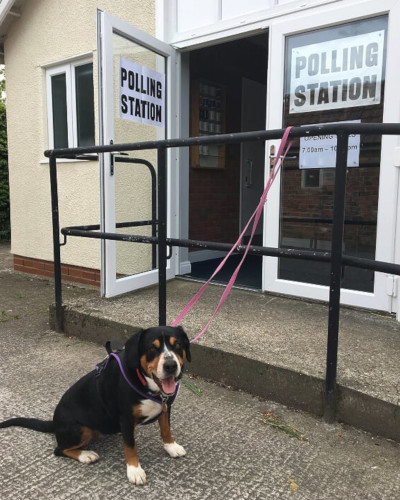
Alfie's Diary At The Polling Station

How do you work with PRs and brands – are review products and new launches useful?
Review products which are relevant are always welcome. I won’t change the food my dogs are on for the sake of a review, but I can gauge their reaction to it using it as a treat. Other things we happily test, as long as we can see it. I won’t take on a review that is obvious won’t add any value for readers.

We don’t just carry press releases which come in, unless there is a relevant angle. Too many press releases are adverts dressed up as news but without a newsworthy element.

We do like some of the infographics that come in, but again here question data and rule some out as being contrived. At the end of the day, we are interested in anything that will be of genuine interest to our readers.

For PRs looking to work with you and your blog, how would you prefer they approach you?
Always by email. Please bear in mind we can receive a lot of enquiries, so if we have not replied in five minutes that doesn’t mean it will be considered helpful to send us a follow up email. I have dogs to walk and other books to write as well.

What other blogs do you read?
I dip into blogs rather than reading them religiously. They are a great source of information on a whole range of subjects, not just pets but every area of life. There are very few answers that you can’t find on the internet these days.

Reach-the-right-influencers-with-the-Vuelio-media-database

A Question of Ethics

Keeping the influencer industry responsible

Despite growing pains and continuing flux, the influencer industry continues to expand into mainstream culture and creep its way further into marketing and PR budgets. According to a Markets and Markets report cited in the #FuturePRoof guide We’re All Influencers Now, the international influencer marketing sector is predicted to grow 30% by 2024 – that’s £4.5 billion to £18.4 billion.

Big money means big responsibility for an industry still catching up with the accountability that comes with success, and ethics and regulation is what many speakers at this year’s Influencer Marketing Show were advocating for.

Speakers across the breadth of agency, creator, brand and tech brought up the issue of how to keep the industry accountable and ethical. For influencer marketing guru Scott Guthrie, influencers themselves have a moral obligation, as well as a legal requirement, to do the right thing by their audience.

Some obviously poor choices from those making a living from social media were highlighted by Scott – the hijacking of California wildfire hashtags by some Instagram influencers being one particularly unfortunate example. That influencers should make more ethical choices was also urged by artist and activist Alice Skinner. Fully aware of the responsibility she has to the young girls who make up a large portion of her following, she works to stay true to them as well as her own values: ‘It’s hard, but I want to be able to live with myself. I’m learning not to work with brands that don’t align with what I make, that don’t align with my beliefs and ethics’.

Working with those brands that align with their values doesn’t just help influencers avoid a guilty conscience, it also helps with keeping that authentic voice necessary for holding on to an engaged following.

During the panel with Alice Skinner on re-defining influence, fellow creator Rob Eades mentioned the dwindling effectiveness of product review posts, an early mainstay of the industry that don’t work as well in a post-sponcon world. In Rob’s experience, ‘people see through that stuff now’. After missteps like the Kardashians using their influence to advertise weight-loss teas, followers are smarter and are less likely to engage with inauthentic brand alignment or unethical promotions (which the slimming tea controversy most definitely was).

But what of the brands and agencies that work with influencers? Industry professionals certainly don’t escape the blame. Being an ethical industry extends to finding influencers and high-profile voices that match with what’s being promoted – actress and vocal feminist Maisie Williams working with The Body Shop on its #ForeverAgainstAnimalTesting campaign being a good example of a natural fit. A bad example was Mystery Brand working with Jake Paul, whose young audience shouldn’t, ideally, be visiting gambling websites.

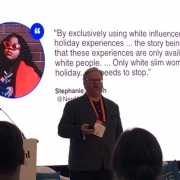
Agencies have a responsibility to choose the right influencers, and that includes making sure their choices and reach are diverse. Stephanie Yeboah (interviewed in Vuelio’s Women of Colour series), on noticing brands choosing to only work with white influencers, spoke up about it on Twitter and wrote a Metro piece that got a lot of attention in the industry. ‘Brands are actually trying’, said creator Adanna David during the panel with Alice and Rob, but they need to go beyond tokenism, ‘Sometimes I have been a token. But maybe it’s a sign that things are changing’.

Where individual sense and conscience checking won’t do it, future regulations on the influencer industry will. For Gary Csiszar, CEO and Founder of Post for Rent, speaking during a panel on creators and branded content at IMS, the future is going to bring restrictions: ‘Regulation will be more strict on influencer marketing – that’s what I’ve started to experience in different countries.’ It’s unavoidable, and bound to bring positive change, but self-regulation for individuals and companies working in the sphere is a good foundation. Asking: is this authentic? Is this ethical? Is this inclusive?

And not promoting gambling sites and slimming teas to children – that’s a given.

For more on ethics in influence and influencer marketing governance in public relations, sign up for our upcoming webinar ‘We’re all influencers now with Stephen Waddington, Sarah Waddington and Andrew Terry. The guide from FuturePRoof can be read here.

Psychreg

Mental Health Blogger Spotlight: Dennis Relojo-Howell, Psychreg

Dennis Relojo-Howell – AKA The World’s First Blog Psychologist – covers mental health, psychology and wellbeing over on his blog Psychreg. Starting as a directory of people interested in psychology back in 2014 (Psychreg being a portmanteau of  ‘psychologists’ and ‘registry’), the blog now provides resources for those who need them, as well as mental health-related stories and articles.

Dennis shares his thoughts on the growing awareness around mental health issues as well as the advantages of being a part of the blogging community when you happen to be an introvert.

How do you describe what you do to other people?
I’m a freelancer, a content creator – which is a millennial job. I work from home running the mental health website Psychreg. I also organise mental health events. Another aspect of my work is that I get invited to deliver lectures on mental health in different countries.

How much of a community is there around mental health bloggers?
As mental health is being pushed into the spotlight, I would imagine the community to be as vibrant as that of other sectors (such as marketing and politics). For instance, there are now events and awards dedicated solely for those within the mental health field. There is also a wide audience for mental health.

What’s the best thing about being a professional blogger (if you consider yourself to be one!)?
I consider myself to be a professional blogger because this is my full-time job. Prior to taking this role, I worked for a PR agency in London, and before that as a university lecturer (I taught psychology and sociology). One of the best things about being a blogger is I get to attend some free events and I also occasionally receive gifts. I am also a bit of an introvert so I love working on my own, at my own pace and style. I’m also honoured to have been dubbed the world’s first blog psychologist by a number of publications.

What does the future of blogging look like?
Promising. More and more people are now looking for independently-produced content – be it podcasts, videos, or blogs. Also, there’s a thriving community of bloggers who keep on thinking of fresh content to offer to their audience, so the blogging landscape will definitely continue to be more dynamic.

It seems like mental health is attracting more attention in society recently, why do you think that is?
I feel that this is because our attitude as a society has evolved. Although more needs to be done, we have already made significant progress in that there are now more people who can comfortably talk about their mental health issues. It also helps that there are high-profile celebrities and personalities who champion mental health.

Are businesses/employers doing enough to support the mental health of their staff?
I would say so. There are now programmes in place in some companies which are aimed to support staff in relation to their mental health and well-being. This is of course still a luxury, because you cannot expect all companies up and down the county to have such a programme.

What’s the best mental health initiative you’ve seen?
I would say the Neurodiversity Celebration Week. It was launched by the teenager Siena Castelon, an award-winning autism advocate. Her passion and commitment in raising awareness about autism is remarkable.

How do you work with PRs and brands?
I harness the power of social media to look for potential brands to collaborate with. For PR agencies, I still don’t know how it started but I receive press releases from different agencies on a daily basis. I publish most of these press releases on my blog.

What advice do you have for PRs looking to get in touch?
Feel free to send an email to blog creators. They are always on the hunt for content, so it is a win-win situation for bloggers and for your clients. I welcome content relating to mental health and well-being from PR agencies. You can find my contact details on my website.

What other blogs do you read?
For mental health blogs – I don’t read my competitors’ blogs! Aside from mental health, I am also interested in politics and social issues, so I regularly read spiked, Unherd, and Quillette.

Reach-the-right-influencers-with-the-Vuelio-media-database

Mike's Open Journal

Mental Health Blogger Spotlight: Mike Douglas, Mike’s Open Journal

Mike’s Open Journal originally started as an outlet for blogger Mike Douglas to write about his own experiences with mental health. It now features an archive of content on lifestyle, health, fitness, dating, and relationships alongside the useful information on mental wellness.

Mike tells us more about how blogging has helped him with his own mental health journey, how it’s attracting more attention in society, and some examples for how workplaces can support the mental health of their staff.

How do you describe what you do to other people?
I started to write about my experiences with mental health illness because I was in a particularly bad place with my mental health and needed a healthy outlet. At that time, I could not see a way out of the darkness or how I could continue.

Writing/blogging (and subsequently, podcasting) provided me with an opportunity to express my thoughts and feelings – something I have always struggled with. Though, as a dyslexic male, that may not be a surprise. Fortunately, I am now in a much better place and am delighted to be able to share my experience with mental health (illness and wellness) through the blog and share conversations with guests via the podcast.

Blogging has grown so much in the last five years or so. There is such a huge range of blogs you can follow. Just last year I discovered pet bloggers through Vuelio, so there is definitely something for everyone.

It is a great way to share your experience/thoughts with other people without the limitation of geography or transport.

How much of a community is there around mental health bloggers?
My experience is that there is an ever-growing number of us and creating your own community is increasingly easy to do. For the most part, mental health bloggers are very supportive and are great at signposting to information and relevant material.

Like in any community, there are times when people disagree, there are cliques and closed groups. However, this is true of any ‘real life’ community and isn’t something exclusive to us or blogging in general. I have found the mental health blogging community to be particularly accepting in that we all have our own views and experiences and there is often a very positive non-judgmental environment.

Linked to community, I am so very proud to mention the Mental Health Blog Awards which I founded in 2017. We have held two events focused on providing recognition, sharing resources/supportive tools and growing our own networks. The third annual event will be held in July 2020.

What’s the best thing about being a professional blogger (if you consider yourself to be one!)?
I do not consider myself a ‘professional blogger’, I think because of how I started. Blogging was a coping strategy for me and has grown into being a tool to share, connect, educate (others and myself) and signpost.

Last year I tried to keep to a weekly schedule, this year I have reverted back to posting when I want or need to. That works much more for me. Part of being a blogger is working out what schedule you want to keep to and if that is realistic and worthwhile.

The best thing for me is hearing from people who have found acceptance, recognition, or the confidence to seek support after reading one of my posts. It is a privilege to be able to support other people by sharing my story.

What does the future of blogging look like?
I believe blogging will continue to grow. We have already seen the platforms used expand and evolve. Business websites regularly have a ‘see our blog’ section, there are Instagram posts with captions longer than some ‘traditional blog’ posts.

That’s all before we talk about the expanding topics, subjects and fandoms.

It seems like mental health is attracting more attention in society recently, why do you think that is?
National campaigns like #TimeToTalk, #GetBritainTalking, World Mental Health Day and World Suicide Prevention Day (there are many more) have raised the public profile of mental health. There is now much more awareness of mental health, illnesses, symptoms and how people can be affected. Slowly people are also becoming aware of the support available.

Campaigns like Heads Together have seemingly provided people with permission to talk about mental health, which is great. It is however important to remember there are still many people who are unaware of how mental ill-health can affect someone and how to support them. Or that mental health is not just about illness, it is also about wellness. So we still need to be prompting these discussions and campaigning for better education (and services).

Are businesses/employers doing enough to support the mental health of their staff?
It depends where you work. Great examples I have seen include:
• Having a Mental Health First Aider
• Having signposting material to a local service – local Mind, Samaritans, wellbeing group(s)
• Including MH as part of staff inductions and training
• Providing opportunities for staff to suggest/feedback on staff wellbeing
• Having a WAP (Wellness Action Plan)
• Making sure staff actually take their lunch break
• Encouraging all staff to listen, support, signpost – you do not need to be an expert

What’s the best mental health initiative you’ve seen?
I am slightly biased as I now work at a mental health charity and have been part of the team developing our Ambassadors project, so I think that’s pretty awesome (easthantsmind.org).

Some of the other initiatives I think are great include #DumpTheScales, #AskTwice, #ItAffectsMe and #StopSuicide.

Each of the initiatives has a focus and clear message. They have also worked hard to make their campaigns relevant to everyone.

How do you work with PRs and brands? What advice do you have for PRs looking to get in touch?
Working with brands is something that often affects mental health bloggers less as many just want to share their story/experience. For me, I enjoy bringing mental health/wellbeing to new settings/environments. Some of the brands I have collaborated with were very much with that wellbeing approach in mind. Some examples would be: Go Ape, The Body Shop, Boston Tea Party and local Pride events.

Not every opportunity is relevant to me or to my audience. So it is important to remember and keep in mind the purpose of your blog and what you and/or a brand are bringing to a post. For example, The Body Shop collaboration was a great way for me to talk about relaxation and self-care. I didn’t cover other aspects of their stock because that is not an area I have particular knowledge or interest in. It’s identifying what works for your/your blog/the brand.

I have a brief media kit available on the website where you can find out a bit more about me. You can also drop me an email at [email protected].

What other blogs do you read?
In the last month I’ve been reading posts from vickyflipfloptravels.com, irunoffroad.wordpress.com, and lifeoflily.co.uk.

Reach-the-right-influencers-with-the-Vuelio-media-database

TwitterForBrands

Getting ready for launch – #TwitterForBrands

Gone are the days of launching your business, redesign, or new products purely in paper or in a TV spot. Brands have to launch on Twitter to take off, according to the platform’s director of business marketing Carlos Cantu, speaking on #TwitterForBrands at #MarTechFest 2019.  

Cantu came with the statistics to back up the importance of Twitter – citing that three in four people say that their Twitter community are the first people they look to for advice when wanting to learn more about a topic. And the immediacy of the response this social media channel can give isn’t the only advantage. Audience research has also shown that a 31% increase in memory encoding occurs when content is discovered in Twitter versus other online platforms, making it particularly sticky. Launch leaders (brands who are particularly good at this kind of thing) know the importance of using the platform to make things stick – another stat shared during the session was that launch leaders are 2.4 times more likely to use social listening (like Pulsar, which recently joined the Access Intelligence Group) as a guide for their strategies.

So how can the rest of us tap into Twitter as a tool when working on a launch? Research, timing, relevance, and reinforcement is key, advised Cantu. Start with finding the right audience for your product and message, and make sure to connect with what’s already happening. Coming into a conversation halfway is as weird online as in life, so tap into what’s going on in the space you’re entering. Pick the right time (the window for a successful launch has shortened, along with our attention spans) and be ready to adjust your strategy and collateral with all the real-time data at your disposal. And for better brand awareness? Cultural relevance. When Thea Lauryn Chippendale was mocked for her ASOS outfit on Tinder and went viral on Twitter, ASOS smartly invited her to model for the website.

Not every effort on Twitter is going to go viral, but reinforcement will keep the momentum going for your launch. Cantu’s advice was to go big on the reveal (another number to remember – 40% of launch budget was spent by the launch leaders on launch day and the days leading up to it), and then keep the conversation going with good creative that will resonate. Concise and clear copy, good visuals, and clear branding works when you don’t have a Tinder match nightmare to help tell your story.

In summary, it’s tweeting strategic and creative content that can get brands better results for their launches. With only 15% of brands interviewed in a recent Bain & Company study meeting their KPIs for social, there’s ample opportunity to make more use of Twitter as a launching pad. Did we mention we launched our new look this week, by the way?

ICCO logo

ICCO reveals 2019 Global Awards shortlist

The International Communications Consultancy Organisation (ICCO) has unveiled a shortlist of world-leading agencies, in-house teams, and professionals for its 2019 Global Awards.

The Global Awards celebrate outstanding of PR practice from across the world. This year, entries for the 27 awards came from more than 30 countries and were judged by an international panel of experts spanning four continents.

Hosted by broadcaster and journalist, Ayesha Hazarika MBE, the prestigious awards ceremony will be held on Tuesday, 3 December, at The Savoy, London, uniting PR professionals from a diverse range of cultures and countries for a night of networking and celebration.

Chair of Judges, Loretta Ahmed, CEO, Grayling Middle East: “Once again we’ve had a stellar set of entries into this year’s ICCO awards. Work from so many countries around the world showed the judges time and again the power of storytelling done well in many different contexts. Winning agencies are to be commended on the dedication to stand-out creativity and flawless execution, with campaign measurement in particular improving year on year.  In many categories the winners secured their award by a fraction of a point, proving the quality of all agencies shortlisted. So, to every agency that was shortlisted and made it to the screens of judges around the world we commend you!”

Best of luck so everyone shortlisted and we look forward to hearing who the winners are in December.

Find the full 2019 shortlist here.

The Design Sheppard

Interiors Blogger Spotlight: Stacey Sheppard, The Design Sheppard

Stacey Sheppard is the blogger behind The Design Sheppard – originally created in 2009 as a place to store the content Stacey gathered while researching for articles, and now a space for interior design inspiration and one of the top ten blogs in the sector.

We spoke to Stacey about blogging as a job, the importance of keeping things honest in the blogging industry, and being a self-appointed cork ambassador (it’s totally a thing – you’ll see).

How do you describe what you do to other people?
I always say I’m a freelance writer and blogger. I started my career as a staff journalist on a print publication and worked as a magazine editor for a number of years before I started my blog. I find that the response I get is less confused if I say freelance writer first. There are still a lot of people out there who don’t actually understand blogging and how it can be a job.

How much of a community is there around interiors bloggers?
For me, the community is the best part of being an interiors blogger. I don’t know what it is like in other niches but in interiors it is so open, welcoming and supportive. I’ve made lifelong friends through blogging, some of whom I’ve only actually met once or twice in real life but who I speak to every single day. I find the interiors blogging community to be really uplifting, inspiring and positive and that makes me proud to be part of it.

What’s the best thing about being a freelance writer and blogger?
The best thing about it is getting to do something that I love every single day. I wake up each morning excited for the day ahead, eager to get to work and see what opportunities will open up for me.

It’s also the freedom of being able to write about anything I’m interested in and sharing those things with my audience. I’ve come across so many talented people since I started blogging and I’ve had the pleasure of interviewing so many great designers. I love being able to give these people a platform to show off their skills.

What does the future of blogging look like?
This is a tough question and I think we’ve all been asking ourselves this recently. The rising popularity of Instagram has obviously sent waves through the blogosphere and left many of us wondering how our blogs can compete. However, we have to remember that we are in complete control of our blogs and no algorithm changes can destroy what we have built or reduce our visibility – that can’t be said for Instagram accounts. In fact, we’ve started to see lots of larger Instagram accounts now creating blogs alongside just to safeguard their future.

Another thing that is changing the industry is the tightening rules and regulations around advertising and brand partnerships. The ASA is continually bringing out new guidelines and regulations in an attempt to create transparency for our audiences and to ensure that they know when they are being advertised to. There was a lot of confusion at first but what is expected of us with regards to disclosure is becoming clearer. There are a lot of bloggers out there who aren’t playing by the rules though. I think it’s a dangerous game to play and in the long run it will be damaging. We gained our followings because people trusted us, they liked our authenticity and they believed that we had their best interests at heart. Those who don’t properly disclose their relationships with brands are disrespecting their readers and in the long run, this can only have a negative outcome.

How do you describe your style?
I hate being asked this question as I really don’t know the answer. Some bloggers have a really distinctive, recognisable style that is instantly identifiable. I don’t have this. I like industrial interiors, I like Scandinavian style, I like mid-century modern. My style also changes from room to room and from week to week. I tend to just go with whatever I’m into at the time. At the moment, that is biophilic design and incorporating lots of natural materials and greenery into my home.

What’s your favourite room in the house?
I’d probably say my bedroom. Now that my kids are mostly sleeping through the night, they aren’t invading that space so much. It’s starting to feel more and more like our own private sanctuary again. It still needs work before I’m totally happy with it, but plans are underway.

How long do you leave a redesign before wanting to do it again?
I’m actually not that big a fan of change. I like consistency at home and a feeling of stability and I couldn’t get that if I was constantly redesigning and redecorating. I tend to spend a really long time working out how I want a room to make me feel and how I want to use the space before making any changes. Then once I do it, I’m in it for the long haul because I’ve put the hours in working out a scheme that I will love. Of course, I make small changes every now again, like changing cushions, adding shelves and expanding my plant gang. But big changes are few and far between.

What’s the best collaboration you’ve worked on with an agency or brand?
I recently worked with The Colour Flooring Company who took me on a trip to Portugal to see the cork harvest and then to the production plant to see it being processed. I’ve loved cork as a material for many years and I’d always wanted to see the harvest. It was such a fun trip and I came back so full of enthusiasm for this remarkable material. I’ve pretty much appointed myself as a cork ambassador.

What advice do you have for PRs looking to get in touch?
Drop me an email and let’s talk.

What other blogs do you read?
Swoon Worthy, Apartment Number 4, Archie & The Rug, fabric of my life, Dear Designer’s Blog, Seasons in Colour, Hello Peagreen, Well I Guess This Is Growing Up, Boreal Abode, In Two Homes, The Interior Editor, Nordic Notes, grillo DESIGNS and new favourite Raspberry Flavoured Windows.

Reach-the-right-influencers-with-the-Vuelio-media-database

Influencer Marketing

Ethics, pivot tables and avoiding the Terminator: 6 lessons from the Influencer Marketing Show

The panelists at this year’s Influencer Marketing Show had a lot to say about the current state of the influencer industry and how it can be evolved going forward. Most of the advice revolved around brand values, making sure the influencers you’re working with aren’t ‘jokers’ (one speaker’s take on Paul brothers, Aaron and Jake) and keeping things creative.

We attended as many sessions as possible to bring you the best tips from the world of influencer marketing.

1. ‘Avoid the hype cycle’ of AI and ‘get your pivot tables out’
Christian Gladwell from M&C Saatchi Performance
When it comes to the ubiquitous yet amorphous promises of AI for the marketing and influencer industry, the advice during Christian Gladwell’s The Power of People & AI: How Human Supervision Can Drive True Performance was to work towards useful and meaningful automation in what he called the ‘grey industry’ of AI. Unregulated algorithms without human oversight could lead to a dark future (for example, a 2029 Los Angeles with The Terminator walking around kind of future, according to Christian). Christian’s advice for avoiding this – pivot tables galore, and making use of human analysts to find data anomalies as they happen, to keep AI going in the right direction. A direction that isn’t cyborg-Arnold-Schwarzenegger-shaped, ideally.

2. ‘Ignoring ethics is a ticking timebomb in terms of safety’
Scott Guthrie, strategic influencer marketing consultant
Self-regulation of the industry was a big theme with many of the speakers at this year’s event, and something mentioned by Scott Guthrie a few times during his quick rundown of recent influencer controversies in A Question of Ethics: Why Producing Ethical Content is the Right Thing To Do. Future fallout akin to vegan blogger Yovana Mendoza Ayres eating fish or all the things the Paul brothers (yup) have been doing over the last few years can be avoided if brands and agencies focus on ethics alongside exposure.

3. ‘The key to authentic influence is aligning with those key to your brand. Ask yourself the question – why do people follow them?’ 
Adanna David, creator
Authenticity is still what pays off for influencers, despite all the new technologies, virtual avatars and metrics being mooted at this year’s show. Adanna, speaking on the panel for Re-defining Influencer, highlighted an authentic connection as the true tool for producing the best work with brands and agencies. Pick the right influencer, whether macro or micro, for your campaign to make sure you’ll be hitting the right audience.

4. ‘Instagram is not going anywhere soon’
Rob Eades, creator
Also discussing how influence is taking so many different forms, Rob assured the audience that Instagram will continue to be important. Relevance metrics, rather than ad metrics, is his bag to measure the impact and quality of his own work. And it’s not just connecting with a following that makes Instagram important for influencers – artist and visual activist Alice Skinner said that every big job she’s had has been through her DMs (bigger brands she’s worked with include Benefit and Skinnydip), so get in touch.

5. ‘Remember you’re working with real people. It’s not a standardised media buy’
Lisa Targett, UK general manager at TRIBE
During the Creator and Branded Content: The Big Debate panel, Lisa Targett advocated for careful consideration of influencer follower counts and full transparency from both sides when choosing who to work with. Despite some widely-publicised missteps from a few influencers in recent years – bought followers, unethical content, misrepresentation of beliefs – the message from the panel was that influencers, real people, are worth working with and are invaluable when you find the right fit.

6. ‘Sometimes in social you just have to go to your boss and say, “we need to do this”. You have to be brave’
Rachel Kneen, social media lead at Just Eat
Not all successes can be measured or benchmarked – for Rachel, sometimes a good idea at the right time, from the right person, is good enough.

Find the right influencers and make your story matter with the Vuelio Influencer Database.

Ronan IMS

Vulnerability is a natural part of being a creative

With 89% of PR and communications experiencing issues with mental wellbeing, how can we implement change within our own organisations to find a healthier way of working through, and with, our vulnerabilities? Ronan Harrington of Alter Ego and Extinction Rebellion shared some of his ideas for change during ‘New Work Needs Inner Work’ at the Performance In Live, sister show to Influencer Marketing Live.

‘Overwhelmed is the default’, is how Ronan Harrington summed up work in the PR and marketing industry during his keynote speech. Looking out into an audience of communications professionals, Ronan proposed a new way of working based on emotional honesty and growing comfortable with uncertainty.

Marketers and PRs use stories and each of us brings aspects of our own story to our work, whether or not we mean to. Ronan told of childhood experiences being what drives him in his career and the importance of saying ‘Yes, and’ to each challenge that arises.

For him, vulnerability is a natural part of being a creative and shouldn’t be shied away from or hidden. Rerouting this scary aspect of work into honest and healthy office interactions is what will change experiences on this career path for the better.

Pretending traditional office hierarchies are normal ‘isn’t normal’
Hierarchy was pinpointed by Ronan as a ‘way of hiding’ for many workers in the world of PR and marketing – a way to avoid making decisions and staying in a space of self-doubt. A move to circular structures rather than a top-down approach was proposed – a formula Extinction Rebellion has adopted for its own organisation.

Whether the commuters in the audience agreed with the format some of the group’s recent protests took (Ronan himself acknowledged a few of the examples that may have impacted those in the room ‘build a culture where you can acknowledge mistakes and grow through them’), this structure is one that aims to encourage a less-toxic environment and accountability without blame.

Moving towards a ‘culture of wholeness and self-management’
The advocation of self-organisation and regular emotional check-ins with colleagues was met with an anonymous audience question about the importance of funding for these efforts – how can every company afford to bring in consultants for making a happier and mentally healthier environment for their employees, or therapists for regular check-ins during stressful projects?

Surveys and co-counselling within teams was recommended in response – small things that acknowledge the stresses and vulnerabilities of working in this creative sector and enable people to work through and perhaps be inspired by them.

Read practical advice on improving mental wellbeing in PR.

We're all influencers now

#FuturePRoof guide tackles influencer marketing governance for public relations

#FuturePRoof has published a guide that addresses the need for influencer marketing governance in public relations, with clear guidance for practitioners and influencers. 

According to Markets & Markets the global influencer market is currently estimated to £4.5 billion in 2019.

The #FuturePRoof guide aims to give public relations a voice around the critical area of governance for influencer marketing. It’s a challenging area of practice that sits between marketing and public relations, and earned and paid media.

Click here to read the guide: We’re all influencers now. 

Sarah Waddington, founder and editor of #FuturePRoof said: ‘The #FuturePRoof guide highlights best practice for brands, agencies and influencers. Everyone involved in a campaign has a responsibility to adhere to relevant advertising and media law’.

In the UK influencer campaigns are governed by existing Advertising Standards Authority (ASA) and Competition and Markets Authority (CMA) laws. Chartered Institute or Public Relations (CIPR) and Public Relations and Communications Association (PRCA) members are also covered by their own codes of conduct.

Francis Ingham, Director General of the PRCA said: ‘Influencer marketing is a burgeoning area of our practice, but the number of cases brought by the ASA and CMA proves that too many influencers and practitioners are falling foul of the standards we expect. All PR professionals working with influencers have an ethical duty to ensure they – and those they work with – comply with the law. The PRCA Code of Conduct compels professionals to deal honestly with the public – that includes being transparent over any commercial agreements with third parties. Failure to uphold these standards damages trust in our industry.’

The #FuturePRoof guide characterises the market, includes applicable media law and guidance from advertising, marketing and public relations. It covers guidance for campaigns where no money is exchanged, gifts in kind such as accommodation or travel, and financial payment.

The tension between earned and paid campaigns isn’t only a challenge for marketing and public relations practitioners, it has also led to influencers breaching advertising and trading standards law.

#FuturePRoof says that there is a growing need and opportunity for formal representation for influencers. What’s clear from the guide is that PR is in the best position to take ownership of influencer marketing, giving it both structure and clear standards for the benefit of business, influencers and the public.

Scott Guthrie, independent influencer marketing consultant and co-author of the guide, said: ‘The public relations industry has been slow to offer leadership on influencer marketing to practitioners and influencers. We’ve been here before with search engine optimisation (SEO), social media, and content marketing. It’s important that PR doesn’t miss out again’.

The guide has been written by Scott Guthrie, and independent influencer marketing consultant, and Stephen Waddington, managing director, Metia, and Visiting Professor, Newcastle University.

It includes contributions from Rupa Shah, Founder and Director of Hashtag Ad Consulting; Andrew Terry, Partner and Head of Intellectual Property & Media, Eversheds Sutherland; and Vuelio’s Jake O’Neill.

Vuelio is delighted to support the publication and will be hosting an exclusive webinar with Sarah Waddington, Stephen Waddington and Andrew Terry on 7 November. It is free to sign up, and if you can’t join us live a recording will be sent to all registrants after. Register here

PR difficult conversations with journalists

How to manage difficult conversations with journalists

A guest post written by Jodie Brazier, Comms Consultant at Topline Comms

Promised you’d get something over to a journalist before their deadline but can’t? Need to ask a contact to pull an article about a client? Conversations like these are best avoided, but sometimes you don’t have a choice. Jodie Brazier from Topline Comms shares some tips to help prevent awkward moments before they happen, and how to approach these conversations when you can’t.

Conversations with journalists are a daily occurrence in my work at Topline Comms – I work on the STEM team and I’m lucky enough to deal with loads of amazing science and engineering journalists. One of my favourite parts of the job is sharing exciting new stories from clients with them, but not every conversation with a journalist is a smooth one.

Here are some tips on how to avoid difficult journalist conversations.

What to do if you can’t meet a journalist’s deadline:

To prevent this from happening:

  • Always check with your client that they are happy to commit to a deadline before you confirm it with a journalist
  • Be realistic. It’s much better to be upfront and say you won’t be able to meet the deadline and negotiate an extension than to commit to something which you know you’ll be unlikely to fulfil and leave the journalist hanging

What to do if it still happens:

  • Let the journalist know as soon as possible. The sooner you tell them (especially if it’s for a print publication) the more time they have to find something to fill the vacant space
  • Be honest and apologetic. Don’t try to make up an elaborate excuse; if the content is stuck in approvals, let them know that and make it clear that you know it’s an issue
  • Have an idea of when it will be ready. It’s likely the first thing a journalist will want to know once you’ve told them it won’t be ready in time for their deadline

If you need to pull an article at the last minute:

To prevent this happening:

  • Pulling content is a big no-no and a PR nightmare, so prevention is vital!
  • Make sure that all content is signed off by your client (and by all the key client stakeholders that need to see it) before it goes to the journalist. Or, if it’s an interview, be very clear with your spokesperson that they shouldn’t say anything that they wouldn’t want to see published

What to do if it still happens:

  • Unfortunately, sometimes there are circumstances that are beyond your control. It’s best to let the journalist know asap so they can arrange something to fill the space
  • You could also offer the journalist another story they could use instead
  • Be honest and tell them why the article is being withdrawn. Understanding the reasoning will make getting the bad news a bit more bearable

All in all, when it comes to breaking bad news to journalists, clear and frequent communication is key. Keep them informed of content status and if there are any issues, notify them as soon as possible. Think about if someone was to break this news to you, how best would you want to be told?

Build relationships with journalists in your sector – find them with the Vuelio Media Database and find out what they need with the Journalist Enquiry Service.

Vuelio Product Update – October

We are constantly improving Vuelio for our clients, this month we’ve used machine learning to enhance journalist profiles.

Top topics displayed on journalist profiles

Knowing what a journalist has recently written about can help you to decide who is most likely to cover your story.

To enable you to better select media contacts for your campaigns, we’ve added the top 10 topics, names and places journalists have covered so far this year (2019) on their profiles in the Vuelio Media Database.

As an online monitoring provider, we already scan millions of articles from across the web to deliver your media coverage. We’ve used this data to build a machine learning algorithm that can identify if a word/phrase – also known as an ‘entity’ – falls into one of three categories: a name of a person or organisation, a place or a topic. This process is called ‘Named Entity Extraction’. It then collates this information and counts the number of mentions for each word, which is displayed on a contact profile.


We will continue to use this technology to improve how you search for information in Vuelio and it will contribute to other innovations. Watch this space.

influencer marketing and the law

Influencer marketing and the law

Influencer marketing is an industry worth today some £4.5bn, expected to reach £18.4bn by 2024. It has grown fast, driven by an exponential take up of social media and explosion in online publishing across multiple channels.

From Facebook to Twitter, YouTube, Instagram, TikTok and Medium, we’re in an age where seemingly anyone can be an influencer – whether an 18-year-old producing makeup tutorials in their bedroom or the 98-year-old Iris Apfel who was signed this year to IMG.

Inextricably linked to the rise of the internet and social media, influencer marketing is built on processes and ways of working that are themselves relatively new. We’re at the birth of an industry where influencers, from bloggers and vloggers to podcasters and Instagrammers, and the PRs, brands and marketers collaborating with them are still working out the rules and determining best practice.

To help you understand your responsibilities and how you can comply with the law, Vuelio and the CMA have put together an exclusive guide: Influencer Marketing and the Law, which outlines best practice for influencers, PRs and marketers.

It is full of practical guidance around consumer protection law, terms of contract, social media posts and disclosure tools, and can improve how you approach brand partnerships and help you to achieve best practice.

We’re also indebted to John Adams from Dad Blog UK, the guys at Daddy & Dad, Kate Everall from LesBeMums, Hayley Hall, Elle Linton from Keep it simpElle and Jo Middleton from Slummy Single Mummy, who have each contributed their own experiences of disclosure and compliance.

You can download the white paper here.

SocialBookshelves.com

Literature blog spotlight: Dane Cobain, SocialBookshelves.com

Dane Cobain is the author of SocialBookshelves.com, a top 10 UK Literature Blog. A record of all the books Dane reads, SocialBookshelves.com covers every genre and each review is the same number of words as the number of pages in the book.

We spoke to Dane about the book community online, the future of blogging, his favourite new authors and how he likes to work with PRs.  

How do you describe what you do to other people?
This is a great question because I do quite a lot and different people know me for different things. For example, in my local open mic scene, I’m known as a singer/songwriter. First and foremost, I consider myself to be a writer, and so I tell people that I write books and blog posts for a living. Sometimes I’m writing for myself and sometimes I’m being paid to write for other people. So while I am a blogger, that’s not the only thing that I do. I wear a lot of hats!

How much of a community is there around literary bloggers?
For me, I think that it’s more that there’s an overall ‘bookish’ community. Most of the activity takes place on social networking platforms, so there’s a thriving ‘Bookstagram’ community and I myself make ‘BookTube’ videos and take part in the community there. Book Twitter is also thriving but I tend to avoid it as there can be a lot of negativity and there’s a tendency for people to go on witch hunts. At least from what I’ve seen of people talking about it on BookTube, even the people who take part in Book Twitter recognise that it’s kind of toxic at times, although it does of course have plenty of plus sides too. For bloggers, there might not necessarily be a community around blogging, but they’ll typically take part on another platform. For example, perhaps their blog also has a Bookstagram account and they drive traffic and engagement to their blog through that.

What’s the best thing about being a professional blogger?
I consider myself to be a professional writer, of which blogging probably makes up somewhere between 30-50% of my work. My own personal blogs etc. do bring in some income, but only a small proportion. But they do allow me to charge a premium for my services when I write blogs for other people. I’d have to say that the best thing is that I have a flexible job where I’m my own boss, I control my own destiny and I’m doing what I love. It feels as though everything is aligned, so whether I’m writing for myself or I’m writing for a client, I’m pushing my career in the right direction.

What does the future of blogging look like?
This is another good question and it’s a tough one to answer. I suppose that arguably the most important trend will be the diversification of the blogosphere. What I mean by that is that people of all walks of life and with all sorts of different interests will continue to be attracted to blogging, while new platforms will keep coming along to help power those blogs. Other than that, I don’t think anyone can really know what the future of blogging will look like.

What’s your favourite book of all time?
Every time I’m asked this question, I say that it’s Northern Lights by Philip Pullman. That’s because it’s the book that made me fall in love with reading in the first place.

If you could only read in one genre ever again, which one would you choose?
That’s a tricky one because I read across pretty much every genre. I’d probably have to go for the nebulous genre of ‘modern classics’.

Which new author should we be aware of?
How long have you got? I read quite a lot of indie authors and there are some fantastic up-and-coming writers who have far fewer readers than they deserve. One of my favourites at the moment is an author called Charles Heathcote, who’s written the Our Doris series. They’re basically humorous novels following an old northern couple called Doris and ‘Arold a little bit in the vein of Keeping Up Appearances. I very rarely actually laugh out loud when I read a book, but I did with the Doris books.

How do you work with PRs and brands?
I have a PR details page on my site and I’m listed on various media databases. I read all of the emails that I receive but I get so many pitches that I don’t reply to unless I’m actually interested, and these days I probably only accept maybe 2% of pitches. But I’m up for all sorts of things, from basic book reviews to author interviews, giveaways etc. I’ve also been lucky enough to go on some press trips including to York for York Literature Festival and to Latvia on behalf of the British Council to spread the word about Latvian Literature ahead of London Book Fair.

What advice do you have for PRs looking to get in touch?
The best thing to do is to email me. Bear in mind that I get a lot of requests, too. In fact, unless a book is super relevant to my interests then there’s not much chance that I’ll read it, so it helps to get a feel for the kind of stuff I like. It can also help if there’s something above and beyond just a book on the line – for example, I still have fond memories of a PR from several years ago who sent me a hot water bottle to go with the book so I could get cosy while reading it.

What other blogs do you read?
I actually don’t tend to read many blogs myself, but I follow a lot of people on Goodreads and watch a lot of BookTube channels. In fact, I think quite a lot of people who follow my blog actually mostly get updates from my Goodreads account, because I cross-post all of my reviews both there and on Amazon.

Reach-the-right-influencers-with-the-Vuelio-media-database

PRCA

2020 PR and Communications Council: elections are open

The PRCA has announced that elections are open for the 2020 PR and Communications Council.

The PR and Communications Council provides a formal mechanism for the industry’s most senior practitioners to consult on the key issues impacting PR and communications. The Council – which acts as a think-tank for the industry – informs the PRCA’s strategic priorities and delivers best-practice guidance for professionals.

Elections are open to all PRCA Members, including those who have sat on the council previously. Members are eligible to nominate themselves, as well as other practitioners.

Elections will close October 30th, 2019.

Following the election, a new Chair and Vice Chair will also be chosen. Please inform Isobel Arrowsmith if you’re interested in nominating yourself for Chair/Vice-Chair, and submit a manifesto detailing your plans for the Council (no more than 200 words).

Amanda Coleman FPRCA, head of corporate communications at Greater Manchester Police, and current Chair of the PR and Communications Council, said: ‘I have enjoyed every minute as Chair of the PRCA Council this year. It has given me an opportunity to discuss the PR and communication issues of the day and the future with fellow practitioners from across the industry. It has been personally eye opening and very rewarding to see both the similarities and the differences in what we all deliver.”

To nominate yourself for the 2020 PR and Communications Council please email Isobel Arrowsmith at [email protected].

No deal Brexit

PR Industry prepares for no deal Brexit

Both the PRCA and CIPR have been awarded grants from the Government’s Business Readiness Fund to help the PR industry prepare for the potential of a no deal Brexit.

The PRCA plans to use its grant to deliver a programme of events and resources before the current Brexit deadline, 31 October. It will include legal guidance to ensure PR professionals remain compliant with the law after the UK’s exit.

Renna Markson, engagement director at the PRCA, said: ‘The prospect of a No Deal Brexit presents Public Relations businesses with an extensive list of logistical challenges. These include the management of personal data across borders to issues facing EU nationals employed by UK agencies. The PRCA will deliver practical information in a clear and digestible format to ensure the industry is as prepared as possible by October 31st.’

The CIPR will use its grant to launch a series of video shorts advising businesses on communicating effectively in advance of a no deal Brexit. Designed for a range of small businesses, the videos will feature PRs providing advice on general preparation related to comms activities, covering specific sectors such as Transport, Health and Construction as well as small and medium-sized PR agencies.

Alastair McCapra, chief executive of the CIPR said: ‘Most businesses in the UK are SMEs and many have not yet prepared for a no deal Brexit. How they communicate with their stakeholders in the final days before we leave the EU may be crucial to their future success. Our role at the CIPR is to help SMEs communicate effectively in these uncertain times; these videos will provide some certainty.’

The CIPR videos are being developed and delivered by Launch PR. They will be shared in paid promotion campaigns on social media between 16 October and 31 October.

Further information on the PRCA’s programme will be announced shortly.

Mental health 2019

3 ways to improve mental wellbeing in PR

Last week, to coincide with World Mental Health Day, the PRCA and Opinium published research into mental health in our industry. The study found that 89% of PR and comms practitioners have struggled with their mental wellbeing and that overall levels of wellbeing in PR are lower than the UK average.

There are many ways to contribute to better mental health in the workplace, from buddy systems and mental health first aiders to no-evening-email policies and encouraging digital switch offs.

These generally focus on two of the biggest problem areas: not being able to open up, which ultimately leads to more pressure and stress, and the stress of workload creating a bad work/life balance.

The PRCA and Opinium research, Opening the Conversation: Mental Wellbeing in Public Relations, helps to define these main areas with three takeaways for employers to help their employees thrive:

  1. Recognising the impact of workload on mental health and introducing effective workload management techniques
  2. Offer mental wellbeing initiatives that enhance mental wellbeing and encourage their usage
  3. Embrace mental wellbeing throughout the whole organisation

All three foster company cultures that promote positive mental wellbeing and help to create a space where employees and colleagues feel comfortable to talk about their mental health.

What is clear is that more needs to be done to help improve mental health in the industry and give it a bigger focus. Studies like this help to shine a light on issues and provide practical advice but ultimately, it’s up to the agencies and in-house teams to adopt these for the benefit of all.

Victoria Del Rico relevance LA

New York, London, Los Angeles: Relevance International expands its global offering

Relevance International has opened its third office in Los Angeles, California. The new location is the third for the leading real estate, hospitality and luxury goods PR agency, with offices also in New York and London.  

The new office is strategically located between West Hollywood and Beverly Hills and will be led by director Victoria Del Rico. Del Rico is an experienced lifestyle PR specialist whose previous work includes press and social media campaigns for brands such a Piero Lissoni Associati, Acqua di Parma, Verono Homes and The Four Seasons in Florence.

Del Rico is fluent in Spanish and Italian, which brings the agency’s spoken languages up to seven, and specializes in foreign luxury companies looking to enter the US market.

Suzanne Rosnowski, founder and CEO of Relevance International, said: ‘With an undeniable synergy between the New York, London and Los Angeles markets, opening an office on the west coast has been an integral part of the global vision from the start.

‘As our client list has expanded to include projects and companies in the region, being on the ground in LA was a natural next step to further establish Relevance International as a premier global agency spanning reach into even more time zones – because media never sleeps.’

Consistently ranked in the Observer’s PR Power List as one of New York’s Top Specialty PR Agencies, Relevance International has a unique combination of boutique sensibility and international reach. The LA opening also marks the second anniversary of the UK office, which is now headed up by Fiona Harris.

It’s clear Relevance International is looking to continue with its current momentum, Rosnowski said: ‘Next, we’ll be exploring opportunities in the east – perhaps fairly far east.’

PRCA

9 out 10 practitioners struggle with mental wellbeing

The PRCA and Opinium has conducted the industry’s largest piece of research on mental health, which has found that 89% of PR and communications practitioners have struggled with their mental wellbeing.

Launched today, on World Mental Health Day, Opening the Conversation: Mental Wellbeing in Public Relations highlights the pressures facing PR practitioners and that overall levels of wellbeing in PR are lower than the UK average.

The report also reveals that 31% of PR professionals say they find their job very stressful and 59% says this stress is caused by their workload.

The report reflects the findings of this year’s Mental Wellbeing Audit, which gathered the views of more than 400 practitioners. The Audit incorporates The Warwick-Edinburgh Mental Wellbeing Scale, which is recognised as a best practice mechanism for gathering data on mental health and wellbeing.

Francis Ingham, Director General of the PRCA said: ‘The time for our industry to take action on mental health is now. And this is the latest in the PRCA’s concerted effort to do just that. While it’s encouraging to see more practitioners discussing mental health with colleagues, far too many of our colleagues are still suffering. For too long, our industry has tip-toed around this issue but we now have an opportunity to take action and create meaningful change. Attitudes are changing. Conversations are starting. Let’s now enact the recommendations of this report to create tangible change for the future of our workforce.’

If you would like to get involved in the PRCA’s campaigning work on mental health, please contact [email protected].


Marcus Jaye

Men’s fashion spotlight: Marcus Jaye, The Chic Geek

Marcus Jaye is The Chic Geek, cult fashion blogging sensation and author of Fashion W*nkers, a new book celebrating fashion passion. For Marcus, the title is a badge of honour and the book covers the dos and don’ts of making your way in the confusing world of style.

We spoke to Marcus about his book, sustainability in the fashion world and how he likes to work with agencies and brands.

Note: surprisingly, this post contains swear words.

How do you describe what you do to other people?
I’m a men’s style blogger under the guise of my alter ego, The Chic Geek. He’s got red hair and glasses, a bit like me, but is much better looking and funnier.

Can you tell us about your book?
My new book, ‘Fashion Wankers – It Takes One To Know One’, launches at the end of October.

Published by Ammonite, the idea is, in the age of Tom Ford’s ‘Fucking Fabulous’, ‘Eggslut’ and ‘Bollocks To Brexit’, the Fashion Wanker is the new fashionista. The truly stylish are the first to poke fun at themselves. It’s all about confidence and being able to laugh at yourself. It’s also a very British thing and what makes us leaders in fashion.

How did the book come about, did you pitch it or were you approached?
I pitched it. I had a previous book in 2011, but I wanted to write something new. This new book is for both sexes and looks at all the different contemporary Fashion Wankers there are and how you can be a better one. Being a fashion wanker is a good thing; a style badge of honour. I wanted to do something that was great for gifting and would put a smile on people’s faces. The world doesn’t need any more boring books.

Fashion Wankers

What was the best part of bringing the book together?
Trying to squeeze all my silly and funny fashion sayings in and celebrating the ridiculousness of fashion, the reason I love it so much.

How important is social media to modern bloggers?
It’s important because it’s your voice. It’s also your ears and eyes to see what is going on in the world. The only negative is the obsession with numbers and vanity side of it.

How significant is waste and sustainability in the fashion world?
Fashion and sustainability are never going to be fully compatible, but there are many things to be done to reduce waste and close the loop on fashion waste and things that are no longer desired. People, brands and companies are making the right noises, but, like with everything, it will come down to the economics.

Marcus JayeWhat’s your favourite item of clothing?
Ooh, that’s a tough one. I bob along on the fashion ocean and am always open to try new things. COS just gave me a trouser/half kilt combo, and, while I was slightly out of my comfort zone, I liked it.

If you had to give one piece of style advice, what would it be?
Don’t overthink it. Ask somebody who you trust and admire for advice. Sometimes it is about stopping wearing something – looking at you skinny jeans – rather than buying something new.

How do you work with brands and PRs?
I want to hear about everything. I particularly like things that are new and never been done before, especially in grooming. You can’t be rigid in this business. What I like/dislike today will be different this time next year. That’s what makes fashion and style exciting and exhausting…

What’s the best collaboration you’ve worked on with an agency or brand?
I really enjoy being able to come up with original concepts and ideas. The Chic Geek is over 10 years old now and I’ve done many collaborations over that time. The best ones are the ones which challenge you and start with a really strong idea. It helps if it’s fun too.

What other blogs do you read?
The men’s community is very supportive and we all see each other at events and launches. I like the ones who have a point of view and opinion and really say something (even if I disagree with it!).

Reach-the-right-influencers-with-the-Vuelio-media-database