Greggs sausage roll

Five Things You Shouldn’t Have Missed – 17 November 2017

This week’s Five Things You Shouldn’t Have Missed includes Greggs’ sausage roll, Josh Rivers being sacked by Gay Times, Twitter’s verification ticks, Russian troll farms and ONLY ONE WEEK TO GO UNTIL THE VUELIO BLOG AWARDS!


1. Greggs and the sausage roll

Sausage rolls greggs
Greggs has apologised this week after posting an image of the three wise men gathered round a manger containing a sausage roll, rather than Jesus Christ. The image, which sparked outrage among Christians online, was made to promote a £24 advent calendar from the bakery, which has a different voucher to spend in store behind each day’s window. While the firm has apologised for causing offence, the story has garnered a lot of coverage for Greggs and its advent calendar, perhaps suggesting there is no such thing as bad publicity.


2. Josh Rivers fired from Gay Times

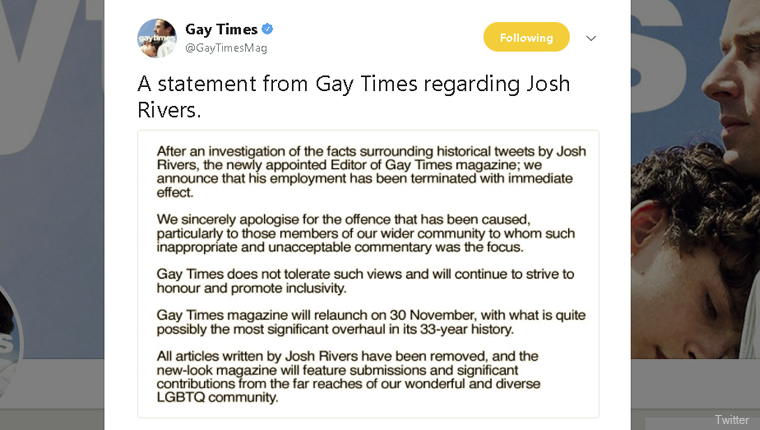
Josh Rivers fired

An investigation by BuzzFeed into Josh Rivers, who was recently appointed editor at Gay Times, found dozens of offensive tweets sent by Rivers between 2010 and 2015. They included ableist, racist, transphobic, anti-Semitic and misogynistic comments, and BuzzFeed read them all to Rivers in an interview. Rivers was shocked and appalled at his own tweets, saying he was a ‘lost’ and ‘angry’ person when he wrote the remarks.

After initially suspending Rivers to investigate, Gay Times – which had claimed Rivers’ appointment would best serve the magazine’s diverse and culturally inquisitive audience – fired Rivers yesterday. It has also removed all of Rivers’ articles from the site.


3. Twitter strips verification from alt-right

Twitter verified blue tick

The Twitter blue tick, which was once the mark of a celebrity mysteriously hand-picked by Twitter, has in recent times become more accessible – with anyone able to achieve verification for meeting a few simple criteria. But now Twitter has changed its rules and removed the blue-tick from some high-profile far right and alt right users. American white supremacist Richard Spencer and English Defence League founder Tommy Robinson are two such figures to lose their verified status.

Twitter acknowledged that the system, which was supposed authenticate and identify a voice in an age of FAKE NEWS, has recently been seen as Twitter endorsing certain figures that it in no way intended. It is currently working on a new system for verification.


4. Government urged to investigate Russian ‘troll farms’

Russia

New research has suggesting that Russian troll farms – allegedly social media bot accounts that focus on a particular topic to influence it – may have been active during Brexit. While the actual numbers of accounts are low, and the genuine power of these accounts and methods questionable, Theresa May has announced that the Intelligence and Security Committee will re-form and investigate imminently.

Russia’s role in Western democracy was also attacked by Theresa May this week at the Lord Mayor’s Banquet. She accused Russia of direct meddling and weaponizing information. The Russian Foreign Ministry hit back, bizarrely hoping Theresa May will one day drink Crimean Massandra wine.


5. ONE WEEK TO GO – VUELIO BLOG AWARDS

2017 awards for bloggers

The third annual Vuelio Blog Awards takes places in one week’s time! All tickets have been sent out, the goodies are being prepared for the goodie bags and we’re getting ready for the greatest night of the year!

Taking place at the Bloomsbury Big Top on 24 November, the Vuelio Blog Awards will celebrate 15 outstanding winners on a night when hundreds of bloggers come together, along with PR and communications professionals, for fun, food and frolics.
What did we miss? Let us know in the comments below! 

Russia

Government urged to investigate Russian troll farms

As claims of Russian interference in the Brexit vote mount, Parliament’s powerful Intelligence and Security Committee is being urged to explore the role that Russian based ‘troll farms’ played on Twitter during the referendum. Theresa May has faced calls from across Parliament to up the UK’s response to these claims, and announced during Wednesday’s Prime Minister’s Questions that the Committee would re-form imminently.

If a Committee investigation does go ahead, it will signify a marked shift in response from the UK, which has so far seen Theresa May and Boris Johnson stress that, while Russian interference takes place, it has not extended to Brexit.

That viewpoint is at odds with research from the University of Edinburgh, which has brought these concerns to the surface once again. The research identified a number of bot accounts operating from the Kremlin-linked Russian Internet Research Agency, tweeting about Brexit during and after the referendum.

While Brexit is undoubtedly a foreign policy win for the Kremlin – leaving the EU with a less cohesive Russian policy and a disruptive period of negotiations to distract member states – there is currently no conclusive evidence that these troll farms had an impact.

Professor Laura Cram, director of neuro-politics research at the University of Edinburgh, has urged caution over assuming the reach of their findings, given the relatively small number of accounts and that the majority of tweets were sent after the vote had taken place.

These points considered, the impact of Russian accounts may not be quite so far reaching as policy makers fear, although they nonetheless play a part in the wider debate about bots and political campaigns. For her part, the Prime Minister may be hoping that any Committee investigation does not require the Government to break from its policy of cautious engagement with the Kremlin, at a time when the UK is trying to build as many bridges as possible.

UK Government

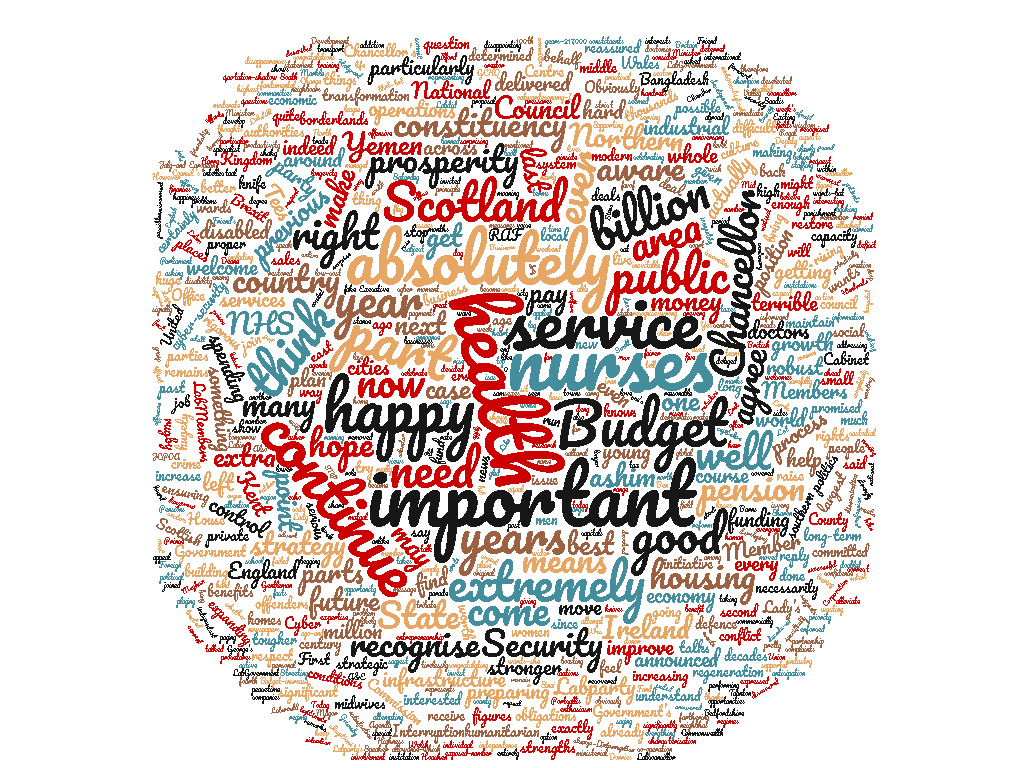
PMQs: Theresa May’s word cloud – 15 November 2017

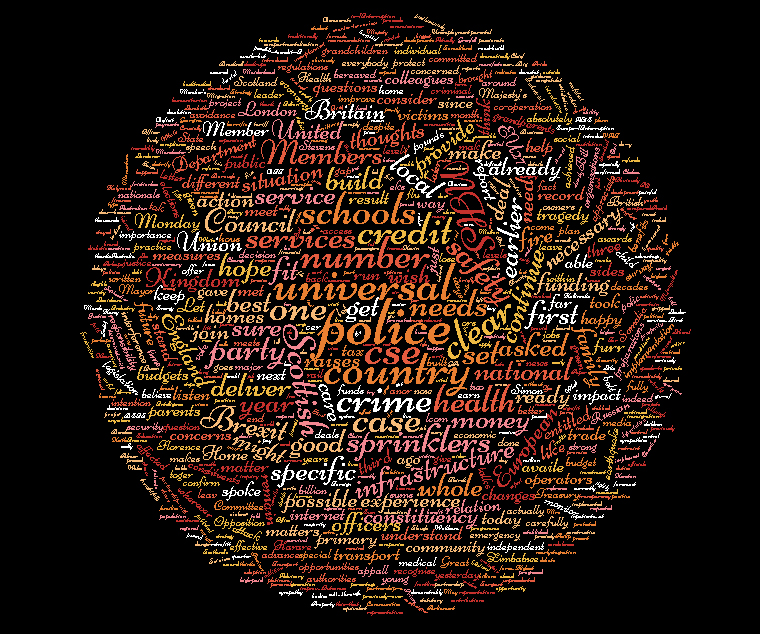
This week’s PMQs was dominated by funding issues across the police, NHS and fire service, as well as crime stats and universal credit. We present the word cloud for Theresa May’s answers at PMQs on 15 November 2017.

Word cloud

Funding
With Budget day on the horizon, it’s unsurprising that funding played a major role this week. May fielded questions about schools, the NHS, police and firefighters from MPs hoping for a say in next week’s announcements, as well as Carolyn Harris, who asked the Chancellor to legislate for a Children’s Funeral Fund.

Crime
Theresa May and Jeremy Corbyn clashed over police funding and crime stats, with the latter arguing that funding was down and crime had gone up. May disagreed, saying crime was down by almost a third.

Universal credit
Universal Credit has become a weekly topic at PMQs, and this week was no exception. There were calls to halt the reforms from Jeremy Corbyn, Stephen Lloyd and Tracey Brabin, ahead of a Commons debate on the roll-out tomorrow.

Europe
May is facing rebellion over the EU withdrawal bill, which began its journey through committee stage yesterday, and today she answered questions from Michael Tomlinson, Paul Masterton and Charlie Elphicke on the impact of Brexit.

Schools
Corbyn asked for assurances that school funding cuts would be reversed, after 5,000 head teachers wrote to the Chancellor with a request for more resources. According to May, there are record levels of funding going into schools and a fairer funding system.

Sovastock

Autumn Budget speculation 2017

The Autumn Budget will be delivered on 22 November. While the exact content remains a secret until then, there are a few areas where the Chancellor is likely to make bold moves.

This is the second budget of the year, after the Chancellor scrapped the Spring Budget to have one, simpler, fiscal event in autumn. As the last budget was only eight months ago, this will likely be more stripped back than usual; but with Brexit on the horizon and a weak election to recover from, there’s still a lot of ground for the Chancellor to cover. Here are the Vuelio Political Team’s predictions of what will be in the Autumn Budget 2017.


First Time Buyers
It is expected that Philip Hammond will target first time buyers in the budget with a reduction in stamp duty. This kind of move would prove popular with young people looking to get on the housing ladder, but disappoint the wider market as it would only apply to first time buyers. A move such as this would have the biggest impact in London where the cost of living and property is higher than across the rest of the country.


Pensions
Hammond looks likely to make an announcement concerning pensions, and he has a few options to choose from. The most controversial move would be to make changes to the triple-lock on pensions; however given the DUP’s fondness of it, this looks unlikely. The Taylor Review suggested that the self-employed should be auto-enrolled onto a pension scheme through the self-assessment process, but the most likely change Spreadsheet Phil would make is reducing the annual pension contribution. If this change goes forward, it will hit very high earners the hardest, making it more politically palatable and easier to put before Parliament.


Investment schemes
The Enterprise Investment Scheme (EIS) – designed to attract investors to small UK companies – also looks likely to be targeted. The scheme provides up to 30% tax relief on investments of this kind which, while a useful funding source for high risk companies, has attracted criticism from those who believe it is used by wealthy individuals to avoid tax. Along with the Seed Enterprise Investment Scheme (SEIS), EIS has been under review for the last year. It is likely that tax relief will be cut to 20% as a result of changes.


Student loans
The student loan shake-up was first announced at the Conservative Party Conference. Proposals include a tuition fee freeze at £9,250, and it is expected that the repayment threshold will increase from £21,000 to £25,000. Research from the Institute of Fiscal Studies shows that 77% of graduates do not repay their loan in full under the current system, and it estimate this will go up to 83% if this rise is put in place. The fact the Conservatives are considering the increase is testament to the threat of Corbyn.

While high interest rates on student loan repayments have been a toxic issue for the government, it seems Hammond has heeded calls to reconsider decreasing them. Meanwhile, it has also been reported that the Chancellor may force universities to use different pricing structures depending on the employment rate of each course.


Public Sector Pay cap
Hammond is under increasing pressure to lift the cap that has seen public sector pay limited to a 1% annual increase since 2013. Jeremy Hunt and Justine Greening are understood to be leading cross-departmental efforts to lobby the Chancellor to increase pay across all sectors, as he has done for the police and prison services. It looks likely that the budget will see the cap lifted, with the possibility of a staggered approach to offset costs, focusing on the shortest-staffed areas first.


Whisky tax
Back in March, the Chancellor used the Spring Budget to raise the excise duty on Scotch, leading to an increase of 36p per bottle. However, figures released by HMRC show one million fewer bottles were sold in the first half of 2017 than the year before, and the industry is now lobbying hard to see this tax hike reversed. Given that this move would also appease Conservative MSPs, this rumour will be worth keeping an eye on.


Business rates
With business rates expected to increase 4% next year, leading lobby groups have come together in a concerted effort to ensure the increase is put on hold in the Budget. The coalition, which includes the Confederation of British Industry, British Chambers of Commerce and Federation of Small Business, is arguing that a rise of this level could be the tipping point during an already uncertain time for business. It now looks likely that the planned rise will be scrapped and business rate increases will instead be aligned with the consumer price index.


Don’t want to miss anything from the Autumn Budget? Sign up to receive our comprehensive summaries of key policy announcements direct to your inbox.

Politics on Sunday – 12 November 2017

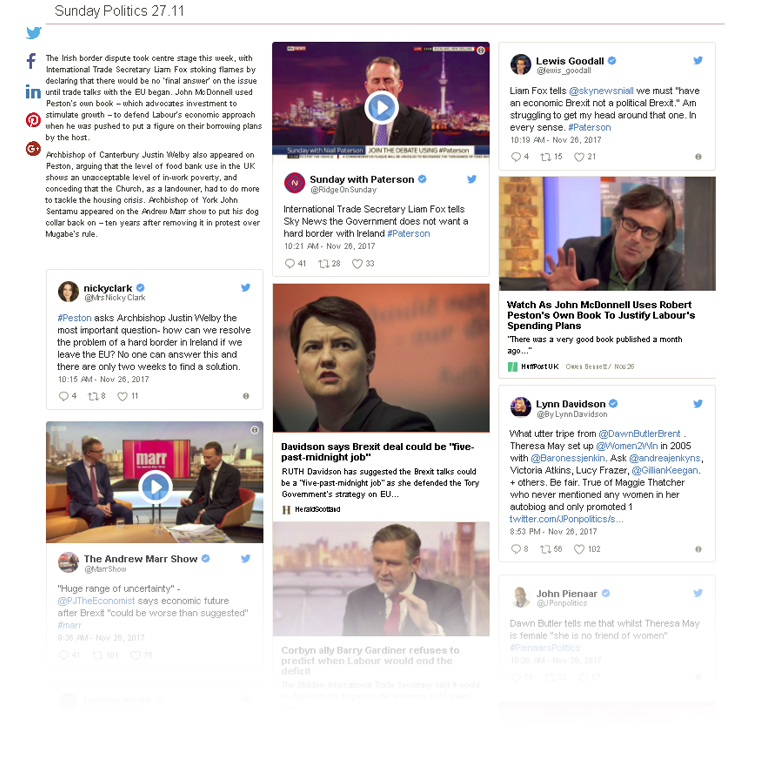
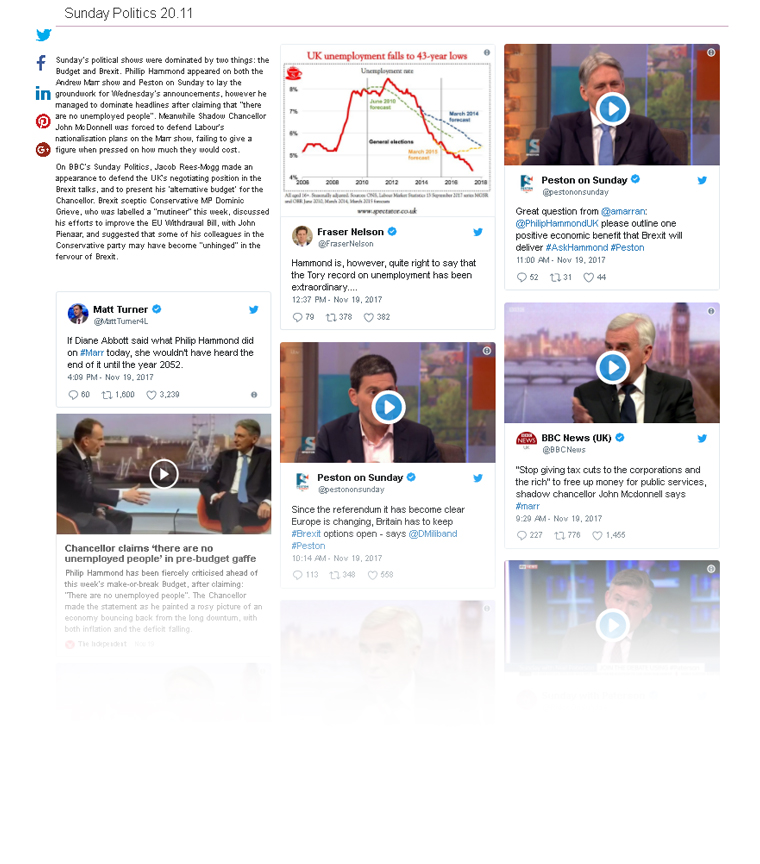
Missed any of the political coverage from the weekend?

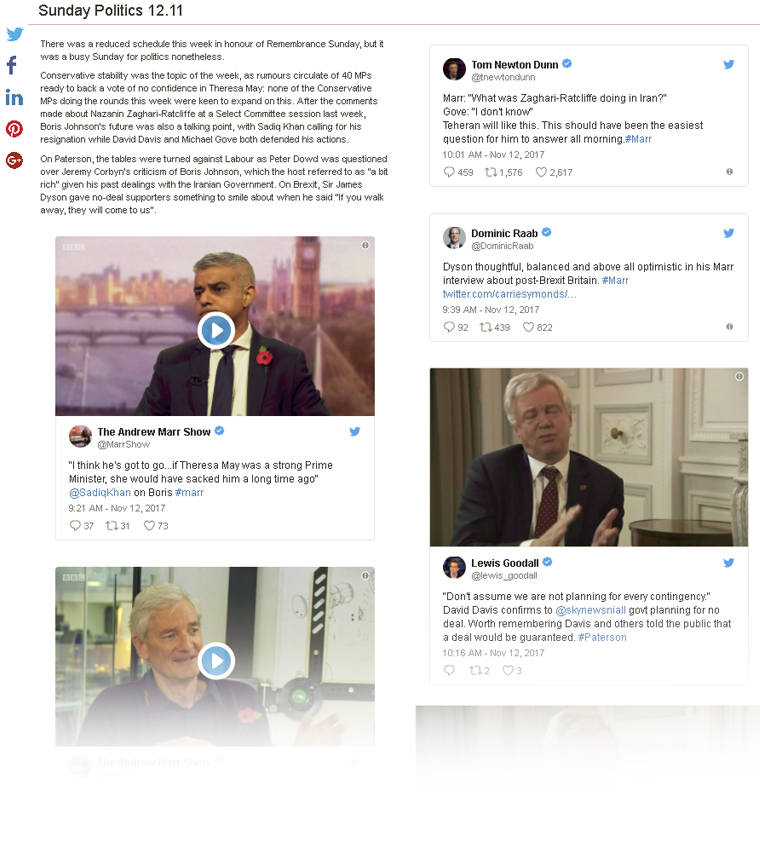
There was a reduced schedule this week in honour of Remembrance Sunday, but it was a busy Sunday for politics nonetheless.

Conservative stability was the topic of the week, as rumours circulate of 40 MPs ready to back a vote of no confidence in Theresa May: none of the Conservative MPs doing the rounds this week were keen to expand on this. After the comments made about Nazanin Zaghari-Ratcliffe at a Select Committee session last week, Boris Johnson’s future was also a talking point, with Sadiq Khan calling for his resignation while David Davis and Michael Gove both defended his actions.

On Paterson, the tables were turned against Labour as Peter Dowd was questioned over Jeremy Corbyn’s criticism of Boris Johnson, which the host referred to as ‘a bit rich’ given his past dealings with the Iranian Government. On Brexit, Sir James Dyson gave no-deal supporters something to smile about when he said ‘If you walk away, they will come to us’.

Check out our dedicated Canvas of political coverage by clicking here or on the image below. Want to make your own canvas? Find out how

Sunday Politics 12 November


Vuelio Brexit Bulletin, 10 November 2017

As the sixth round of Brexit negotiations conclude this week, we bring you the latest news, developments and stakeholder reaction in our Brexit Bulletin.  After a week which was noticeably light on negotiation meetings, there has been no announcement of major progress, leaving leaders with little time to reach agreement before the December summit of EU leaders.

  • Labour utilised an obscure power to compel the Government to give its Brexit impact assessments to the House of Commons Exiting the European Union Committee. However, Brexit ministers have cast doubt on the nature of the assessments, saying that time will be required to pull together the necessary material and warning that publication in full would not be in the national interest.
  • At the CBI’s conference, US Commerce Secretary Wilbur Ross outlined the changes in regulations needed to secure a trade deal between the UK and the USA, while insisting on the importance of maintaining ‘passporting’ rights for financial services. Theresa May and Jeremy Corbyn each outlined their Brexit vision.
  • The Government will amend the EU Withdrawal Bill to specify the date and time of the UK’s departure from the EU, Theresa May has announced. The Government has also introduced its new Trade Bill to the Commons, with the Customs Bill to follow.


Want the full bulletin? Sign up to Vuelio Political Updates here. 

Politics

Today’s Political Headlines – 10 November 2017

A round-up of the latest political headlines, including Penny Mordaunt’s appointment, the Brexit date, Northern Ireland’s status in the customs union and David Cameron’s lobbying. 

Penny Mordaunt appointed as International Development Secretary
Penny Mordaunt, previously minister for disabled people, has been appointed as the new International Development Secretary, following Priti Patel’s resignation. The Times says the appointment keeps the balance between leave and remain supporters in the cabinet, and suggests that it was a ‘consolation prize’ after Mordaunt emerged as a front-runner for the post of Defence Secretary last week.


European Commission calls for Northern Ireland to remain in customs union
The Daily Telegraph and the Financial Times break the story that a European Commission document shows that Ireland wants ‘concrete reassurance’ on the issue of the Irish border before the next EU leaders’ summit in December. It appears to require that the UK remains in a customs union with the EU, or that Northern Ireland has a special status and remains in a customs union, creating a trade border between the rest of the UK and Northern Ireland. A negotiator quoted in the Financial Times described Ireland’s stance as a ‘wild card’ factor.


Brexit date to be set in law
Writing in The Daily Telegraph, Theresa May has announced an amendment to the EU Withdrawal Bill, setting the date and time of the UK’s departure from the European Union as March 29, 2019 at 11pm GMT. Looking ahead to the next stage of the bill’s scrutiny in the House of Commons, she promises to listen to MPs who suggest improvements.


Budget news: Hammond refuses to loosen the purse springs, plans NHS spending increase and taxes on diesel cars
According to the Daily Mail, the Chancellor is refusing release billions of pounds for investment and won’t compromise on plans to eliminate the budget deficit by 2025, causing frustration for the Prime Minister. The Times reports that Hammond is planning to include more funding for the NHS in the budget. It says that the Chancellor is considering both ‘a cash injection’ and a pay boost for frontline workers. The Financial Times says that higher taxes will be placed on sales of new diesel vehicles, either by increasing VAT or creating a new levy.


Calls for cabinet reshuffle, amid ‘fierce debate’ in Downing Street
A story in The Guardian claims that senior figures in the Conservative party are calling for a ‘bold reshuffle’ of Theresa May’s cabinet, arguing that a ‘new generation’ of Conservative MPs need to be promoted. Others, including civil servants and whips, are warning that this might cause instability.


David Cameron lobbied China over planned investment fund
The Times reveals that David Cameron discussed a ‘UK-China fund’ being set up by figures including Lord Chadlington, a Conservative peer, with Chinese vice-premier Ma Kai during a visit to the country. If the fund is set up, the paper reports that Cameron is considering taking a role. As the fund does not currently exist, he did not need to seek official clearance.


Carwyn Jones may face investigation over handling of harassment allegations
The Guardian says that Carwyn Jones, the Welsh First Minister, may face an investigation over his handling of the allegations against Carl Sargeant, who was found dead after being sacked last week. Separately, The Daily Telegraph reports that John Bercow, the Commons speaker, has said that Charlie Elphicke, the suspended Tory MP, should be given the details of the allegations against him.


Metropolitan police chief calls for tougher sentences for young offenders
The Daily Mail carries remarks made by Cressida Dick, Commissioner of the Metropolitan Police, in which she called for tougher sentences for young offenders, which would ‘actually deter people’. She was speaking to the Howard league for Penal Reform, whose Chief Executive, Frances Crook said that ‘it is unusual for a police officer to comment on areas outside their expertise, like sentencing’.


Want to learn more about the Vuelio political services?

Politics

Today’s Political Headlines – 9 November 2017

A round-up of the latest political headlines from the UK’s media, including Priti Patel’s resignation, a Brexit ‘crisis’, the sexual harassment scandal and Corbyn’s call for sprinklers. 

Priti Patel resigns amid unauthorised meetings scandal
Yesterday evening Priti Patel resigned as International Development Secretary, having been summoned back to London by Theresa May following further revelations about her authorised meetings with Israeli officials. The BBC explains the scandal, whilst The Times says that friends of Patel believe that the story was leaked by the Foreign Office to kill off an attempt by her to change Government policy towards Israel. The Daily Telegraph reports that allies of Patel claim that she is ‘livid’ and ‘could do some pretty hard damage’ to the Government from the backbenches.


EU leaders fear Government instability could lead to Brexit crisis
The Times says that ‘fears are growing in Brussels’ that instability in the British Government could lead to a new Prime Minister or new elections, resulting in a Labour victory. Brussels is therefore planning for a disorderly ‘no deal’ exit or even for the UK to decide to stay in the EU. The Financial Times reports that the UK will offer more clarity on budget commitments if the EU simultaneously outlines a transition deal, but that the EU will only do this the UK makes ‘sufficient process’ on financial issues, quoting a diplomat who described this as a ‘chicken and egg’ dilemma.


Sexual harassment scandal: bar manager speaks out and Welsh First Minister criticised
Alice Bailey, a former bar manager at Parliament’s Sports & Social Bar spoke to The Sun about her experiences of harassment by MPs whilst working at the bar. When she asked bosses about reporting one incident, in which an MP followed her onto her bus home, she was told that she would not be believed. Meanwhile, the Daily Mail reports calls for Welsh First Minister Carwyn Jones to resign as a result of his handling of allegations against Carl Sargeant, who was found dead earlier this week having been sacked from his cabinet post.


NHS Chief Executive warns of soaring waiting lists
The Guardian reports that Simon Stevens, Chief Executive of NHS England, has called for NHS England to be given at least £4 billion more in 2018-19, and for the Government to emulate German, French and Swedish levels of health spending. He warned that waiting lists could reach 5 million if action wasn’t taken.


Corbyn calls for high rises to be fitted with sprinklers
Labour leader Jeremy Corbyn is to call for £1 billion to be set aside in the budget in order to fit all social housing blocks with sprinklers, starting with those over 30m (ten storeys), to prevent a repetition of the fire at Grenfell Tower, The Mirror says.


Gove backs ban of neonicotinoids
The Guardian reveals that Environment, Food and Rural Affairs Secretary Michael Gove is to back a proposed ban of neonicotinoids across the European Union. In an article for the paper, Gove writes that ‘the risks neonicotinoids pose to our environment, particularly to the bees and other pollinators which play such a key part in our £100bn food industry, is greater than previously understood’.


Iranian prisoner’s husband asks to accompany Boris on Iranian visit
The husband of the Iranian prisoner Nazanin Zaghari-Ratcliffe has told The Sun that he will ask if he can accompany Foreign Secretary Boris Johnson when he visits Iran. Richard Ratcliffe told the paper that he had not seen his wife for 18 months and that Johnson had repeatedly turned down requests to meet. The Foreign Office told the paper that Johnson would meet Ratcliffe and try to arrange a family reunion.


Leading US General warns against cuts to the UK’s armed forces
Lieutenant-General Ben Hodges, who commands the US Army in Europe, has told the BBC that if the British armed forces ‘got any smaller’, the UK’s position as a US ally and leading NATO member would be at risk, and the country would struggle to meet is global commitments.


Find out more about Vuelio political services. 

Politics

Today’s Political Headlines – 8 November 2017

A round-up of the latest political headlines from the UK’s media, including Priti Patel, Brexit, Paradise Papers and the NHS. 

Priti Patel returns to London amid further accusations
Priti Patel, the International Development Secretary, is flying back to London, following further revelations about unauthorised meetings in Israel. The Times reports that she breached Government protocol by visiting the Golan Heights, had further unauthorised meetings after returning, and that Lord Polak, ‘a leading figure in a corporate lobbying group’, sat in on meetings. The Daily Telegraph claims that Priti Patel departed for Uganda earlier than originally planned yesterday, missing questions in Parliament.

Brussels says that the UK needs to concede to secure trade talks, banks warn of job moves and Government handling of negotiations faces public disapproval
The Guardian has been told by Brussels officials that there is less than a month for the UK to make a concession to secure trade talks. The Financial Times says that a group of large financial institutions warned the US commerce secretary that slow progress with Brexit planning and an unstable government may force them to move thousands of jobs out of London. The Daily Telegraph has a poll showing that the Government’s handling of Brexit negotiations has a 66% disapproval rating.

Paradise Papers revelations continue
The BBC and Guardian are continuing to publish revelations from the ‘Paradise Papers’. Recent revelations include that the Prince of Wales has a ‘conflict of interest’ (according to Sir Alistair Graham, former chairman of the Committee on Standards in Public Life) between his investments and his environmental lobbying, and the use of the Isle of Man as a tax haven, with Margaret Hodge suggesting that Lewis Hamilton should not receive a knighthood. The Times has revelations about the use of tax havens by Labour councils.

NHS will need £24bn more funding by 2022
The Guardian reports that Jim Mackey, Chief Executive of NHS Improvement, told the NHS Providers conference that the NHS in England could need as much as £24.2 billion more funding than currently pledged by 2022, or it will have to scale back services. A report produced by the King’s Fund found that ‘there will be a significant and growing gap between the resources given to the NHS and the demands it faces’.

Corbyn aide suspended
The Mirror says that David Prescott, Jeremy Corbyn’s aide and son of the former Deputy Prime Minister John Prescott has been suspended ‘amid the sexual harassment crisis’. He has not commented on the allegation, and the Labour Party would not comment on this specific case.

Carl Sargeant, former Welsh minister, found dead
Carl Sargeant, former Welsh communities secretary was found dead yesterday, after being sacked from his job and suspended from the Labour party on Friday following accusations about his behaviour. The BBC reports that Welsh First Minister, Carwyn Jones, is facing criticism about his handling of the situation.

Johnson says words were ‘taken out of context’ in Iranian prisoner remarks
The BBC reports on Foreign Secretary Boris Johnson’s said that his remarks about Nazanin Zagheri-Ratcliffe, currently imprisoned in Iran, were ‘taken out of context’ and that he intends to visit Iran to discuss the case before the end of the year. Her husband said that Johnson’s clarification was a ‘good thing’.

IFS warns of uncertainty surrounding Scottish income tax increases
According to The Daily Telegraph, research by the Institute for Fiscal Studies has found that Scottish First Minister Nicola Sturgeon’s planned tax increases could backfire, with there being ‘a lot of uncertainty’ over whether more money would be raised. The Scottish Government said that it had considered ‘a range of potential revenue impacts’.

Get in touch for more information about Vuelio political services. 

Politics on Sunday – 5 November 2017

Missed any of the political coverage from the weekend?

After a week when sexual harassment in Westminster has continued to dominate headlines, it’s no surprise that this issue was the focus of Sunday’s political shows. After a flurry of rumours that Whips had been using information about sexual misconduct in order to maintain party discipline, Home Secretary Amber Rudd used her appearances on Marr and Paterson to deny the existence of any such ‘black book’. Meanwhile, Anna Soubry criticised the ‘trial by media’ taking place against MPs in light of a lack of system to investigate claims made against them.

Labour has also been under pressure to explain its response to harassment allegations. Emily Thornberry said she was ‘ashamed’ of on-goings in her party after it emerged that Kelvin Hopkins had been promoted to shadow cabinet after claims were made against him, while a young party activist was told not to report her rape at a Labour event.

Beyond sexual harassment, Mark Carney appeared on Peston to discuss the ‘Brexit effect’ on the economy, which he claims has lowered the bank’s predictions for foreign investment in Britain by 20% since the month before the referendum.

Check out our dedicated Canvas of political coverage by clicking here or on the image below. Want to make your own canvas? Find out how

Canvas for politics 6 November


Prime minister

Energy Price Caps: Is Theresa May a Marxist?

The Conservative Government has published proposals for a bill to allow a cap on energy tariffs, which it previously described as ‘Marxist’.

The proposals followed on from Theresa May’s announcement of a cap on energy prices in her speech to the Conservative Party Conference, and the inclusion of the policy in the party’s manifesto at the general election earlier this year.

Proponents of the measure say that it will prevent overcharging of vulnerable consumers and that the current system loads the dice against new entrants to the industry, limiting competition. Over two decades after energy privatisation, 80% of customers are still with one of the ‘big six’ firms and many challenger firms believe that a price cap will increase competition in the market.

Opponents warn that the proposal could lead to vulnerable customers paying more, and that competition in the sector is already working.

A time traveller from 2015, when Ed Miliband’s proposals for an energy price cap were being derided by Tory politicians as ‘Marxist’, ‘Wonga-like’ and ‘extremely dangerous’ would be startled to see a Conservative Government proposing something similar.

So, how did we get here?

Those of us monitoring politics have noticed a shift in the political mood as a campaign inside and outside Parliament gathered pace. Its figurehead has been the Conservative MP John Penrose, who has made frequent media appearances promoting the idea, sponsored a debate in the House of Commons, and on the very evening that Parliament was dissolved in May was addressing the All-Party Parliamentary Group on energy costs. Other innovations included a website showing how much people in each constituency were overpaying, produced by one of the industry’s challenger firms.

Together, these elements formed a successful campaign which brought this issue firmly onto the political agenda and into Government policy, and MPs have signed-up to the cause in ever-increasing numbers.

Vuelio attended a Conservative Party Conference fringe event, the day before May’s conference speech, at which Penrose revealed that 212 MPs had signed a letter supporting the cap – an increase of 20 in just a week. He also paid tribute to the work of the campaigning organisation 38 Degrees, whose petition had helped to put pressure on MPs.

However, the final form of the bill is still up for grabs. In his statement, the Secretary of State for Business, Energy and Industrial Strategy Greg Clark told the House of Commons that the draft bill was to be scrutinised by the Business, Energy and Industrial Strategy Select Committee. That committee has already organised a session in which it will take evidence from energy firms, Ofgem, and an expert on economic regulation.

As currently written, the bill leaves many of the precise details to Ofgem, so interested parties will also need to keep a very close eye on their thoughts. Already there are signs of conflict: Labour are claiming that the bill is ‘inadequate’, whilst the Lib Dem MP and former Energy and Climate Change Secretary Sir Ed Davey is arguing that the measure will damage competition and increase prices for vulnerable consumers.

Even Penrose has concerns about the form of the cap: he has been arguing for a relative price cap, not an absolute one. In layman’s terms, this means that the Government would limit the difference between a company’s highest and lowest tariffs, rather than setting a maximum price. Those affected by the proposed cap will need to monitor the progress of the bill through Parliament very closely.

If you would like to know more about political monitoring and the services Vuelio offers, get in touch.

Brexit, business and price caps: stakeholder priorities for the new Parliament

As Parliament returns after a busy conference season, attention has turned to which issues the stakeholder community will be seeking to engage parliamentarians on over the coming year. Given the engagement opportunities associated with conference fringe events, we’ve broken down the fringe calendars of the two main parties to gage the themes which have taken centre stage.

Brexit

As would be expected, Brexit has played a starring role on the fringe this year: at both Labour and Conservative conferences, it made up the largest proportion of event type amid the uncertainty facing stakeholders across all sectors as to what a post-Brexit UK will look like.

Brexit fringes by host organisation

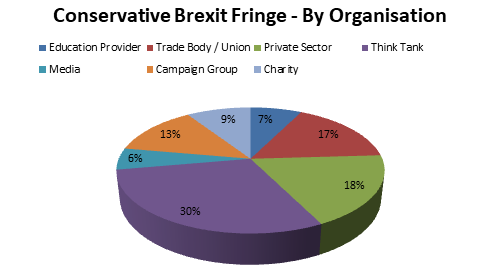
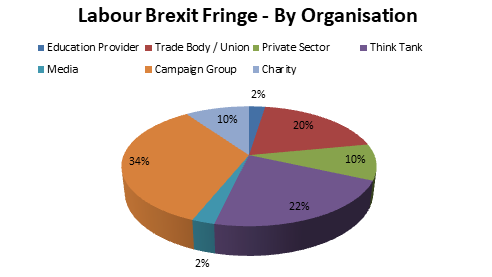
In order to gain a clearer idea of the stakeholders hoping to influence the Brexit agenda, we’ve broken the Brexit events down by the organisations which have hosted them. Think-tanks made up a predictably high proportion of events at both fringes, and focussed on a broad range of issues ranging from the economy to freedom of movement. Beyond this, the Conservative conference was defined by private sector organisations focussing predominantly on business and economy issues: whether agriculture, fishing or aerospace, industry stakeholders were keen to make their mark. Given the Conservative’s undefined position on Brexit so far, it is unsurprising that business leaders took the opportunity to exert some influence during conference season.

conservative brexit

In Brighton, events focussing on business and economy also took centre stage, although there was a marked lack of industry voices in comparison to Manchester. Discussion here came mostly from campaign groups and trade bodies focussing on how the labour market will look in years to come, potential trade policy and the impact of Brexit on austerity. At both fringes, there was a level of engagement from education providers which points towards an increasing nervousness around post-Brexit research funding, EU students and the skills market.

labour brexit

Business and economy takes centre stage in Manchester

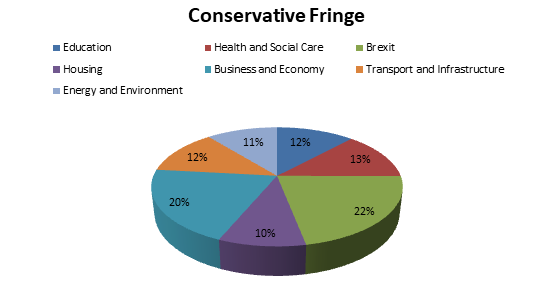
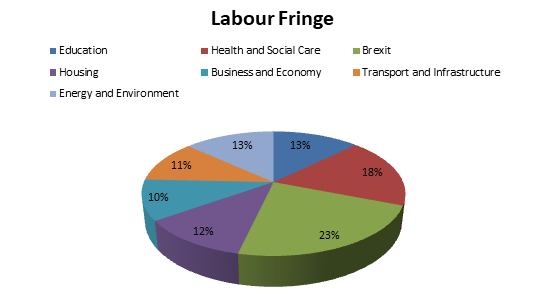
While Brexit was, unsurprisingly, the defining feature of both fringes, beyond this the key difference was the level of business engagement at each conference. Business and economy events at the Conservative conference were the second most popular fringe type after Brexit: given the natural tendency for business interests to veer towards the party in power and see return on investment from their engagement, this should come as no surprise. In contrast, Labour saw less business led events than health, education or housing. Beyond reflecting the uneasy relationship between Labour and the business community currently, that the opposition’s fortunes have changed dramatically since June 8th may mean that business leaders are yet to engage properly with the idea of a Corbyn led government.

The prospect of an energy price cap loomed large over Manchester, with fringe events grappling with the ideological implications of a Conservative government imposing market regulations. However, the stakeholders present at many of these events – ranging from smaller energy companies to consumer protection organisations – were largely positive about the cap, the emphasis being that this is a temporary measure to correct the market, rather than a long-term plan for state control.

conservative fringe

Health and social care tops the agenda at Labour

The primacy of health and social care in Brighton points towards Labour’s continued dominance as the party of choice for stakeholders pursuing this agenda. As with many of the fringe events at Labour conference, a large proportion of the organisations hosting these events were campaign groups as opposed to membership bodies or charities. While Labour’s position in opposition means this should to some extent be expected, that health and social care still dominated the fringe implies it will top the party’s agenda for the coming year. Looking at the topic of health events, there were more devoted specifically to the NHS in Manchester than in Brighton. Given the tumultuous relationship between the Department of Health and the NHS to date, this suggests a desire from the health service feels to engage with the government directly.

labour fringe

PLMR’s Joe Mitton gives his rundown of the Tory Conference and the PM’s keynote speech

Vuelio Political Services teamed up with integrated communications agency PLMR to bring you the top news and analysis from the Conservative Party Conference 2017.

Read what Joe Mitton, Senior Consultant at PLMR, thought were the key takeaways from what was an eventful Conference.

The Conservative Party Conference in Manchester this week (1-4 October) sought to heal the divisions of the disappointing general election result for the Party, and to articulate an optimistic alternative to the unexpectedly popular vision of Jeremy Corbyn’s Labour Party.  For a party in government, it is a somewhat strange position to be in; having to construct an alternative to the Opposition’s narrative.

Many speakers, including the Chancellor Philip Hammond, focussed on the need to promote once again the benefits of a free market economy.  Hammond reminded the party faithful that most of the electorate is too young to remember the economic difficulties of the 1970s.  Other MPs made passionate cases for market-led economic growth, so it was interesting that the final speech of the conference by the Prime Minister revived her plan for a retail energy price cap.

Prime Minister’s Speech: Social mobility and the ‘British Dream’

Theresa May addressed the Conservative Party Conference in Manchester today (4 October).  While much of the more frothy commentary will focus on the croaky delivery and the rather pointless interrupting prankster, we thought it more useful to look at the policy content and the vision that the Prime Minister articulated.

May repeatedly referenced “the British Dream” – a “dream that life should be better for the next generation”.  This appears to be partly a call for social mobility, and partly an affirmation of progressive, ongoing economic growth and personal attainment.

It remains to be seen whether this vision will have much traction with voters, especially the young, who face daunting house prices and virtually non-existent real wage growth. With only passing mention to Jeremy Corbyn, the central theme in May’s speech of a “British Dream” seems designed to provide an optimistic counter-narrative to the bold promises with which Corbyn’s Labour has successfully attracted new voters.  Which of these visions prevails may well be the defining political question of the next five years in British politics.

In an effort to bring a sense of authenticity and conviction to her vision, Ms May somewhat uncharacteristically spoke about her own family background and her grandmother’s job as a domestic servant.  She also spoke of her own health issues and treatment by the NHS.  May emphasised social justice and recognised, in several anecdotes and points, that she understands that minority ethnic communities still face significant inequalities.  She said that she got into politics to address precisely these kinds of injustices.

The main new policy announcement was that the government would seek to cap household energy bills – which came as a surprise to many at the Conference who had assumed that that policy had been quietly shelved after the last general election. Energy companies came in for some quite sharp criticism in Ms May’s speech, and it seems now likely that an energy price cap of some kind will indeed be introduced this parliament, with the Opposition very unlikely to block such a popular move.

The Prime Minister also announced £2 billion more for new social housing.  This, alongside earlier announcements of a university tuition fee freeze and £10 billion in additional Help to Buy funding, is part of a broader pitch by the Conservatives’ to address the issues facing ordinary working people.

The test will be whether Ms May’s vision resonates with the public as authentic, deliverable and inspiring, or whether public life and media commentary continues to focus merely on stunts, gaffes and personality cults.

ABOUT PLMR

Founded in 2006, PLMR is a fully integrated communications agency with offices in London, Edinburgh, Birmingham and Cambridge. They work across all sectors, from transport and technology to education and energy, expertly offering a suite of key communications services: public affairs, PR, crisis management, media training, digital, film and design, planning communications and campaigns.

Conservative-Party-Conference-Banner-Blog-Post

Conservative Party Conference – Final Day

As the Conservative Party Conference comes to a close, Theresa May has been handed a P45, Boris Johnson is facing fresh calls to resign and Jacob Rees-Mogg has come face to face with protestors crashing his fringe event. With surprise appearances from Katie Hopkins and Bear Grylls, not to mention the usual smattering of eggs thrown at delegates, this year’s conference has been one to remember.

With so much to keep up with during the four-day conference, our political team has summed up all the speeches, influencer reaction and key fringe events for you, in one place.

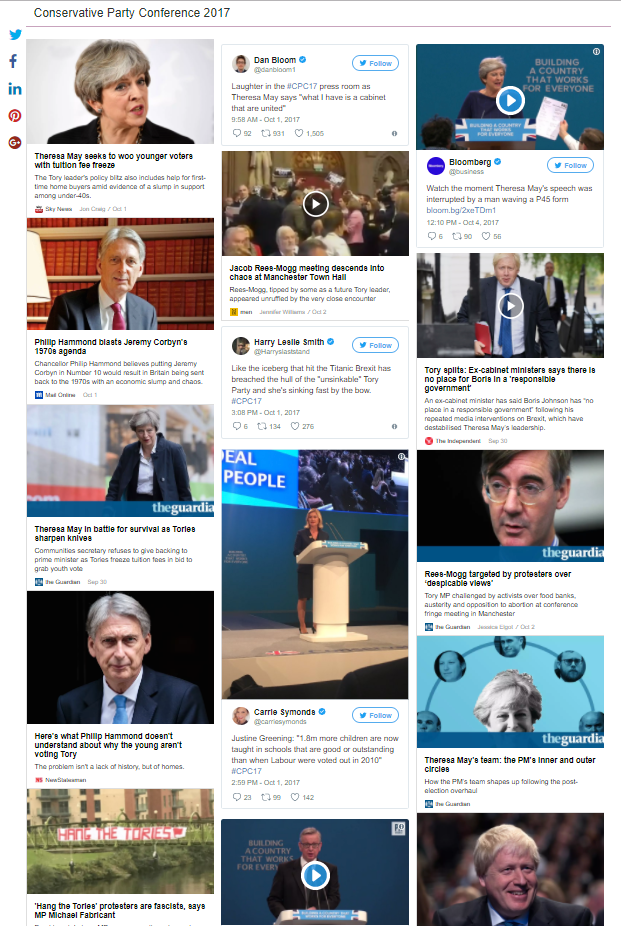
Take a look at the biggest stories from this year’s Conservative Party Conference on the Vuelio Canvas > >

CPC2017 Canvas Final Day Blog

Conservative-Party-Conference-Banner-Blog-Post

Conservative Party Conference – 2nd Day

The Conservative Party Conference is now underway and the highlights so far include Chancellor Philip Hammond announcing an extra £300m of funding for rail infrastructure in the North, Environment Secretary Michael Gove announcing the Government will increase the sentences for those who are found guilty of animal cruelty and Universal Credit being rolled out as originally proposed with more advance payments becoming available.

Have you missed something from Conference? Check out our Canvas below, which brings together all the biggest stories from this year’s #CPC2017 conference.

And if you want daily updates for the Conservative party conference, including key speech summaries and fringe event round-ups, sign up to receive our email alert here.

The Business Hub

The Business Hub at the Conservative Party Conference

Vuelio is continuing its presence at the major party conferences as the official Monitoring & Intelligence Partner of PLMR’s Business Hub at the Conservative Party Conference, from 1-4 October.

The Business Hub is also partnered by London City Airport, the Daily Telegraph and Costa Coffee, as PLMR creates an exciting and engaging environment in which to meet and do business.

The Hub will provide a work, meeting and refreshment space for high-level political and business attendees that includes the CEOs of the FTSE 250, journalists and political dignitaries. It will be spearheaded by former advisor to Boris Johnson, Joe Mitton; former Crown Estate advisor recently seconded to the Conservative Party General Election campaign, Nicolas Clark; former Conservative Party Staffer, Francesca Dobson; and PLMR Events Manager, Felicity Fisher.

The Business Hub’s morning and evening events include panel debates, Q&As and receptions across aviation, the care sector, skills and Brexit. The Daily Telegraph’s Christopher Hope will record his popular Chopper’s Brexit Podcast from the Hub and London City Airport’s Business Reception will be an event highlight as an integrated part of the Conservative Party’s Business Day.

Vuelio is not only providing phone charging points for The Business Hub – to ensure delegates can keep connected and concentrate on their communications – but delegates will also have access to our expert reports so they can experience more of the Conference than is physically possible.

Elin De Zoete, managing director of PLMR, said: ‘Against the backdrop of Brexit and the 2017 General Election, this year’s Conservative Party Conference will be particularly important for many if not most, industries.

‘The party conferences offer a unique opportunity to deliver a company’s engagement priorities with political decision-makers, particularly following the new intake of Members of Parliament, and PLMR is on hand to help our clients to build both lasting and beneficial relationships’.

Joanna Arnold, CEO of Vuelio, said: ‘We’re delighted to partner PLMR’s Business Hub and provide our political intelligence to Conference guests. At Vuelio, we’re all about communications so we’ll use our presence at the Conference to ensure delegates are successfully managing theirs.’

Vuelio has been providing free daily reports, directly to inboxes, across the Conference season and the Conservative Party Conference is the next event we’ll be covering. You can sign up to receive our political team’s updates by clicking here.

Five Things You Shouldn’t Have Missed – 29 September 2017

Taking a brief hiatus from our podcast (and reverting to old-fashioned reading), we present five things you shouldn’t have missed from the worlds of media, marketing and communications.

1. Labour Party Conference

Labour Party Conference 2017

The Opposition party’s conference produced a plethora of headlines, from Emily Thornberry’s attack on Boris Johnson to John McDonnell’s pledge to bring PFI contracts in-house. Reports from the official four-day event also included the BBC’s Laura Kuenssberg being given a bodyguard after receiving online abuse; the party tackling antisemitism in the party with new, stricter rules; the party’s position on the Single Market being debated by all sides; and Jeremy Corbyn’s closing speech calling Labour the ‘government-in-waiting’.

If you missed anything from Conference, you can see all of the biggest stories on this Vuelio Canvas. And, if you want daily updates from the Conservative Party Conference directly to your inbox – sign up here.

2 . Uber’s London licence

uber

Transport for London announced it would not renew Uber’s private hire operator licence after 30 September. They claimed the operator wasn’t safe or up to the required standard for the licence. The firm immediately vowed to fight the decision on appeal, which buys them time past the 30 September deadline. The ban has caused outrage among Uber’s 3.5 million London users and 40,000 drivers, many signing Uber’s petition against the decision.

Uber’s CEO Dara Khosrowshahi published a letter in the Evening Standard apologising for the mistakes they’ve made, Sadiq Khan claimed people should direct their anger at Uber rather than TfL, and reports emerged that two of the four reasons TfL gave for revoking the licence are actually its own responsibilities. With Prime minister Theresa May also now part of the story, calling the ban ‘disproportionate’, expect this one to keep going.

3. Twitter Trials Longer Tweets

Twitter bird

A small group of Twitter users are now testing double-length tweets. If the test is considered a success by the social network, then 280-character messages will be rolled out across the platform. Jack Dorsey announced the decision in a what was considered by some to be a verbose tweet.

Twitter, in true Twitter style, panicked at the idea of change and then made it all a big joke:

4. Hugh Hefner dies

Hugh Hefner

The founder of what became the media empire Playboy, died this week aged 91. At its height, Playboy Magazine sold seven million copies a month but in later years its content model has struggled to keep up with the internet. Opinions are divided on the man, with some calling him a legend who sexually liberated America and supported LGBT and civil rights, while others saw him as a misogynistic user of women.

You can make your own minds up.

5. IMPRESS bans board members

British newspapers

The royal charter-backed press regulator IMPRESS has banned its chief executive and three board members from dealings with major newspapers. After the press ran their own investigations, IMPRESS published a report largely agreeing that Jonathan Heawood, Emma Jones, Maire Messenger Davies and Martin Hickman, had all taken positions that could create perceptions of bias against the press – from positive views of campaign group Hacked Off to retweeting negative messages about certain papers and publishers.

IMPRESS has no members that are considered major newspapers so the ban is, at the moment, somewhat moot. Though if the Government enacts Section 40, which will require all papers to join a royal charter-backed regulator or face heavy penalties, then this story could become huge.

Something we’ve missed? Let us know on Twitter on in the comments below. 

Labour Party Conference – Final Day

The Labour Party Conference is coming to a close for 2017, with a huge number of headlines generated from the four-day event.

The Single Market was the key focus early on but has since been joined by John McDonnell’s pledge to bring PFI Contracts in house, Emily Thornberry’s BoJo criticisms, the party tackling antisemitism, and Jeremy Corbyn’s speech in which he said Labour were the ‘government-in-waiting’.

The mood today was buoyant, with several minutes of ‘the Jeremy Corbyn song’ welcoming the opposition leader to the stage before his speech began.

He closed with the words: ‘Labour can and will deliver a Britain for the many not just the few’.

Have you missed something from Conference? Check out our Canvas below, which brings together all the biggest stories from this year’s #Lab17 conference.

And if you want daily updates for the Conservative party conference, including key speech summaries and fringe event round-ups, sign up to receive our email alert by clicking here.

Labour conference day 4

Labour Party Conference – Day Two

Vuelio’s political services team is at the Labour Party Conference in Brighton to bring you all the latest news. 

Day two has been dominated by discussions about the party’s position on the UK’s membership of the European Single Market. Mayor of London Sadiq Khan said he would like the UK to remain permanently in the single market. John McDonnell said the party needs to make sure it takes into account the concerns of those who voted to leave.

Shadow Foreign Secretary Emily Thornberry aimed parts of her speech at Foreign Secretary Boris Johnson, claiming that Johnson should take a ‘paternity test’ to see the true origin of the arguments and false claims surrounding Brexit.

Shadow Brexit Secretary Keir Starmer said this is a tragic moment for the Government, and it does not have the strength to govern. Starmer’s speech also picked on Johnson – he was listed alongside David Cameron and Theresa May – the ‘authors’ of the ‘Brexit tragedy’. Starmer touched upon the subject of the day, saying that Labour could keep the UK in a reformed single market and a form of customs union.

Shadow Chancellor John McDonnell delivered the keynote speech and will have made headlines with his pledge to end new Private Finance Initiative (PFI) contracts and bring existing contracts back ‘in-house’. McDonnell also said that he would attempt to introduce a cap on the interest payments on credit cards.

Don’t want to miss anything from Conference? Make sure you’re signed up to the Daily Updates

The biggest stories of the day are available on our Day Two Canvas – click here to see the Canvas in full.

Day 2 labour party conference

Lib Dem conference summary

The Liberal Democrat conference today came to a close, with the final Vuelio conference bulletin covering all the highlights from the fourth and final day.

The top action from today includes the party’s latest Brexit-related motion; Norman Lamb’s speech and Vince Cable’s rousing conference close.

This final speech from the party’s leader cautioned against the Lib Dems being seen as ‘UKIP in reverse’. Wrapping up four days of Lib Dem activity, he asked activists to join him in taking ‘the Liberal Democrats back to Government’.

Vuelio’s Political Services team has collated all the main stories from the major news outlets, including the Guardian, Mirror and Express, as well as top influencers on social media. They are available all in one place on our special Lib Dem conference canvas.

If you think you’ve been missing out, and you want to make sure you receive daily updates for the Labour and Conservative Party Conferences – sign up to receive our special alerts directly to your inbox.

Lib dem canvas