
Article 13

Industry associations react to EU copyright vote

The European Parliament’s vote to pass new laws for copyright on the internet has been met with criticism from industry giants like Google, high-profile Youtubers, and associations including the CIPR and PRCA.

‘Memes’ and parody are safe under the Article 13 – passed on Tuesday with a 348-274 vote – but reuse of material beyond reaction gifs created for sharing on Twitter or Tumblr could be subject to censor. Francis Ingham, director general of the PRCA said: ‘We risk chilling online engagement with overreaching roles on copyright. This comes, ironically, at a time when we need the public to engage with the news more than ever’.

Though Article 13 has the aim of passing accountability for copyright-breaking content from the public and onto the digital companies that host its distribution, this may still have unintended negative consequences for individuals looking to share their thoughts on current events online. The directive’s upload filters – though intended to support news organisations and providers – may silence public opinion before it can be shared and, according to the CIPR’s stance, ‘damage the rights of internet users’. For CIPR Chief Executive Alastair McCapra, ‘Mandatory licenses and content filters are a disproportionate response to the problem and will not tackle the problem of the illegal sharing of right-protected content online.’

High-profile figures are on each side of the argument regarding the new laws, such as musicians Wyclef Jean (against) and Debbie Harry (for). Companies who had protested the passing of Article 13 include PornHub – a platform that has previously provided a haven for users leaving the social blogging platform Tumblr post-censorship to instead create and share GIFs with them [This link is surprisingly safe for work]. Tumblr’s ban on ‘NSFW’ content in December 2018 has already seen the social blogging site lose 30% of its web traffic, and though Article 13’s copyright focus is far from Tumblr’s ‘female-presenting nipples’ aversion, social sharing sites could still be negatively affected in a similar way when it comes to engagement and user numbers.

For journalists and content creators, the new laws are designed to support and protect their work from companies sharing without payment or proper accreditation. A noble aim, but one that comes with caveats and consequences that won’t always be conducive to creativity and reward. Laws that could curb future controversies like that of the @fuckjerry account aggregating without consent may also harm journalistic free thought, and that’s something that will have an impact on the PR industry.

McCapra said: ‘[Article 13] will force restrictions on the way PR professionals work and deliver value for clients and businesses across Europe’, which is a view that many PRs are likely to share in the coming months. However the industry reacts to the new laws as their reality sets in, PR firms and freelancers (and the content creators they work with) are going to have to get creative to work with the incoming filters and restrictions… or the new opportunities, depending if you’re team Jean or team Harry.

Vuelio are exhibiting at B2B Marketing Expo 2019

On 27 and 28 March, the ExCeL Centre will transform into Europe’s leading marketing event, B2B Marketing Expo. Exhibiting on stand 2212, the Vuelio team will be ready to answer any questions about our portfolio of products, from the market-leading journalist enquiry service to our fully integrated communications suite.

You’ll find the Vuelio stand close to three masterclasses, including digital marketing, customer acquisition and empowering your ecommerce, so why not get up to speed with the latest marketing theory and visit our stand all in one trip!

With hundreds of other exhibitors to visit at B2B Marketing Expo this year you’ll need to make sure you’ve got a solid plan, so you don’t miss anyone out.

And we’ll be running a special competition for a chance to win £100 for a charity of your choice. Just speak to any member of the Vuelio team – you can’t miss us.

Unable to make it this year? Follow @Vuelio and stay up to date with the latest news, events and blog posts.

UK Bloggers Survey PR opinions

The blogosphere is evolving – what does the PR industry need to do to catch up?

Bloggers are getting smarter about navigating the industry and finding success, according to results from the UK Bloggers Survey 2019, but could the PR industry be doing more to adapt alongside them?

According to the statistics, more bloggers are choosing to monetise their posts, with women in particular utilising blogging as a business rather than a hobby. But there’s still improvement to be made in how PRs can work with the community to measure success, to improve diversity within the UK blogging sphere, and to work on the gender split that continues in key verticals.

72% of the female bloggers surveyed blog for professional reasons rather than personal, in comparison to a 44% personal/56% professional split for male respondents
Is the fact that women are leading the way in monetising their blogs a sign of dominance in the sphere? ‘I think it’s to do with men blogging for fun outside of a day job and not seeing it as generating the kind of income they might like’, says Fiona Scott, who works with bloggers for her Wiltshire-based media consultancy. ‘Women may be more willing to accept a lower income in return for doing something they love which fits around their other responsibilities, e.g. children.’

That the results are a reflection of continuing gender inequality is a view backed up by Mindy Gofton, head of marketing strategy & innovation at i-com.net: ‘Research has shown that women’s spending money is more likely to get spent on the family as a whole, while men’s spending money is more likely to get spent on themselves. Given that women have lower average salaries and that they are far more likely to work part-time or to be full-time carers or full-time parents, it stands to reason that monetising a blog is a way to have a little additional financial freedom that their male counterparts simply don’t need.’

89% of the bloggers felt that PRs should focus on the quality of engagement to measure success
Methods of measuring success is something PRs and bloggers still disagree on, with bloggers valuing quality over the PR focus on quantity. Is this something that needs to change?

‘Measuring the success of a blogger campaign is something the PR industry needs to work on’, says Nobull’s junior account manager Amy Green, who has previously decided not to work with higher-following bloggers if they don’t fit a campaign’s specific objectives. ‘The standard “PR Value” and “Circulation” almost don’t apply anymore. Understanding what the purpose of the campaign is defines how you are going to measure the success.’

‘I think it’s important to not only focus on numbers but also on the engagement,’ says Nicole Rohde at luxury fashion brand Maxwell-Scott. ‘We are all aware that nowadays there are millions of fake accounts on social media and there is also the hidden world of buying fake Instagram followers. I often ask bloggers for case studies on previous collaborations so that I can estimate the level of engagement a post about my brand will get. It’s more important to find a blogger that absolutely fits in with the overall strategy of your brand, rather than the biggest.’

40% of bloggers consider themselves more trusted than traditional journalists (down from the 54% the year prior)
What do PRs consider better value – features in traditional media, or posts from high-profile bloggers? 40% of bloggers surveyed believe they’re more trusted than journalists, and they may be onto something. Bloggers often have more capacity to work on a piece, according to Procoal’s Tom Bourlet: ‘With the expectancy now on many journalists to burn and churn through content on a much more regular basis to match online demands, they simply don’t have the time they used to.’

Speed is something Model Village CEO William Soulier also sees as a positive: ‘The limited red-tape in terms of sign-off and internal processes enables bloggers to turn around content much faster. This ultimately gives them an edge.’ But it’s detail that Nicole appreciates in the fashion sphere: ‘Bloggers will usually provide outfit suggestion to go along with your product. They show how the item can be used in everyday situations, which provides the target audience with a better idea.’

Whether bloggers are a more reliable choice that traditional journalists is something head of outreach and content Simona Bojare considers in her work at Ascent Group: ‘I still work with A LOT of bloggers but I’ve become a lot more selective than I was few years ago. As an industry, we’re definitely seeing people/readers be a lot more sceptical when it comes to influencer/blogger endorsements. This is due to those few that have had lousy disclosure practices in the past.’

Danny Whatmough, managing director, Integrated Media at Weber Shandwick believes both traditional journalists and bloggers need to be judged on their individual work and merits: ‘Trust and authenticity are topics that are sensitive but important in both disciplines. There are examples on both sides where practitioners have not been trustworthy or authentic and this has an impact on the whole industry.’

None of the female bloggers who took part in the survey write about politics, gaming, music, or tech. Of those that took part in this survey, 93% identified as White British
Results from The UK Bloggers Survey 2019 mirrored a continuing gender disparity across certain subjects in the wider blogging community, as well as the shockingly low percentage of high-profile BAME bloggers and influencers in the UK. Whether the existing, predominantly white, blogging community isn’t an inviting space for BAME creators to join, or PR companies and brands aren’t doing enough to work with those who are already a part of it, there’s no disputing that there are many voices out there, and more needs to be done to find and elevate them.

‘For PRs to make a strong difference, they need to stop following and repeating what their competitors are doing and to look elsewhere, see the people who are trying to get their name out there and just need the opportunity to be heard’, believes Tom Bourlet. ‘They need to analyse their previous marketing efforts or influencers worked with and see if they have followed a consistent pattern and see whether there is an opportunity to change this and to build in more diversity.’

‘Lack of diversity is a problem that the PR industry faces too’, says Danny at Weber Shandwick. ‘It’s important that we work hard – including through surveys like this – to hear from a diverse range of opinions and properly reflect the audiences that we are looking to reach. Whether that’s through PR outreach, data and insight or news articles, we all have a responsibility to support diversity that will, ultimately, make the output and results of campaigns stronger.’

Work in PR and want to work with the best bloggers in the business? You need the Vuelio Media Database.

PRCA conference

Public Affairs industry gears up for Brexit

Yesterday, senior figures from across the public affairs industry gathered for the inaugural PRCA Public Affairs conference. With the UK still due to leave the EU in just eight days, the conference topic was unsurprisingly ‘Cutting through Brexit’.

Opening the discussion with a speech that ranged from emperor Diocletian to Voltaire’s Candide, Brunswick Group’s head of public affairs, Jon McLeod [pictured], explained that Brexit was one of those moments where the page of history turned but it was still unclear what would be on the other side.

Theresa May’s former director of legislative affairs, Nikki da Costa, who is now senior counsel at Cicero Group, provided insight into the goings-on at Number 10. She suggested that it would now have become ‘exhausted’ and ‘defensive’, unable to adapt to the changing climate. She argued that the last few years had seen Parliament grow in strength, doubted that May would get her deal through and thought the chances of there being a general election this year were high.

What does this mean for the public affairs industry?

It’s clear that Brexit has already provided new opportunities for a sector that thrives on political uncertainty, from high levels of engagement with c-suite executives, as FTI Consulting’s Alex Deane observed, to relatively small companies needing to work with public affairs agencies for the first time, as John Higginson of Higginson Strategy has experienced.

However, there have also been problems. According to Gill Morris, founder of DevoConnect, practitioners like her who do something a ‘little bit different’ have suffered from ‘Brexit paralysis’. There are future opportunities too, Deane pointed to regulatory divergence potentially allowing the UK to become a world leader in new technologies, such as driverless cars.

Another important question was if the UK’s attractiveness as a base for international businesses would decline after Brexit. The Law Society’s Alexandra Cardenas felt that the UK would still be an attractive destination because international businesses valued the certainty of UK common law and its expert courts.

Dominick Moxon-Tritsch of Taxify said that the UK was currently a good environment for start-ups, but that Brexit risked this, while tax policy had already pushed some tech firms to choose alternative locations. He also expressed concern about the UK being left on the margins of pan-EU regulations.

Ketchum’s Jamie Robertson warned that there was a risk of global businesses feeling that they were being ignored or treated with hostility by the Government, though the ‘eccentric’ political system provided opportunities for public affairs professionals to provide their expertise to multinational businesses looking to invest in what is still an ‘essential’ market for them.

So far Brexit has been good for most public affairs practitioners, exposing the industry to a broader and more senior range of clients as businesses reach out for a helping hand in a time of adversity. However, the post-Brexit era will pose new challenges, from changes in the strategy of multinationals to getting to grips with an independent UK trade policy. Whatever happens in the coming days and months, it’s clear that ‘business as usual’ will not return any time soon.

Webinar: Understanding the Blogger Survey Results

The UK Bloggers Survey has revealed there’s more professional bloggers working full time, but they’re posting less frequently and generally not using press releases or publishing traditional PR pitches.

Our next webinar will be looking at the results of the survey with top blogging guests: Yaya Onalaja-Aliu and Lloyd Griffiths from Hand Luggage Only and Elle Linton from Keep it simpElle.

Sign up to join our live webinar on Tuesday, 26 March 2019

Elle, Lloyd and Yaya will be sharing their own experiences of working as bloggers, and how their commercial work is shaped by their relationships with PRs and brands.

The results revealed that 32% of blogs still receive over seven pitches from PRs a week, but less than 2% result in published content. This is not surprising when we know that 58% of bloggers believe they should be paid for all coverage they give to brands, which is probably the clearest indication of difference between traditional PR/journalist relationships and ‘new’ PR/blogger relationships.

Bloggers and PRs use different measures to agree levels of compensation – PRs often looking at evidence-based facts and data, whereas bloggers consider the time it takes to create content and their own levels of experiences in the industry.

Reasons to agree compensation

We’ll also be discussing results that suggest a majority of bloggers still believe that PR regard traditional journalists as more important than bloggers even though most believe bloggers give a platform to opinions the mainstream media neglects.

Join us live for our webinar and Q&A on Tuesday 26 March at 11am or sign up to receive a recording of the webinar after it airs.

UK Bloggers Survey 2019 Featured Image

19% of bloggers charge over £250 per blog post

Over a quarter of all blog content is compensated for in some way, with some bloggers charging over £1,000 per post.

The number of full-time bloggers – for whom blogging is their main source of income – has increased 50% year-on-year. While the vast majority of bloggers charge under £250 per post, the 19% who command fees above this reflect a broader professionalisation of the industry, which is fast becoming a recognised career choice.

Professional bloggers earn even more for collaborations, which typically involve multiple blog posts and social media posts. A quarter of bloggers charge over £250 for a full collaboration, with 4% earning over £1,000.

The stats come from the UK Bloggers Survey 2019, the annual report of the blogging industry from Vuelio and Canterbury Christ Church University, which has included pay for the first time. The survey also covers bloggers’ views of their industry, how they’re working with brands and PR, the use of social media and the growth of the ‘supersector’.

‘Supersectors’ – Fashion & Beauty, Lifestyle, Parenting, Food & Drink and Travel – account for around two thirds of all blogs. While three of these supersectors have grown since 2016, Lifestyle and Fashion & Beauty have seen declines, with the latter experiencing a 14% drop over the last two years. The rise of Instagram is probably a factor as these visual-friendly topics have found natural homes on the social platform without the need to have their own blogs.

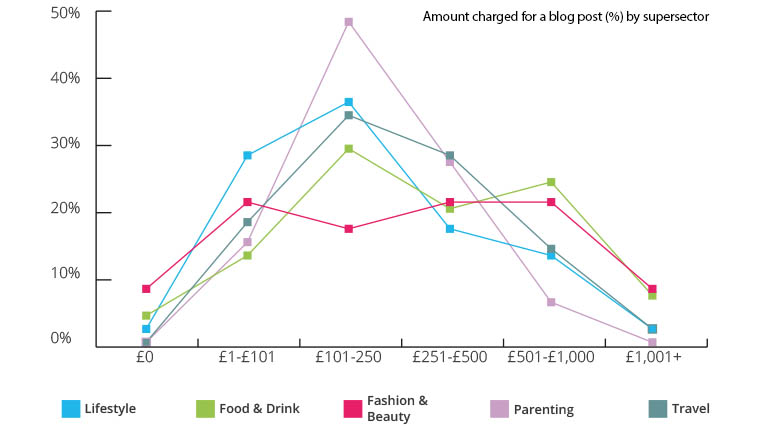
The supersectors receive more PR pitches for stories than any other category, suggesting they’re key to the growth of influencer marketing, which is already considered to be worth anywhere from $2bn to $10bn. This is reflected in charges for blog posts – Fashion & Beauty and Food & Drink have the biggest proportion of bloggers who charge over £1,000 per blog post.

The survey follows a recent spate of bad press in influencer marketing, with fake followers and non-disclosure two of the biggest issues facing the legitimacy of the industry. A huge majority of bloggers (88%) believe sponsorship disclosure is important for every collaboration but that still leaves a sizeable minority for whom this requirement is not a priority.

Bloggers have also commented on the future of their industry, with almost a quarter (24%) believing that blogs will become driven by advertisers’ needs and nearly half (42%) believing their audiences will become more sceptical of bloggers’ motives.

Download the full survey here

Want to work with bloggers, vloggers and influencers? You need the Vuelio Influencer Database – the definitive source of bloggers who accept PR materials in the UK. 

Alex Jacquot letter

Qantas and Oceania Express: how the human touch helps brand fly high on Twitter

If you’re up on brand engagement or extremely-ambitious children building businesses on social media, you’ll have seen Alex Jacquot’s successful schmoozing of Qantas boss Alan Joyce this week. Alex, the Sydney-based 10-year-old ‘CEO’ of ‘start-up airline’ Oceania Express, got in touch with Alan, the 52-year-old CEO of Qantas, for advice on providing a quality service for his customers. Because funnily enough, both Alex and Alan’s airlines are planning similar Australia-to-London flights at the moment.

Alex asked: ‘I’m thinking about, as you are, about an A350 for Sydney/Melbourne to London flights. Seeing as it is a 25-hour flight, we are having a lot of trouble thinking about sleep. Do you have any advice?’

Alan’s response: ‘…to your troubles thinking about sleep on 21-hour flights. This is something we are grappling with too, as we embark on Project Sunrise (which is our plan for flying passengers non-stop between the east coast of Australia and London).’

Cynics may suggest this was a meticulously planned attempt to get publicity for Project Sunrise, but that wouldn’t change the outcome. To media outlets covering the viral tweet, it’s ‘heart-warming’ and ‘cute’, and a story worth publishing.

Just as most of us would prefer human aircrew flying from Melbourne to London instead of the automatic pilot from ‘Airplane’, humanity is what works for brand engagement rather than robotic automated approaches.

Using the human touch to achieve Twitter success is nothing new – here are six examples of brands flying high you may have missed:

1. Wendy’s grapples with wrestling fans
The brand that helped Carter get his nuggs is well-known in social media circles for its sass and witty replies – even interacting with fans of things other than chicken. Wrestling fans, for example, can always depend on the Wendy’s account (and whichever WWE fans are running it) to give thoughts on upcoming bouts and reply with popular catchphrases.

To those who don’t watch this stuff, it seems niche. But to fans, it inspires loyalty to a fast-food brand, which happens to be a perfect accompaniment to pay-per-view watching.

2. Merriam-Webster uses words good

Dryly tweeting long words people can use in their next Scrabble game is one way to use Twitter if you’re a dictionary account. Another is to react to the same things your followers are tweeting about, with added commentary. Merriam-Webster has been helpfully explaining some of the new phrases that have come out of the Whitehouse since 45 moved in, which is very Covfefe, as well as smart PR.

3. DiGiorno brings us back to dough

Making use of popular hashtags is another tried and tested approach for quick engagement, and live-tweeting Maria’s escape from the Nuns and Nazis in ‘The Sound of Music’ is always popular. DiGiorno, the US-based pizza brand, got some tasty returns on their participation during NBC’s live production of the musical in 2013, earning 4,000 extra followers and 65 million media impressions after write-ups in outlets including USA Today, Buzzfeed and Mashable.

4. Fiat drives their followers away in Germany
Back in 2013, the Fiat 500 Abarth was just ‘too fast to follow’. So fast, in fact, that Twitter users were swiftly blocked from following its social media account in Germany. Rushing to see if you’ll be left out can be just as powerful a force as fear of missing out – a tactic also used by the Thanos subreddit that banned half of its community last year. Individual bans: turns out lots of people quite like it.

5. The Philadelphia Flyers’ social media team hits it out of the park

If you watch ‘The Walking Dead’, or read the comics, you’ll know why this Philadelphia Flyers tweet got so much attention. If you don’t [SPOILERS] – actor Steven Yeun tweeted support for the Detroit Red Wings, which the Flyers (the rival team) didn’t take too kindly to… so they tweeted support for Lucille, the baseball bat that’s used to kill Yeun’s character in The Walking Dead TV series. Ouch. It’s nasty, and petty, and got retweets from Dead watchers, and follow-up articles on sports and entertainment websites. Which didn’t hurt the Philadelphia Flyers brand at all.

6. Twitter gets ‘excited’ for a Meghan Trainor press release [Mildly explicit]

And now to the uniquely human trait of hubris. This is a hard thing to pull off, but when it works, it goes viral quickly. This press release for pop star Meghan Trainor’s upcoming single release was considered to be so overwritten and overambitious, it had to be shared with the world. A lot. Not every product can be publicised with phrasing like ‘smashing bae’s junk to smithereens’ but in this instance, it worked, and became one of the most successful press releases of recent times – achieving huge coverage for ‘All the Ways’.

If something’s embarrassing, novel, or features a cute kid who wrote someone a cute letter, it’s got a good chance of getting your brand some attention, particularly from all the humans out there who’ve got access to a retweet button.

Brexit calendar

Brexit: Is the comms industry ready?

The CIPR has issued new Brexit guidance to help PRs prepare for Brexit.

The guide delivers information relevant to the profession on matters such as data protection, copyright law and travel. It also highlights the role public relations professionals can play in helping businesses prepare for every eventuality, particularly if the UK leaves with no deal.

The practical guidance has been published ahead of the UK’s scheduled exit from the European Union on 29 March and tonight’s crunch vote.

Emma Leech, CIPR President said: ‘Despite the frustrating lack of clarity surrounding the impact of Brexit on professional services, it is crucial that PR professionals familiarise themselves with the basic details of the process and the potential outcomes for businesses. Whether you work in an agency, in-house or as an independent practitioner, there are likely to be significant changes to the way your clients or business operates. This guide will equip you with a basic understanding of how to help clients and organisations navigate the complexities of Brexit.’

View the CIPR Brexit guidance here

There’s a lot of uncertainty about how Brexit may affect the comms industry, so we asked some top PR bloggerss for their views:

Sarah Hall, founder of Sarah Hall Consulting said: ‘Whether we like it or not, Brexit offers a great opportunity for strategic PR professionals. Our role is to help organisations navigate change but to do this you need the appropriate training and qualifications. It’s why I’ve been talking about public relations as a management function via my #FuturePRoof community and latterly via the CIPR to encourage practitioners to upskill accordingly.’

Scott Guthrie, marketing consultant said: ‘Brexit is affecting comms in two ways: by seemingly keeping all other news from front page for almost two years; and, by heightening a sense of anxiety. My clients are typically small businesses. Small business accounts for over 99% of all private sector businesses in the UK. Yet, just 6% of small and medium-sized businesses feel the Government is listening to their concerns about Brexit. That is causing them anxiety and preventing them from making any significant business decisions.’

It was also the topic of our recent webinar Emergency Brexit with Iain Anderson, executive chairman at full-service communications and market research agency Cicero Group; Gill Morris, chief executive of DevoConnect; Matthew Elliott, who was chief executive of the Vote Leave campaign; and our host lobbying supremo Lionel Zetter.


Mental Health

7 tips to improve mental health in PR and comms

Mental health is finally starting to get the attention it needs in society. As our Issue Spotlight: Workplace Mental Health revealed, it’s high on the Government’s agenda and has drawn in a range of stakeholders across MPs, charity and business. 

It’s also a major issue in PR and comms, which is why PRWeek asked a question about mental health to its most influential comms professionals in the Power Book 2019. The question, ‘What key practical step can your organisation take to improve staff mental health?’ produced answers covering a range of helpful advice for anyone working, or managing, in communications today.

1. ‘Restricting out-of-working-hours emails and calls where possible
This comes from James Herring, CEO and co-founder of Taylor Herring, but it’s a popular tip throughout the Power Book. While some answers discuss different ways to create a digital detox, limit specific hours or even offer in-house apps that encourage staff to switch off (that last one’s at Frank), ultimately they’re all saying the same thing – when you’re not at work, don’t be at work.

2. ‘Create a culture in which mental health is spoken about and dealt with in the same way as physical health’
Sarah Hall, former president of the CIPR, makes this point, which many work places are still struggling to implement. We easily accept people’s inability to come into work or perform their best when struck with physical illness but there’s a gap where mental health is not understood in the same way. By talking openly and treating it as you would any other illness, mental health becomes less stigmatised and those that need help are more able to get it.

3. ‘We offer free financial-planning clinics’
This is one of a range of perks Mark Flanagan, UK MD at Portland outlines and one which could do a great deal for the mental health of many. There are lots of links between mental ill health and financial problems – in many cases both negatively feed off each other making each situation worse. Good financial planning, which is often a service not available to most, helps people avoid this spiral.

4. ‘Put personal needs at the heart of development plans’
Ella Dorley-Brown, MD at The Academy, makes this suggestion. It’s often easy to make development plans with the business in mind and the many ways to achieve those goals, but if we develop people with their needs in mind we will have happier, more productive staff and that will ultimately help achieve the business goals.

5. ‘We are rolling out Mental Health First Aider training’
A number of those interviewed have said they have Mental Health First Aiders in their companies and agencies. Anna Bartle, vice-president, corporate affairs at The Estée Lauder Companies UK and Ireland, goes on to say that these First Aiders will ‘spot the symptoms of mental-health issues if they occur, offer initial help and guide a person towards support.’ Having other staff looking out for colleagues is a great way to make the environment at work more supportive and more understanding of mental health issues. Even if you don’t have officially designated First Aiders, training for staff to help spot those in need could make a world of difference to someone’s life.

6. ‘Create safe spaces for people to talk about their lives without fear that it might impact their prospects’
This one is from Greg Beales, director of campaigns, policy and comms at Shelter. It highlights the stigma still attached to mental health in the workplace whereby many people feel they can’t speak up, which ultimately will make things worse. If your culture allows people to talk about it without any fear of retribution, it will improve the mental health of the whole company.

7. ‘Offer flexible working hours and a choice of work location’
Said by Shakila Ahmed, comms director at Travelodge, this is another popular point raised throughout the Power Book. While some go as far as four-day work weeks or unlimited holiday, it doesn’t have to be that much of a change to make a big difference. Adapting to meet the needs of each staff member will often get the best out of them; if you have the flexibility to manage everyone individually, it will not only improve mental health but also increase productivity and performance.

…and finally, a plea
We were struck by Simon Enright, Director of comms at the NHS’s answer, which included a plea. He said: ‘We were grateful to the RHS Chelsea Flower Show for donating a mental-health garden to Camden and Islington Mental Health Trust. Can anyone donate another to each NHS Mental Health Trust in the country?’

How does your company or agency improve mental health at work? Let us know on Twitter @Vuelio.

IWD what's it like to be a woman in the industry

International Women’s Day: What’s it like to be a woman in this industry?

For this year’s International Women’s Day, our female colleagues completed an anonymous survey about IWD and working as a woman in the industry. The first post is here. In this post, we look at what it’s like be a woman in the industry – covering the PR, public affairs and the tech sectors, just as Vuelio does.   

We’ve also been overwhelmed with positive comments for our CEO, Joanna Arnold, because as a tech SaaS company it’s highly unusual that we have a female leader – and we’re proud to be different.

What makes Vuelio different
‘Vuelio works outside the industry norm as we have Joanna as our inspiring female CEO and a number of women in senior management positions across the business. I’m proud to be part of a progressive company that values women and men equally.’

‘I particularly like that I have a female CEO in the software industry as it isn’t what people would expect!’

‘Women are capable of doing anything and everything. Our CEO is an example that women can fit in to IT industry and can drive the whole company.’

‘I very much hope that the women I work with feel that it is great to be a woman in this industry and in this company.  We are led by a female CEO; the gender split for our senior leadership team mirrors our overall gender split, and in those departments where there is a gender imbalance such as Development and Sales our managers are fully aware of this and actively looking for female candidates.’

‘Being a woman in Vuelio is fantastic as there are many women within the leadership team to inspire and learn from. Being a woman in the sales industry in general can be challenging. I have been patronised and underestimated many times in the past but again, Vuelio is different to the rest of the industry.’

‘After working for men for most of my career it is genuinely refreshing and inspiring to be working in a company with a woman as CEO and other smart women in the senior team too. As a woman, you look at them and realise that if you work hard maybe someday you can be them too.’

‘I am very proud to be employed at a female-lead company. It is incredibly motivating to know that my leader understands my perspective and provides me with opportunities to drive my career forward.’

‘I think people associate a SAAS company to be run by men, and so it means a lot to me that the CEO of this company is a woman. Having a woman CEO is inspiring, and very important to me, and is one of the main reasons I work at Vuelio.’

The industry is positive and supportive
‘Being a female in the industry means acknowledging the hard working and successful women that do an amazing job. It’s a powerful time to be a woman and inspiring to be surrounded by supportive, strong women!’

‘Being a woman in this industry has overall been a very positive experience and I feel I’m held at equal balance to my male colleagues. I feel respected and am glad to be in this industry.’

‘I think it’s important that we celebrate success from both men and women in the industry, there’s some really inspiring people that have worked very hard to get where they are regardless of their sex! We are lucky to have an inspiring CEO who is a constant reminder that being a woman should not get in the way of being successful!’

The differences in PR and Public Affairs
‘Public affairs seems quite pale, male and stale. That’s not the case here – this is a very supportive environment and being a woman doesn’t feel like a hindrance at all.’

‘In my opinion, it’s pretty saturated by women – however sometimes at the top it can feel a bit like an old boys’ club. It’s inspiring to see women reaching new heights, taking positions in C-Suite and board level positions. I think it’s important for women to empower each other, but actually to inspire both men and women if we want true equality.’

‘PR and Public affairs are quire difference in their gender balance, Public Affairs is still male dominated, particularly in leadership roles. There is still a long way to go, however organisations like Women In Public Affairs are breaking down barriers and connecting successful female leaders with those seeking mentorship and insight. This is exactly the kind of programmes that the industry needs!’

‘It still depends on what room you end up in on any given day – in some, people with deeper voices are automatically given more credence and respect, or you’re expected to clean up after people, or be okay with being spoken over in meetings. There are still portions of the industry that haven’t moved on from the sexist 90s PR/media culture. But we’re doing GREAT compared to lots of other industries, and I’m grateful for that.’

‘Being a woman in media is not as bad as it is in other industries, because there are lots of women in PR. There’s a solidarity there, and I feel pride and hope seeing more women in senior positions than in industries like finance, for example. However, as a woman of colour in the industry, you can still feel as if you are at the bottom of the barrel. I am a freelance journalist too, and find I have struggled to have my voice heard more than others. As a woman of colour in the industry, you have to fight twice as hard to be heard. We need solidarity and understanding of this fact from other women.’

‘We have some really influential women in this industry and I think compared to others, it’s easier to be successful in the media/PR space. I think it’s harder to be taken seriously as a woman in Public Affairs, and this is still hugely male dominated.’

‘I’ve found it to be positive and sit within an evenly split team of both men and women. Attending industry events does show that the more junior roles are often women with men taking the top spots, hopefully this will change thanks to organisations like Women in PR and Women in Public Affairs. Plus, I’ve been lucky enough in my career to work with a female PR powerhouse: Mary Whenman!’

‘The PR industry is dominated by women whereas in the tech industry, only 30% of workers are female. I think it’s important for young girls to have role models working in industries that aren’t traditionally female, breaking traditional barriers and showing that there are no gender specific jobs. Most importantly, it’s about being who YOU want to be. Within our industry, there are a lot of inspirational women who are trying to drive change, so it’s time we try to tackle issues such as the gender pay gap!’

The challenges of being a woman in the industry
‘I have at times in the past had to work a lot harder to prove myself and get my points across than perhaps some of my male counterparts did simply because they were louder or more confident – although I don’t think that was ever a conscious bias my employers had; for the most part I don’t think they realised they were doing it.’

‘Laddy banter can often dominate conversations where women are in the minority, and it’s difficult to know how best to position yourself to fit in.  I’ve generally had the best experience when teams are made up of a diverse range of people.’

‘Like in any industry, juggling motherhood with your career can be challenging even if your employer is willing to offer flexible working hours. It’s still relatively uncommon for parents to share parental leave in the UK and, with high childcare costs, many women find themselves taking a break from their career or cutting work hours until their children reach school age. I have been lucky to continue working since having my child but unfortunately not everyone has this option. Taking a few years off can seriously affect your chances of finding a new job and your future pension pot will also stay frozen until you are able to start contributing again. The same goes for women applying for jobs around their childbearing age – gender bias, conscious and unconscious does exist in the workplace, which puts a lot of pressure on women wanting to reach their career goals while planning to start a family.’

‘I think sales is a tough role for everyone, female and male. I do think that some preconceptions still exist around ‘salesmen’ being the ideal in this industry. However, I think clients are looking for a credible and friendly advisor, regardless of gender or any other demographic for that matter. It’s also super inspiring to have such an accomplished, driven and overall FUN female CEO!’

‘Last year, my former employer held an event for International Women’s Day. Women who had been successful in their careers spoke to an audience mainly made up of other women. It’s all very well talking about success; however, I think it’s important to recognise that, often, women have a great deal more to think about than their male peers on a day to day basis. Whether that’s the pressure of looking a certain way (i.e. the time and money it takes to look merely ‘acceptable’ to a corporate crowd), to the potential discomfort of walking home from work alone in the dark, to carefully positioning how you come across so you appear to be ‘strong’, but not a ‘bossy bitch’, etc. These are the things that I’m REALLY interested in hearing about – I feel it’s important that these annoyances are shared so women don’t feel isolated in the work place. The fragility of a few men’s egos have caused me considerable stress over the years – in and out of work. It’s an exhausting task to balance everything. A truly open dialogue about gender is vital in order to facilitate EVERYONE in feeling empowered enough to be their true selves, and not be inhibited by their gender, whether they be male or female.’

IWD what does it mean to you

What does International Women’s Day mean to you?

For this year’s International Women’s Day, our female colleagues completed an anonymous survey about IWD and working as a woman in this industry. In this first post, they talk about International Women’s Day and what it means to them.

What does International Women’s Day mean to you?
‘It is about striving for balance and acknowledging that women have a significant part to place in the workplace and should be equally valued and compensated.’

‘A special day to remind women that we are wonderful but also that we still have some way to go in the fight for equality. And that’s ok, we are in this together.’

‘Solidarity and recognising how far women have come and achieved. Empowering each other and creating awareness on equality worldwide is important!’

‘To celebrate how far women have come in terms of being valued and represented in society, since the days when we were considered inferior to men. Luckily, in most of the western world, we have now gained a seat at the table and it’s a chance to celebrate the success of those who helped us get there, but also a reminder that there is still some way to go in some countries, for example less access to education, health and safety risks and political representation.’

‘Gender equality is still an issue in many contexts, it is not a ‘given’ that men and women are treated or perceived in equal terms. IWD provides an opportunity to have positive discussions regarding the importance of gender balance and to celebrate wonderful female role models who are leading the charge.’

‘Like many men and women, my views on the need to secure women’s rights and shape an equitable society have been influenced in recent years by raising a daughter.  A daughter who (despite often wearing gender-neutral clothes and playing with ‘boy’ toys and having a proudly feminist working mother and a father who is more useful in the home than her mother), said at the age of six when asked if she would like to be a doctor, ‘I can’t be a doctor, only boys can be doctors.’ A daughter who had to be persuaded to remain in the top maths set at school because she was the only girl from her form in that set.  A daughter who has repeatedly heard other mothers saying to their daughters, ‘Don’t worry, darling, I wasn’t any good at maths/science/technology either’ as though those things were in some way not cool or aspirational.  A daughter who has said she can’t call herself a feminist because she associates that term with being unfeminine or anti-men.  A daughter who sets high standards for herself and the women in her life, but who is comparatively tolerant of the foibles and failings of the men she knows (in a ‘Oh, shame they can’t help it’ sort of way).  We kid ourselves if we think we don’t have to be alert to gender bias in our society and International Women’s Day is a great time to stop and think about that.’

‘This is a day where I can reflect how proud I am to be a woman and recognize the progress I’ve made in my career and personal life.’

‘For me, its super important. I have a couple of really inspiring women close to me, in my work and personal life and I think it’s great to take a moment to appreciate and reflect on their success/journey.’

Am I a female role model

Am I a female role model? International Women’s Day with Joanna Arnold

I am delighted to be writing this on International Women’s Day. For me, IWD is a fantastic movement that recognises and promotes the achievements of women and finds ways to support and encourage more to fulfil their potential. It’s not a single event confined to 24 hours – each year feels like another step in the right direction with more progress for women’s rights and gender equality.

Joanna Arnold IWD 2019But it’s patently clear that there’s still some way to go. We know, from the PRCA Census, there’s a 21% gender pay gap in PR and comms, which is higher than the UK average (which is obviously too high itself). The Census also revealed a 7% increase in female MDs since 2016, but men still dominate at the top and true equality is therefore still lacking.

At Vuelio, our story is a little different – we have an even gender split across senior management and a female CEO, which is rare for a tech company.

I was recently asked whether I feel a responsibility to be a strong female role model as the CEO of Vuelio. The answer is complicated because I feel a responsibility to be a role model for all my staff, no matter what gender, and try to champion excellence in Vuelians* in all its forms.

As a business we’re aware that not all departments are as diverse as they could be, and where we have an uneven split – in Development for example – we’re actively seeking to bring more female Vuelians into the fold. This isn’t just a gender policy but part of a wider belief that a diverse workplace makes better products, services clients more effectively and solves problems more efficiently.

So, I tend not to focus on my role in the company as a woman, but as someone who has worked hard and is now in a position to support and mentor others in this business. I actively seek to increase diversity and mentor brilliant people, so they can progress their careers at Vuelio. The fact I can strive for this and also be a female role model to other women in this industry is truly humbling and a responsibility I take seriously.

That’s why for this International Women’s Day we’ll be highlighting the views of female Vuelians from our company survey and we’re also delighted to have a guest post from Heather Baker, CEO at TopLine Comms, with advice for young female PR professionals.

But we’re not confining these brilliant voices to a single day, instead we’ll continue to featuring regular commentary and guest posts from excellent women in the industry. We have a few lined up already but there’s always room for more.

So, if you’re a brilliant woman, we’d like to hear from you. Get in touch and let’s start a conversation.

Happy International Women’s Day.


*Vuelians work for Vuelio, because we’re cool like that.

Heather Baker feature

International Women’s Day: Advice for young female PR professionals

This is a guest post from Heather Baker, Founder and CEO at TopLine Comms.

Reassessing the gender pay gap on International Women’s Day

Today marks the 108th International Women’s Day. It serves as a collective call for gender parity and this year’s theme #BalanceForBetter is, in my opinion, one of the best yet. It recognises the fact that balance isn’t just an issue that affects women, but a business issue: and it’s a really important distinction to make.

Even though PR has historically (and somewhat stereotypically) been perceived as a female-led industry, there is still a marked gender pay gap. According to the PRCA’s 2018 PR and Communications Census, the current pay gap between male and female PR professionals stands at 21%. When you compare this to the 2018 ONS stats, which put the gender pay gap at 8.6% for full-time workers (the closest it’s been for 21 years), you realise how far behind the PR industry really is.

Initiatives like International Women’s Day are important because they help create change and raise awareness. On the topic of gender parity, you can already see positive changes in education, with more children being taught how to code at primary school in the UK. By comparison, I went to an all-girls school and had to learn knitting and cooking alongside maths and physics. I ended up studying psychology at university; I would have preferred engineering but it just didn’t occur to me at the time.

Fortunately, my mum was a career woman and my dad always treated me like an equal, which helped me develop some valuable self-belief. After graduating, I went into PR. I’m proud to say that my company, TopLine Comms, is an equal opportunities employer and that our STEM specialist team comprises an equal gender split.

Having built TopLine from scratch, here are some of the things I’ve learned along the way that might help anyone starting out in public relations, or any other career for that matter.

Help others
Watch enough romantic comedies and you’ll end up believing that female colleagues need to be archenemies, but that shouldn’t be the case. Women must help other women succeed. The first step is to help others and hold yourself accountable for speaking up about positive gender parity and equality in your workplace.

Mentorship is extremely important to empower younger generations to fill the shoes of their seniors. Look out for mentorship programmes, or simply ask a more senior female colleague to mentor you and show you the ropes

Run your own race
Social comparison theory is the belief that humans are driven to self-evaluate by comparison to others. It’s easy to believe that your peers are better than you – maybe you think that they have better senior relationships, get to work on more exciting opportunities or get better results. But comparison is the thief of joy. It’s a dangerous practice and one that stops you from running your own race and focusing on you. Be yourself, know your strengths, use them wisely and the rest will follow.

Set boundaries
If you haven’t read Michelle Obama’s book ‘Becoming’, I strongly recommend that you do. In the book, she talks about the idea and importance of balance – precisely the theme of this year’s International Women’s Day. Juggling a career, family and friends, and still having time for yourself is no easy feat, so it’s vital that you set boundaries and stick to them.

Try to identify what you feel comfortable sacrificing and what you don’t, and then make sure that don’t compromise on it. It’s different for everyone so, as mentioned above, don’t compare your choices to others. You’ll find lots of articles with top tips from successful people, from not reading emails first thing in the morning to creating lists and getting enough me time. Ultimately, it just comes down to what you need to do to be your most productive self. Find what helps you to balance your time and don’t be embarrassed to incorporate it into your schedule.

Awareness days give us an excuse to reflect on important issues that affect our lives. Let’s use this year’s International Women’s Day and theme of #BalanceforBetter to tackle the gender pay gap and talk more openly about how women can succeed in the workplace.

PR Tips for Monzo success

4 PR tips for Monzo success

This is a guest post from Katy Bloomfield, Comms Director at TopLine Comms.

Monzo is arguably the UK’s biggest fintech success story to date. Just look around any London underground station and you’ll see hordes of commuters tapping in and out with their bright coral cards. Millennials are mad about Monzo; they make up its biggest market and help to drive its popularity, which continues to spread like wildfire.

In 2018, Monzo welcomed its millionth customer and secured new finance through customer crowdfunding, boosting its value to more than $1bn (£787m). Not bad for a digital bank that first launched in 2016. From its semi-humble beginnings, Monzo has grown into an industry leader. Plenty of start-ups want to emulate its success, and many PR agencies would love to work with them.

There is no doubt that Monzo’s spectacular trajectory is a great story, but it’s important to remember that a number of factors contributed to its rise. Here are four lessons PR firms and professionals can learn from Monzo.

1. Pay attention to timing
When it comes to PR, there is little better than being in the right place at the right time. To maximise this sweet spot, you need to understand your market fully – that includes your target audience as well as your competitors. Pay attention to trends, behaviours and events – this will help you identify the perfect moment to announce yourself.

Monzo, of course, could not have timed its arrival better. The 2008 recession did some serious damage to banks’ reputations, and consumer confidence hit rock bottom. The financial services industry worked hard to rebuild its reputation, but an increasingly tech-savvy customer base wasn’t satisfied with more of the same.

Digital disruptions were upending all sorts of status quos, from hailing a taxi (Uber) to booking accommodation (Airbnb) – and banking was no exception. In 2016, the foundations for a fintech revolution were already in place: 47% of the world, for example, used mobile banking. Monzo was not the first fintech to launch, but it launched during a perfect storm of opportunities and, crucially, launched with a better product than its competitors.

PR lesson: Keep a close eye on the market, and make sure your communication is well-timed.


2. Play the long game
Good timing requires patience, agility and a stockpile of content to release at the right time. It doesn’t pay to publish everything all at once, you’ll simply overwhelm your audience and drown them in messaging. Monzo used incremental communication tactics like focus groups, online surveys and social media teasers, and only then did it launch its first campaign.

Monzo also knows how to whet appetites and seed interest. The company cleverly staggers news, product updates and announcements: and the strategy works well. Founder and CEO Tom Blomfield recently penned a blog post on the company’s planned updates for 2019, introducing an exciting next stage of features that could add some serious value to Monzo’s core offering. The response has been positive, loyal and anticipatory – you can almost ‘hear’ the bated breath.

PR lesson: Keep your powder dry.


3. Know your audience
Monzo knows its target audience inside out. The company is enmeshed in millennial culture; using collaboration to create a democratic business. The Monzo Community Forum is one such example, encouraging customers to become advocates and evangelists known as ‘Monzonauts’. This community is treated to special events and their insights and ideas are fed back into product development for testing in Monzo Labs.

The Monzonauts are such an integral part of the bank that when the company’s original name, Mondo, faced a trademark challenge from another business, they came up with ‘Monzo’. By allowing Monzonauts to guide the company’s development and get involved, Monzo created a product that people want and will recommend. It worked; early referrals accounted for 80% of the company’s early-stage business.

PR lesson: Focus on the customer. They are your biggest asset.


4. Get out there and network
Blomfield has a rather rarefied circle of friends which assisted the company’s ascent. That said, he had to get out there, meet them and convince them of his idea’s viability – which he did. Blomfield cofounded GoCardless, a business aimed at streamlining direct debit collections, with two friends while studying at Oxford. They pitched the start-up to Y Combinator, an innovation incubator in Silicon Valley and in the process, met – among others – Mark Zuckerberg.

In 2014, Blomfield became Chief Technology Officer at Starling Bank. This was one of the UK’s first fintechs to launch after the financial crisis. During this time he met and worked with many top industry people, some of whom now work for Monzo or helped cofound it.

PR lesson: Building a business relies on making good relationships with key people. Make sure your communication efforts are targeted at the brand’s network of contacts – as well as its customers.  


Whether you’re a PR agency, or looking for one, keeping these four tips front and centre at all times will give your marketing efforts more oomph in the highly competitive world of fintech.

sharron and anita pr blind date

PR and Journalist ‘Blind Date’: When Relevance International met The Travel Magazine

Our third ‘couple’ in the first of our ‘blind date’ series were Anita Gryson, associate director at Relevance International and Sharron Livingston, editor at The Travel MagazineHere’s what happened when they met for their PR and journalist ‘blind date’. 

How was your lunch?
Sharron: It was interesting and fun. Anita was a fabulous lunch date.

Anita: Lunch was enjoyable and informative. It was a great opportunity to catch up with Sharron who I hadn’t seen since before I started working at Relevance International, just over a year ago. The team at Vuelio did a fantastic job at ‘matching’ us seeing as Sharron and I have both been working in the travel and lifestyle sector for over ten years. We met each other at the start of my career when I had just moved to London. We travelled together to a luxury resort I was launching in the Seychelles, and have made sure to arrange regular catch ups since then.

Sharron is passionate about travel and is regularly interviewed on TV, radio and in the press about travel trends and destinations. She updated me on the latest news from The Travel Magazine, a travel portal with highly informative, upbeat and inspirational articles for people who love to travel. We discussed potential stories for some of my clients including The Royal Atlantis Resort and Residences opening in Q2 2020 and The World’s 50 Best Restaurants’ 50 Best Explores travel series.

Did you learn anything new about their role? If so, what?
Sharron: I wasn’t aware of her new role. So, it was great to chat about what she does and who and her clients are.

Anita: It was interesting to hear about the way in which The Travel Magazine works with brands. She explained that the magazine has existed purely as an online publication since 2009 and is focused on brand journalism and cross-platform storytelling. As storytellers, they work with clients to include their brand and product offering as native advertising through highly informative, upbeat and inspirational articles. They also use their substantial social media following to not only promote a brand but also engage their readers with it.

In the past 10 years, The Travel Magazine has worked with hundreds of clients, including airlines, accommodation providers, CVBs, DMOs, visitor attractions, travel accessories, tour operators, OTAs, cruise companies, and many more.

Were you surprised by anything they told you about their job?
Sharron: No

Anita: Sharron and I established that there is definitely a misconception that our jobs are all about travelling, sipping champagne and parties. Ironically, we were discussing this over lunch while sipping a glass of wine.

Naturally, everyone sees the glamour of a career which involves travelling around the world. Due to the valuable time spent away from the office, travel time, layovers and time differences, the role can also involve fact checking at midnight having just landed at Heathrow, or writing a press trip report or article in transit to ensure deadlines are met. To be successful as a travel journalist or PR, it is a must to be passionate about travel and determined to get the job done. Sharron always delivers.

If you could share one top tip from lunch what would it be?
Sharron: Ask lots of questions and listen intently.

Anita: I would advise brands who want to engage with influencers to look further than those who are associated with Instagram. Online platforms can be valuable and have proven to make a difference to a brand’s bottom line.

Do you think this lunch will change how you interact with PRs/journalists in the future?
Sharron: Not really.

Anita: Driving results for clients and forging strong relationships with journalists will always remain at the forefront of my mind. Ultimately, our aim is to get that story published. Taking time to get to know someone’s likes and dislikes helps us build strong working relationships. Being professional, passionate and connected continue to be key work values I live by.

Did you disagree on anything? If so, what?
Sharron: No. It was a conversation and an exchange of ideas and we explained how we work and what we are looking to achieve.

Anita: The conversation cards we were given allowed for an interesting conversation about journalists and PRs, best and worst experiences, what we look for, respectively, when working with journalists and PRs, and common misconceptions. We were very much on the same page.

If you could change one thing about PRs/journalists what would it be and why?
Sharron: Only that I would like to receive only relevant stuff, but with round-robins that is not likely.

Anita: I’d love to swap jobs for a day so that PRs can appreciate the hard work that journalists do as well as what we do for them.

Finally, do you think you’ll stay in touch?
Sharron: Yes. I am sure there are ways to work together.

Anita: Absolutely. It was great to hear how The Travel Magazine has evolved since its launch. I hope to still be working with Sharron in ten years’ time, and again ten years after that, with regular catch ups and lunches. A big thanks to Vuelio for arranging this one!


Sharron and Anita’s ‘blind date’ took place at the Paternoster Chop House aka the First Dates restaurant! If you’re a PR or a journalist and you’d like to be set up on one of Vuelio’s professional ‘blind dates’, please email Rebecca Potts.

Emergency Brexit

Emergency Brexit: Predictions for the Comms Industry

The UK is set to leave the EU on 29 March – that’s only 25 days away. Our next webinar will explore what these final weeks have in store for the comms industry and what’s coming next.

Emergency Brexit takes place at 11am on Tuesday 5 March. You can sign up to join us live, or receive the recording afterwards.

The webinar will hear from leading industry experts including Iain Anderson, executive chairman at full-service communications and market research agency Cicero Group, Matthew Elliott, who was chief executive of the Vote Leave campaign, and our host Lionel Zetter.

Matthew, who is now senior political adviser to Shore Capital, has been described by the Financial Times as ‘one of the most formidable political strategists in Westminster’, by the New Statesman as ‘one of the most successful – and feared – campaigners in British politics’, and by the BBC as ‘one of the most effective lobbyists at Westminster’.

He previously led the successful NOtoAV campaign in the 2011 referendum on changing Britain’s voting system, and he also founded the TaxPayers’ Alliance and Business for Britain.

Iain is an expert in integrated communications, global political risk and public policy. He has over 25 years’ experience in communications, initially as a business journalist and then as a founding shareholder at Incisive Media. He has also worked for a range of politicians, including Kenneth Clarke MP on his leadership bids.

He is co-founder and executive chairman at Cicero Group and focuses on public policy and corporate communications strategy supporting many global FTSE and Fortune 500 blue chip organisations. He provides CEO and Board-level counsel.

Lionel is known across the industry and has written, spoken and taught widely on politics and public affairs. The former CIPR President is an expert in lobbying and will play host to our other esteemed guests.

The webinar will cover the comms aspects of the original Brexit referendum, the effect the result has had on communications and business over the last three years, how to prepare for Brexit and what the likely scenarios are over the next four weeks and beyond.

Everyone who signs up will have a chance to question our guests but if you’re unable to join us live you’ll receive a recording of the whole webinar afterwards.

Sign up here, and prepare for Brexit.

Amanda Coleman

PR Blogger Spotlight: Amanda Coleman

Amanda Coleman is head of corporate communication at Greater Manchester Police and uses her blog to share opinions and expertise on issues across the industry. Amanda’s blog is featured in the Top 10 UK PR Blogs, and we caught up with her to talk about how Brexit and other issues are affecting comms, and why it’s important to love what you do!

What’s in store for the blog in 2019?
I never really make firm plans for the blog I just see what happens and then work from that point. It was set up so I could share some thoughts, views and ideas as long as I can still do that then I will be happy.  

How has PR changed since you first got into the industry?
It has changed almost beyond recognition. There was no social media when I moved into PR and we had one computer that could access the internet for the whole office. At the heart of it though the skills are still similar, it is about people and understanding them as it was when I started. 

How much is Brexit affecting comms in the UK?
I think the uncertainty is what is affecting people the most.  

What’s the biggest issue facing the industry (outside of Brexit)?
The issues remain broadly as they have in recent years. The lack of diversity is a critical issue as is the gender pay gap that still exists. The challenge is also to demonstrate real business benefits and to have the right data and analytics to support what we do.  

Are traditional media outlets losing their importance to the industry?
From my perspective no. Their role is changing but the move for media to rush to break the news digitally means they are moving to be more relevant to modern audiences. The way our society is organised means they are still influential among stakeholders. 

What’s the best campaign of 2019 so far?
I think it has to be the Greggs vegan sausage roll mainly for the interaction that the brand had with Piers Morgan. As a vegan, though, I  am yet to taste one. 

What advice would you give students looking to join the PR industry?
Find the right brand or organisation for your values and interests. You spend a lot of time at work and if you can’t love what you do then you can’t give your best.          

What are your best pitch tips for PRs?
Understand the business and know the data. 

Do you receive pitches from other PRs looking to work with you in your capacity as a blogger?
Very rarely but that is probably because I work in the public sector and people realise I need to be careful about any conflicts of interest.  

What other blogs do you read?
I love finding new blogs or first blogs from people. I am always drawn to communication and PR blogs. I love all those who are on the Top 10 including Sarah Hall, Ella Minty and Stephen Waddington

Reach-the-right-influencers-with-the-Vuelio-media-database

MK and Wadds

Comms School aims to create top bloggers of the future  

Top PR bloggers and Metia colleagues, Stephen Waddington and Marcel Klebba, have joined forces to help students get ahead in their careers through blogging and creating communities. We spoke to them to find out what Comms School is and how it’s going to help progression in the industry. 

What is Comms School?
It’s a community for anyone that’s keen to learn practical communication skills to get ahead in their job. During the initial 12-week course we’ll cover the basic skills you need to land a job and get ahead. We’re running webinars every other week.

Who are you?
Stephen recently landed at Metia, the digital marketing agency, as managing director. Marcel is a new colleague who captured industry attention in 2016 thanks to his relentless approach to blogging and networking while at Westminster University. We’ve both been named top ten industry bloggers by Vuelio for the past few years and Marcel was crowned the UK’s top PR blogger in 2017 [pictured, above, with Stephen celebrating his win].

Why have you set up Comms School?
There’s a gap between what students are taught at college or university and the practical skills needed to get ahead at work. Mentoring, work placements, Twitters chats and initiatives such as Richard Bailey’s #PRstudent blogging community all help. We want to help people that are looking to get ahead in their career as well as create a talent pipeline for Metia.

What will success look like?
We want to help students land jobs by blogging and building networks. It would be great to see our students feature in the Vuelio blog ranking in the future and maybe there will even be an award-winning blogger among our graduates.

What topics will you cover?
The six sessions and online discussions will cover blogging; building a social profile; developing an online community; content creation; and finding a job and getting ahead.

How do I join a session?
We’ve built a virtual classroom on Facebook. Follow the link or search for Comms School. Please come and join the growing community of more than 300 people. Sessions start on 5 March.

School’s in – good luck to everyone taking part in Comms School, we look forward to seeing you in our rankings soon! 

DEFRA

Government comms focuses on influencer outreach

Michael Gove’s announcement that he has appointed 10 ‘green ambassadors’ is the latest sign that the political and influencer worlds are colliding.

Under Gove, the Department for Environment, Food and Rural Affairs (Defra) has embarked on an ambitious programme of work. Some of this is forced – leaving the EU requires major changes to agricultural, fisheries and environmental policies – but much of it seems to stem from Gove’s own desire to make a mark.

Indeed, improving our environment seems to have become something of a personal mission for Gove, who tweeted that footage of the impact of plastic pollution on our oceans in David Attenborough’s Blue Planet II had left him ‘haunted’. Measures he has announced include a ban on plastic straws, stirrers and cotton buds and a deposit return scheme for drinks containers.

When Theresa May launched the 25-Year Environment Plan in January 2018, one of its measures was a commitment to make 2019 the ‘Year of Green Action’, alongside a commitment to scope out ‘an evidence-based behaviour change strategy’. Indeed, one of the most important parts of delivering the environmental change our planet requires is to deliver behavioural change by getting us to appreciate our impact on the environment.

With this in mind, it is hardly surprising that Gove has chosen to work with influencers in order to communicate his department’s environmental message. By moving beyond ‘traditional’ ambassadors – you might expect such a list to contain charity leaders, academics or high-profile businesspeople – Gove will know that his message is reaching a larger, more diverse audience that more conventional figures simply wouldn’t reach.

Indeed, the list of ten ambassadors is wide-ranging. It contains Besma Whayeb, whose blog Curiously Curious was ranked as one the top ten UK green blogs by Vuelio, and Sian Conway, the Green & Eco Influencer of the Year 2018. Alongside these, the list also includes an endurance swimmer, television presenters and an adventurer who sailed across the Pacific in a boat made of 12,500 plastic bottles. And while there is an academic – Professor Tim Jackson – even he has nearly 11,000 Twitter followers.

Gove’s expressed hope is that his strategy will, ‘ensure that this country is recognised as the leading global champion of a greener, healthier, more sustainable future for the next generation’.

The ambassadors were introduced at a reception which also featured the #iwill4nature campaign, encouraging young people to take part in green social action. Among the newly-announced influencers was the student Izzy McLeod, who blogs as The Quirky Queer. It seems clear that by working with younger influencers to spread messages about environmental responsibility to their peers, Defra hopes reaching the next generation and implementing its environmental goals will be much easier.

Scott Guthrie

PR Blogger Spotlight: Scott Guthrie

Scott Guthrie’s blog focuses on informing PRs on everything to do with influencer marketing, alongside content around wider comms topics. Scott Guthrie is one of our Top 10 UK PR Blogs and we caught up with him to talk about influencer marketing issues in 2019, top tips for pitching and why The Body Shop is winning at influencer marketing so far this year. 

What’s in store for the blog in 2019?
More of the same. I wrote 47 articles on influencer marketing for my blog in 2018 plus a dozen or so covering public relations in general. Increasingly my aim is to peer over the brow of the hill at the issues influencer marketing is likely to face in the near and midterm.

Last year I foresaw three major issues for the nascent industry: influencer fraud; lack of transparency in disclosing advertisements; and a media backlash. These issues will rumble on throughout 2019 but we will also look beyond compliance to consider the ethics surrounding influencer marketing. For example, we will consider why it’s not okay to promote gambling sites to young, impressionable audiences, and why ‘merch’ shouldn’t be so oversold. The industry will also start to ask questions about kidfluencers, image manipulation and virtual influencers. I’ll be writing about these issues and how the industry approaches them via regulation and trade body codes of conduct.

How has PR changed since you first got into the industry?
I can still (vaguely) recall foot messengers delivering financial results and press releases by hand to the City editors. While in newsrooms rip and read printers spewed out headlines from the Press Association. Press releases were usually faxed to newsrooms. The importance of a good story told well from a trusted source hasn’t changed. The technology surrounding news acquisition and distribution has. Technology has splintered the entire media landscape.

How much is Brexit affecting comms in the UK?
Brexit is affecting comms in two ways: by seemingly keeping all other news from front page for almost two years; and, by heightening a sense of anxiety. My clients are typically small businesses. Small business accounts for over 99% of all private sector businesses in the UK. Yet, just 6% of small and medium-sized businesses feel the Government is listening to their concerns about Brexit. That is causing them anxiety and preventing them from making any significant business decisions.

What’s the biggest issue facing the industry (outside of Brexit)?
Influencer marketing offers an amazing opportunity to the public relations industry. The discipline can transcend ‘selling stuff’ to embolden positive reputation, communicate an organisation’s purpose, assist in a crisis situation, or scale subject matter expertise heightening employee advocacy in the process. The biggest issue is the risk that these opportunities are passed up by the PR industry. The risk that these opportunities are squandered; handed over to the other creative industries only for us to look back in future years and realise our mistake. The same mistakes of missed opportunity that we saw with failing to shape the future of social media, SEO or content marketing.

Are traditional media outlets losing their importance to the industry?
There is no secret that the media has fragmented from print, to online and social media. In turn influencers have emerged on every media, in every market. This does not mean that traditional media outlets are no longer important. It does mean that, as effective communicators, we need to know which mastheads, broadcasters and individuals are influencing the important people we are seeking to influence on behalf of our clients. Our opportunity is to work with these organisations and influencers and to engage with their networks in the way we have traditionally done solely with journalists.

What’s the best campaign of 2019 so far?
The Body Shop works with influencers in two very separate ways: to sell product; and to affect positive social change. For its Forever Against Testing campaign, the cosmetic company sought to gather eight million signatures in the form of a petition to take to the United Nations. The campaign over achieved its objective in under the time allocated: 8.3m signatures in 3/4 time. The campaign demonstrated a fundamental element of influencer marketing – that influencers can help affect change in behaviour and opinion. And that the change needn’t be confined to a purchase decision. The campaign also highlighted the importance of an integrated communications programme.

What advice would you give students looking to join the PR industry?
Read widely and read deeply. Acquire a firm understanding about how the PR industry is put together and look to specialise in a particular area. Follow relevant hashtags on LinkedIn and Twitter. Start to form your own opinion then codify and collate those opinions into your own blog. Writing about a subject is a wonderful way to better understand that subject. It is great way to showcase your mastery of the subject and mark yourself out from other graduates looking to enter the industry.

What’s your best pitch tip for PRs?
Never pitch blind. Know who you’re pitching to. Know what they’ve written or broadcast recently. Know their point of view. Understand their audience. Attempt to establish a degree of relationship before you need to pitch. That might mean following the journalist on social media, sharing their articles and commenting on them. My best pitch advice is to be useful to the journalist.

What other blogs do you read?
I am a major fan of Richard Bailey’s work at PR Place. He edits the site and his Friday morning round-up posts are a must-read for PR practitioners regardless of whether they are just starting out or well-established in their careers. I also enjoy talkinginfluence.comstedavies.cominfluenceonline.co.uk,orlaghclaire.com, and the Vuelio Blog natch!

Reach-the-right-influencers-with-the-Vuelio-media-database