CIPR Climate Change and the Role of PR

‘You have a direct role to play’ – CIPR’s Climate Change and the Role of PR conference

This morning’s sessions for CIPR’s half-day conference on climate change offered advice and solutions for PR practitioners to lead on sustainable practices and strategy – something posed as a challenge, an opportunity, but also a responsibility for the sector.

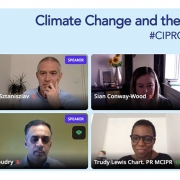
Following an introduction from CIPR president Mandy Pearse, event chair Trudy Lewis led attendees through panels, presentations and discussion including Climate Group’s director of internal communications Luke Herbert on ‘How comms professionals can save the planet’ and A Plastic Planet’s co-founder Sian Sutherland sharing ‘Truth, responsibility, opportunity, risk, legacy – 5 words in 15 minutes to sum up the importance of the plastic crisis for every business’.

The role of comms professionals on pushing forward with awareness, education and action was underlined throughout the morning, with great importance placed on true engagement and interest versus surface-level messaging for profit.

‘For comms professionals, there’s so much uncertainty on how climate measures will take place, but the pathway is very clear,’ said Luke.

PR communicators have ‘one foot in our organisations and one foot in the world – you’re ideally placed on this issue. You have a direct role to play’.

Sian underlined the responsibility of comms and PR: ‘The myths and the facts are all our responsibility and we need to start telling the truth’.

On the plastic crisis, Sian shared facts not widely featured in the narrative being shared regarding climate change, that considerations of plastic’s impact on soil is often ignored in favour of concern for our oceans, and that recycling is not a cure-all, despite reliance on it as a sign of engagement in environmental issues. ‘We down-cycle plastic,’ said Sian. ‘There are no recycling fairies’.

Action alongside education is what Sian advocated for in the industry, using examples of The Plastic Planet’s ‘Sack the sample sachet’ campaign and work with Kraft Heinz.

‘It’s a failing to believe that words = action if there are no consequences,’ said Sian.

‘The pandemic has created a line – there are businesses that will step across this line… and those that won’t. They will be our future dinosaurs’.

On moving forward with action and education – advising clients to ‘go green’ – speakers Sian Conway-Wood of #EthicalHour, CommsHero’s Asif Choudry and PersonaR & WhiteElephantDigital’s Andras Sztaniszlav were ready with answers.

The first step – understanding what ‘greenwashing’ is, and how to avoid it. According to Sian Conway-Wood:

‘We’re all being greenwashed from all angles. There are companies that are doing this intentionally, and the small businesses that just don’t know any better. But we can be the gatekeepers.’

Personal, as well as professional, integrity was urged by Andras: ‘There are people that are very good at influencing, but don’t live sustainably. Authenticity needs to be considered when we talk about the responsibility of PR professionals.’

For Asif, sustainability should be part of a creative agency’s resources for clients. Making any paper used FSC-certified, making sure clients are aware that this is possible and available to them. ‘People aren’t aware that these things exist,’ shared Asif. ‘We let our clients know as an active marketing drive’.

That there is a strong business case for ESG planning and strategy, alongside the ethical concerns, is something that shouldn’t be ignored by any individual or organisation within the comms sector.

‘It’s not just about risk management; the ‘doom and gloom’,’ said Sian. ‘It’s becoming more and more of a consumer demand. Education is happening and awareness is growing – the way to be profitable is to be sustainable.

’We all know the reports, we all use the phrase climate emergency, but they can make people put their heads in the sand. That’s the same with consumers – people just don’t want to hear it.

‘We need to use our comms skills. The good news is, we’re all here, we can do that!’

Andras pointed out the changed role of PR, from ‘painting better pictures’ for companies and clients, to being part of strategy, with a seat of the boardroom, to becoming a key part of operations.

Asif summed up the mix of personal with corporate responsibility, and how vital PR will be for communicating importance, intent and plans for action on climate change and environmental responsibility:

‘People have to want to do it. You have to keep going, it’s not a subject you can get bored of. There’s going to be costs involved, you have to reinvest profits and revenue.

‘Above all, you’re doing it because it’s the right thing to do’.

Find out more about CIPR’s Climate Change and the Role of PR conference as well as the speakers and topics being cover on the website.

Looking for more on ESG? Download our report The ESG opportunity for PR and check out five reasons why ESG needs to be part of your planning this year.

woman networking online

Building lasting relationships with PR & Journalist ‘speed dating’

This year we have partnered with two fantastic organisations, Journo Resources and Freelancing for Journalists, which support journalists, from those at the start of their career to those who are getting to grips with the freelance way of life.

To help PRs and journalists continue to build lasting relationships we ran a virtual ‘speed dating’ event where four PRs and four journalists each had four 15 minute ‘dates’. We caught up with them afterwards to get their feedback and see if any professional relationships were blossoming.

Firstly, did you enjoy your ‘speed dating’ experience?

Amy Borrett, Data Journalist at the New Statesman: Yes, I did enjoy the experience. I thought the conversations offered an interesting insight into the work that the PRs do and the relationship that they have with the companies that they represent. I found it refreshing to connect with people that I would not normally encounter as part of the beat that I usually cover.

Claire Beaumont, Head of PR & Content at Igniyte: The experience was great, really well thought through, and gave me chance to speak to journalists that I wouldn’t normally speak to. As I’m based in the North I’ve struggled to be able to access these type of events, as they are often based in London first thing in the morning.

Vanese Maddix, freelance journalist: Yes, I really enjoyed my speed dating experience. It was my first time attending something like this. At first, I was nervous that I wouldn’t know what to say but the conversation flowed really well on both sides.

Allie Nawrat, journalist at UNLEASH: It was really fun and a super informal way to chat to some PRs about their jobs and their lives.

Lee Simpson, account director at Fourth Day PR: I really enjoyed my speed dating experience! It was so refreshing to speak to journalists in this way, particularly when it’s notoriously difficult to get them on the phone – and we can’t meet for coffees currently.

Finbarr Toesland, freelance journalist: Yes, there was a good mix of PRs representing firms in different industries. The 15-minute slots were great to speak to more than just one PR and to hear a range of ideas.

Were you surprised by anything the journalists/PRs told you about their job?

Amy Borrett, Data Journalist at the New Statesman: Not especially, although I was surprised at the breadth of companies that they worked with.

Claire Beaumont, Head of PR & Content at Igniyte: It’s always really interesting to get first hand accounts from journalist about how they’re working in the industry at the moment, and how things have changed and evolved.

Vanese Maddix, freelance journalist: Not necessarily, however, I’m used to connecting with PRs with beauty clients, so it was nice to connect with PRs with a whole range of clients not necessarily in my field.

Allie Nawrat, journalist at UNLEASH: Not so much. I have quite a few friends that work in PR so I am pretty clued into how journalism differs and what us journalists can do to make their lives easier! (AKA replying to emails and actually being friendly!)

Lee Simpson, account director at Fourth Day PR: I was surprised to hear from one journalist that they sometimes find it difficult to get high quality comment for their features turned around quickly from PRs. It made me realise that quality and speed are absolutely vital.

Finbarr Toesland, freelance journalist: Not really, but it was interesting to hear about the pressures facing PRs as they deal with requests from journalists at the same time as keeping their clients happy.

Victoria Heywood, Communications Officer at Guide Dogs: Not really, as I myself have been a journalist before. It was a bit surprising to have some journalists from some very niche subjects or with a mostly international audience. With them we had a bit of struggle to work out how we could work together in the future as our interests/needs didn’t really overlap. Hopefully as this event expands you’ll be able to ‘matchmake’ people more?

What do you think people misunderstand about PR/journalism?

Amy Borrett, Data Journalist at the New Statesman: I think there is a lot of misunderstanding around what data journalists do, especially around the nature of the data that we need to stand up a good story.

Claire Beaumont, Head of PR & Content at Igniyte: People tend to misunderstand about what is involved in PR, it could be something simple like not knowing what is involved, or what our days look like from day to day. I always try and explain to people that I manage brands (personal or business) and that involves so many different things, PRs always have a lot of plates spinning in the air.

Vanese Maddix, freelance journalist: I think sometimes people assume that if you work in journalism that you get to call the shots about absolutely everything from automatically getting to decide which publications you want to write for, which isn’t true. Even if you work in-house for a publication, you still have to pitch your ideas and a pitch is not always picked up the first time around.

Allie Nawrat, journalist at UNLEASH: I think a lot of people think that it is national newspapers or bust – like they should only be focused on getting stories into nationals. But actually, in terms of business, you want potential clients to read the stories, you are often better to get the story into a smaller B2B publication with knowledgeable sector-specific journalists.

I think PRs often get it more – but the general public don’t really get the breadth and depth of the media industry and that it is much more than the Daily Mail, Guardian and BBC.

Lee Simpson, account director at Fourth Day PR: PRs seem to get the most bashing on social media for starting emails with ‘Hi, hope you’re well’ and pitching irrelevant stories to journalists. So, there’s perhaps a common misconception that PRs are blithely pitching their clients in for things when in reality, in my experience, that couldn’t be further from the truth. Most of us are just being nice and trying do the best work we can for our clients!

Finbarr Toesland, freelance journalist: I don’t think many people are aware of the process in which articles are created. From pitching, speaking to sources to editing, the general public only see the ‘finished product’ and a lack of transparency around the creation process needs to be addressed so there is more trust in journalism.

Victoria Heywood, Communications Officer at Guide Dogs: That anyone could do it and it’s not a real profession or skill!

If you could change one thing about journalists/PRs what would it be and why?

Amy Borrett, Data Journalist at the New Statesman: I think I would like to receive more tailored pitches that fall within my beat. Too often PRs reach out with pitches and companies that are quite clearly outside of the areas that I cover.

Claire Beaumont, Head of PR & Content at Igniyte: I appreciate that journalists are busy, but even something simple like a one-word email saying no to pitches would be so helpful. Pitches often go into the ether and I don’t want to bug by following up on something they don’t feel is right for them at the time.

Vanese Maddix, freelance journalist: I think PRs are great and amazing at what they do. If I could change one thing it would probably be for PRs and Journalists to build an even deeper bond. I’ve had some really great 1-1 Zoom sessions with PRs where we’ll have a virtual coffee and get to know each other better.

Allie Nawrat, journalist at UNLEASH: Constant following up, especially on the phone. Journalists are often at the whim of editors – so even if they wanted to cover a story, they often can’t – so not nice to be made to feel bad for not covering something.

I also think being insistent on phone calls or video interviews – sometimes email questions suffice and save us journalists a lot of time (transcribing is a real time waster for us!).

Lee Simpson, account director at Fourth Day PR: It would be useful to receive feedback on stories that aren’t hitting the mark. That way we can offer the most value as possible to each other and nobody needs to waste too much time.

Finbarr Toesland, freelance journalist: It would be great if PRs got in touch with more tailored pitches, rather than simply pitch broad topics that I would never cover, which wastes time for both the PR and journalist.

Victoria Heywood, Communications Officer at Guide Dogs: I don’t love churnalism/clickbait that is about causing division and driving revenue. It’s a shame the economics of journalism have changed so much.

Hopefully you’ve made some professional connections, do you think you’ll stay in touch?

Amy Borrett, Data Journalist at the New Statesman: I can definitely see fruitful collaborations with some of the PRs in the future.

Claire Beaumont, Head of PR & Content at Igniyte: I’m hoping so, I think the matches that were chosen were really good, and I’m looking forward to working together on future projects.

Vanese Maddix, freelance journalist: For sure, everyone I spoke to was super lovely. There was a whole heap of giggles and it was lovely to learn about upcoming projects from the PRs which I’m looking forward to seeing pan out.

Allie Nawrat, journalist at UNLEASH: Definitely! I have already connected with a few of the PRs on social media and will hopefully get a few good stories out of it.

Lee Simpson, account director at Fourth Day PR: Absolutely! We have already connected on LinkedIn and Twitter. Maybe you could go full Cilla Black and revisit this in a year to see how our relationships have flourished.

Finbarr Toesland, freelance journalist: Yes, I intend to keep in touch with a few of the PRs and will reach out to them when an article I’m working on needs expert commentary.

Victoria Heywood, Communications Officer at Guide Dogs: I hope so, yes!

Are you a PR or a journalist looking to build new relationships? Email Rebecca Potts, our Group Events Manager to put your name down for our future ‘speed dating’ events.

PRCA and Opinium climate change report

PRCA and Opinium report finds the comms industry ready to tackle climate misinformation

The PRCA’s Misinformation in the Climate Crisis Strategy Group and Opinium have launched their first research report which shows a readiness to fight climate change misinformation within the PR industry.

200 PR and communications professionals took part in the study to explore the current perception of the climate crisis and misinformation, the challenges, and the role of communications practitioners.

Key takeaways from the report results include:
– More than 75% of professionals feel that more needs to be done by the PR industry to tackle climate crisis-related misinformation
– A fifth of PR professionals feel nervous about their organisations getting involved in the climate crisis debate
– 60% of professionals believe that clients are too eager to jump on a bandwagon talking about the climate crisis, without enough action

Opinium’s complementary study of 2000 nationally representative UK adults found that 47% of social media users admitted to consuming content related to the climate crisis that was either made up or exaggerated over the past month via social media. Only 45% of those polled could accurely describe what misinformation actually is.

‘What this research has done is give this strategy group a clear goal: to help comms professionals fight the spread of misinformation by levelling up their knowledge, celebrating genuine action and providing best practice,’ said chair of the PRCA strategy group John Brown, CEO and founder of Don’t Cry Wolf.

‘This year has to be about moving beyond intent and into action. There is a heap of extraordinary work coming from industries including energy, manufacturing and technology that is perhaps being silenced in favour of bandwagoning and greenwashing. If this strategy group can play a meaningful role in changing the narrative from one of fear, nervousness and false promises to confidence, clarity and action, then we’ll have fulfilled our goal.’

Opinium research manager Sophie Holland added:

‘Misinformation surrounding the climate crisis is a major issue which creates confusion and negativity around this debate, it’s vital that people have the correct information to inform their choices. We are delighted to be supporting the PR and Comms industry in taking a lead on tackling this vital issue. These insights certainly highlight the scale of the issue at hand here, as well as the challenges that the PR and Comms industry faces in creating meaningful action on the climate crisis with the organisations they work with.’

Results from this research will be launched at an industry panel event today at 1pm. The strategy group is asking the industry to share examples of success and best practice via this webform.

5 reasons why ESG needs to be part of your planning this year

5 reasons ESG policy needs to be part of your planning this year

ESG – that’s ‘Environmental, Social and Governance’ – is a big trend being talked about by thought leaders and business leaders for 2021. It has become even more important as the year has progressed, with questions of ethics and social consciousness being asked of world leaders, big business and even celebrities – Dua Lipa, Little Mix and The Weeknd all touched on social and political issues while accepting their Brit Awards last week, with the winners who didn’t potentially appearing out of touch to viewers and fans.

ESG as an opportunity for PR is the subject of our next webinar, on Wednesday 19 May, which will cover our exclusive report The ESG opportunity for PR with authors Stephen Waddington and Dr Jon White, alongside contributor Rebecca Zeitlin. You can sign up for the webinar here, but in the meantime, here are five reasons why ESG should be on your mind and in your comms strategies…

1) The legacy we leave behind is important
‘The ESG agenda is a very clear area of growth for next year,’ said Astute.Work and #FuturePRoof’s Sarah Waddington when considering upcoming challenges and opportunities for the public relations industry. ‘With this we have an unrivalled opportunity to help organisations embrace green, build social capital and think about the legacy they’d like to leave for future generations.’

2) The majority of millennials care about ESG approaches
According to the 5WPR 2020 Consumer Culture Report, 83% of Millennials believe it’s important for the companies they buy from to share their beliefs and values. And there are a lot of Millennials out there, who’ll be around for a while yet, making purchasing decisions, and deciding which brands and people are worthy of engaging with.

3) The pandemic has sped things up – in technology and in ethics
‘Attitudes to ESG are rapidly changing because of the COVID-19 pandemic,’ says Hybrid Air Vehicles head of communications and external affairs Rebecca Zeitlin. ‘Scrutiny is the single word that I’d used to describe what’s brought ESG to the fore as an issue. The pandemic has created an opportunity to think and act differently’.

4) Your boss probably sees potential in investing in ESG
According to recent research from Grayling, 63% of senior leaders believe that businesses have a responsibility to society at large, and 85% also believe collective responsibility is important for future business success.

5) … yet, not enough organisations in the PR sector have an ESG agenda yet
Our recent study of ESG in PR found that only a third (31%) of organisations have policy in place to manage ESG while 41% said that it’s currently a ‘work in progress’… meaning there is lots of opportunity to get it started and to get it right for your colleagues, your stakeholders and your clients, both present and future.

Check out our webinar The ESG opportunity for PR for all things ESG policy as well as discussion of our exclusive report: The ESG opportunity for PR with authors Stephen Waddington and Dr Jon White, and contributor Rebecca Zeitlin. 

Emmanuel Ofosu-Appiah

PR Interview with Emmanuel Ofosu-Appiah on PRCA’s Race and Ethnicity Equity Board

Mercer UK’s PR manager Emmanuel Ofosu-Appiah was announced as the latest appointment on the PRCA’s Race and Ethnicity Equity Board (REEB) back in January of this year, and is already involved in groundbreaking initiatives for the PR industry.

PRISM – the board’s Public Relations Inclusion Support & Mentoring programme – was launched in April and will aim to support professionals of all ethnicities in their careers in PR and communications.

Emmanuel shares the importance of mentoring programmes like PRISM, the challenges REEB seeks to tackle and whether the industry at large is doing enough when it comes to equity and anti-racism.

What most excited you about getting involved with REEB?

The PRCA’s Race and Ethnicity Equity Board is certainly a breath of fresh air and what the industry needs. We are a group of diverse and dedicated communications professionals who are passionate about making an impact in the PR industry. I am most excited about ensuring that the PR industry moves forward and that we see progress on all the promises from various organisations. I look forward to helping steer our new mentoring programme PRISM and bring on new mentors who can inspire the next generation.

What do you see as the main challenges to REEB’s aims for the industry?

Our ambition is to create immediate and long-term proportional racial equity in PR and communications. Last year we saw a huge shift in the attitudes towards racial diversity. People across all levels of seniority acknowledged that this was no longer something that could be ignored. Our biggest challenge is making sure the momentum we gained last year carries through and translates into positive and meaningful action.

Is the UK PR industry doing enough to become truly equitable and anti-racist?

No. There are some outstanding examples of organisations and agencies doing brilliant work, but these tend to be the exception rather than the rule. Some industry progress has been made but we’re still in the very early stages of this journey. How many agencies and organisations have proportional representation on their Boards? How many openly disclose their ethnicity pay gap? There’s so much more we can and should be doing as an industry.

How vital are mentors for junior PRs/those just starting in the industry?

Mentors are essential and a crucial part of any PR’s development! I believe that without my mentor Lord Michael Hastings I would certainly not be where I am today. He is a seasoned business man and senior executive who has seen all sides of business. It is fascinating just listening to his insights and gain wisdom from him.

Mentors can also be a great sounding board when you have difficult situations to face and it is key you have someone you can trust who has your best interests at heart.

What’s the best piece of advice you’ve been given during your career?

My first experience of public relations was in 2011 as an intern in Manchester and I am still so thankful to the team at Havas PR and MD Brian Beech for taking a risk and opening the door. During my time at the agency, Brian advised me to not look at my surroundings but to where I was heading. This was such a simple piece of advice but they are words I use to focus my mind and career progression.

We need more leaders who are willing to give young people from disadvantaged backgrounds a foot in the door. I truly believe that the leaders of tomorrow will depend on the actions of those in positions of influence and power now.

How did you originally get started in public relations/communications?

As mentioned, I took part in short internship following my second year of university at Havas PR which is a part of the global Red Havas Network. Following this, I took part in the Taylor Bennett Foundation scheme which was an intense 10-week training course in public relations. During the programme I met so many inspiring professionals from the world of corporate communications and we were mentored by amazing and smart individuals from the Brunswick senior team. It gave me a real taste of what professionals within the industry were doing on a daily basis and the importance of managing your organisation’s reputation.

I was pretty sold on the idea of becoming an adviser to companies and ten years later I am still here so pretty pleased with the outcome, to be honest.

COVID-19 has had a huge impact on the PR industry – how has it impacted your work, personally?

Working from home has been a real rollercoaster for me. I have a young son which means that I have had to completely adjust my usual work schedule to work around him. However, I have also really enjoyed spending more time with the family and being able to see my son develop and grow.

At Mercer, we have a very flexible approach to working from home so it has been rather refreshing to be able to do it and still contribute to projects. I keep in touch with my boss regularly and colleagues in the UK each week so we can support one another as best as we can.

It has been difficult to not be able to meet friends or go out as usual but thankfully non-essentials shops are slowly opening up so I cannot wait to get to a restaurant.

Would you still recommend PR as a career to future graduates?

Absolutely! I understand that speaking to journalists and dealing with complex issues on a regular basis can be quite demanding. However, you learn so much working in public relations and nothing beats securing positive coverage for your business/clients.

Big scary question here – what are you hoping to have achieved by this time next year (personally, and with REEB)?

Well, I am not 100% sure on what the future holds but I am hoping to have travelled outside of the country and to have progressed professionally. I am hoping that REEB will continue to grow from strength to strength and that we bring on board some real interesting partners to help with our mission.

Find out more about the PRCA’s Race and Ethnicity Equity Board on the website and apply (as a mentor or mentee) for PRISM here.

For more on the work of REEB, read our interview with chair Barbara Phillips.

PRCA, CIPR and ICCO team up on mental health initiative

CIPR, PRCA and ICCO team up to tackle the mental health problem in PR and communications

The Chartered Institute of Public Relations (CIPR), the Public Relations and Communications Association (PRCA) and the International Communications Consultancy Organisation (ICCO) have teamed up to address mental health challenges within the public relations and communications industry.

Working in partnership with Opinium, the industry bodies have launched a survey to gauge the wellbeing of those currently working in PR. Results will be used to form a cross-industry joint summer programme with the aim of tackling the mental challenges PR practitioners face as part of their jobs. Opinium’s Workplace Mental Wellbeing Framework will provide support.

‘The impact of the stress attached to working in public relations needs no introduction,’ says CIPR chief executive Alastair McCapra. ‘The fast-paced, public-facing nature of our work means it can be incredibly rewarding but also hugely taxing. It is the single biggest threat to the profession as a whole – whatever sector, whatever discipline, and whatever level you work in – it shouldn’t have to be this way and collectively this is something we can only change by working together. The pandemic has only served to heighten existing pressures which is why now is the right time for our respective bodies to work together in playing our part to support our members and the wider profession.’

PRCA director general and ICCO chief executive Francis Ingham agrees that the pandemic has magnified existing issues:

‘There is no doubt that the industry’s mental health challenges have been compounded by the pandemic. Our people have worked under extraordinary pressure and we must now do everything in our power to establish policies and foster cultures that prioritise mental health. Every employer has a responsibility and a duty of care towards their staff in this regard. I’m pleased that the industry bodies will be working together to create positive change. This is our opportunity to create the change our industry needs.’

Opinium CEO James Endersby sees the joint initiative as a real opportunity to make meaningful change for the industry at large:

‘This has been a challenging year for everyone, with the pandemic impacting so many areas of our lives including our mental health and work lives. Given the challenges we have all faced this year, businesses now have an even bigger role to play in supporting their employees with their mental health. We are delighted to once again be partnering with the PRCA, ICCO and the CIPR to conduct our workplace mental wellbeing audit amongst their members, both agency and client side. If you don’t listen to employees, you can’t effectively help support them with their mental wellbeing – we hope our insights will help accelerate change across the sector at a global level.’

Everyone working within PR and comms are invited to complete the survey to aid the initiative – take part here.

For more on mental health stresses in the public relations industry, here are 7 ways to protect your mental health in PR and communications and these tips for staying motivated at work.

Worried about burnout? Watch our accessmatters session with KDP Consulting’s Katie Phillips on her experiences and what you can do to look out for yourself and your coworkers.

Ways PR and communications people can protect their mental health

7 ways to protect your mental health in PR and communications

It’s Mental Health Awareness Week in the UK and 2021 has perhaps wrought more strain on the mental wellbeing of those working in PR and communications than any other year.

PR is already well known as a high-stress industry, so if possible, let’s take this week to protect our mental health as much as we can. Here are seven ways, from seven mental health professionals, for you to focus on looking after yourself, your colleagues and your friends when it comes to work-related stresses.

1) Take control where you can and reframe the situation when you can’t, says mental health campaigner and co-founder of The Positive Planner Ali McDowall
‘Many of us reflect on what we would like to let go of from our pre-Covid lives as we head back in to some form of normality. There is a sense of anxiety as we feel the need to dive back into toxic working relationships, busy weekends and seeing people that perhaps we don’t want to. The good news is we can have some control and what the last year has taught us is that self-care looks different for everyone. If a weekend hanging out in your own company sounds like bliss, then make it happen! If you seek connection, then get that social engagement in to your diary. It’s all about feeling empowered to do whatever feels good for you.

‘Of course, many of us don’t have control over working environments and this can add to the stress and anxiety we feel. Try and reframe it by taking a lunch break that nourishes your soul, go for a walk or sit and listen to a podcast; it’s all within your planning control. Self-care isn’t selfish, it’s a necessity.’

2) Switch off at a set time each day, says Freeletics training specialist David Wiener
‘Coping with unsustainable workloads, switching off, work/life balance, dealing with difficult colleagues and preparing to head back into the office, are all problems people are facing as the world starts to get back to some-what normality.

‘Finding a way to switch off from your phone/computer at a set time each evening will not only reduce stress and screen time, but is incredibly important when it comes to finding a strong work/life balance.’

3) Talk things out, says sleep expert and neurophysiologist Dr Nerina Ramlakhan
‘If you are struggling with the idea of heading back to the office, try talking to others around you including your team and your manager. Allow yourself the time and space to explore these feelings. Remember that although many things will return to normal, we ourselves as a society have changed and the benefits of a more flexible and less pressured future have been experienced by everyone.

‘Remember that when you are feeling anxious and overwhelmed, self-care is even more important. Eat breakfast within 30-45 minutes of waking and, throughout the day, limit caffeine and drink at least two litres of water. Remember to allow yourself the chance to rest and recover during the day, taking regular, small breaks from work every 90-120 minutes. The breaks give your brain a chance to reboot and process information, which helps you sleep deeper at night.’

4) List the things you’re grateful for, says functional medicine health coach, Peppermint Wellness founder and Wellness Unwrapped host Suzy Glaskie
‘A gratitude journal is a brilliant way to help you focus on the positive and drift off to sleep with happy thoughts rather than ruminating on the stroppy email that landed in your inbox from a client today – or the seemingly impossible amount of work on your to-do list. All you have to do is keep a special pad by your bed and write down three things each evening that you’re grateful for from that day. Once you start looking, you’ll spot them more and more easily: it could be a great piece of coverage you got – or the fact that a colleague helped you out to meet a deadline.

‘It’s comforting to know that we can only think one thing at once. That means that if we’re expressing our gratitude for the lovely text you received from a friend this morning, you can’t at the same time be ruminating on what your boss said to you or feeling anxious about your job prospects. The gratitude crowds out the negative thoughts, boosts our feelings of positivity and self-worth – and signals to our body that it can relax now.’

5) Learn to say no and pay attention to your own boundaries, says psychologist and Remente co-founder Niels Eék
‘Often, stress can be caused by feeling overwhelmed, due to taking on too much and trying to please everyone. As you head back into the workplace, learning to say no and acknowledging your own limits and workload, as well as managing your time better, can result in you feeling happier in your working environment and reduce feelings of anxiety.

‘When returning to the office, you may find that you feel less confident in large groups of people. After so long without face-to-face contact, socialising is likely to feel more tiring or stressful than usual. It is good to remember that feelings of anxiety are something that many people will be feeling. Sometimes, telling a coworker that you need some time out and having an open conversation can be the best way to work out what boundaries you all need. The most important thing is to ensure that you are articulating how you are feeling so that you don’t feel a mounting pressure to act in a certain way.’

6) Show compassion to others, says clarity, alignment and confidence coach Danny Sangha
‘The key advice I would give is in relation to being mindful that we are all experiencing the same adjustments and the resulting stresses and strains. With that in mind, let’s show some compassion to one another and look for ways in which we can provide support where it’s required to ensure that the work environment and culture is accommodating of the adjustments that everyone is making. It’s important to invest some time at the outset to set up some face-to-face time with colleagues to help re-align and build that all important rapport with one another.’

7) Managers: stop ‘leavism’ as soon as possible, says psychotherapist and www.headucate.me founder Mark Newey
‘A new word in Human Resources terminology has arisen: “leavism”. This is people feeling obligated to complete their expected workload out of hours, even where they are using annual leave to catch up! Work/life balance has been an issue for many people for years, but the problem seems to be going up several levels. This is a serious timebomb in the making for mental health.

‘It’s fascinating that in the UK we have one of the lowest productivity levels in Europe and yet we work some of the longest hours. There’s a definite pattern there.

‘Overloading colleagues with work and expecting longer hours, leads to stress, which in turn leads to a definite decrease in productivity, sometimes as much as 40%. When we’re mentally well, we get more done in less time. Managers need to re-address workload immediately, not only to help colleagues settle back in, but on an on-going basis.’

For more on protecting your mental wellbeing during Mental Health Awareness Week and beyond, check out more advice in 11 ways to mentally prepare for an eventual return to in-office working and these tips for staying motivated.

Guilt by association - Government lobbying and PR

Guilt by association and why we need to fight back

This is a guest post from BDB Pitmans head of public affairs Stuart Thomson. 

The recent outcry about David Cameron’s efforts at lobbying have been followed-up with stories about texts between the Prime Minister Boris Johnson and leading businesspeople. These have been treated as ‘lobbying scandals’ but while there isn’t a professional lobbyist to be seen we are all being drawn into the fallout.

Both the PRCA and CIPR have been very clear in their condemnation and have called for action.

Chair of CIPR Public Affairs, Rachel Clamp said:

‘Too much lobbying activity is currently out of scope of lobbying legislation and that must change. The independent investigation into David Cameron’s lobbying of government provides the opportunity put in place new, wider reaching legislation that will drive greater transparency and a positive, and respected future for our profession.’

PRCA Public Affairs Board Chair, Liam Herbert, said:

‘Disclosure and transparency are vital in restoring public confidence. The public affairs and lobbying industry has always been committed to transparency and ethical public affairs.’

Both are defending Public Affairs in a way that we all need. A number of individual members of the profession too have been calling for action.

We all know that engagement plays a valuable role in politics and that it improves the quality of the decisions made. As the Cabinet Office itself recognised:
‘Lobbying – seeking to influence public policy, government decisions or legislation – can improve results by ensuring that those developing and considering the options are better informed about the consequences of the available options. Lobbying is a perfectly legitimate activity that has been carried out for many years in many different forums by a wide variety of individuals and groups of all sorts.’

Government departments themselves also now try to reach out more than they have ever done because they recognise that engagement is needed. As we have seen from the example of the European Super League, decisions made in secret, behind closed doors, between a select few will fail. So, openness and transparency are what is needed.

In other professions, if someone does something wrong then they are portrayed as a ‘bad apple’ or outlier. In the case of public affairs, the whole profession is tarnished. Fundamentally, as a profession, we are not trusted.

There are ramifications for our businesses or functions if that is not tackled head-on. The profession itself, unlike many other sectors, would welcome greater regulation and improved clarity over the rules.

There is a danger that when looking at changes to the rules, that Government chooses to try to close loopholes to protect its own reputation rather than looking at the issue. We need to push the issue to government and the role of the CIPR and PRCA is critical for us all.

But we also each bear a personal responsibility as well. That means joining one, or both, of the bodies and committing ourselves to following their codes. It means ensuring that we all follow best practice, keep up our CPD and call out poor practice if we see it. We also have to be clear about what we do and don’t let anyone, even relatives, slip into lazy stereotypes about our profession.

We need the CIPR and PRCA to take the fight to government, but we also need to fight our own corner as well. Together we will ensure that it is a profession that is respected and taken seriously.

For more on the intersection of politics and public relations, read our previous post on PR’s ‘bad PR’ problem

PR and Communications Tracker

More innovation to come in Q2 according to latest PR business tracker

The second set of results from Carta Communications’ and The Pulse Business’ quarterly PR and Communications Tracker show an increase in optimism among PR leaders for Q2.

Reinventions of approach and services is one of the biggest trends in the latest survey of in-house PR leaders, which found that 45% have made ‘significant changes’ and a further 41% have made ‘some changes’ to the way they operate since the start of the coronavirus pandemic.

A third (32%) of respondents reported feeling ‘very positive’ about the future of their business over the next year, with another 58% feeling ‘quite positive’. Only 24% had felt ‘very positive’ and 63% ‘quite positive’ at the start of the previous quarter.

Carta Communications founder and director Matt Cartmell said: ‘Our industry has now embraced what I call ‘perma-pivot’, in which any sense of stasis has been banished with leaders forever finding new ways to deliver their storytelling and reputation management capabilities. It’s never been a more exciting time to be working in the world of PR.’

Imogen Osborne, owner of The Pulse Business, is glad to see the spurring of innovation: ‘What a relief to see some good news in terms of an upbeat industry that has thrived on re-invention and is taking bold steps to maintain growth. At the start of the pandemic, many comms leaders spoke in cautious tones, daunted by the prospect of remote working and managing seemingly disparate teams. In fact, this new hybrid model is clearly producing results and makes a sound business case for constant innovation.’

To offer your own insights for the next PR and Communications Tracker, email Imogen Osborne via [email protected].

Catch up on previous results from the PR and Communications Tracker here.

PRCA REEB PRISM

PRCA’s Race and Ethnicity Equity Board launches mentoring programme PRISM

REEB, the PRCA’s Race and Ethnicity Equity Board, has launched its PRISM mentoring programme to aid professionals of all ethnicities to succeed in PR and comms.

PRISM, which stands for Public Relations Inclusion Support & Mentoring, is supported by People Like Us and the UK Black Comms Network, and is free for PR and comms practitioners across the globe.

PRISM’s initial six-month mentoring programme includes six meetings (virtual or face-to-face, where permitting), with all mentors receiving required training before being paired with their mentees. All participants will also be required to abide by REEB’s founding principles of respect, sensitivity and confidentiality.

‘We all need help at every stage of our careers,’ said PRCA REEB chair Barbara Phillips. ‘Professionals who are Black and Asian need PRISM, as it acknowledges that their struggle to reach the highest echelons of our industry will be different and likely more emotionally arduous than their White counterparts. We have created a meaningful, impactful programme.

‘For mentees this means more than a quick coffee squeezed in when your mentor can spare the time. And for mentors this means supporting, sponsoring and doing everything in your power to help your mentee succeed. It’s for the professionals new to the industry and the senior practitioners knocking on the C-suite door, waiting for someone to finally let them in. We are expecting some really great results.’

PRCA Director-General Francis Ingham MPRCA said:

‘Our industry must do more to give Black, Asian and ethnically diverse professionals the opportunity to succeed. PRISM won’t create change overnight but will play an essential role in creating a fair and level-playing field for professionals from all backgrounds. I would like to thank Barbara and REEB for their leadership, as well as People Like us and the UK Black Comms Network for their valued support.’

More information on PRISM and how to apply can be found on the PRCA website here and for more on the aims of REEB, read our interview with chair Barbara Phillips.

How PR can stop the spread of misinformation

How PR can stop the spread of misinformation

This is a guest post from Charlotte Dimond from Yorkshire-based virtual agency Sidekick PR. Charlotte is a Chartered PR professional with more than 20 experience of agency life.

Misinformation and disinformation existed long before social media came into being but now, thanks to the reach and immediacy of the platforms, the spread of factually incorrect information has been amplified and it has become so dangerous that it could have a major impact on public health, safety, and business.

The difference between misinformation and disinformation is intent. Simply put, misinformation is described as the unintentional sharing of factually incorrect information without malice and disinformation as the deliberate creating and/or sharing of factually incorrect information, to get people to believe something or behave in a certain way.

This guest blog post will discuss how we can tackle misinformation and disinformation and what the platforms are doing to help.

1. Don’t share misinformation
In the past year we’ve seen misinformation shared widely on a number of topics from elections to Covid-19 and mask wearing to vaccines. Sadly, disinformation campaigns have been created to influence opinion on all those topics and more.

So, what do we do? Don’t share information without thinking! The last thing you want to do as a PR professional is to be sharing false information.

The platforms have finally started to introduce changes to make the user think before sharing information. Twitter is trying to make people think twice before they share articles they have not read. Users about to click retweet without having read an article are now asked if they want to read the article before they retweet it.

Read the link, don’t just retweet – but as well as reading the information, check out the credibility. Which leads me to my next point.

2. Check the source
Where does the information come from? Is it a trusted source? Can you be sure it is factually correct? If in doubt don’t share it.
The amount of times family members and friends send me information and say ‘have you read this? Can you believe this?’ and a quick search shows it is deemed to be fake news, factually incorrect information, or basic twaddle, is quite worrying.

Don’t just accept the information that is appearing on your timeline as fact. Question it.

3. What can we do?
Work with your organisation to be the trusted voice people need. Be open, honest, and timely with your communications, this will help if you are faced with misinformation or disinformation. If people trust you, because you’ve built that reputation for telling the truth, not shying away from problems and dealing with issues you’ll be in a better position to tackle incorrect information from random sources.

4. Help!
If you want to measure how successful a campaign has been, there are umpteen tools and frameworks out there to help, if you have an ethical query there are models, ethics trees and guidelines to help, but as an industry we’re not there yet with the strategic guidance and support that is needed for practitioners on tackling misinformation and disinformation.

Research is desperately needed in this area to help us to equip ourselves with the information and tools to provide the best counsel.
So for now, be the trusted voice and make sure that the truth is out there.

Kate O'Sullivan and Chester

PR Interview with Kate O’Sullivan, Revitalise & Grow podcast

Looking for more PR and marketing podcasts to help you make the most of your comms efforts this year? ADPR has launched the Revitalise & Grow podcast, presented by Kate O’Sullivan, and featuring advice on a variety of public relations topics.

Read on for the aims of the podcast, ideal guests and the opportunities 2021 will bring to the industry.

Revitalise & Grow

Tell us a bit about Revitalise & Grow

Revitalise & Grow, savvy marketing tips for success, aims to be your friendly audio companion to mastering everything marketing, PR and communications related. Each episode is standalone with tailored advice regarding a particular PR topic, such as media relations, maximising social media, how to measure PR and how to work with influencers.

Making PR accessible to all is our mission and we are delighted to finally be able to share with you something we have been working on for the past few months! We have put our heart and soul into creating the Revitalise & Grow podcast, which we hope will give small businesses the advice, support and ideas they need to grow their own business through PR.

Are there any particular guests you’d love to have on?

We would absolutely love to invite guests from the marketing, PR and communications industry, as well as small business owners!

What do you think will be some of the biggest opportunities for PR this year?

All of us have been affected in one way or another by COVID-19. Many businesses have been hit hard, and we have all had to adapt to navigate in unknown territory — figuring out what is best for employees and families, while safeguarding the business. Here are our tips on how to start planning for recovery in your business in a post COVID-19 world, when things start to return to (almost) normal. We do anticipate there will be some fabulous opportunities on the horizon!

Will podcasts like Revitalise & Grow be an important part of future development and learning in PR?

The new podcast is designed to give businesses the tools to help them optimise their own PR. Each podcast has additional materials available for the listeners to access, supporting small businesses to achieve their business goals.

Want more PR-related podcasts to listen to? Check out our pick of the best PR podcasts here and here.


Accessible Communications Guidelines

PRCA publishes guide to producing accessible content

The Public Relations and Communications Association (PRCA) has published a guide in association with Current Global to aid PR and communications professionals with the delivery of content accessible to people of all abilities

Research from Current Global, MAGNA and IPG Media Lab has revealed that 15% of the global population live with a disability and that 64% of those who use assistive tools experience challenges when accessing content.

PRCA Accessible Guidelines

The PRCA’s 35-page guide features case studies, advice and tools for PR practitioners who want to make their content fully accessible, including how to develop accessible content and campaigns whether visual, text, social media-focused, influencer-led or a physical or virtual event.

‘As professional communicators, it is incumbent on us to make communications inclusive for people of all abilities so we can reach every member of society,’ said PRCA director general and chief executive of ICCO Francis Ingham.

Co-founder and CEO of Current Global George Coleman added: ‘The technology and tools to help us do this are readily available, so the key priority is to update the way we work to adhere to best practices laid out in the guidelines.

‘Every day content is published that isn’t accessible to all. It doesn’t have to be this way. Over a billion people worldwide have some form of disability, a significant audience many are excluding. We have a moral duty to address this – and we hope the guidelines provide a practical starting point to instigate change to the way the industry works.’

For more on accessibility in PR, read our previous post on 5 ways to make your workplace more inclusive for dyslexic individuals.

CIPR Lobbying

CIPR research reveals UK attitudes to MP and Minister lobbying

According to new research from the Chartered Institute of Public Relations (CIPR), two-thirds (67%) of UK adults believe the public need to know more about lobbyists’ attempts to influence MPs and Ministers.

Commissioned by the CIPR and conducted by Opinium, the report surveyed over 2,000 members of the public. Results include:

  • 59% agree that businesses and organisations such as charities, trade unions and pressure groups should be able to meet with MPs and Ministers with the intention of promoting ideas to inform and influence public policy
  • 52% agree that businesses and organisations can help create better public policy and law by influencing MPs and Ministers through lobbying
  • Just 15% agree that the public has enough information about who is lobbying MPs and Ministers.

The paper, released today, outlines CIPR’s commitment to calling for transparency and ethical practice in the industry as well as its partnership with I Have A Voice to support work engaging young people with politics.

I Have A Voice founder and director Rebecca Deegan said of the partnership:

‘Having an impact through lobbying is something we should be proud of. Most of us who came into this profession did so because we want to make a positive contribution. I’m delighted that this partnership with the CIPR will support our mission to achieve that, particularly at this crucial time.’

CIPR President Mandy Pearse said of the research: ‘This highlights the appetite for more transparency in the important process surrounding lobbying activity.

‘The public are sympathetic with the need to lobby and for organisations to have their voices represented, but this contract has to be based on trust which can only come from greater transparency and fairer processes. The lobbying rules, as they are, are not fit for purpose and we urge the investigation announced by the Government to consider our new proposals in improving the system for the good of our democracy.’

The CIPR will continue its focus on lobbying at its upcoming event ‘What could changes to lobbying legislation mean to those who are lobbied?on 20 May, 12.30 – 2pm, with Dame Angela Eagle MP and Institute for Government deputy director Dr Hannah White.


Big businesses believe ESG is critical in 2021

Big businesses believe ESG is critical in 2021

Three-quarters of senior business leaders believe ESG – Environmental, social and governance – issues are more important than ever this year, according to research from comms agency Grayling.

The survey of 500 business leaders included in Grayling’s whitepaper New Collectivism: Building Better Business found that 45% of senior leaders in big businesses agreed that ESG would be more important than in any previous year. 82% also believe the decisions they make in 2021 will be more important than in previous years.

Reflecting the move from the ‘profit first’ approach of the 70s and 80s to modern ethics-led aims, 63% of the senior leaders surveyed agree that businesses have a responsibility to society at large, with 85% also saying collective responsibility is important for future business success.

Sustainability is also an important factor for modern business, as 43% of all large business leaders consider it a priority. Challenges cited by respondents to the Grayling survey included COVID-19 limiting sustainability conversations (26%), politicisation (14%) and customer, consumer and Government pressure (14%).

Grayling head of corporate, UK & Europe Tom Nutt said that the report findings ‘confirm what we have been observing for some time now – that businesses are reassessing the wider role of their organisations in society. This is being driven by three things – concerns about climate change and the environment; social unrest around the world and the simple fact that sustainable business is good business.

‘It’s an understatement to say that the last year has been a momentous one for business. But the effect has been to speed up and add greater urgency to existing trends, rather than new ones emerging. I expect this sense of urgency to be on display at COP26 this year which is undoubtedly the most important UN Climate Change conference ever.’

Grayling’s whitepaper New Collectivism: Building Better Business can be downloaded here.

For more PR trends to be ready for this year, check out our round-up of insight from 13 PR thought leaders.

Considering your own ESG strategy? Read our report The Environment, Social and Corporate Governance (ESG) opportunity for public relations

Stress Awareness Month

Stress Awareness Month: How to support staff wellbeing

Hotwire head of people and culture Kam White focuses on developing people strategies, driving cultural change initiatives and organisational transformation programmes across the business. In today’s guest post, she shares her insight on how to support staff to promote better wellbeing during Stress Awareness Month and beyond.

For many of us, the last year has seen stress awareness in the virtual workplace brought to the fore, as businesses – and their staff – adapt to a new way of living.

This year’s Stress Awareness Month comes at a time where employee mental health and stress levels are under intense pressure, and how employers support their teams through COVID-19 will have a lasting impact on the long-term health and success of the business. The focus is no longer on work/life balance, but more fundamentally how wellness is the foundation to many of our people activities.

Working thoughtfully

At Hotwire, we have always had a proactive approach to supporting employees in dealing with stress, with a strong focus on developing two-way trust and supporting the individual, whatever their personal circumstances. Our philosophy centres on a preventative culture – rather than reacting when people need support, we do our part to stop people ending up in that situation in the first place. This means encouraging people to be open about how they are coping with work, but also that work itself is not a cause of stress.

Thoughtful Working is at the centre of the Hotwire Employee Value Proposition. This philosophy centres on trust in the individual to work smartly and deliver outputs, as long as they are thoughtful to their colleagues and their clients (internal or external) – in the location and at the times which work best for them – and this has not changed just because we are all at home.

A culture of self-care and wellness

Over the past year, we have been committed to developing a more disciplined, self-care culture to support our staff in addressing any workplace stress or pressure. We realised that people are tired and planning lots of activities and zoom calls made them even more tired.

Instead we have focused on giving people time out and distractions and any activities we have planned are relaxing and not intrusive. As part of our new self-care initiative at Hotwire, we are looking at intellectual wellbeing, providing support across the six areas of wellness: emotional, physical, social, intellectual, spiritual and occupational, in particular.

As adults, we can stop learning, especially when we are busy with work, but learning is so important to help keep minds engaged. With this in mind, we lined up a variety of inspirational speakers to do 30-minute chats in our weekly team meetings to continue to educate employees.

We also gave all staff in the UK office two half days and further half days planned to coincide with lockdown easing to spend time with family, meet friends and enjoy the outdoors. A virtual walk in aid of charity is also planned and we introduced a monthly cinema afternoon experience to provide a welcome distraction from the day-to-day hustle, enabling them to relax and watch a film together, albeit virtually!

Undoubtedly, employers need to be more sensitive to what is going on in employee’s lives other than work right now. Those businesses which have a robust wellbeing culture which trust and support individuals within the team will be best placed to have a happy and stress-free workforce.

How employers can promote stress awareness and support their employees:

1) Design the work around the wellness of your staff
Create a culture where the human element of what we do comes first – don’t have endless ‘people initiatives’ that mean well, but can cause additional pressure when your teams are already tired. Thoughtful working is a way of working we have built around our people.

2) Be there for your staff, when it matters most
It is important to have eyes and ears everywhere to be able to support staff across the business. You may want to train other members of staff across roles on mental health first aid. This will help those struggling with stress and mental health to, firstly, be able to identify someone who can help them and secondly, be able to spot someone struggling with mental health before it starts affecting their work.

We have professionally trained several mental health first aiders as specialists to help anyone who may be struggling and have adopted a policy to look out for each other and provide those in need with the resources to get better. We also do regular surveys to assess how people are feeling as well as regular peer group sessions with P&C and the MD.

3) Help staff prioritise workloads
Something we’ve started doing at Hotwire recently is encouraging a ‘what NOT to do list’ as a helpful way to work out priorities, actions and what is causing stress, so that employees can take control of their workload and tackle it head on! We had direct employee feedback that when you have lost control you need to take control of the things you can influence. In some cases, managers need to enforce a ‘circuit breaker’ to ensure their teams know when to stop.

4) Provide supporting materials
It is likely that many members of staff would have gone through a tough time over the past year during the pandemic. At Hotwire we developed a Mental Health Toolkit, available 24/7 for staff to access. This includes a number of resources that all employees can access including helplines, useful tips, articles, podcasts and a free download of the Headspace app. This way, staff can access these materials as and when they choose to support them with stress and wellbeing.

5) Take a proper break
Make sure you encourage all your staff to take their much-needed annual leave allowances to help make sure staff can relax and switch off. Something else we offer at Hotwire which people find incredibly valuable is our sabbaticals. Every four years, you can take six weeks at full pay or 12 weeks at half pay, to take a break and come back re-energised.

6) Encourage healthy and productive days
While many staff continue to work at home due to the pandemic, an employer becomes not only a workplace but also a support network too. Whilst remaining sedentary for a working day, it can be difficult to find the motivation to exercise and maintain a healthy work / life balance.

Why not encourage staff to take regular screen breaks, take a walk at lunchtime and log off on time in order to have their daily exercise? As a company, we provide meditation classes, which take place weekly via Zoom! We also encourage our employees to download the Headspace app to provide them with access to meditation techniques, which they can implement to help manage stress levels.

For more on managing stress in the workplace, catch up on our accessmatters session with KDP Coaching & Consulting’s Katie Phillips on preventing burnout and these tips for getting (and staying) motivated in 2021.

Ideation tips for successful digital PR campaigns

Ideation tips for successful digital PR campaigns

This is a guest post from Chloe Rowlands, Digital PR Strategist at I-COM.

When it comes to thinking creatively and ideating for a digital PR campaign, it can be difficult to know where to begin.

Many people have their own preferred methods for coming up with ideas, whether that’s with a traditional brainstorming session or some industry research, however, there are certain steps you need to include in your ideation process to ensure your campaign has a higher chance of success.

You need to consider the following things when ideating:

• What topics are relevant to your industry, audience and services/products?
• Do you have any interesting company news or product sales data that you can utilise to create a story?
• Look for inspiration either by following digital PR accounts, or looking at competitors and seeing what campaigns are doing well
• Where is your audience likely to read? This allows you to target the right publications
• Once you know which publications you want to target, spend time consuming the news via these sites so you can see what kind of stories they share, and what style they write in – this helps when it comes to pitching your idea
• What emotional response do you want to achieve with your campaign?

Evergreen and newsworthy Topics
Before any ideation session, it’s worth writing down a mix of both evergreen and topical themes that are relevant to your industry. For example, evergreen topics are ideas that never date and are regularly covered such as:

• The Kardashians
• The Weather
• Christmas

Topical themes are things that are being covered in the news now. Both evergreen and topical content have something in common – they have wide audiences that are interested in them, and journalists are more likely to cover the idea if it sits under one of those brackets.

A great tip would be to tie both a topical and newsworthy topic together, as this provides you with a stronger chance of coverage and offers a more unique story for journalists.

What emotional response do you want to achieve?
Before ideating for a campaign, it’s important to consider what the objectives are and also, what way do you want the piece to be received by your target audience?

For example, are you wanting to position your brand as an expert on a current, newsworthy issue? Do you want to create social media buzz or are you wanting to draw attention to something important on a serious subject but in an engaging way?

Research has shown that campaigns that evoke certain emotional responses, tend to have a higher success rate in terms of coverage and links. The top three emotions revealed were nostalgia, happiness and disgust – clearly indicating what resonates the most with audiences. Take this into consideration before starting a campaign, which emotional response best fits your brand and will help you to achieve your objectives?

Utilise resources
One of the best ways to come up with strong campaign ideas is to follow accounts within your industry or follow the work of competitors to see what people are talking about.

There are also many different tools and resources that help make brainstorming for ideas a lot easier, from easily searching trending topics to seeing exactly when certain subjects peak in the press!

Want more on ideation and content creation? Check out these tips on creating content in-house

AIinPR survey

AIinPR launches global AI Literacy in Public Relations Profession survey

CIPR’s Artificial Intelligence in Public Relations Panel (AIinPR) has launched its AI Literacy in Public Relations Survey in association with Page to assess understanding of the topic among PR professionals worldwide.

Results from the five-minute survey will inform plans for AIinPR work on improving knowledge levels and performance in the use of big data and AI across the industry.

All practitioners who work in PR across the world are encouraged to take part and can opt in for an additional short phone interview to further help with AIinPR research.

‘Data and AI literacy is an essential skill to develop for public relations practitioners who want to remain relevant,’ said AIinPR chair Kerry Sheehan.

‘The coming months and next year will be crucial for us with AI in our own roles and in our advisory roles. The AIinPR Panel knows there is an urgent requirement for AI-aware and public relations practitioners upskilled into real data and AI. Public relations practitioners should be at the forefront of AI innovation in our own roles and, importantly, holding organisations, businesses and brands to account on ensuring only ethical AI4Good is built and deployed, and trust is maintained in our roles as reputation guardians and solutions-led leaders. We have a vital role to play here.’

Page VP for communications and content Eliot Mizrachi added: ‘As PR adopts cutting-edge AI and machine learning, there will be profound opportunities to more deeply understand stakeholders and deliver more personalised content and experiences. At the same time, we must be cognisant of its implications, from algorithmic bias to the need to evolve how professionals work with these new technologies.

‘Now is the time to assess what we know, what we don’t, and develop smart approaches.’

AIinPR lead academic Professor Anne Gregory also highlighted the importance of understanding AI across public relations: ‘We have seen a growing number of governments, NGOs and businesses across the globe adopting data and AI technologies in their business processes, activities and interactions. It is now embedded into almost every commercial and social transaction.

‘Understanding AI is vital for the PR profession both in our own work practices and as advisers to senior leaders. With the power for good and harm that big data and AI offers, someone has to the perform the ethical guardian role. That is down to us.’

The AI Literacy survey can be completed here.

Find out more about the aims of CIPR’s AIinPR panel in our write up of its launch and research.

embracing technology in a crisis opening slide

Embracing technology in a crisis

This morning our head of marketing, Jake O’Neill, took to the virtual stage at Government Event’s Public Sector Crisis Comms Conference to talk about the importance of technology in both the strategy and delivery of crisis communications.

Chairing the event was Rachel Roberts, CEO and founder of spottydog Communications and CIPR President-elect 2021. Roberts opened the conference by discussing the importance of human relations in public relations and said that communicators need to keep at the forefront of their minds that what they say can affect people and make an impact on real lives, referencing the deaths of Dr David Kelly, Caroline Flack and Sophie Gradon, who were all thrust into the public eye.

Rachel also reminded the audience that comms needs to be the influencer in the organisation and make sure crises are handled with efficiency and consistency. She said the past 12 months has seen communications mark out their place in the boardroom and ‘we now need to cement this place’.

Echoing Rachel’s thoughts on keeping comms at the top table was Francis Ingham, director general of the PRCA. With the pandemic leaving plenty of legacies, some positive but many negative, Francis stated that a clear positive for the comms industry is that ‘we’ve recognised a simple truth, when so many things have closed down or been taken away, we’ve had to rely on our ability to communicate.’

He said that reputation has been key to withstanding the ongoing crisis, as an organisation’s most valuable asset is its reputation.

Francis highlighted the key takeaways for public sector comms from the pandemic:

  • Communications has found its seat at the top table and now needs to keep it.
  • The workplace has changed and this has had positive consequences for our industry, e.g. flexible working.
  • Collaborative working has been forced upon us and we’re better for it.
  • Internal comms has truly found its proper place and is important to every organisation.
  • We’ve become more inclusive in our comms and we need to remain so.
  • Our experience from the last year has taught us a lot around m/disinformation and while there’s still work to be done this will help us into the future.
  • The shift to digital media is accelerating.

With talk turning to the importance of upgrading digital skills in the industry, Jake’s session was very timely.

Using the unique insights from the recent PRCA Crisis Comms Conference panel Vuelio moderated, combined with in-house knowledge of PR and comms technology, Jake shared the reasons why tech is fundamental to comms. He explained that ‘technology underpins every aspect of how we engage with society and the core skills of a PR person rely on them being tech literate.’

As technology is fundamental to comms it’s also fundamental to crisis comms.

We’re now in an age of social media and, as such, a lot of things can look like a crisis when they are not. Giving the example of Jackie Weaver, Jake explained how this was not a crisis, rather it was an event, as everyone involved was aware of the video and the council members had uploaded it themselves.

Crises can come from multiple sources, not just social media, so it’s important to make sure the technology is in place to monitor, respond and manage the different platforms a crisis may occur. Using technology in this way can help identify what is a crisis, what is being said and which communities and audiences are saying it.

When it comes to using technology to respond to a crisis, it’s important to get the channel right. It’s not always necessary to publish a statement when a direct message would be sufficient, but the time has passed where organisations can stay silent on an issue thanks to social media.

Jake concluded that one of the most important aspects of a crisis is to evaluate what has happened and how the comms function responded. Using technology to log and keep a record of messaging and communication with stakeholders is an excellent way to review each crisis as no two crises are the same. Data is key to understanding a crisis and with the right technology you should be able to feed these insights back into your crisis management plan.

Find out more about technology best practice in communications with Vuelio.

Jane Latham

Feeling human at work in PR and communications

This is a guest post from Splendid Communications‘ head of wellbeing Jane Latham about her ‘Feel Human at Work’ programme which aims to help staff ‘navigate life’s ups and downs with kindness’.

A few weeks ago, I was excited to relaunch my career at Splendid in a newly created role, Head of Wellbeing, having served as finance director for the previous nine years. This marked the culmination of a long journey of personal development, during which I had adopted a more mindful approach to living, and in so doing, found myself being naturally drawn into offering therapeutic support to those around me, both at home and work.

Having embraced the Human Givens approach to emotional health for as long as I can remember, it made sense for me to formalise this development by qualifying as a Human Givens therapist. Combining this approach with the Insights Discovery personality profiling methodology, along with my in-depth knowledge and love of Splendid, I have formulated a unique wellbeing programme called ‘Feel Human at Work’, incorporating a range of interactive workshops for all staff, as well as leadership training and one-to-one coaching. All of this aims to promote an open and inclusive culture of mental health and wellbeing across the business.

So, what is the Human Givens approach? As humans we are all born with a set of fundamental emotional needs, which at Splendid we define as the needs for security, control, status, headspace, belonging, teamwork, development and purpose. They can be thought of as rungs on a ladder of emotional health, as with Maslow’s famous hierarchy of needs. We also have a range of mental resources such as our instincts, memory and a lively imagination which can help us to get our needs met. These needs and resources are collectively the ‘Human Givens’. Emotional issues arise when, for various reasons, our needs are not being met in balance. Furthermore, the needs on the lower rungs must be met before we can fully focus on the higher rungs. Understanding and applying this simple yet powerful guiding framework helps to foster positive emotional health and wellbeing.

Meanwhile, the Insights Discovery methodology uses a simple four-colour model based on the psychology of Carl Jung to help us to understand our working style, strengths and the value we bring to the team. We are all a unique mix of Fiery Red, Sunshine Yellow, Earth Green and Cool Blue energies, which determines how and why we behave the way we do. Not only does this model help us to understand ourselves, but it also helps us to connect better with our colleagues, supporting more respectful, productive, and positive working relationships.

The Feel Human at Work programme will be rolled out over the coming year, to include a range of interactive workshops for all staff as well as leadership training and one to one coaching. A key theme is communication; learning how to adjust our behaviour to respect the emotional needs of others, and to bring out the best in the different personality-types we are dealing with. The aim is to equip everyone with the emotional intelligence to improve and strengthen their relationships with others both inside and outside the workplace.

There is also a strong focus on dealing with work-related anxiety, with the provision of a range of tools to develop emotional resilience; including breathing, relaxation and movement, mindfulness and visualisation techniques, various modalities of which I am qualified to teach. I am hoping to reintroduce regular live classes once we are back in the office, along with some other on-site wellbeing support initiatives. It is through the development of resilience that it becomes possible for us to freely express the Splendid values of passion and creativity.

Another key value at Splendid is collaboration, and with the support of the Splendid wellbeing team, I am currently developing a calendar of exciting activities and initiatives: watch this space for further news, but as an example, in Mental Health Awareness week, amongst other things, everyone will be learning some basic techniques in mental health frontline support.

Given last week was the first anniversary of us all working from home, I was really pleased to see in a recent staff wellbeing survey that the score for the statement ‘I feel part of the overall work community and accepted for who I am’ had increased over the last year and was now the joint highest score, along with ‘I feel proud that I work at Splendid’. I see this as a testament both to Alec and the senior team’s abiding passion for Splendid, and the people-first culture championed across the business. There were of course some lower scores too, especially around the need for a good work-life balance, and we are actively working on how to address these issues.

In summary, I believe I am building on strong foundations as I roll out this progressive wellbeing programme at Splendid, and I am looking forward to helping the team thrive as we re-emerge into the uncertainty of a post-Covid world. These may be strange and potentially unsettling times, but to end on a more philosophical note: life will always be full of ups and downs, and what really matters is how we choose to respond to these. One of the key lessons I have learned over the years is that, invariably, kindness is the answer, and it is often kindness towards ourselves that is most needed.

At the end of the day, we are all human.

For more on workplace wellbeing, check out our accessmatters session on avoiding workplace burnout with KDP Coaching’s Katie Phillips.