
GDPR

GDPR and bloggers: what are the rules?

John Adams of DadBlogUK.com recently wrote a guest post for us proposing the need for a blogger association. As part of the subsequent conversation on Twitter, bloggers said some topics, like the GDPR, needed to be better clarified for bloggers (something an association would be able to do).

At Vuelio we’ve been doing a lot of work around the GDPR, telling the comms industry what it means for them and what they might need to do. You can read our white paper, guide, listen to our webinar, and see answers to frequently asked questions part one and two.

Here, we’ve put together some questions bloggers might have about the GDPR, with answers below:

I’m only a hobbyist, does the GDPR apply to me?
The GDPR applies to anyone who is collecting and using EU citizens’ personal data. It doesn’t matter if you’re a full-time blogger or work for free.

What’s personal data?
Anything that can identify an individual – whether it’s on its own (an email address) or combined with another piece of information (a job title and a company). So, if you’re collecting names, emails, personal preferences and anything else that could identify people, then you’re processing personal data.

Am I Controller or Processor of this data?
The GDPR splits responsibility of data into Data Controllers and Data Processors. Controllers decide how data is collected/managed/used and Processors do what they’re told by the Controllers to process the data in a lawful way that’s compliant with the GDPR.

So, if you’re running a competition, starting a newsletter or doing a giveaway, you’re deciding what information is collected, how it’s stored and what you’re using it for. You’re a Data Controller. Your processors will most likely be software platforms you use, like your web platform, your host and your email platform.

Can I get someone to sort this out for me?
No (sorry). The GDPR is your responsibility. If there’s one thing that’s clear, it’s that you need to understand your own obligations and compliance with the GDPR. Guides like this can only ever be guides – you need to understand why your data processing is compliant with the GDPR, and if you don’t (or it isn’t) you probably shouldn’t be processing data.

What kinds of areas am I processing personal data?
Possibly (but not limited to): newsletters, competitions, giveaways, comments, analytics tracking (if it includes identifiers like an IP address), inbound and outbound emails through your email platform, PR/brand contact sheets and invoicing information.

What does the GDPR say I must do when using this information?
You must have a lawful basis for processing personal data. There are six, but it’s likely you’ll consider one of three: consent, legitimate interest and contract.

Consent: This basis is all about giving individuals real choice and control. There are specific rules about consent, especially how clear you make the consent so people know what they’re agreeing to up front.

Consent must be a positive opt-in, so you can’t make people opt-out by unticking boxes. They must be actively choosing to agree to whatever it is you want from them.

In all cases, you must make it clear why you’re collecting their data and what their data is being used for. So, if they’re signing up to a newsletter, the data is being used to send them your content – that’s a simple explanation. But, if you’re then using that data to give it to partner brands or sell lists to certain PR agencies, that’s more complicated and you must make it explicit on the sign-up form.

This also includes the stages of processing and storage, and you must explain they will have a clear means to opt out at any point (and give them a clear means to opt out from any comms you send them). Not everything has to be written on a consent form; you could write detailed information in your privacy policy and link to it. But when in doubt about what to include, include it – it’s better to have too much information than not enough.

Legitimate interest: This is the broadest basis for processing personal data and you may use it when someone would realistically expect you to process their data for a particular purpose. For bloggers, this might be analytics tracking or storing emails with personal data in your inbox. You need to work out your legitimate interest and it must be weighed against the rights and freedoms of the person whose data you’re processing. You must publish this and direct people whose data you’re processing with a legitimate interest to it. One possibility is writing out the legitimate interest explanation clearly in your privacy policy and then linking it from emails.

You must also give a clear means for people to opt out at all times, should they exercise their right to do so.

Contract: Sometimes you have to process someone’s information to fulfil a contractual obligation. This would apply for invoices and billing, but you still need to document that this is the basis you’re using. If you’re using contract as the basis, processing must not exceed what would be reasonably expected by the other party (so you can’t sign someone up for your newsletter because you’re billing them).

Do I have to tell everyone that I have their data and how I’m using it?
Yes, but that doesn’t mean you should be sending people emails to ‘reconsent’ (if you do, you could be in breaching PECR, which is a whole other post!). If you’re processing data under legitimate interest, you must still tell people you have their data and it’s being processed on the basis of your legitimate interest.

What if someone wants to stop me processing their data?
Unless you have a good, legal reason to continue processing their data (which would be in your legitimate interest), then you must comply. Your data storing platform should have a means for you to remove them without removing all of their details (so you don’t accidentally re-add someone who requested removal).

What if someone wants to know what data I store on them?
This is called a Subject Access Request (SAR) and you have 30 days to comply. You have to let them know about ALL the data you’ve processed that pertains to them – including information from your email platform, inbox, CMS, any spreadsheets and anywhere else you’ve used or stored their data.

Do I need records of what data I have?
Probably, though it’s different for different sized companies (see below). Records should include what data you’re collecting, your lawful basis, types of processing, security measures and granular details like how and when you obtained someone’s data. This is useful if someone wants to know what data you have on them.

I don’t process data very often, do I need to keep records?
The Information Commissioner’s Office (ICO) is responsible for policing GDPR compliance in the UK. The ICO states that if you have less than 250 employees, you only need to keep records for processing activities that:

  • Are not occasional
  • Could result in a risk to the rights and freedoms of individuals
  • Involve the processing of special categories of data or criminal conviction and offence data

What about breaches?
If you find out that the personal data you hold is subject to a breach (it’s been hacked into or you’ve left a logged-in laptop on the train) then you MUST report it to the ICO within 72 hours. If it’s an accident and you generally have good processes in place to comply with the GDPR, then the ICO will look more favourably on you. If you’ve not got any evidence you’ve considered the GDPR or processed data lawfully, then the ICO has the power to fine you up to £17m. Yikes!

What if I’m collecting data for a third party, like a brand or PR agency?
This must be clearly explained in your privacy policy – the GDPR is all about people knowing how and why their data is being used.

What about the platforms I use?
You are responsible for ensuring you’re using only GDPR-compliant platforms. Check your terms, email any help desks you have and find out how they’re complying with the GDPR. If they don’t seem right, or aren’t being helpful, shop around – this is important and all companies should be taking it seriously. At Vuelio we’ve taken our responsibility as both a Data Controller and a Data Processor very seriously, and communicated this to our clients and the industry we work in. We believe every software company should be doing the same.


Want to know more? The ICO’s website may help or you can tweet us and we can do our best, but remember – you must understand the GDPR and you are ultimately responsible for complying.
PR Examples website

The UK’s Top PR Blog, PR Examples, has a new owner

PR Examples was created in 2011 by Rich Leigh, and will be familiar to the industry for listing the best examples of creative PR stunts, campaigns and events. It has also topped the Top 10 UK PR Blogs several times and was recently a finalist at the Vuelio Blog Awards 2017.

In January, Rich sold PR Examples to James Herring, who is the co-founder of top PR agency Taylor Herring. We caught up with James to talk about the agency, which you can read here, as well as Taylor Herring’s acquisition of the top blog in the UK. He told us about the blog’s rebrand, the problem with car and perfume ads and how he sees PR Examples evolving.

What drew you to PR Examples?
I’ve always been a fan of PR Examples, in fact a week or so before it went live, I launched a Tumblr site, called Stunt of the Day, which did kind of the same job. Rich Leigh, who has become a pal of mine, called me up and said, ‘You won’t believe it but I’m literally on the brink of launching PR Examples!’

We both had a keen, geeky, likeminded interest in collecting up great brand work and curating it somewhere. A place where anyone working in comms can dip in to see how different brands are using creativity to land a message or solve a client problem. Rich got in touch at the back end of last year and said, ‘I think it’s time for me to move on’ – his agency has been going from success to success – and for us it was a bit of a no brainer really.

Big credit to Rich for building the foundations of a resource that’s well-used by agencies and in-house teams.

How was the rebrand gone?
The rebrand seems to have gone down well; we modified the logo and some parts of the site – mostly we focused on making it fully responsive so it would work as well on mobile as it does on desktop.

We also paid some attention to the newsletter and had a growth spurt in the newsletter subscribers; we’re now approaching 7,000 which is encouraging. Plus, we have around 60,000 unique readers a month.

Not everyone in the industry is going to be interested in the type of content that’s on PR Examples, so if you work in City PR it’s probably not for you and if you work in Internal Comms you probably have other challenges. We know we’re not for everyone but it’s a fun project.

As an agency, we’ve always started the morning by saying, ‘Who’s seen something good?’ and in our morning paper review, we’ve always been spotting work, campaigns and ideas that might inspire and fuel what we do. It wasn’t too much of a stretch to turn that into a quick 200-word blog to share with our readers.

PR Blog stories

In terms of the content and contributors, have you changed anything?
Rich is still one of our contributors, though he hasn’t actually been very active of late so I need to name and shame him for that! There are three or four people at Taylor Herring who are regularly blogging at the moment. We change the team working on it from time to time, but we’re also talking to other agencies to get them involved as well: W Communications have put two people forward, as have Frank and Premier.

The end goal would be to have a regular team from a broad range of disciplines and sectors who were regularly contributing. Our next challenge is to index the work so people can easily find stuff. So, if you work in retail and you want to see what creative campaigns supermarkets have done of late, it would be easy for you to find them.

We came up with a groanworthy word for this the other day – a ‘Newseum’ of great creative campaigns.

Ultimately, the thing that makes the work that appears on PR Examples different to what you may see on other trade sites is that it has cut through into through the news cycle or generated good engagement on social.

So, it’s definitely not about beautiful car adverts, which – along with perfume ads – are the worst kind of advertising there is in my opinion.

Why?
OK this is a generalisation but there’s no innovation in car and perfume ads. They live in a weird, vapid, self-obsessed world that is of no interest to anyone but themselves.

We’re interested in campaigns that have cut through into the news cycle and have got people talking. We’re looking for something that’s different or surprising.

Have you got an example?
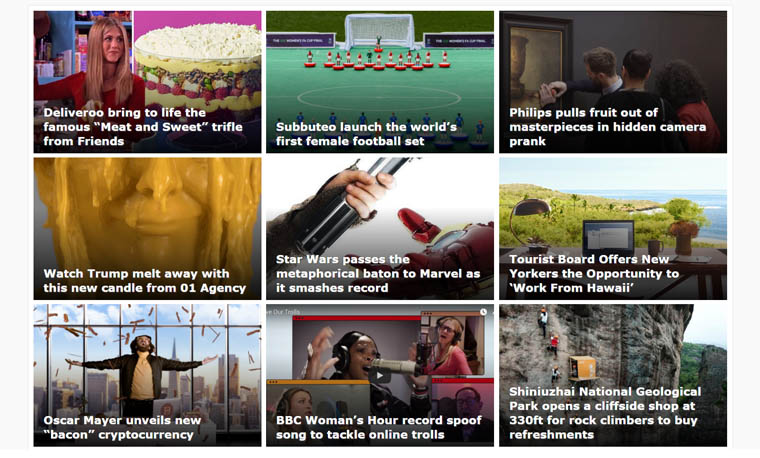
One of the Chinese National Parks put a shop halfway up a climbing wall on a mountain, which someone from the agency spotted in Metro and asked, ‘Do you think it’s a PR stunt?’ And it was! And, even better, no one had spotted it for that. The story had a mountain, rock climbers and a shed bolted to the cliff face where you can purchase bottle of water or energy bar. A lovely creative idea and that’s what the site’s about. Celebrating cool ideas.

Chinese national park PR stunt

With other agencies contributing, will you ever get to a point where you stop them writing about themselves, if it’s too advertorial?
I think people are generally self-aware on that kind of content. No one feels comfortable blowing their own trumpet. We’re interested in the inside story – how you came to the idea, the barriers and challenges. That’s what would make it different. We, at Taylor Herring, need to work out how we’re going to do that too. We have to resist the temptation to talk about ourselves too much but I think we’ve managed to tread the right side of the line so far.

We’d actively welcome agencies or in-house teams to write a first-person, inside track account of what the campaign was like to work on.

Is PR Examples driving business to Taylor Herring? Is it making money like your other site The Poke?
It’s not been built to drive business to Taylor Herring – in fact the link is hard to find. It’s buried at the bottom of the FAQ page. The discipline of scouring the internet every day to find creative work is very valuable to us and our daily work. Analysing and scrutinising those kind of projects gives you a good insight into what does and doesn’t work.

Our video production company, St Mark’s Studio, has become the temporary sponsor of the site because we’re hoping other agencies, in-house teams and brands might need some help creating low cost entertaining video content. Which is what St Marks is set up to do.

We originally took on PR Examples because we thought it might be a good fun thing to do and we are in the business of being fascinated by creative comms.

Currently St Mark’s is sitting in that sponsor slot. However, there are enough service providers in the industry that could potentially step up and help us meet the running costs. It would be nice to think our newsletter could have a sponsor and we could work with companies on native content editorial, things like that.

PR Examples, at this scale and with its number of page impressions, is quite easy to manage.

We decided we’re not going to try and monetise it for the first 12 months, we’re just trying to make it good.

If people like it, we might be more ambitious.

Final Word?
We are actively looking for new contributors – so interested parties should get in touch. They can blog as little or often as they want to.


Reach-the-right-influencers-with-the-Vuelio-media-database

Love My Dress

A Spotlight with Top Wedding Blog, Love My Dress

Love My Dress is written by Annabel Beeforth and was recently ranked in the top 10 UK Wedding blogs. Created after Annabel’s own wedding in 2009, Annabel not only helps couples create their own perfect day but also writes about the importance of love and the value of marriage.

We caught up with Annabel to talk about the success of her blog, the Royal wedding, using social media, working with brands and the wedding blogger industry.

Love my dressWhat makes your blog successful?
I think it’s a few things, but broadly it’s our consistent approach to the story and not just the images. In a world that is so image driven, we have always understood the need to tell the story too and our readers are constantly feeding back how much they appreciate this. We have always taken pride with the sensitivity with which we handle every wedding we share. We’re incredibly privileged to have been allowed access into these intimate moments in people’s lives.

Secondly, closed Facebook groups have had a phenomenal impact on the relationship we have with our readers. We have a really close connection to our audience now – this connection has helped us develop trust so that when we need to gain feedback or survey the community, time and effort is given willingly. Without realising it initially, we were creating a community of Love My Dress ambassadors in establishing these groups. We absolutely love being able to dip in each day and catch up with our reader’s wedding plans.

Also, we’ve always shown absolute loyalty to the wedding industry. My husband is a graduate in fashion design and formerly had his own design business. It was back in 2000, when social media wasn’t a thing, and having been through that experience with him has, I believe, given me a deeper insight into the challenges faced by small design/artisan business owners. He has also taught me so much about craftsmanship, the quality of design etc.

We are constantly trying to innovate. We’ve just spent months recreating our wedding directory from scratch and believe that our resource will set a new precedent for directories of its kind.

There are a lot of market forces at play right now that are making it difficult for many businesses to find their groove and thrive in our industry – showing these businesses support when they most need it is absolutely vital. For example, the full impact of Brexit has yet to seen but it’s going to have a potentially enormous and damaging impact on many small businesses in our industry – boutiques, for example, relying on shipping in designs from overseas; the import taxes and duties could end up crippling their cashflow. I’m absolutely passionate about supporting our industry and the wealth of creative and entrepreneurial talent within and I think this passion shows through in Love My Dress.

Also, the efforts we are making to increase the diverse nature of our site content is becoming increasingly more important. It’s a timely comment given the imminent marriage of a member of the Royal family to someone who is mixed race, but inclusivity and representation of women/people of colour on sites like ours is SO important in 2018. It’s absolutely not acceptable to have to scroll and scroll the Instagram feed belonging to a site like ours to find a person of colour.

You would be surprised how many major wedding publications/sites/Instagram feeds have no representation of women or people of colour on their Instagram feeds at all. We are working really hard to make those who feel marginalised within the wedding media world feel more included. This doesn’t just extend to people of colour but people with disability and LGBQT community too.

What’s your favourite part of a wedding?
The ceremony always gets me. These are intimate moments in people’s lives and how they choose to use the ceremony to publicly commit their love to another both fascinates me and fills my heart.

What’s your favourite kind of wedding?
I generally avoid the term ‘theme’ like the plague when it comes to weddings! It just isn’t a word that aligns with the way we present weddings to our readers – feels all a bit too ‘fancy dress’.

My favourite weddings, however, are always the most honest ones – the ones where the couple tailored the day as a true reflection of themselves and who didn’t overlook the reason they were marrying in the first place. I love intimate family weddings – children running riot, joy and laughter captured on camera in natural, non-posed fashion. They are always my fav.

How many weddings have you been to?
Actually, not that many! The last one I attended was in 2012! It was that of a disabled bride who documented her wedding planning journey through Love My Dress. It was an absolute joy and pleasure to be there on the day to see her exchange her vows with her fiancé.

Has wedding planning changed with the rise of social media?
Social media is the perfect platform for those seeking wedding inspiration as it’s so visually driven, but it can be a bit of a double-edged sword. Having so many ideas so easily accessible on screen can be both wonderful and utterly overwhelming at the same time. In fact, I personally feel the whole scene is rather saturated.

Pinterest and more so, my fave, Instagram, have revolutionised the way couples are planning their wedding. Many couples are finding suppliers through Instagram which is why it’s so important we show love and support to our clients through this powerful social media platform.

How do you work with brands and PRs for your blog?
There are, in my view, a small handful of excellent wedding PRs in the UK and I think that on the whole, most of them now realise that sites like Love My Dress don’t work in the same way a traditional print outlet would – we can’t, or at least, we don’t, offer free editorial. We’ve worked really hard to build our social following and create a site that is read loyally and believe that is worth paying for. But when the PR gets it, it can be a marriage made in heaven. We’ve worked with some absolutely wonderful clients thanks to successful partnerships with some great PRs. On the whole, PRs have, in our experience, provided access to an artisan/independent part of the market that we take great pride in supporting – artisan jewellers and independent dress designers for example.

Reach-the-right-influencers-with-the-Vuelio-media-database

What are the best campaigns you’ve collaborated on?
Jenny Packham, Pronovias, Goldsmiths, Emmy London for H Samuel Jewellers.

What do PRs always get wrong?
I think these days there really isn’t room for the kind of mass, depersonalised mail out that will always inevitably get binned. I will always take time to read a tailored PR pitch and respond, even if it means the pitch was unsuccessful. If it looks like the PR has made an effort to get to know us and truly consider the brand match with their client, then I appreciate that. Emails that arrive with a ‘Hi!’ or ‘Hello,’ and no name are always a big turn off as it suggests no effort has been made to get to know us. Why should we take any time considering and responding if this is the case?

What do you call yourself (blogger/influencer/content creator etc)?
To be honest I’ve been trying to veer away from the terms ‘blog’ and ‘blogger’ for a couple of years now because I don’t believe they truly reflect what we do now. We were definitely blogging back in 2009/10, but these days, we’re editing our own online platforms, creating content, establishing brand partnerships and innovating as best we can as we continue to pave a path that has never been trodden before.

I more often than not refer to myself as Editor – but even then that doesn’t truly capture the full extent of my role. Though the term ‘influencer’ sometimes irks me, I will use that too because I think in today’s social media vocabulary, most people understand this represents a site or individual with a significant following in their niche, which we undoubtedly are.

What other blogs do you read?
The Pool (though sometimes it’s editorial approach to weddings and lack of support for the wedding industry leaves me feeling really unhappy), A Playful Day, Blogtacular and Me and Orla.


Annabel and Love My Dress are both listings on the Vuelio Influencer Database along with thousands of other bloggers, vloggers, journalists, editors and opportunities. 

Five Things: Leveson II, Klout, This is America, Martin Sorrell and #FuturePRoof

This week’s Five Things includes the demise of Leveson II and Klout, Childish Gambino’s This is America, the return of Sorrell and the launch #FuturePRoof.

1. Leveson II – the sequel that refuses to start

Lord Leveson
Leveson II, the second part of the Leveson Inquiry, was already stopped by culture secretary Matt Hancock (“Are you on Matt Hancock?”), at the beginning of March. Now the Government has won a narrow victory against a Labour move to force it to start. Ed Miliband tabled the amendment to the Government’s data protection bill but it was narrowly defeated by 304 votes to 295.

Ed Miliband’s impassioned speech highlighted David Cameron’s previous promise for Leveson II to be carried out. Refusing to give way to other MPs, he also said it was a matter of honour for all politicians and asked the Government, ‘How dare you?’. Hancock responded: ‘The choice isn’t between doing something, and nothing. It is between doing something, and something better.’

Following the defeat, Tom Watson chose not to push for a vote on section 40, which in part would have required publishers to pay legal costs of both parties in disputes no matter what the outcome. This is clearly flawed as both Leveson-backed IMPRESS and press-made IPSO already allow for low-cost resolution.

There’s already suggestions the Lords will push the amendment back to the Commons for a second vote as the first was so close. We might not have seen the last of Leveson yet.


2. Out of Klout

Klout ends

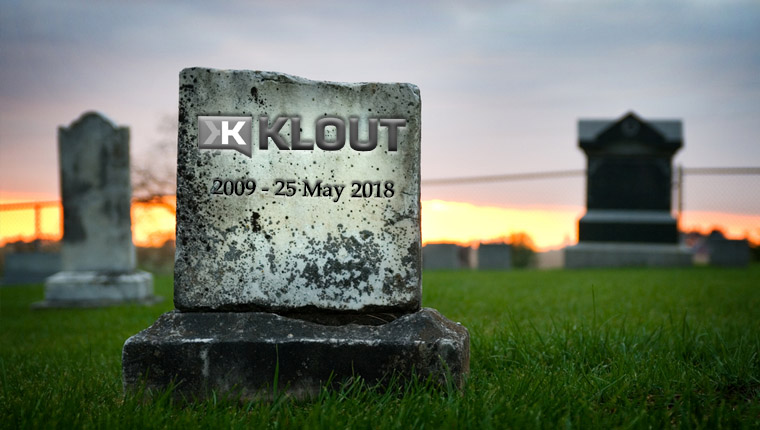
What’s your Klout?* Is a question that many people working in social media asked each other seven years ago, but recently your Klout score has gone the way of your follower count on Google Plus. One of the most popular ways of measuring influence online, Klout was founded in 2009 by Joe Fernandez, who apparently built it to get a job at Twitter. It was bought by a private company, Lithium, in 2014 for $200m and on 25 May it will be no more.

25 May, I hear you say, isn’t that date significant for another reason? Why, yes. But amazingly, Lithium failed to mention the GDPR as a factor in Klout’s demise in the official statement. Apparently, Klout no longer meets Lithium’s long-term strategy.

Incidentally, Klout has been used as one of the many metrics that makes up the Vuelio Influencer Score, but thankfully we use such a broad range of complex tools that the loss of Klout will not have a detrimental effect on our unique measurement. You can read more about our influencer rating here.

Klout, on its own, has been criticised over the years for its algorithm which has, on occasion, rewarded questionable people with more influence than others. The secrets of the algorithm may have been forced into the open by the GDPR, but now we’ll never know.


3. This is America

This is America

It’s hard to know where to begin with Childish Gambino’s (aka Donald Glover) latest release, This is America. To call it a song is insufficient; the music and lyrics are powerful but that power pales into insignificance when compared to the video:

Articles and essays have already been written on this overnight cultural phenomenon (it’s on 75 million views in under a week). Discussions about the video’s ‘hidden meanings’, from his confederate trousers and Jim Crow references to the Charleston church shooting and ‘Death’ riding a pale horse, have filled social media and the digital press. It’s particularly pertinent following Kanye West’s recent comments that slavery was ‘a choice’.

It also follows Black Panther, which itself was itself a cultural shift but in a Hollywood/Marvel superhero kind of way. What Childish Gambino has done means so much more. It’s a violent, compelling piece of art, that continues to produce meaning with every watch, and it will fuel sections of the commentariat for weeks to come.


4. Martin Sorrell to ‘start again’

Martin Sorrell

If only Klout would stick around, we’d be able to measure Sir Martin Sorrell’s when he ‘starts again’. That’s his vow this week, after abruptly leaving WPP. As reported by the FT, Sorrell was speaking at the technology conference in New York and said: ‘I’m not going into voluntary or involuntary retirement.’

As he never had a non-compete clause with WPP, Sorrell is free to set up a competitive ad company and target some of the $16bn business he helped build up over the last 33 years. He already has an idea for a new ad agency model, he said it would be: ‘more agile, more responsive, less layered, less bureaucratic, less heavy’. This is particularly surprising considering WPP’s hugely complex set up has been credited to Sorrell, and he was described as the only person capable of keeping it all together.

Sorrell said he would not wait long until he made his next move, so expect the new agency launch to appear in a future Five Things.


5. #FuturePRoof 3

3

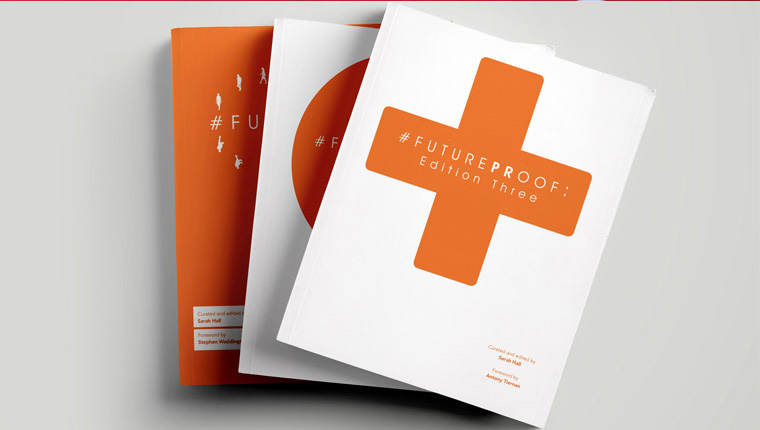
Sarah Hall, agency owner and CIPR President, has released the third edition of her hugely popular #FuturePRoof series this week, a special edition marking the 70th anniversary of the NHS. Titled The NHS at 70 with Lessons for the Wider PR Community, the book features 25 chapters from 25 contributors, all of whom either work in or around comms at the NHS.

The health service is one of the UK’s most-loved institutions but is currently facing huge problems in terms of service delivery, funding and staff shortages. The book puts communications at the heart of the solution, championing best practice and excellent innovations to inspire the NHS to carry on fighting the good fight.

#FuturePRoof is also hugely inspirational to the wider communications industry with lessons across every communications discipline from internal comms and employee engagement to using new technology and measuring campaign results.

Find out more about #FuturePRoof online.


What did we miss? Let us know on Twitter @Vuelio.

*Me? My Klout score is 46 and I’m an expert in Blogging, Public Relations and Communications. And Buzzfeed, apparently.

FuturePRoof

#FuturePRoof: Cultural Graffiti and Sanctioned Dissent

The third edition of Sarah Hall’s #FuturePRoof, which focuses on communications within the NHS, launched yesterday. The 25 chapters, from 25 authors, provide key insight to both the inner workings of the NHS and to best practice in the communications industry. In this post, we’ll be looking at the chapter by social leadership consultant Julian Stodd, and what comms can learn from cultural graffiti and sanctioned dissent.

Stodd argues that in society, graffiti is ‘a voice that is claimed, not granted’. In our organisations there is ‘cultural graffiti’, which is when opinions and views are shared without fear of consequence. This ‘graffiti’ resides solely on social.

For the NHS, this is perhaps a more obvious phenomenon – sometimes anonymous, often critical but generally constructive doctors, nurses and patients discuss the NHS on social, outside their ‘formal’ space. Sometimes this grabs national headlines, the #ImInWorkJeremy hashtag was used widely when the health secretary criticised doctors for ‘not working seven-day weeks’.

Cultural graffiti is also apparent in other organisations; social has become the platform for office grumbles, unfiltered company news and customer complaints.

Stodd says that formal power doesn’t reach social spaces, ‘where cultural graffiti is scrawled and shared’. As such, organisations cannot control them and instead need to understand ‘social leadership’ and its fuel: reputation.

Social status is based on reputation, which on social is granted by communities. What’s significant is that social leaders don’t necessarily have formal power or any authority in traditional societal structures, so social leaders are easily overlooked or, worse still, underestimated.

Jack Monroe is a prime example – the budget food writer who won her Twitter libel case against Katie Hopkins, often has to explain on Twitter how, despite her social reputation (she has 126K followers), she still struggles to make ends meet. Her social fame and influence obviously does not translate to formal structures, but her social status is unquestionable.

So how does an organisation manage cultural graffiti?

Stodd says organisations need to listen and learn, which is simple enough. But more than that, he says as with real graffiti, organisations should sanction dissent. Graffiti artists know there are places they’re allowed to work, certain shops or spaces where graffiti has been allowed. For Stodd, organisations need to sanction cultural graffiti and understand the stories being told, wherever they’re being told.

We all know that social is the dominant force of storytelling in our society and it should be part of every comms professional’s strategy. Just because Wetherspoons closed all of its social accounts, that doesn’t mean it is exempt from cultural graffiti. The fact it no longer seems to care what’s happening on social could be a big mistake, as staff, customers and suppliers are free to discuss the company and tell their own stories.

Communications is all about telling the story you want to tell and if you lose control of the storytelling process, you lose control of the story. If we take the time to understand cultural graffiti, and how others tell our story, we can regain control of the conversation.

Do you listen to and understand cultural graffiti in your organisation? Or do you think it’s better to ignore the dissent? Let us know on our social space: @Vuelio.

#FuturePRoof: The NHS at 70 with Lessons for the Wider PR Community, comes highly recommended and is available online.

Curiously Conscious

Kindness, convenience and joy: Curiously Conscious

Besma Whayeb is the author of Curiously Conscious, the ethical lifestyle blog that was recently named in the Top 10 UK Green Blogs. Focusing on sacrifice-free ethical living, Besma writes about everything from natural make up to renting clothes. We caught up with Besma to talk about sustainability, working with brands in a beneficial way and technology connecting the green community.

What makes your blog unique?
My blog focuses on ways to live kinder that are convenient and add joy. It’s about being ethical and eco-friendly without making sacrifices!

Will we ever live in a fully sustainable world?
I don’t believe it’s possible to be 100% sustainable, however, there are so many ways we can get close to that. Renewable energy, electric cars, and better distribution of resources will accelerate us to a more sustainable world.

What are the biggest eco/green trends that we should all be aware of?
With Fashion Revolution Week just finished, there was a lot of talk about plant-based leather alternatives, and demanding transparency from fashion brands. Food-wise, more brands are moving towards sustainability rather than vegan/plant-based niches. And beauty is all about harnessing the power of plants to produce makeup that looks good and nourishes skin.

How is technology helping us be more environmentally aware?
Technology has been a brilliant way to connect the green community – no matter where our specific interests lie – and has seen ethical and eco blogging really grow.

Who do you think has the most responsibility when it comes to the environment (individuals/industry/media/government etc)?
Industry can make the biggest, and quickest change, but it’s hard to encourage whole businesses to move away from a focus on profit to also consider people and the planet. It’s why I write to inspire individual changes, and call on brands to take note – our demand for ethics will encourage the supply of better business practices.

How do you like to work with PRs and brands?
I’m particular about the brands I work with, as I’d like them to really benefit from featuring on my blog or social channels. In this way, I like to form relationships with PRs or Brand Reps, and work on a series of posts or sponsored content that is created specifically to achieve a campaign’s aims. I respect they understand their brand’s strengths, and they respect that I understand my audience’s preferences.

Reach-the-right-influencers-with-the-Vuelio-media-database

What are your favourite campaigns or collaborations that you’ve been part of?
I enjoyed being a Brand Ambassador for Yushoi last year; my posts were centred around finding balance, which is something I really encourage. I also found working with Fat Face was incredibly popular, especially with their organic cotton ranges, which shows how much demand is out there for ethical high street brands. And a personal favourite has to be visiting MacDonald Hotels’ Monchique Hotel & Spa in the Algarve – a truly five-star experience all round.

What do you call yourself (blogger/content creator/influencer etc)?
I’m a blogger first, but I think the term influencer is better considering the amount of work that goes into my social channels is equal to the time spent writing.

What other blogs do you read?
Other than my fellow bloggers in the Top 10 Green Blogs list, I love The Good Trade, Make It Last and Simply Liv & Co.

Besma and Curiously Conscious are both listings on the Vuelio Influencer Database along with thousands of other bloggers, vloggers, journalists, editors and opportunities. 

TraveLynn Family

Around the world with the TraveLynn Family

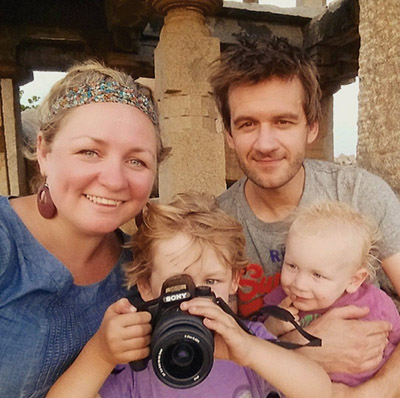
The TraveLynn Family is mum Jenny, dad Jason and boys Arthur (four) and Ezra (two). They travel around the world, truly embracing a global sense of wanderlust and living abroad. We caught up with Jenny who told us about the misunderstood safety of travelling with young children, planning school around travel and working with PRs and brands.

family travel blogWhat makes your blog unique?
I write about adventure family travel with young kids. My boys are just two and four years old and already they have been hiking in the Nepalese Himalaya, meditated with monks in Thailand, slept on overnight trains in India, and walked alongside giraffes in Malawi. As parents, my husband and I try to push the boundaries of family travel and are on a mission to dispel the myth that adventure travel needs to wait until the kids are older.

Before the kids came along, my husband and I were avid intrepid travellers and we soon realised that we only had to adjust are travel style slightly to continue our passion. In fact, I am currently writing this from the shores of Lake Malawi! We’re six weeks into a four month overland trip through Africa in a Land Rover Defender with roof tents. We started in Johannesburg and are making our way through Mozambique, Malawi, Tanzania, Zambia and Botswana. Before this, we were living in India and called Bangalore our home for a year. We moved for my husband’s work and took advantage of all the new travel adventures possible on our doorstep; including Sri Lanka, Nepal, Thailand and as much of India as possible.

How does ‘regular’ family life fit around travelling?
We still have a bedtime routine, battle tantrums, and negotiate the never-ending demands from our kids. We are still very much a regular family. Travel just creates a different backdrop to the challenges of parenting life, and offers different sensory playgrounds and novelties as we investigate new places together. Where we are perhaps different from your regular family is that we prioritise travel and take every available opportunity possible for adventure.

How are/will the kids be schooled?
My kids are not yet of schooling age, so thankfully we don’t yet have to negotiate term dates. As we’ve been living in India and now on a long-term travel adventure, they haven’t really experienced the nursery/pre-school system that so many kids have in the UK. However, we have playdates whenever and wherever possible, always stop for a playground, and I also have a bag of crafts, LEGO and magazines that comes everywhere with us. We find that our boys learn so much on the road from all the different experiences and social interactions. Plus, with all the quality family time together while travelling, we find they blossom.

However, come September, our eldest will be starting school. It will then be an interesting ball game managing our love of adventure family travel around the restrictions of term time. We’re still just working all that out.

What’s your best advice for people thinking about going travelling with families?
Don’t wait. These early years flash by so quickly in a sleep-deprived blur. Do something amazing that will create everlasting memories. Just travel slow, always have snacks handy, and take lots of photos.

TraveLynn

What’s the best thing/place/experience you’ve had as a family while travelling?
This is a tough one as we really have so many amazing experiences to choose from. I could say it is reaching the summit of Poon Hill at 3,120m in Nepal, watching the sun rise over the Taj Mahal, or witnessing a herd of elephants bathing in the wilderness of South Africa. However, the best ‘thing’ about family travel for us is time. It’s the time to be on our own schedule, time not distracted by other commitments, time to just simply share day by day experiences together. Some of my fondest memories of this current trip in Africa is watching the boys put on a ‘show’ in the evenings by the fire, races into the sea after a long day on the road, or just snuggled in our tent together reading a book. It’s the time to actually stop and appreciate the little things.

Is the world a scary place with such young children?
Not at all. We find that travelling with young kids breaks down those barriers with strangers. People are often inquisitive of the boys and want to chat to us; even the hardest haggler in India cracks a smile with the boys around. It’s truly wonderful seeing the world through their eyes. Things can go wrong when travelling and the boys are completely oblivious to them. If anything, they normalise stressful situations.

Where haven’t you been that you still want to visit?
Oh, so many places! We are yet to explore much of the Americas. There’s still so much of Europe; Scandinavia and Greece have been on my list for far too long. And Antarctica – the ultimate adventure destination.

What should PRs and brands know about you?
I keep it real and push the boundaries. Adventure travel with kids so young of course has its challenges, but I want to inspire my readers to take on those challenges and reap the rewards.

Reach-the-right-influencers-with-the-Vuelio-media-database

What’s the best collaboration you’ve work on?
I’ve recently been collaborating with Malawi Tourism to demonstrate Malawi as a safe and wonderful destination to travel with young kids.

What do you call yourselves (bloggers/content creators/influencers etc)?
I prefer travel blogger or travel writer.

What other blogs do you read?
I’ve made some wonderful friends through my blogging journey so far. It really is a such a supportive network. Other family travel bloggers I follow from the UK include: Wandermust Family, Globetotting, Go Live Young, Mini Travellers, Mummy Travels, Tin Box Traveller, Travel Mad Mum – there are so many to mention!

The TraveLynn Family is listed on the Vuelio Influencer Database along with thousands of other bloggers, vloggers, journalists, editors and opportunities. 

May 4th

Five Things: Cambridge Analytica, Sainsbury’s, Elon Musk, Wright Stuff and Kanye West

HAPPY STAR WARS DAY. This week’s top five things you shouldn’t have missed includes Cambridge Analytica’s demise, Sainsbury’s PR mistake, Elon Musk’s sales call, the end of The Wright Stuff and the latest Kanye Kontroversy.


1. Farewell Cambridge Analytica

Demise

Just when you thought a company had really got to know you, it files for bankruptcy. Cambridge Analytica, which was at the centre of the recent Facebook data scandal, has commenced insolvency proceedings. The official statement blamed ‘unfounded accusations’, which led to it being ‘vilified for activities that are not only legal, but also widely accepted as a standard component of online advertising in both the political and commercial arenas’.

Thanks to the pesky media reporting on the one-way-mirror-equivalent of corporate transparency, ‘virtually all’ of the company’s customers and suppliers have been driven away. There are now questions being raised about whether Cambridge Analytica, or its staff, will rise from the ashes and continue to operate in the shady world of political profiling.

As for Facebook, the social giant seems to have managed to leave the scandal behind – its earnings and results do not reflecting a company in crisis. However, with plans to get into the online dating game – where the level of processed personal data is extraordinary – the data issues may not be over.


2. We’re in the money!


In PR whoopsie of the week, Mike Coupe, CEO of Sainsbury’s, was filmed singing ‘We’re in the Money’ from the musical 42nd Street. He was, at the time, waiting to be interviewed by ITV about his company’s proposed £10bn merger with Asda.

As reported by the Guardian (which, incidentally, is serving up sidebar ads for Waitrose next to the story), Coupe expects Sainsbury’s to make £500m in extra profit from the deal. In a follow-up statement from the company, Coupe is quoted as saying: ‘It was an unfortunate choice of song, from the musical 42nd Street, which I saw last year. And I apologise if I have offended anyone’.

Straight-faced, a Sainsbury’s spokesperson said: ‘We all know these songs stay in your head. To attach any wider meaning to this innocent, personal moment is preposterous.’

Preposterous.


3. Elon Musk being Elon Musk

Tesla

Elon Musk, chief executive of Tesla, took the unusual move of agreeing to let a YouTuber ask a question during an earnings call. Gali Russell is an NYU grad student and retail investor who owns 54 shares in Tesla, which he says is ‘pretty much my entire portfolio’. He tweeted Musk with the backing of 150 shareholders to see if he could ask a crowdsourced question; Musk replied, ‘Ok’.

Musk used the YouTuber to avoid answering standard earnings-call questions from analysts about business and finance. While he was saying, ‘Boring bonehead questions are not cool. Next. We’re going to go to YouTube. Sorry, these questions are so dry. They’re killing me,’ Tesla’s share price was tanking.

Russell’s questions focused on tech and Musk encouraged him to ask more and more – in total the YouTuber managed 10 while on the call. This approach may be appropriately quirky for Elon Musk but it’s a misstep in terms of company PR – the analysts were unimpressed and still suggest Musk’s optimism for the company’s success is unfounded.


4. No more Wright Stuff

Matthew Wright

Matthew Wright, host of Channel 5’s The Wright Stuff, has announced he is stepping down from his role after 18 years. The weekday mornings current affairs programme is one of Channel 5’s flagships and the channel has confirmed the show may continue with a new name and presenter.

Wright blamed the demands on his personal life and said he and Mrs Wright, ‘pass like ships in the night’ as he goes to bed at 7pm and gets up at 3am. BBC’s media editor, Amol Rajan, paints a different picture. The former audience researcher on the programme said: ‘Matthew Wright always said to me that he would stop presenting The Wright Stuff when it stopped being fun.

‘Recently, it stopped being fun.’

He blames the fact the show’s production moved to ITN, which brought huge changes and meant ‘its jovial and fun spirit struggled to make the transition into a new culture’.

Whatever Channel 5 decides to do, come the end of June/early July, there will be a two-hour Matthew Wright-shaped hole in the schedule.


5. Kanye West

He may be an international superstar but surely Kanye West’s greatest achievement is now appearing on his second Five Things post – two weeks in a row! Last week we were discussing Kanye’s controversial opinions getting him into trouble after he praised President “We are both dragon energy” Trump. This week, Kanye has upset everyone during an interview with TMZ, by claiming slavery was a ‘choice’.

Kanye said: ‘When you hear about slavery for 400 years. For 400 years?! That sounds like a choice. You was there for 400 years and it’s all of y’all. It’s like we’re mentally in prison. I like the word ‘prison’ because ‘slavery’ goes too direct to the idea of blacks. Slavery is to blacks as the Holocaust is to Jews. Prison is something that unites as one race, blacks and whites, that we’re the human race.’

After he explains this radical viewpoint, TMZ staff member Van Lathan piles into Kanye for ‘not thinking’. Kanye tried to clarify his views on Twitter (where else!). I can’t believe anyone missed this, but if you did – here’s the video:

Pr and comms stats

86,000 people work in PR and communications

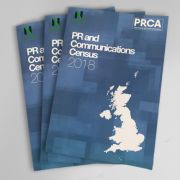
The UK PR and comms industry has grown nearly 4% since 2016, when the industry had just 83,000 people. New figures from the PRCA’s 2018 Census also reveal the industry is now worth £13.8bn, up 7% from 2016.

The comprehensive survey, which took information and views from nearly 1,700 respondents, was launched at Golin on Tuesday 1 May by PRCA director general Francis Ingham and PRWeek’s editor-in-chief Danny Rogers.

Among a whole host of detailed revelations, the study revealed the gender pay gap within the industry; something that’s been largely impossible up till now because most organisations don’t meet the 250-employee threshold set by the Government for mandatory gender pay gap reporting.

The average salary across the whole industry is £45,950, but for women it’s just £42,588 and men its £53,952. This 21% gender pay gap is even more shocking when we consider that 66% of the industry is female, suggesting that women fill the more common junior roles while men take the fewer senior roles.

This formed part of the discussion at the launch event, as both Ingham and Rogers were questioned about the gender pay gap. Somewhat putting the two successful men on the spot, an attendee asked what women could do to earn as much as their male counterparts. Both suggested through their own experience, it’s about asking for it and knowing your own worth, and suggested more pay transparency could be useful.

The census also looks at ethnic diversity, and reveals that 78% of the industry is white British, which is the first time it has been more diverse than the country (though it still falls short of the London diversity levels, where the majority of the industry is based). Beyond British, the industry is 89% white, which is a 2% decrease from 2016; no other ethnic grouping makes up more than 1%. There were no details on a diversity pay gap, which was later suggested by an attendee and Ingham agreed it would be looked at in future Censuses.

One of the most surprising areas of the census is the section on evaluation. It reports that 24% of professionals recognise the Barcelona Principles 2.0 over other valuation methods, while 12% still use AVEs. The use of AVEs is dropping, down 4% since 2016, but what’s perhaps more concerning is the lack of a replacement.

A huge 33% of the industry does not use any evaluation methods, while 20% use blended methods of existing frameworks and other tools or in-house models. As the post-launch discussion revealed, the industry is in desperate need for standardisation in this area, to prove its value and increase its professional status.

Ingham said that PRs would never be loved, but he thinks the industry should be respected. He likened the role of comms to that of finance or legal – you don’t need to be shouting about the work for people to know how vital it is. When asked if more could be done to regulate the industry to improve its reputation, Ingham pointed to the expulsion of Bell Pottinger from the PRCA last year, and said, ‘On the same day, 17 agencies joined the PRCA’.

The full report is available online, and allows an entire industry to benchmark both individual company practices and compare against everyone else in the market. Hopefully the positive trends we’ve seen toward a more diverse industry will continue, while those worrying signs of a lack of standardisation and professionalism will be addressed.

Make Wealth history

The number 1 green blog in the UK: Make Wealth History

Jeremy Williams writes the Top UK Green Blog, Make Wealth History. Covering a whole range of environmental and sustainable issues, Jeremy believes that true change comes from the people. We spoke to Jeremy about the latest in green innovations, global environmental trends working with PRs.

What makes your blog unique?
I’m curious about lots of different things, so the blog is a fairly unusual mix of sustainability, development, politics, architecture, green tech and all sorts. And I focus on solutions. There’s plenty of bad news out there, and I’ll cover that, but I want the blog to inspire people to action rather than make them depressed about the state of the world.

Will we ever live in a fully sustainable world?
Yes, although there are two ways to end up in a sustainable world. One is to design it and shift towards it deliberately. The other is to wreck things so badly that industrial civilization becomes impossible. I’m a big advocate of the first approach, naturally.

What are the biggest eco/green trends at the moment that we should all be aware of?
For a long time, people have been predicting that renewable energy would fall in price until it became cheaper than fossil fuels, and then the shift could really accelerate. We’re at that point right about now. Look out in a couple of years’ time for a similar moment when electric cars cost the same as petrol ones.

How is technology helping us be more environmentally aware?
I’m a big fan of smart meters that allow us to see how much energy we’re using in real time. It definitely makes me more aware of what I’m using and how I can reduce it. I also really value phone apps that help me to identify birds, trees or wildflowers.

Who do you think has the most responsibility when it comes to the environment (individuals/industry/media/government etc)?
Responsibility is shared, but if you think about it, businesses won’t move unless the Government tells them to, and Government won’t move unless the voters call for it. So, it’s up to us to kick up a fuss.

How do you like to work with PRs and brands?
I’m fairly choosy about who I work with, as I often have to critique corporations or bad business practice, and I don’t want to be a hypocrite! But I do have regular book reviews and host affiliate links for books.

Reach-the-right-influencers-with-the-Vuelio-media-database

What are your favourite campaigns or collaborations that you’ve been part of?
I’m an ambassador for Kiva, the microfinance charity, and I love being able to point people to what they do.

What do you call yourself (blogger/content creator/influencer etc)?
I call myself a writer and campaigner if I’m talking about my broader work, as I also write books and research reports and all sorts of other things. But I’m happy to call myself a blogger when I’m talking about the blog.

What other blogs do you read?
There are lots that I check in on occasionally, but I’ll give a shout to Carbon Brief, Circulate News, From Poverty to Power and The Climate Lemon as some of my favourites.

Jeremy Williams and Make Wealth History are both listed on the Vuelio Database, along with thousands of other fantastic bloggers, journalists, editors, MPs and SpAds.

Brenda Cuby

Make your lives greener with The Green Familia

Brenda Cuby is the author of The Green Familia, the family-focused eco blog that recently ranked in the Top 10 UK Green Blogs. We caught up with Brenda who told us about becoming more eco-friendly, society’s collective responsibility and working with brands.

What makes your blog unique?
We are aimed at those who wish to make green changes to their lives one step at a time.

Will we ever live in a fully sustainable world?
We need to believe in this and hope that by encouraging everyone to make changes that this will become a reality.

What are the biggest eco/green trends at the moment that we should all be aware of?
There is a shift in the plastic-free movements and this will keep pushing for those changes to be further followed through. The use of electric cars is something that is coming with all the major car companies now investing in this. As our natural supplies erode, we will see more people taking an interest in this area.

How is technology helping us be more environmentally aware?
Technology can be a big help with apps on your smartphone to help you control your heating, encouraging us all to be more eco-friendly.

Who do you think has the most responsibility when it comes to the environment (individuals/industry/media/government etc)?
We all have a collective responsibility to stand up and be counted. Individuals, by making changes to their buying habits, will force industry to make the changes needed. The media has a huge part to play and if they can showcase the valid and good reasons as to why we should all be turning our focus to a more ethical way of living then that is great, but again they will only do this if their paymasters i.e. industry, come on board. The Government should lead by example, if they made the changes needed to their departments it would soon filter down.

How do you like to work with PRs and brands?
I love to receive content from them that is unique and fits my audience, so I like them to work with me and not just send me any old press release.

What are your favourite campaigns or collaborations that you’ve been part of?
There have been many small Kickstarter companies like Ohyo bags through to the big companies like British Gas.

What do you call yourself (blogger/content creator/influencer etc)?
I call myself an ethical blogger.

What other blogs do you read?
My Zero Waste, The Rubbish Diet, Moral Fibres and Eco Thrifty Living to name a few.

Anne-Marie Lacey Debbie Sharratt

How to improve your influencer relations

Good relationships are built on trust and transparency – and this is exactly what our next webinar will be exploring.

We are delighted to be joined by Anne-Marie Lacey, managing director of Filament PR and Debbie Sharratt, independent PR practitioner and blogger at My Boys Club, at 2pm on Tuesday 15 May, to talk about improving influencer relations.

Sign up to the webinar here

Giving both the perspective of the PR and the influencer, this unique webinar will provide our audience with an insight into what best practice truly means.

Anne-Marie and Debbie have also written a guest post for us on the topic of ethical and effective influencer relations, explaining how everything from the approach and the pitch to the work and results is improved when ethical best practice is employed.

One of the major areas of influencer relations is disclosure: when to disclose, how to disclose and why to disclose. Our webinar will decode this tricky area and make it easy for you to follow the rules. Anne-Marie and Debbie will also be providing real-life examples to help you get it right first time.

The webinar will also explore:

How to use the ASA guidelines, CAP code, Google rules and social media secrets
Ensure that you not only abide by the rules but that you’re taking advantage of all the opportunities these frameworks offer.

How ethical relationships can boost your brand’s reputation and ROI
It’s difficult to underestimate the importance of working ethically, which should not be seen as a chore but as professional advantage.

What to do if your influencers break the rules
Not everything goes to plan but if you’re working ethically but your influencers don’t want to, what options do you have?


We hope you can join us at 2pm on Tuesday 15 May, but if you can’t attend, don’t worry, you can sign up here and we’ll send you the recording either way!

Daily News

PR lessons from Trinity Mirror’s local media

David Higgerson, digital publishing director at Trinity Mirror Regionals, recently tweeted about his company’s attempt to measure the success of content in a new way. In doing so, he provided the PR industry with a unique chance to learn how to reach local media.

Higgerson’s measurement method alone would be interesting for PRs looking at alternatives to the oft lambasted AVE. The fact Higgerson has singled out loyal readers means they’re likely to be local to the region, as opposed to someone who has stumbled across a regional news site. This method should also appeal to PRs as it focuses on content that has a high impact without necessarily being ‘right’ for publishers. For many PRs, the ‘right’ story is the one that has the biggest impact.

So, what stories top Higgerson’s list?

  • Woman abandoned on snowy dual carriageway at midnight after Delta Taxi blunder (Liverpool Echo)
  • Heartbroken family pay tributes to ‘cheeky, funny and caring’ Jordan killed on A63 (Hull Daily Mail)
  • ‘We don’t know if we can carry on’ Couple driven to the brink of divorce by their eight-year-old son’s fits of violence (Wales Online)
  • Baby died after mum was left with midwives who had never delivered twins before – because all the doctors were busy (Manchester Evening News)
  • Man tells of birth of baby son the day after his mum’s body was found (Belfast Live)
  • Newcastle United news RECAP – Besiktas star midfielder linked; details of Kenedy loan details (Chronicle Live)
  • Family in ‘financial ruin’ as insurers refuse to pay out after devastating house fire (Devon Live)
  • Biker dead and devoted dad in prison after tragic crash in Plympton (Plymouth Herald)
  • Power cuts sweep North Wales as Storm Emma brings snow and high winds – updates (Daily Post)
  • Witness of fatal A30 crash describes the ‘utterly horrific’ scenes in bid to make others think twice (Cornwall Live)

On the surface these stories seem to be only bad news – tragic accidents, loss and disasters. Unless you live in Newcastle, then you like football.

But if we look a little closer there’s a pattern here, which all PRs could learn from:

They’re nearly all human-interest stories – eight of them focus on individuals or families and most have multiple elements (usually a combination of events makes the story more interesting/shocking/surprising)

They’re all concerned with local issues – unsurprising, but worth remembering that the stories that have the greatest impact in local communities, focus on the local communities

They all have long, detailed headlines – not a new lesson but the world of digital media means clever titles have been eschewed in favour explanatory titles

They’re all original journalism – none of them are generic stories, they’ve all required the journalist to put some work in to interview people or visit locations

Higgerson then reveals high impact stories (using the same metrics) but ordered in terms of highest active engaged time. These stories are similarly human interest, locally focused, have long headlines and are original journalism, but they tend to focus on groups of people rather than individuals.

The 100 women celebration by Wales Online or the Daily Post’s monthly round up of criminals that have been imprisoned, shows a trend towards groups. While these stories are generally longer, you can’t help but feel that people dwell on stories where they may recognise or know individuals, and the more there are to see, the longer they stick with the story.

Local media is a key target area for many national PR campaigns that want to have a high impact in communities rather than more generic national coverage with less depth. For PRs, this involves more work as they have to tailor their stories much more thoroughly, including finding local case studies, but the end result often makes it worthwhile.

Not sure who to reach out to at local media titles? You need the Vuelio Media Database, which lists thousands of local titles as well as their editors and journalists. 

The Style Editor

The fashion editor’s guide to global travel

Bonnie Rakhit is The Style Traveller. Bonnie was previously fashion editor at British Elle Magazine, Sunday Times Style and Grazia, and uses this expertise to show off the most stylish places on the planet. The luxury travel blog, which was recently named in the Top 10,  gives a unique perspective on hotels, destinations and experiences.

We caught up with Bonnie to talk beautiful places, her favourite bloggers and working with a diverse range of brands.

What makes your blog successful?

I think authenticity has a lot to do with it. I only feature hotels and destinations that I have personally visited and stayed at myself, which means my reviews are genuine and honest. I also love aesthetically beautiful properties and locations so the blog should hopefully deliver a bit of aspirational wunderlust.

The Style Traveller

What makes luxury travel better than other types?
Everything! From the organisation, the service, the hotel decor and quality of food and staff. I’ve done my fair share of backpacking and loved it at the time; there is definitely a place in my heart for the good old days of roughing it. But a little older, wiser and few more pennies in the pocket, I feel like I’ve worked long enough and hard enough to deserve a bit of luxury on my holidays.

What destination would you suggest to first time travellers?
I think rather than easing yourself in, go big for your first destination and pick a location that is as far removed from your day to day life as possible. Go for adventure and stunning locations that will assault your senses. My top destinations of all time are India, Cuba and Brazil.

What about seasoned travellers?
I feel that if you’re an avid traveller you’ve seen and experienced so much already that you need to push the boundaries a little further and experiment more. If you’ve ‘done’ all the big tourist vacations why not try off-the-beaten-track places. Pick Anguilla rather than Jamaica, Boston rather than New York or Bilbao rather than Barcelona. There’s so much to discover wherever you go.

Bonnie Rakhit

Is there anywhere on your bucket list you’ve yet to visit?
I’m currently planning a trip to Peru in August. But otherwise I still haven’t been to Hawaii, Tahiti or Fiji. The Pacific is still my oyster to discover.

If you could only take three items with you when travelling, what would they be?
My phone is a must, from photography to itinerary I can’t live without it. A scarf or wrap is so useful, covering off everything from a blanket on the flight, cover up in the cold or religious temple to beach towel and sarong – it’s a versatile bit of kit. And sunscreen!

What should PRs know about you?
I love all things luxury and aesthetic experiences. If it will make for a beautiful photograph and content, I’ll be there.

Reach-the-right-influencers-with-the-Vuelio-media-database

What’s the best PR/brand campaign you’ve worked on?
I’ve worked on hundreds of campaigns over the last few years from Mercedes Benz to Veuve Clicquot, from Peru to Prada and Primark. I also work with lots of hotels and tourist boards. If you think your brand or product will be a good fit for me then just reach out and contact me directly.

What do you call yourself (blogger/influencer/content creator)?
All of the above.

What other blogs do you read?
I like Angie Silverspoon for a more foodie perspective and also Feya from Fitness on Toast for all things health and fitness. I also love Aggie Lal from Travel In Her Shoes and Sam Kolder’s YouTube.


Bonnie and her blog are both listed on the Vuelio Database, along with thousands of other fantastic bloggers, journalists, editors, MPs and SpAds.

You shouldn't have missed

Five Things: Top 150, Millicent Fawcett, Facebook, Kanye and Daily Express

Much to Amber Rudd’s delight there have been other news stories this week. But with Prince Louis, historic scenes in Korea and Trump’s announced visit on Friday 13 July – you probably missed some of these…

1. PRWeek Top 150

Top 150
Okay, so if you’re in it, it’s very unlikely you missed it. PRWeek has released its Top 150 UK PR Consultancies, which once again sees Edelman sitting pretty above the rest. Though with only 0.9% revenue growth year on year, 2019 may see a new contender for the crown. The mostly likely choice? Weber Shandwick. The multi-discipline agency has seen a massive 19% year-on-year revenue growth, and it’s now snapping at the heels of Edelman.

This ranking is the first without Bell Pottinger, which in 2017 ranked 13th. The top 20 in 2018 are no doubt benefitting from the redistribution of the fallen agency’s £27m of revenue.

Other key stats from the 150:

  • 23 saw a fall in revenue, two didn’t change and the remaining 125 all grew – The Romans by 108%!
  • Only 27 agencies are based outside London, none of which make the top 20 (the biggest non-London agency is Pegasus in Brighton at 26 on the list)
  • Edelman has the most staff with 497 employees, and Steinreich Comms Group has the least with just nine
  • 38 agencies shrunk, 21 remained the same and 89 took on more staff – Yellow Jersey growing from six staff in 2016 to 23 in 2017 (that’s a rise of 283%)
  • Finsbury is the best performing agency in terms of revenue per employee, with each staff member accounting for £294,118


2. Millicent Fawcett

suffragist
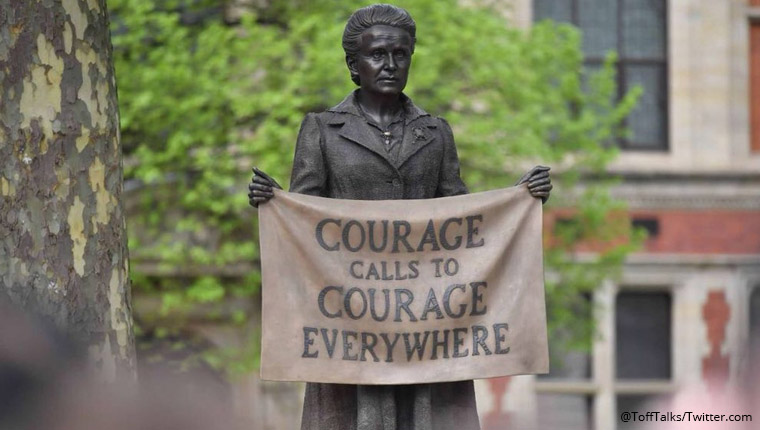
A statue of the suffragist Millicent Fawcett has been unveiled in Parliament Square. The statue, which shows Fawcett holding a banner that reads, ‘Courage calls to courage everywhere’ celebrates 100 years since the Representation of the People Act (when the first women were allowed to vote). The statue has proved controversial, with the Guardian collecting views that the words on the banner are a ‘travesty’, or the statue is of the wrong person; City A.M. suggests Fawcett would be ‘outraged at today’s feminism’, as it is ‘creating an unnecessary victimhood narrative, to which women are encouraged to subscribe’; and the Spectator calls the statue ‘embarrassing’ as it is ‘timid, ponderous, confused’.

Fawcett’s statue is now one of the few in the country that represent real, non-royal women, which can only be a good thing and hopefully a sign of change.


3. Facebook joy

Facebook
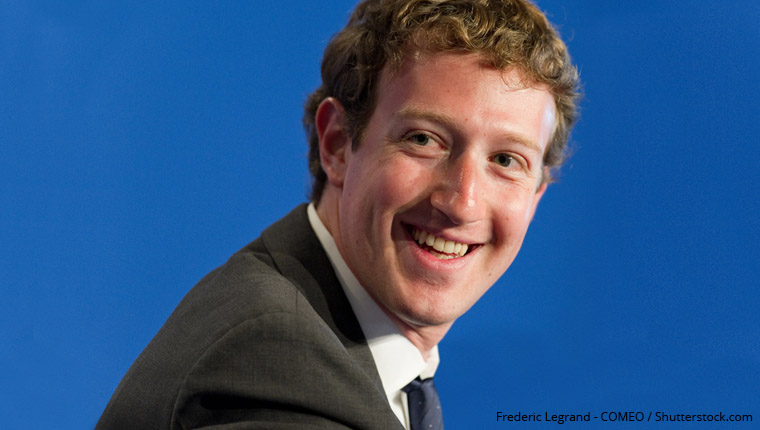
It wouldn’t be Five Things without a Facebook story but it’s rare that it’s good news. The social giant has posted record revenues in the first quarter of the year, despite all the negative press (covered here, here and here). Beating analysts’ expectations, the company brought in $11.97bn of revenue, which is up 49% from 2017. Twitter also benefitted from social media growth, posting a quarterly profit, with revenues up.

In further good news for the Zuck, the #DeleteFacebook campaign seems to have had no legs. Daily active users grew quarter-on-quarter by 48m to 1.45bn, and monthly active users are also up to 2.2bn. Both numbers are 13% up on the same quarter last year.

Repurposing the word ‘important’, Mark Zuckerberg said: ‘Despite facing important challenges, our community and business are off to a strong start in 2018. We are taking a broader view of our responsibility and investing to make sure our services are used for good. But we also need to keep building new tools to help people connect, strengthen our communities, and bring the world closer together.’

All this good news has been offset (a tiny amount) by Ofcom’s report that only 70% of British social media users consider Facebook to be their main platform, down from 80% last year. Of course, this means nothing when we see that Facebook is losing out to WhatsApp and Instagram, both of which it owns.

As a lot of noise around the Facebook scandal came at the end of March into April, we may yet see an impact from the deluge of negative news. So we’ll see it in a Five Things story in about three months.


4. Not losing fans and influencing people

West
Kanye West has become a prolific tweeter in recent days as he gears up for his new album. Among his many, many words of wisdom – including: ‘I don’t believe in horizontal hierarchy. If you build a ladder too high it’s actually most dangerous for the people at the top’, and ‘we have freedom of speech but not freedom of thought’ – were his thoughts on Trump. In two tweets Kanye said:


And, almost like a joyous child:


Trump responded to Kanye, saying ‘very cool!’

Rumours that Kanye lost millions of followers because of the MAGA hat tweet have been quashed by Twitter, who said any discrepancies in numbers are actually just ‘inconsistencies’. But that didn’t stop Kim Kardashian rushing in to Kanye’s rescue:


We could obviously make this post go on and on, and surely books will one day be written on Kanye’s musings. Except his musings are a book, which Kanye is writing in ‘real time’. So maybe one day his musings will just be published, and all of us will have the Book of Kanye on our coffee tables. I look forward to chapter 26:


5. Express concern

Express editor

Trinity Mirror’s takeover of the Daily Express hit further trouble this week as Matt Hancock (Yes, the one who is, is a founder of, and is on: Matt Hancock) suggested there might need to be a public interest intervention on the deal. The Competition and Markets Authority (CMA) is already deciding whether it needs to investigate the acquisition, so Trinity Mirror currently has to keep the Express and Star Newspapers as a separate entity until the CMA comes to a conclusion.

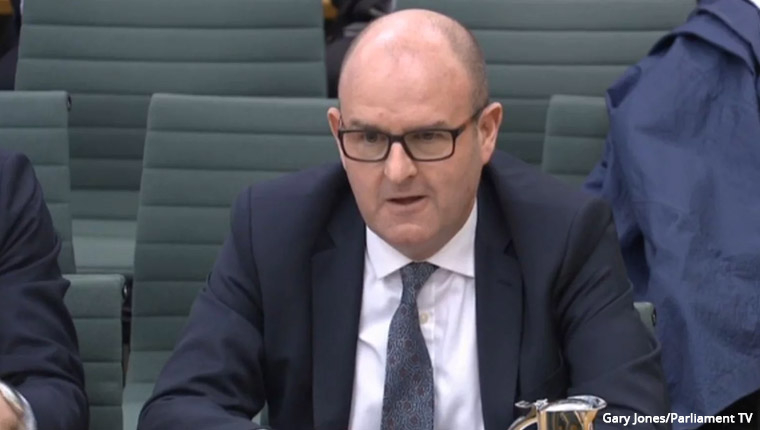
Though that didn’t stop them installing new editors across the titles. Gary Jones, who was made editor of the Daily Express, told a Government committee that some previous Express front pages were ‘downright offensive’. For some reason this was misconstrued by the British press as an ‘admittance’ of some sort of failure or guilt, rather than a new editor (from a left wing background) distancing himself from his paper’s past (of a right wing persuasion).

Read more about Trinity Mirror’s Express concerns here, including why the acquisition is very unlikely to be seen as a competition issue.


Did we miss anything? Let us know on Twitter @Vuelio.

Marcel Klebba

MK: The Best PR Blog in the UK

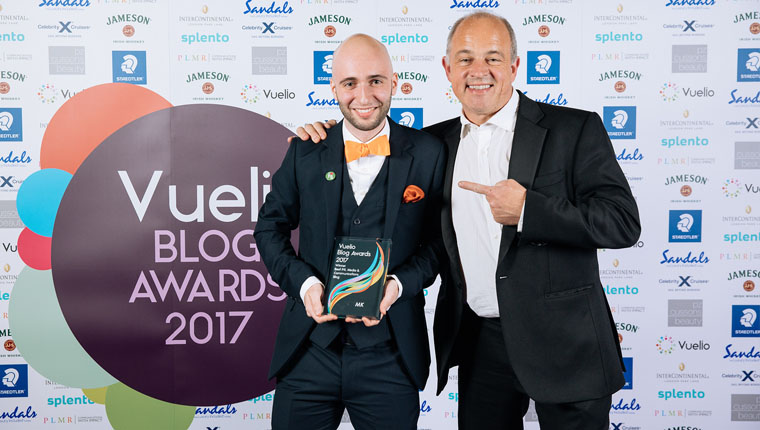
Marcel Klebba is MK, author of the eponymous blog that was crowned Best PR, Media & Communications Blog at the Vuelio Blog Awards 2017. MK started his blog while studying at university and it provides a unique insight into a PR student turning pro.

We caught up with MK to talk about winning his award, the importance of mentors and reaching high profile people.

What’s your background?
I’m originally from Poland. Four years ago, I came to study PR and advertising at the University of Westminster and while I was studying I aimed to get as much work as experience as possible. In my final year, I started a blog, which became my playground to explore ideas, connect with likeminded people and learn more about the industry.

You studied both advertising and PR, how did you choose one over the other?
I don’t think I would be the right fit for advertising. PR appealed more to me, because I’ve always loved media and been surrounded by it growing up. I really appreciate the power of media and PR, and I wouldn’t be exposed to that so much in advertising.

You’ve interviewed some really high-profile journalists, is that thanks to you or the blog?
The blog is massively helpful when it comes to approaching people, because I can say: ‘I’ve got a platform and I want to interview you/I want your opinion/I want your quote – just for my blog’. I think that’s very enticing for people. Twitter is also a great place to chat with people, especially journalists. I don’t think journalists like to be pitched to on Twitter but it’s definitely a good place to build a rapport and relationship.

Does connecting with people through the blog help you professionally?
Definitely. Whenever an email pops up in a journalist’s inbox with my name, and they saw my name on Twitter the other day, it’s probably more likely to be opened and read. And they know I’m not going to jeopardise the relationship we’ve built with a bad pitch.

It sounds like having a blog has helped you a lot, do you think other PRs should have their own blogs?
I don’t think blogging is for everyone – it’s a massive commitment. Blogging is a great idea for PR students, but there are so many sites that have been abandoned after a few posts. It’s great from a career standpoint, but people should be aware that it’s a responsibility, and a blog needs to be constantly updated and it needs attention.

You mentioned students, and they make up some of your readers. How do you interact with your audience?
Through Twitter mostly – it allows to see who is interacting with my blog and commenting on my posts. Also, I get feedback from PR students that enjoyed my blog, which is great, and other people in the industry including my colleagues.

Talking of industry colleagues, I know how important mentors and mentorship is to you. What roles do they play in your development as a blogger and PR?
It’s huge. I started the blog because two people specifically – David Gallagher, then Ketchum but now Omnicom PR Group, and Stephen Waddington – told me I should be writing in order to have a great career. There always seems to be people around you that supply you with good advice, and it’s always good if you’ve got an issue or questions, to go to them directly. I wrote a blog post about mentorship, and in that I wrote that it doesn’t have to be one-to-one sessions, it can be reading something they’ve written or listening to a podcast they’ve made. In the digital world, mentorship can be more virtual and those people don’t necessarily even need to know they’re mentoring you.

Marcel Klebba and Stephen Waddington

You’re at the Vuelio Blog Awards, sitting with, among others, your mentor Stephen Waddington (pictured above), and you win the Best PR Blog award. What’s that like?
A little bit of imposter syndrome. It was huge, a highlight – I didn’t believe it and I definitely wasn’t expecting it. Now, I feel like I’ve got a mission and I still need to plough through, even if there’s difficult times or I’m lacking inspiration. I need to think how I could bring value to the industry and tell people things they might find interesting or to engage people who are just starting out and are thinking about a career in PR.

What’s the community of PR bloggers like?
I think it’s small, but everyone has their own speciality: Ella Minty is all about reputation and the power of influence, Stephen Waddington is all about the tech and professional practice, Scott Guthrie covers influencers, PR Examples covers stunts, and Richard Bailey is doing amazing work bringing everything together and supporting student communities with PR Place. There are also some really remarkable student blogs, including my friend Orlagh Shanks’, Jessica Pardoe’s, as well as the community blog Ulster PR students.

What’s your speciality?
Careers, starting out in the industry and documenting my journey.

You’re making a name for yourself in the PR world, what do you think has contributed to the opportunities?
Because of the blog, I built relationships. I was recently on a panel with Women in PR about personal branding and the people from the panel knew that I wrote my dissertation on personal branding, and I wrote about the dissertation on my blog. So, I think it’s everything all together.

The blog leads to so many opportunities. We are in a niche area – so I’m not a beauty blogger and I’m not getting free cosmetics – but the biggest benefit of having a blog is building relationships with likeminded people. In the last year, I’ve been running the Four PR Questions series, which is all about interviewing high profile leaders and I think this made me connect with other people and get my name in front of them.

Reach-the-right-influencers-with-the-Vuelio-media-database

What are your top tips for reaching high profile names for interviews?
The majority of people who are afraid of reaching out to the high-profile figures, think they are not reachable. They’re afraid of failure. I was rejected loads of times and lots of people didn’t respond, but there are plenty who did respond and let me interview them.

I think it’s a case of trying and not being afraid you’ll be rejected, because rejection will happen. Also, high profile people are just human – and if there’s someone junior approaching them – they will be impressed.

What are your future plans?
Obviously I want to remain in Vuelio’s Top 10 PR Blogs. Professionally, I want to stay in the agency side of things, and start managing people and thinking about strategy, and implementing digital. I want to keep learning and be challenged every day.


Marcel Klebba, MK, is listed on the Vuelio Database, along with every other Vuelio Blog Awards winner and thousands of other fantastic bloggers, journalists and editors.

guardian oberserver

Guardian on track to break even

The publisher of the Guardian and Observer has announced that it is on track to break even this year – in line with its three-year plan.

Guardian News & Media halved its losses in the last financial year, reporting a £19m loss, which is down from £38m the year before. The publisher is now in the final year of its three-year plan to break even, which started with the company making a loss of £57m.

Better than expected revenue growth and cost reductions of some £20m, which includes the new tabloid-format paper, means the paper is ahead of schedule to break even.

The Guardian is famously a loss-making paper financed by The Scott Trust.

In a joint statement, Katharine Viner – editor-in-chief of the Guardian – and David Pemsel – chief exec of the publisher’s parent company Guardian Media Group (GMG) – said: ‘We are well on track with our three-year strategy to make the Guardian sustainable and break even at operating level by 2018-2019. Thanks to outstanding collaborative work in the UK, US and Australia, we have finished the second year well ahead of our forecast.’

Revenue at the publisher is up by 1% to £216m, but it is the source of income that is changing dramatically. Print ad revenue is down industry wide, but the Guardian has picked up more than its lost in reader revenues, which now exceed its advertising revenues.

The paper has 800,000 ‘supporters’, including 200,000 subscribers, 300,000 members or regular contributors and 300,000 one-off contributors.

Viner and Pemsel’s statement continued: ‘We have achieved very rapid growth in our reader revenues – contributions, membership and subscriptions – across the UK, US, Australia and the rest of the world.’

The Guardian reports that GMG incurs its own additional costs so the overall loss is likely to be between £24m and £25m when the group officially reports its annual results later this year. In the previous financial year, GMG reported a £45m loss.

Filament PR my boys club

How to have an ethical and effective approach to influencer relations

Influencer relations is a hot topic in communications and done well, can be employed strategically as part of a PR programme to achieve campaign objectives. But, as a professional communicator, how do you go about having an ethical and effective approach to influencer relations?

In this guest post, Anne-Marie Lacey [pictured above, left] and Deb Sharratt [pictured above, right] share their top tips.

Approach
You know the saying, ‘If a thing is worth doing, it’s worth doing well’ – it goes without saying that when it comes to identifying influencers to potentially engage with on behalf of the brands you’re representing, it’s worth doing well.

Vuelio lists 11,000 bloggers and vloggers, and across the world, millions of blog posts are written every day. So how do you sort the wheat from the chaff? Ensure that you’re putting your brand in front of the right people, who have the potential to help you reach a highly-engaged audience? And, those who share an affinity with your brand, its purpose and products?

There’s no short answer. You can use a platform to help you whittle down your search, but by no means is it a case of job done. Just like a traditional press list, creating and building an influencer list needs the same time, care and dedication.

Take the time to look up these influencers and make sure you do your homework. Does size matter? Don’t be bedazzled by big follower numbers if the target audience is all wrong and engagement figures are low. Otherwise, it’s just vanity metrics and ultimately won’t help you to achieve your strategic objectives.

First, take the time to get to know the influencer, their style and content. There’s only one way to do this and it’s a case of getting stuck in. Read their posts, watch their vlogs and follow them on social media to be sure that they are the right fit for the brand you’re representing. Look at what they write and talk about. Are they authentic? See how they engage with their audience. Do they only post quality content or are some of the blogs full of low-quality, paid-for follow links?

Ask to see media packs if they’re not clearly visible online, and really interrogate the data and their profile on Vuelio to whittle down your list. Above all, are they an influencer that you want your brand to be associated with?


Pitch
Apply the KISS rule and keep your pitches simple, short and straight to the point. For fear of sounding like The Four Tops, when you ‘reach out’ to your target influencers, remember to answer the W questions in your pitch – who, what, where, when and why.

This is your opportunity to show the influencer that you know their channels, content and editorial style, as well as clearly being able to demonstrate how and why that influencer is the right fit for the brand. Remember, influencers ultimately create content – whether it’s a blog, YouTube video or Instagram post – for their audience. Make it clear in your pitch why their audience would be interested in the brand and in turn, why their channels are the right fit for your brand placement.

One last top tip when pitching is to try to avoid the scatter-gun approach – contacting a long list of influencers and offering them all the same thing. Asking for a product review? There’s nothing more frustrating for an influencer than when they work hard to produce essentially the same content as a handful of other influencers. It’s a competitive market out there for them too, and so they need something unique to engage their audiences with and keep them coming back to their channels for more. Consider exclusives, or different angles for the same product. Think about long-term relationships too – how can the influencer help you to progress the brand’s story and what opportunity is there for follow ups?

Be clear about payment too. Content creators are not the same as traditional media. Many will be expecting to be paid for the collaboration.


Work
Now this is where we need you to listen, and listen carefully… the ASA has announced a review into how paid-for influencer and native advertising is signposted online, saying that misleading posts damage consumer trust in advertising and that filters back to the brands participating in this bad practice. We totally agree.

As professional communicators, we work hard to build relationships between brands and their target audiences, while doing all that we can to protect and preserve brand reputation. So, when working with influencers, it’s not only a legal requirement for you to get it right, ethically it’s in everyone’s best interest to ensure the integrity and trust in the brand you’re representing.

Reach-the-right-influencers-with-the-Vuelio-media-database

Once your influencer has engaged with you following your pitch and you’re working out the finer details of the agreement, you need to clearly outline your expectations – what you expect, deadlines, budgets and so on. This includes following the regulations set out by the ASA, CAP Code, CMA, Google and the different requirements of each and every social media platform this branded content will appear on. Not to mention, if you’re a member of the CIPR or PRCA, you also need to keep in mind the ethics of the respective Codes of Conduct too.

As a starter for ten, any paid-for content should also be clearly marked as an advert, when paid for, or when receiving product or experiences in kind and there has been some kind of editorial control by a brand – even just asking for a post, inclusion of a specific link or website hashtag is a form of editorial control.

It’s no good having this info buried at the bottom of a blog post – the nature of the brand’s relationship should be clearly marked in the title at the top of any piece of content so as not to be misleading to the audience and run the risk of unethically influencing followers, thereby potentially damaging the brand’s reputation. If the influencer is receiving payment or payment in kind by being gifted a product in order to fulfil their end of the contract, all links back to your brand’s website should be ‘no follow’ links. To be totally transparent, this should also be very clear on any social post linking to the article too.

We appreciate that influencer relations is an emerging discipline and can be a minefield to navigate. A handy way of asserting the nature of a piece of content created by an influencer is to remember the PESO model. If the content has been generated by an exchange of money or something of a monetary value, it is paid and therefore needs to be disclosed as such. If an influencer writes about your brand as your approach has brought it to their attention but there has been no value-exchange-transaction, that piece of content is earned, and so can contain follow links according to Google’s rules.

Moral of the story is, to get the most out of your influencer relations efforts, do your homework. From researching the right influencer, tailoring your approach and keeping up-to-date with the latest rules and regulations to setting out your stall and terms of business. As a professional communicator, it’s your job to protect the brands you represent, and the nuances of influencer relations is something we all need to get-up-to-speed with to do our job ethically and effectively!


[testimonial_view id=14]

RADAR

Journalist Spotlight: Mark Taylor on your Radar

We recently caught up with Mark Taylor, editor in chief at the newly launched Radar Magazine. Mark reveals what goes into launching a new and niche magazine, including international launch parties and a lot of planning! 

Can you tell us a bit about Radar magazine and the idea behind it?
Radar is a publication for financial services professionals who are usually too busy to pick up magazines; those who work in compliance, regulatory, risk and surveillance. Our articles and features will hopefully help them catch breath but also make their lives and high-pressure jobs a little easier. One of the main recurring themes is how technology is revolutionizing every aspect of finance.

How did you go about getting the magazine up and running?
In The Hitchhikers Guide to the Galaxy, Arthur Dent learns to fly by throwing himself at the ground and missing, and then to stay in the air he has to not think about it, so something like that. Our parent company Behavox has a large client and contact base, which we leveraged, along with tapping up luxury brands for ads. Some of the in-depth articles took a long time to pull together, both because it’s a lot of research and interviews with people in various timezones takes planning.

What sets it apart from other publications? Who is the target audience?
We recognise it is niche, but it’s also full of colour and we hope it has a bit more life and bite than most other financial services publications. We’re aiming it at compliance and risk professionals, and to banking executives whose job it is to look ahead and see what threats are coming and how their firms can respond. Aside from being crammed with views and insight from top industry experts, we also tap into the considerable knowledge and skill set of our parent company, a leading UK artificial intelligence technology and people analytics firm, to give the articles an extra dimension.

What role does social media play in your work?
At the moment it’s fairly minor, but we plan to do more and we will be using it as a way of growing the wider community beyond the magazine, through the website and events. LinkedIn is probably best for our line of work; financial services professionals tend to use that more than anything else. Social is a huge part of any marketing strategy, at this point we don’t want to steam in and make mistakes that would be hard to rectify, like promising more than we can deliver, which can be easy when things are shiny and new.

What are your future plans for Radar magazine?
Launch parties in London, NY and Singapore, and a website that will house the articles and more content such as expert opinion and commentary. We want the magazine to help us build a community of compliance professionals and be the backbone of the offering.

What do you enjoy the most about your job? What are the main challenges you face?
I love writing articles and knocking them into shape, always have and (probably) always will. That’s been the same since I started in regional news. We have a small but very powerful team here, and working with them is great; team spirit is crucial in journalism. The main challenge is getting the work in front of the people who should be reading it, which is where helpful PRs come in.

Do you have a good relationship with PRs? What top tips would you give to PR professionals who want to work with you?
My relationship with PRs is for the most part excellent. They should use Vuelio and get in touch with me! We’re always looking for interesting people to talk to. I will usually answer although it is tough sometimes to respond to every query.

What type of press material are you interested in receiving?
Financial services compliance, regulatory, risk and surveillance, in UK, US and Asia. Anything financial technology related is worth sending me, although regulation, enforcement and compliance will get more attention.

Reach-the-right-influencers-with-the-Vuelio-media-database

[testimonial_view id=16]
Mark Taylor and Radar are both listed on the Vuelio Database along with thousands of other leading journalists, editors, bloggers and outlets. 

Sarah Shaffi

Journalist Spotlight: Sarah Shaffi

Sarah Shaffi is a freelance writer who was recently appointed books editor at Phoenix magazine – the lifestyle brand for freethinking modern women. Sarah speaks to us about juggling roles, targeted pitching and having books on the brain…

What’s a typical working day like for you?
There’s no typical working day! I write a monthly piece for Phoenix about books, so throughout the month I’m thinking about whether something would work for the magazine when I see it, and I’m always scribbling ideas on random scraps of paper.

You are also a freelance writer and contribute to various publications. Can you tell us a bit about your work as a freelancer and how you juggle your different roles?
I’m a list person, so my whole organisational process revolves around elaborate to-do lists. I tend to prioritise by week, and juggle things depending on how close the deadline is. My whole career has been spent in journalism, so there’s nothing like a deadline to motivate me. I also find that variety is best. When I’m juggling a number of jobs, then I like to mix and match what I do in a day, so I tend to not spend a whole day writing but break it up by doing some reading as well, or doing one piece of work in the morning and another in the afternoon.

How did you get into journalism?
I got my first job straight out of university at a local newspaper, where I was lucky enough to be sent on a four-month course to learn shorthand and get government and law training before starting work. Since then, I’ve moved around in a number of roles, eventually making the jump from local news to trade journalism, and now in to freelancing.

What do you enjoy the most about your job? What are some of the more challenging aspects?
I love the variety of being a freelancer and getting to work on so many different projects and with different people whose work I admire. The most challenging thing is that constant worry that you’ve not got enough work, and always having to be thinking of the work you’re going to pitch for as well as the work you’re currently doing.

What role does social media play in your work?
Social media is crucial for keeping me in touch with people, especially as I’m now sitting alone at a desk most of the time and not in an office surrounded by people. In the world of books, social media is always great for seeing which books are getting buzz and that I should have on my radar, and it is a place where I can shout about the books I’m really enjoying, as well as the work I’m doing.

Do you have a good relationship with PRs? Do you have any top tips for PR professionals who want to work with you?
Book publicists are notoriously lovely people, and I love talking to them and hearing pitches. My top tip to PRs is to try and familiarise themselves with my reading tastes and the places I work for, and really target what they’re pitching. I don’t want to hear about every book being published, I want to hear about the ones I’ll enjoy and the ones that the audiences I’m writing for will enjoy. Being pitched select titles makes me think you’ve done your homework, and I’m much more likely to respond.

What type of press material are you interested in receiving?
I’m interested in getting book proofs and press releases relating to forthcoming books.

Reach-the-right-influencers-with-the-Vuelio-media-database

[testimonial_view id=15]
Sarah Shaffi (and the titles she writes for) are both listed on the Vuelio Database along with thousands of other leading journalists, editors, bloggers and outlets.